
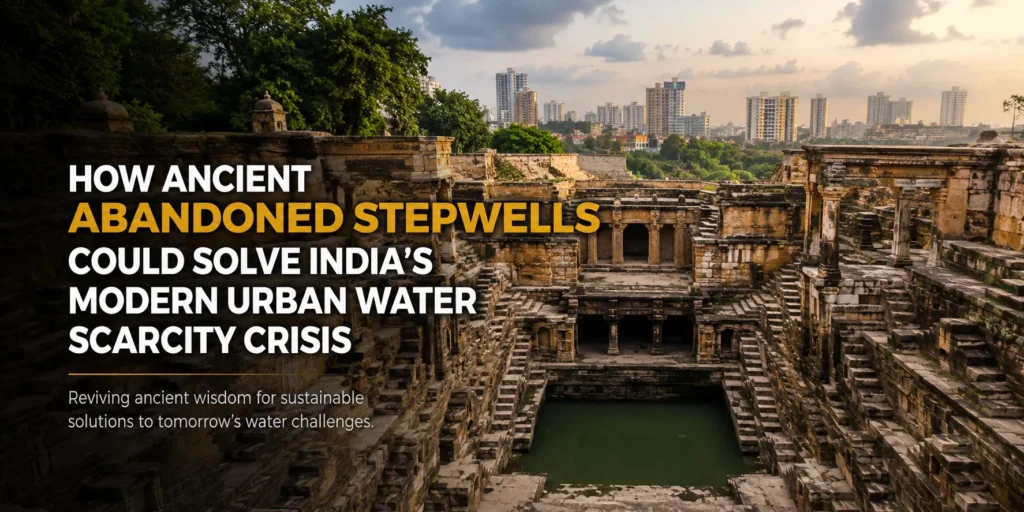

The Irony Beneath Our Feet
Imagine you live in a city where water comes out of your tap for only thirty minutes each morning. You wake up at 4 AM, plastic buckets in hand, and wait. Sometimes the water is brown. Sometimes it doesn’t come at all. Sometimes when it does come, it smells like dirt and rust. You boil it anyway because you have no choice. This is life in parts of Chennai, Bengaluru, Delhi, Hyderabad, and Pune today. Millions of people live this way. They have never known a time when water flowed freely whenever they wanted.
Now imagine that right beneath that same city—buried under concrete roads, apartment buildings, shopping malls, and trash dumps—there is a giant stone well. Not a simple hole in the ground with a rope and bucket. A massive, multi-story underground structure with beautiful carved steps leading down five or six stories into the earth. A structure that could hold millions of liters of clean, cool water. A structure that fed an entire neighborhood for five hundred years without electricity, without pumps, without monthly bills.
We have paved over these stepwells. We have filled them with garbage. We have built bus stops on top of them. We have turned them into parking lots. We have forgotten their names. We have forgotten what they look like. We have forgotten that they ever existed.
And that is the greatest irony of modern India. Our thirstiest megacities are sitting on top of ancient engineering marvels that could solve half their water problems—if we only remembered how to use them. If we only stopped treating rain as a nuisance. If we only looked down instead of always looking far away for solutions.
This is the story of how abandoned stepwells are being brought back to life across India. It is the story of ordinary people who decided to dig instead of complain. It is the story of a technology so simple and so brilliant that it worked for a thousand years before we forgot it in just one hundred. And it is the story of how these stone staircases might just save our cities from running completely dry.
Chapter 1: A City That Forgot How to Drink
Let us travel to a real place: Chennai, 2019. The city made international news because it almost ran out of water completely. Not just low pressure. Not just scheduled cuts. Zero water. Four million people woke up one day to find that their taps had nothing to give. Not a drop. Restaurants closed because they could not wash dishes. Companies sent workers home because the bathrooms stopped working. Schools shut early because there were no toilets to flush. Hospitals had to turn away patients. A wedding hall had to cancel twenty weddings.
The government rushed in tanker trucks. But there were not enough trucks for four million people. People paid ten times the normal price for a single pot of drinking water. Some families spent half their monthly income on water. Fights broke out at distribution points. The police had to be called. One man was stabbed over a single plastic can of water.
Here is the strange part: Chennai gets about 140 centimeters of rain every year. That is more than enough for every person in the city. London gets less rain than Chennai, and London never runs out of water. But most of Chennai’s rain falls in just two months—October and November—during the northeast monsoon. The rest of the year is bone dry. The city is like a person who gets paid a full year’s salary in two weeks and then has to survive the other fifty weeks with nothing.
Where does all that rain go? It hits the ground, flows into drains, floods the streets for a few hours, and then rushes out to the ocean. Chennai’s modern drainage system was designed by British engineers in the 1800s to remove water as fast as possible. Not to keep it. The system works exactly as designed—it throws away rain like garbage.
Meanwhile, buried under shopping malls, apartment complexes, and new highways, over two hundred ancient stepwells sit ignored. Some are completely dry because the groundwater level dropped too low. Others are full of sewage, plastic bags, old tires, broken furniture, and construction waste. A few have been turned into garbage dumps so big that people forgot a well was ever there. Children play on top of the garbage. Vendors sell vegetables on top of the garbage. No one knows that twenty feet below their feet, there is a beautiful stone staircase leading to nothing but darkness and decay.
This is not just Chennai’s story. It is Bengaluru’s story. It is Delhi’s story. It is Ahmedabad’s story. It is Jaipur’s story. It is Lucknow’s story. Every major Indian city is repeating the same mistake: building bigger pipes to bring water from farther away, spending more electricity to pump water higher, drilling deeper borewells to suck out groundwater faster, while ignoring the natural sponge right under their feet. It is like a patient with a bleeding wound who keeps asking for more blood transfusions instead of stitching the wound closed.
Chapter 2: What Exactly Is a Stepwell? (And Why It’s Genius)
Let me explain what a stepwell is, because most of us have never seen one that still works. We have seen modern wells—a concrete ring, a hand pump, maybe a small wall around it. A stepwell is nothing like that.
A stepwell—called a baoli in Hindi, vav in Gujarati, kund or pushkarani in other parts of India—is not a normal well. A normal well is just a hole with a rope and bucket. You lower the bucket, pull up water, and that’s it. It is functional but boring. A stepwell is a building turned upside down. It is architecture reaching into the earth instead of into the sky.
Picture this: You are standing at ground level on a hot summer day. The sun is beating down. The air is dusty. In front of you, stairs begin to descend. Not just ten steps. Sometimes one hundred steps. Sometimes two hundred. Sometimes three hundred and fifty steps, going down as deep as a ten-story building. These stairs are not narrow or scary. They are wide, generous steps made of stone. You could walk down them carrying a pot on your head.
On both sides of the stairs, there are stone walls carved with beautiful pillars, arches, and small rooms called niches. Some niches have carvings of gods and goddesses. Some have carvings of elephants, peacocks, lotus flowers, and dancing women. Some have small stone beds where travelers could rest in the cool air. As you walk deeper, the air gets cooler. The sunlight becomes a thin slice above your head. Your ears pop from the change in pressure, the same way they pop when you go down a mountain or up in an airplane.
At the bottom, there is water. Clean, shaded, slow to evaporate water. The water does not sparkle in the sun because there is no sun down here. It just sits there, dark and still and cold. You could reach down with a cup and drink. No pump needed. No pipe needed. Just your own arm.
Here is why stepwells are engineering genius. Let me break it down into simple parts.
First, they harvest rain directly. Stepwells were usually built in natural low spots where rainwater would collect on its own. But they didn’t just wait for rain to fall directly into them. That would be too slow. They had long side channels—think of them as stone gutters—that caught rain from a wide area and directed it into the well. These channels could be hundreds of meters long. One good monsoon could fill a stepwell for an entire year. Even a single day of heavy rain could add weeks of water.
Second, they cleaned the water naturally. Before rainwater reached the main well, it passed through sand and gravel filters built into the side channels. The same way a coffee filter catches grounds, these stone filters caught dirt, leaves, animal waste, and dead insects. By the time water entered the stepwell, it was already drinkable. No chemicals. No expensive treatment plants. Just sand and gravity doing the work.
Third, they kept water cool and safe. A stepwell’s deep location meant sunlight never hit the water directly. No sunlight means no algae growth. Algae turns water green and slimy and smelly. No algae means the water stayed fresh for months, sometimes up to a year. The stone walls also kept the water cool—sometimes fifteen degrees cooler than surface air. On a forty-five-degree summer day, the water at the bottom of a stepwell was still pleasantly cold, like water from a refrigerator. People would come to the stepwell just to sit near the water and cool down.
Fourth, they worked without electricity. This is the most important part. Stepwells used gravity alone. Rain fell, flowed downhill, got filtered, and filled the well. That’s it. No motors. No pumps. No broken pipes. No monthly electricity bills. No dependence on the grid. When the power went out—which happened often in old India, and still happens today—the stepwell did not care. When fuel prices went up, the stepwell did not notice. When the government raised electricity tariffs, the stepwell kept giving water for free.
Fifth, they recharged groundwater. A stepwell didn’t just store water. It was a giant hole that allowed surface water to seep slowly into the underground layers of rock and sand called aquifers. Think of an aquifer as a giant underground lake made of porous rock, like a sponge. Even when people took water out of the stepwell, the surrounding soil stayed moist because water was constantly seeping out of the stepwell’s walls. That meant nearby hand-pumped wells kept working. It meant the local trees stayed green. It meant the land did not turn into a desert. It meant the village did not have to migrate during droughts.
Sixth, they provided community space. A stepwell was never just a water source. It was a gathering place. Women would come together to fetch water and talk. Children would play on the steps. Travelers would rest in the niches. Priests would perform ceremonies at the water’s edge. In the summer heat, the stepwell was the coolest place in town, cooler than any building with air conditioning. People would sleep on the steps at night because the stone held the cold. The stepwell was the heart of the neighborhood.
Now compare that to our modern system. We have pipes that leak forty percent of their water. We have treatment plants that break down and cost crores to repair. We have borewells that go deeper every year and dry up anyway. We have electricity bills that bankrupt small businesses. We have no community space around a tap. We have forgotten that water was once a shared experience, not just a monthly bill.
Chapter 3: How Modern Cities Broke Water
To understand why stepwells matter today, we have to understand how modern cities broke something that used to work fine. Let me walk you through the disaster step by step.
Today’s cities get water from faraway dams and rivers. Delhi’s water comes from the Yamuna River and the Ganga River, but the Yamuna is so polluted that it has to be treated in expensive plants. The water comes in, gets cleaned, and then travels through hundreds of kilometers of pipes. By the time it reaches a home in South Delhi, it has traveled for three days and passed through twelve different pumping stations.
Bengaluru pumps water from the Cauvery River, ninety-five kilometers away, lifting it up over seven hundred meters of elevation. That is like pumping water to the top of a two-hundred-story building. The electricity bill for this pumping could power a small town. Every time electricity prices go up, Bengaluru’s water becomes more expensive.
Mumbai gets water from seven lakes located outside the city. The lakes are far away and the pipes are old. Every year, Mumbai loses about thirty percent of its treated water to leaks. That water seeps into the ground or gets contaminated by sewage because the sewage pipes are often broken and mixed up with the water pipes. In many parts of Mumbai, what comes out of the tap is not clean water but a mixture of water and sewage.
Hyderabad gets water from the Krishna River, more than one hundred kilometers away. The pumping stations are so huge that they have their own dedicated power lines. When there is a power cut—and there are many power cuts—the pumping stops and the city goes dry.
Chennai gets water from desalination plants on the coast. Desalination means taking salt water from the sea and removing the salt to make it drinkable. It works, but it costs more than bottled water to produce. A liter of desalinated water costs about three rupees just to make, before it even enters the pipes. Most families in Chennai cannot afford that.
Here is what happens next: Treated water travels through long pipes. Those pipes leak. In Delhi, about forty percent of all treated water leaks out before it reaches a home. In Bengaluru, it is about forty-five percent. In Mumbai, it is about thirty percent. Forty percent! That means for every ten liters of water that leave the treatment plant, only six liters reach a tap. The other four liters are wasted. They water the roads. They fill potholes. They create damp spots where mosquitoes breed. They go nowhere useful.
When water finally reaches a home, it comes out for just a few hours per day. Families store it in overhead tanks. But those tanks grow algae if not cleaned twice a month. They breed mosquitoes if not covered properly. They take up precious space on small rooftops. They leak. They crack in the sun. They get stolen for their metal value. They are a constant headache.
And what about all the rain? It falls on concrete roads and flows into storm drains. Those drains carry the rain directly to rivers and oceans. The city does not capture it. The city does not store it. The city does not use it. The city treats rain like a problem to get rid of, not a gift to receive. Rain causes traffic jams, so we hate it. Rain floods our basements, so we fear it. Rain makes our shoes muddy, so we avoid it. But rain is the only source of all the water we will ever have. Everything else—rivers, lakes, wells, dams—is just rain that fell earlier and got stored somewhere.
Meanwhile, every home, every office, every apartment building, every factory, every hotel, every hospital is drilling deeper and deeper borewells. A borewell is a narrow pipe punched into the ground to suck up groundwater. In the 1980s, you could hit water at sixty feet. In the 1990s, at one hundred fifty feet. In the 2000s, at three hundred feet. Today in Bengaluru, borewells go down one thousand feet or more. Some go down fifteen hundred feet. That is deeper than the height of the tallest building in the city.
But here is the thing: groundwater does not magically appear at one thousand feet. It comes from rain soaking into the ground near that spot. It takes years for rainwater to travel down to one thousand feet. If you take water out faster than rain puts it back in, the level drops. And it keeps dropping. And dropping. And dropping.
That is exactly what is happening. Bengaluru’s groundwater level falls by about two to three meters every single year. That means every year, the city has to drill its borewells deeper just to reach the same water. At that rate, in twenty years, there won’t be any groundwater left to pump within two thousand feet. And drilling deeper than two thousand feet is extremely expensive and often impossible because of hard rock.
So cities do the only thing they know: they look for water even farther away. They build longer pipes. They spend more electricity. They raise water bills. They ask for loans from the World Bank to build new dams. But every new dam is farther away than the last one. Every new pipeline is more expensive than the last one. Every new desalination plant costs more electricity than the last one.
It is a treadmill. A hamster wheel. A trap. We are running faster and faster and getting nowhere. And the people who suffer most are the poor, who cannot afford tanker water, who cannot afford to drill their own borewell, who cannot afford to move to a neighborhood with better pipes. They just sit at home with dry taps and wait.
Chapter 4: The Man Who Remembered Stepwells
Let me tell you about a real person. His name is Vikramjit Singh Rooprai. In 2014, he was a regular office worker in Delhi. He had a normal job, a normal apartment, normal problems. One weekend, he went exploring near his grandmother’s old neighborhood in South Delhi and found something strange: a fenced-off hole in the ground with a sign that said “Protected Monument.”
He peeked through the fence. There were stairs. Old stairs covered in moss and fallen leaves. He asked a local shopkeeper what it was. “Oh, that’s the old baoli,” the man said without looking up from his newspaper. “Nobody goes there. It’s full of snakes. Don’t go in there, young man. You’ll get bitten and die.”
Vikramjit didn’t believe in snake stories. He came back the next weekend with a flashlight and a friend. They climbed over the fence—carefully, because the fence was rusty and sharp—and walked down. Thirty steps down, the air turned cool. Forty steps down, their ears popped. Fifty steps down, the flashlight beam showed carvings of peacocks and flowers on the walls. Sixty steps down, they reached the bottom. And at the bottom—water. Clean, still, dark water.
Vikramjit knelt down and put his hand in the water. It was cold. He brought his hand to his nose. No smell. He touched his tongue to his finger. No taste. Just clean, cold, ancient water that had been sitting underground for who knows how many years.
He was hooked.
Over the next five years, Vikramjit became a detective of forgotten wells. He studied old maps from the British era. He interviewed elderly residents in every neighborhood of Delhi. He read Persian documents from the Mughal period. He walked through alleyways and garbage dumps and construction sites. He found stepwells in the strangest places.
One stepwell was under a petrol pump. The workers had no idea. When they drilled to install the petrol tanks, they hit stone steps twenty feet down. They filled the hole with concrete and pretended it never happened.
Another stepwell was inside a police station’s parking lot. The police officers parked their cars on top of a five-hundred-year-old well. When Vikramjit showed them a photograph from 1890 showing the well, they laughed and said, “That can’t be right. We’ve been parking here for twenty years.”
Several stepwells had been turned into garbage dumps. One had a entire abandoned car at the bottom. Another had thousands of old tires. Another had so much plastic that you couldn’t see the water—just a sea of white and blue bags floating on top.
By 2019, Vikramjit had located 168 stepwells in Delhi alone. Most were in terrible condition. Some were completely destroyed—bulldozed to make room for new buildings. But a few—just a few—still held water. The water was often dirty from sewage, but it was there. The stepwells were still trying to do their job, even after centuries of neglect.
He started giving walking tours. He would take groups of ten or fifteen people to see the forgotten stepwells. He charged a small fee and used the money to clean one well at a time. He posted photos on social media. He wrote a book called Delhi’s Stepwells: The Vanishing Heritage. He gave talks at schools and colleges.
Slowly, people started paying attention. A local politician visited one stepwell and ordered it cleaned. A tech company adopted another stepwell and paid for a full restoration. A group of college students cleaned a third stepwell as their final year project. The government’s archaeological department, which had ignored stepwells for decades, suddenly announced a restoration fund.
But Vikramjit knew that cleaning a stepwell was not enough. A clean stepwell is just a hole in the ground. The real question was: could these ancient structures actually provide water to modern neighborhoods? Could a stepwell that was built in 1350 AD help a family in 2025 AD? Could water that fell as rain during the Mughal Empire still be useful today?
To answer that question, we have to look south—to a state that never fully forgot its stepwells. To a village where old women’s memories proved stronger than concrete. To a farmer who decided to dig instead of complain.
Chapter 5: The Village That Never Ran Dry
About three hundred kilometers from Bengaluru, there is a village called Kumbaragatti. It is small. Maybe two thousand people. Mostly farmers and weavers. No big hotels. No tech parks. No swimming pools. No air-conditioned shopping malls. Just fields, looms, and a single paved road that becomes a mud path after the last house.
Kumbaragatti also has a stepwell. Not a fancy one. No elaborate carvings. No pillars or arches. Just a simple stone-lined pit with stairs going down on three sides. It is plain and functional, like a tool instead of a temple. Locals call it the Kalyani, which means “blessed pond” in the local language.
Fifty years ago, the Kalyani was a garbage pit. The village panchayat had thrown all its trash there for decades. Broken pots. Rusted bicycle parts. Dead animals. Plastic. Glass. Cloth rags. Everything that the village wanted to disappear went into the Kalyani. The steps were buried under so much trash that you couldn’t see the top step anymore. It just looked like a low spot in the ground where nothing grew.
Then in 2002, a group of old women gathered at the village temple after evening prayers. They were talking about the old days, as old people do. One of them, a grandmother named Akkamma, said, “When we were girls, we fetched water from the Kalyani. It never went dry. Even in the worst summers, when the river was nothing but mud, there was always water at the bottom of the Kalyani. We would walk down the steps with our pots on our heads. The steps were cool under our bare feet. We would sing while we walked. Those were good days.”
The younger villagers laughed. “That’s just old people talking,” they said. “Nostalgia makes everything seem better. The Kalyani has been a garbage dump for as long as I can remember. There’s no water there. Just rats and smell.”
But one farmer, a man named Basava, decided to test the story. Basava was not a rich man. He owned two acres of dry land and a single bullock. His borewell had gone dry the previous summer, and he had spent his entire savings on tanker water. He was desperate. Desperate people try anything.
Basava gathered ten friends and some basic tools: shovels, pickaxes, ropes, and baskets. They spent two weekends pulling out garbage from the Kalyani. The smell was terrible. The neighbors complained. “You’re spreading disease,” they shouted. “Cover it back up.” But Basava kept going.
At seven feet down, they hit solid rock. The well had been filled completely—not just with garbage, but with rocks and mud that had washed in over the years. Basava was about to give up when his shovel hit something soft under the rock. He dug harder. The rock turned out to be a thin layer of cemented trash—old ash and bones that had stuck together over time. Under it—black mud. And under the mud—water.
Not a lot. Just a wet patch at first, the size of a dinner plate. But over the next hour, as they kept digging, the wet patch grew into a puddle. By sunset, the puddle was a pool two feet deep. Basava knelt down and scooped water into his palm. It was cold. It was clean. It tasted like nothing—no salt, no dirt, no chlorine. Just water. Sweet water.
He cried. A grown man, sitting in the mud, crying over a handful of water.
The news spread through the village like fire in dry grass. The village panchayat, which had ignored Basava’s work, suddenly wanted to take credit. They voted to spend some of their budget on restoring the Kalyani properly. They hired masons to rebuild broken steps. They dug a small channel from the village’s main drainage path to feed rainwater into the well. They planted neem trees around the edge to keep the water shaded. They built a low wall to stop children from falling in.
Today, the Kalyani holds about 50,000 liters of water year-round. That is not enough for the whole village. Two thousand people need more than 50,000 liters. But it is enough for the village’s livestock—the cows, buffaloes, goats, and chickens. It is enough to wash clothes. It is enough to water the small vegetable garden near the temple. It is enough for the potter to soak his clay. It is enough for the weaver to wash his yarn.
And here is the most important number: the village’s three hand pumps, which used to go dry every March, now have water until June. That is three extra months of water. Three months that used to be pure suffering—walking five kilometers to the river, paying for tanker water, fighting with neighbors over a shared well—are now normal months. The children go to school instead of walking for water. The women cook lunch instead of waiting in line.
Why? Because the Kalyani is recharging the groundwater. The well acts like a giant straw that slowly releases water into the surrounding soil. Every liter that sits in the Kalyani is a liter that can seep out through the stone walls and keep the nearby soil moist. That keeps the water table high enough for the hand pumps to reach. It is not magic. It is just slow, steady, patient physics.
Basava is not an engineer. He does not have a college degree. He has never written a report or given a PowerPoint presentation. He does not know what “groundwater recharge” means. He just remembered an old story his grandmother told him and decided to dig. That is all it took. One person with a shovel and a memory.
Chapter 6: The Science of Why Stepwells Work (Simple Version)
Let me explain the science without big words or complicated diagrams. You do not need to be an engineer to understand why stepwells work. You just need to understand three things: sponges, gravity, and time.
Think of the ground under your feet as a giant sponge. The sponge has layers. Near the surface—the top few meters—the sponge is dry most of the year because the sun bakes the moisture away. Deeper down, below about ten meters, the sponge stays wet because the sun cannot reach that far and the pressure from the soil above keeps water from evaporating. This deep wet part is called the water table.
A modern borewell is like a thin straw stuck deep into that sponge. You suck water out. But here is the problem: if you suck too fast, the sponge around the straw gets dry. The water cannot flow through the sponge quickly enough to replace what you are taking. So the water level drops around the straw. Then you have to push the straw deeper. That works for a while, but eventually, you hit rock, and there is no more sponge. The borewell is dead.
A stepwell is different. It is not a straw. It is a big hole—sometimes ten meters wide, sometimes twenty meters wide—that exposes a wide section of the sponge. Rainwater that falls near the stepwell seeps into the sponge naturally through the topsoil. That is called infiltration. But a stepwell also collects direct rain that falls into the hole itself. And it collects rain from far away through the stone channels. That extra water then slowly trickles into the sponge from the sides of the well. Not just at one narrow point, but along the entire height of the well, from top to bottom.
In other words, a stepwell doesn’t just take water out of the ground. It puts water into the ground. Constantly. Every day. Every hour. Every minute that water sits in the stepwell, some of it is seeping outward into the surrounding soil. It is like watering a plant from the inside out.
Scientists call this “aquifer recharge.” Normal people can call it “giving the sponge a drink.”
Here is another way to think about it: Your city’s water situation is like your bank account. Rain is your paycheck. Borewells are you spending money. If you spend more than you earn every month, you go into debt. That is exactly what Indian cities have done for thirty years. They have spent water faster than rain could replace it. They are in massive water debt. The water table keeps falling because they keep borrowing from the future.
A stepwell is like a savings account. It holds onto the extra rain so you have something to spend during the dry months. When it rains heavily for two months, the stepwell fills up. Then, for the next ten months, you can take water out slowly. The stepwell releases water gradually into the ground, keeping the sponge moist for the hand pumps and shallow wells nearby.
And the best part? The savings account never charges interest. It never asks for a password. It never sends you an overdraft fee. It never breaks down during a power cut. It never requires a software update. It just sits there, made of stone, doing its job, for hundreds of years, asking nothing in return except to be kept clean.
Let me give you some numbers so you can see the scale. A medium-sized stepwell that is ten meters wide, ten meters long, and ten meters deep has a volume of one thousand cubic meters. That is one million liters of water. One million liters. A family of five uses about five hundred liters per day for all their needs—drinking, cooking, washing, bathing, flushing. So one million liters can supply that family for two thousand days, which is more than five years. Of course, a stepwell serves hundreds of families, not just one. But you can see the potential.
Now multiply that by the number of stepwells in India. Historians believe there were once at least ten thousand stepwells across the country. Most are gone now—destroyed, filled, or buried. But maybe two thousand still exist in some form. If we restored just five hundred of them, that would be five hundred million liters of storage. Five hundred million liters of water that does not need electricity, does not need pipes, does not need treatment plants. Just stone and gravity.
That is not a small thing. That is a massive thing. That is the difference between dry taps and wet taps for millions of people.
Chapter 7: Why We Abandoned Stepwells in the First Place
You might be wondering: If stepwells were so great, why did we stop using them? Why did we let them fill with garbage? Why did we build bus stops on top of them? Why did we forget something that worked so well for so long?
The answer is not simple. It involves colonialism, modernization, cheap electricity, and a strange kind of cultural shame. Let me walk you through the history.
It starts with the British. When the British East India Company took control of much of India in the 1800s, they brought their own ideas about water. British engineers had grown up in a rainy country where water was never scarce. They did not understand drought. They did not understand the value of every single drop. They believed that moving water through metal pipes was modern and scientific. Wells were backward. Stepwells were especially backward—they looked old, they smelled bad (because of poor maintenance), and they were associated in the British mind with diseases like cholera.
What the British did not understand—or chose not to understand—was that the cholera came from sewage getting into the stepwells, not from the stepwells themselves. If you keep a stepwell clean and protect it from sewage, the water is perfectly safe. But the British did not want to clean the stepwells. They wanted to replace them.
So the British built tap water systems. They built overhead tanks. They built sewers. And they actively filled in or covered over stepwells. In Delhi alone, the British colonial administration sealed more than sixty stepwells between 1857 and 1900. They poured concrete into them. They built roads over them. They turned them into municipal garbage dumps. They erased them from maps.
But the British were only one part of the story. After independence in 1947, India’s new government wanted to show the world that it was modern, too. Modern meant dams. Modern meant huge pipelines. Modern meant pumping stations with bright blue motors and shiny steel tanks. Modern meant concrete and steel, not old stone. Modern meant Jawaharlal Nehru calling dams the “temples of modern India.”
Stepwells looked old-fashioned. They were made of stone that was sometimes a thousand years old. They required manual labor to clean—and manual labor was associated with poverty and backwardness. They didn’t impress foreign visitors. When a World Bank official came to see a city’s water system, you showed them the new pumping station, not the old stepwell. So the government ignored stepwells. Even worse, they actively discouraged people from using them. “Drink from the tap,” the posters said. “Tap water is progress.” “Wells are for villages, not for cities.”
Then came the Green Revolution of the 1970s. Farmers were told to grow more wheat and rice to make India self-sufficient in food. To do that, they needed more water. Much more water. The government gave cheap electricity for borewell motors—almost free electricity in some states. Farmers drilled borewells like there was no tomorrow. Why would anyone bother cleaning an old stepwell when you could just drill a borewell and get water instantly? The borewell was faster. The borewell was easier. The borewell felt like the future.
And because borewells worked so well at first, everyone forgot about the old stepwells. The stepwells became invisible. They were just holes in the ground that collected garbage. Young people grew up never knowing what they were. Their parents had stopped using them. Their grandparents had vague memories but didn’t talk about them. The stepwells faded from living memory.
By 1990, most stepwells in Indian cities were either buried under new construction or turned into garbage dumps. Some were even converted into bus depots or vegetable markets. The stairs were broken. The carvings were stolen by antique dealers. The water was gone—either pumped out or polluted with sewage. In some cases, the stepwells were simply paved over without anyone even noticing. A bulldozer came, pushed dirt into the hole, and the next day a new building went up. No one said a word.
It took less than one hundred years to forget a technology that had worked for over one thousand years. In the span of a single human lifetime—a grandmother could have been born when stepwells were still in use and died when they were completely forgotten. That is how fast we erased our own history.
Chapter 8: The Stepwell Comeback (Real Projects That Work)
But here is the good news: People are remembering. Slowly, in small pockets across India, stepwells are coming back to life. Not as museums. Not as tourist attractions. As working water sources. As neighborhood assets. As solutions.
Let me take you to four places where stepwells have been restored and are actually providing water today. These are not theories or pilot projects. These are real places where real people are using real stepwells right now.
Place 1: Ahmedabad’s Adalaj Stepwell
Adalaj is a small town on the edge of Ahmedabad. Its stepwell, built in 1499 by Queen Rudabai, is one of the most famous in India. Tourists come from all over the world to see its five stories of beautiful sandstone carvings. You have probably seen photos of it—the octagonal shape, the intricate pillars, the cool shadows.
But here is what most tourists do not know: For many years, the Adalaj stepwell was dry. The groundwater level had dropped so low that even the stepwell’s great depth could not reach water. It was a beautiful empty hole. Tourists would walk down the steps, take photos of the carvings, and walk back up. No water. No function. Just architecture.
In 2014, the local government decided to do something different. Instead of just preserving the stepwell as a monument, they restored its original rainwater channels. The channels had been broken and blocked for centuries. Workers spent six months digging them out, repairing the stone, and clearing the path for rainwater. They also built a small check dam uphill from the stepwell to slow down the flow of water and let more of it soak into the ground.
Now, when it rains in Ahmedabad, water flows exactly the way it did in 1499. The channels fill, the water runs down, and the stepwell fills to the top every monsoon. The water is not used for drinking—the stepwell is too close to a busy road, and the government worries about pollution. But it is used to irrigate the gardens of nearby Adalaj village. The village has not bought tanker water for its gardens in seven years. Seven years! The farmers estimate they have saved over two lakh rupees per year in water costs.
Place 2: Hyderabad’s Stepwell Park
In the middle of a crowded Hyderabad neighborhood called Nallakunta, there was a stepwell that had been used as a public toilet for forty years. Yes, you read that correctly. Forty years of human waste. The stench was unbearable. People crossed the street to avoid walking near it. Children threw stones into it for fun. Garbage collectors dumped their loads into it because it was convenient.
In 2018, a group of architecture students from the University of Hyderabad took on the restoration as a class project. Their professor gave them one condition: they had to do it without heavy machinery and without a big budget. The students raised money from their families. They bought gloves, masks, boots, and buckets. They spent every Saturday for four months draining the well, scraping off decades of waste, and repairing the broken steps.
The work was disgusting. The students vomited multiple times. Some quit. But seven of them stuck with it. They wore hazmat suits borrowed from a local hospital. They used shovels and picks and their own hands. They carried the waste out in sealed buckets and disposed of it properly.
When they finally reached the bottom, they found water. Not much—just a few feet. But it was clean water. The stepwell’s natural filtration system had somehow survived forty years of abuse. The students installed a simple hand pump at the bottom, one that could be operated from the top step.
Today, that hand pump provides water for five hundred nearby families to wash dishes, bathe, and clean their homes. It is not drinking water—they don’t use it for that—but it saves those families from buying expensive tanker water for their daily chores. Each family saves about three hundred rupees per month. That is real money for people in Nallakunta. And the stepwell has become a small park. The students planted flowers around the edge. They put in benches. People sit there in the evening. Children play nearby. The toilet smell is gone.
Place 3: Rural Rajasthan’s Community-Led Revival
Rajasthan is India’s driest state. It has the least rain, the hottest summers, and the most unpredictable monsoons. But it also has the most stepwells—thousands of them scattered across villages and small towns. Most are dry. Many are full of sand. Some have collapsed.
One village, named Bhikampura in Alwar district, had a stepwell that had been dry for twenty years. The villagers tried everything: digging deeper borewells (they went down to eight hundred feet and hit only dry rock), calling the government (a minister came once, took photos, and never returned), even performing religious ceremonies to ask for rain (the priest took their money and nothing changed).
Then a local non-profit group called Tarun Bharat Sangh, which had been working on water issues in Rajasthan for decades, suggested an idea. The idea was simple: What if the villagers themselves cleaned out the stepwell and then dug a simple pond uphill from it? The pond would catch rainwater and let it slowly seep down toward the stepwell through the natural slope of the land. No pipes. No pumps. Just gravity and patience.
The villagers thought the group was crazy. “We have no water for our own drinking,” they said. “Why would we dig a pond for the stepwell?” But they had no other options. The borewells were dead. The tanker trucks were too expensive. So they agreed.
One hundred villagers worked for three months. The men dug. The women carried away the dirt in baskets on their heads. The children brought food and water. They dug a pond the size of a small swimming pool—about twenty meters long, ten meters wide, and two meters deep. It was not fancy. It was just a hole in the ground.
The next monsoon, the pond filled. It held water for two weeks after the rain stopped. Then the water slowly seeped into the ground. Over the next six months, the villagers watched the stepwell’s water level rise. Not to the top—they are still waiting for that—but enough to reach the lowest step. The village now uses that water for their cattle. They say it is the first time in twenty years they have not had to walk seven kilometers to the nearest river. Twenty years of walking, ended by a pond and a stepwell.
Place 4: Mumbai’s Hidden Stepwell
In the middle of Mumbai, in a crowded neighborhood called Dongri, there is a stepwell that most Mumbaikars do not even know exists. It is called the Banganga Tank. It is not actually a stepwell in the strict sense—it is more of a stepped pond—but it works the same way. Steps go down to the water on all four sides.
The Banganga Tank has never gone dry. Not once in over nine hundred years. Think about that. Mumbai has grown from a small fishing village to a megacity of twenty million people. The British built railways and docks. The city built skyscrapers and flyovers. The sea level has risen. The climate has changed. But the Banganga Tank still has water.
Why? Because it is fed by natural springs that come from underground. And those springs are fed by rain that falls on the nearby hills. As long as the hills get rain, the tank gets water. No pumps. No pipes. No treatment plants. Just hills, springs, and stone steps.
The Banganga Tank is still used today. Hundreds of people come every morning to bathe, pray, and fill their pots. It is not enough for the whole neighborhood—Mumbai is too big for that. But for those few hundred families, it is everything. It is independence from the city’s failing pipe system. It is security when the taps go dry. It is a living example that stepwells can work in a modern megacity if we just let them.
Chapter 9: Can Stepwells Really Solve Urban Scarcity? (Honest Answer)
Let me be completely honest with you. No fairy tales. No false hope. Just the truth.
Stepwells alone will not solve India’s urban water crisis. That would be like saying a few buckets can put out a forest fire. The crisis is too big. The population is too large—over four hundred million people live in Indian cities, and that number is growing every day. The demand is too high—a single apartment building uses as much water in a day as an entire village used in a month fifty years ago.
But here is what stepwells can do: They can be a critical part of the solution. Think of them as one tool in a toolbox. You would not build a house with just a hammer. But you also would not build a house without one. Stepwells are the hammer in India’s water toolbox—old, simple, reliable, and essential.
Let me be specific about what stepwells are good for and what they are not good for.
Stepwells are best for:
- Neighborhood-scale water storage. One stepwell can serve five hundred to two thousand people for non-drinking uses like washing, cleaning, gardening, and bathing. That is not a small number. Two thousand people is a whole slum or a whole apartment complex. If every neighborhood had a stepwell, millions of people would have basic water security.
- Groundwater recharge. Even a dry stepwell still helps. If you clean it out, it becomes a giant pit where rainwater can soak into the ground. That raises the water table for everyone nearby—including people with borewells and hand pumps. A single stepwell can recharge the groundwater for an area of several square kilometers.
- Emergency backup. When the taps run dry and the tanker trucks are delayed or too expensive, a stepwell provides a local source of water. It is not fancy. It does not come out of a shiny tap. But it keeps people from going completely thirsty. In a crisis, that matters more than anything.
- Cooling and climate resilience. Stepwells naturally cool the air around them. The stone stays cool even when the air is hot. The water evaporates slowly, which cools the surrounding area. In a heatwave—and heatwaves are getting worse every year—a stepwell can be a lifesaver. Several restored stepwells in Delhi now serve as public cooling centers where people can escape 45-degree heat for free.
- Community building. When people share a stepwell, they talk to each other. They watch out for each other. They clean it together. They protect it together. A stepwell is not just a water source. It is a reason for neighbors to become a community. That is something you cannot get from a tap or a tanker truck.
Stepwells are not good for:
- Providing water for heavy industries. A stepwell cannot supply a car factory, a textile mill, or a power plant. Those need huge, consistent volumes of water—millions of liters per day. Stepwells are for people, not for industrial processes. Industries need other solutions, like recycling their water or building their own reservoirs.
- Replacing modern sanitation. Stepwells do not flush toilets. A city still needs pipes and treatment plants for sewage. You cannot just dump your waste into a stepwell—that is exactly what destroyed them in the first place. Stepwells provide water for washing, but the dirty water still has to go somewhere else.
- Drinking water without testing. Stepwell water can be clean, but it must be tested first. In cities, groundwater is often contaminated with chemicals from factories or bacteria from leaking sewage pipes. You cannot just drink from any old well. But once tested, many stepwells provide perfectly safe drinking water. Some even provide better water than the municipal supply.
- Solving industrial agriculture’s water problems. Stepwells are for villages and neighborhoods, not for large farms. A farmer with fifty acres of wheat cannot rely on a stepwell. That farmer needs a different solution, like better irrigation techniques or rainwater harvesting on the farm itself.
So the honest answer is: Stepwells are not a magic fix. They will not make India’s water crisis disappear overnight. But they are a powerful, proven, low-cost tool that we have ignored for too long. And in a crisis, you use every tool you have. You do not say, “This tool is not perfect, so I will not use it.” You say, “This tool helps. Let me use it while I work on better tools for the future.”
Chapter 10: How to Bring a Stepwell Back (Step by Step)
Maybe you are a college student looking for a project. Maybe you are a member of a resident welfare association in your apartment complex. Maybe you are just a curious citizen who wants to do something useful. You want to restore a stepwell in your city. Where do you start?
Here is a simple, practical guide based on what has worked in real communities across India. You do not need a government budget or a team of engineers. You just need patience, common sense, and a few helpers.
Step 1: Find the stepwell. This is harder than it sounds. Many stepwells are not marked on any map. They are not on Google Maps. They are not in the phone book. You have to become a detective. Ask old people in your neighborhood. “Did your grandmother ever mention a well with stairs?” Look for unusual depressions in the ground—places where the land suddenly dips down. Check behind old temples or mosques; stepwells were often built next to religious sites. Search for old photographs in your city’s archives or online. Ask at the local municipal office; sometimes they have old records that no one looks at anymore. If you find a fenced-off hole with stairs, congratulations—you found a stepwell.
Step 2: Get permission. Before you touch anything, find out who owns the stepwell. Is it government land? Private land? Temple trust land? This matters because you do not want to get into legal trouble. Start with your local municipal councilor. Explain what you want to do. Most councilors will be happy to support you because restoring a stepwell is good publicity. Get a letter of permission, even if it is just a simple email. Keep it safe.
Step 3: Clean it safely. Do not just jump into the stepwell. Stepwells can have bad air at the bottom—lack of oxygen, buildup of methane from rotting garbage, or other dangerous gases. Get help from your local municipality or a non-profit that has done this before. If you cannot get professional help, at least follow basic safety rules: wear a mask, work in teams, do not go down alone, lower a candle first (if the candle goes out, the air is bad), and never stay at the bottom for more than a few minutes at a time. Remove garbage by hand or with simple tools. Wear boots and thick gloves. Do not use heavy machines—they will break the old stone steps and could cause a collapse.
Step 4: Check for cracks. Once the well is clean and the air is safe, examine the walls carefully. Are there cracks where water can leak out? Small cracks can be sealed with a mixture of lime and sand, which is what the original builders used. You can buy lime powder at any hardware store. Mix it with sand and water to make a thick paste. Press it into the cracks with a trowel. Let it dry for a week. Large cracks need a professional mason who understands old stone structures. Do not use modern cement—cement is too hard and can cause the old stone to crack further.
Step 5: Restore the rainwater channels. Look for the old channels that brought rain into the well. They are usually long, shallow stone gutters leading from higher ground toward the well. Clean out all the mud, leaves, and plant roots blocking them. If a channel is broken, rebuild it with local stone and lime mortar. It does not have to be perfect—just functional. You just need the water to flow downhill into the well. If the original channels are completely destroyed, you can build new ones using simple concrete pipes or even plastic pipes covered with stone. This is not traditional, but it works.
Step 6: Build a simple fence. A restored stepwell is a hazard if children can fall in. Build a waist-high wall or iron railing around the top. Leave a locked gate. Give one responsible neighbor the key—someone who lives nearby and can open the stepwell when people need water. The fence does not have to be expensive. Even bamboo poles tied with rope will work in the beginning.
Step 7: Test the water. Before anyone drinks from the stepwell, send a water sample to a lab. Your city’s public health department can do this for a small fee. The lab will test for bacteria, heavy metals, and chemicals. If the water is bad, do not panic. You can still use it for washing clothes, bathing, watering plants, and cleaning your home. If the water is good, you can use it for drinking and cooking too. Many restored stepwells have surprisingly clean water because the old filtration systems still work.
Step 8: Teach the neighborhood. A stepwell only works if people take care of it. Hold a small meeting in the local temple, church, mosque, or community hall. Show your neighbors the restored stepwell. Explain how it works. Ask them not to throw garbage in it. Ask them not to wash soap or detergent near the well—soap kills the good bacteria that help clean the water. Ask them to report any damage immediately. Make the stepwell a shared resource, not just a hole in the ground. When people feel ownership, they protect what they own.
Step 9: Monitor the water level. Once a month, measure how much water is in the well. Tie a small weight to a string and lower it down until you feel it touch the water. Mark the string at the top of the well. Pull it up and measure from the weight to the mark with a ruler. Keep a notebook of your measurements. Write down the date and the water level. Over time, you will see patterns. Does the water level go up after rain? Does it go down in summer? How fast? This data will help you understand if your restoration is working and if you need to do more.
Step 10: Celebrate. When the stepwell fills with water for the first time, have a small celebration. Invite the neighbors. Bring snacks. Play music. Take photos. Post them on social media. Let other people see that restoring a stepwell is possible. Your success will inspire others. One restored stepwell leads to two. Two lead to ten. Ten lead to a hundred. That is how change happens—one neighborhood at a time.
That is it. No heavy machinery. No government tender. No million-rupee budget. Just local people doing local work. It is not glamorous. It is not fast. But it works.
Chapter 11: The Bigger Picture (Decentralized Water Grids)
Now let me pull back and show you the full vision. Stepwells alone are great, but stepwells as part of a larger system are world-changing.
Right now, every Indian city has a centralized water system. One dam. One big pipe. One treatment plant. One set of pumps. If that one thing breaks, the whole city suffers. And things break all the time. Pipes burst. Pumps fail. Power goes out. Treatment plants shut down for maintenance. The centralized system is fragile because it has single points of failure.
But a decentralized water system has many small sources. A stepwell here. A rooftop rainwater tank there. A neighborhood pond somewhere else. A small treatment plant for a cluster of buildings. If one source runs dry or breaks, the others still work. The system is resilient because it has no single point of failure. It is like a net instead of a rope—cut one strand and the net still holds.
Stepwells are perfect for decentralization because they are:
- Local (no long pipes that leak)
- Gravity-fed (no electricity needed)
- Low-maintenance (stone does not rust, rot, or break easily)
- Hundreds of years old (they have already proven they can survive wars, famines, earthquakes, and neglect)
- Already there (we do not have to build new ones; we just have to restore the old ones)
Imagine a future where every neighborhood in a city has a restored stepwell. Not for drinking—we still need modern treatment for that—but for everything else. Washing clothes. Bathing. Watering plants. Flushing toilets (with a simple bucket system). Feeding animals. Washing cars. Cooling homes. Cleaning streets. Watering parks.
That would reduce the demand on the central pipe system by thirty to forty percent. A thirty to forty percent reduction in demand means the central system can actually keep up. No more dry taps. No more four AM bucket filling. No more tanker truck fights. No more people fighting over a single plastic can. The pressure in the pipes would increase. The quality of the water would improve because the system would not be overstretched. The electricity bills would go down because pumps would not have to work as hard.
This is not fantasy. This is happening in small pockets of India right now. We have seen the examples—Kumbaragatti, Adalaj, Nallakunta, Bhikampura. The only thing missing is scale. We need ten thousand neighborhoods doing this, not ten. We need a movement. We need every resident welfare association in every city to ask the same question: Is there a stepwell in our area? If yes, why is it still full of garbage? If no, what can we build that works like a stepwell?
The technology is ancient. But the idea is more modern than anything we have built in the last fifty years. Decentralization is the future of water. Stepwells are the key.
Chapter 12: What You Can Do Tomorrow
You have read this far. Maybe you are inspired. Maybe you are skeptical. Maybe you are somewhere in between. Either way, here are concrete actions you can take starting tomorrow. Not next week. Not next month. Tomorrow.
If you are a student: Write a report on stepwells for your school’s science fair. Better yet, organize a field trip with your classmates to the nearest stepwell. See it with your own eyes. Touch the stone. Feel the cool air. Take photos. Share them on your school’s social media page. Ask your teacher to make stepwells part of the curriculum. One student can start a conversation that changes a whole school.
If you are a member of a resident welfare association: Invite someone who knows about stepwells to give a talk in your building. Discuss whether there is a stepwell in your area. Check old maps. Ask the oldest resident in your building. If there is a stepwell, make cleaning it a community project for one Saturday. Each family brings one bucket. Each person spends one hour. By the end of the day, you will have made a real difference. If there is no stepwell, discuss building a simple rainwater harvesting system instead.
If you own a home: Install a simple rainwater harvesting system. A pipe from your roof to a barrel or underground tank. It does not have to be expensive. A plastic barrel costs five hundred rupees. A pipe costs two hundred rupees. A filter made of sand and gravel costs nothing. That small system can save thousands of liters of rain every year. It is not a stepwell, but it is the same idea: catch rain where it falls.
If you are a journalist: Write about the stepwells in your city. Name them. Show photos of their condition. Interview the old people who remember them. Ask your local politician why they are still full of garbage. Ask the municipal commissioner how much money is in the budget for stepwell restoration. Publish the answers. Public shame is a powerful tool. No politician wants to be known as the person who ignored a stepwell.
If you are a government official: Allocate just one percent of your water budget to stepwell restoration. Just one percent. That small amount could restore dozens of stepwells in your city. The return on investment—in terms of water saved, groundwater recharged, and community resilience built—will be higher than almost anything else you spend money on. Write a policy that requires any new construction near a stepwell to protect it, not pave it over. Fine builders who dump garbage into stepwells. Make stepwell restoration a line item in every municipal budget.
If you are a business owner: Adopt a stepwell near your office. Pay for its restoration. Put up a small sign saying your company did it. Your customers will appreciate it. Your employees will be proud of it. Your competitors will feel pressure to do the same. Corporate social responsibility money often goes to fancy projects that look good in reports. A stepwell is not fancy. But it is real. It helps real people. That is what responsibility means.
If you are a farmer: Build a pond uphill from your stepwell. It does not have to be big. Even a small pond will slowly release water into the ground, raising the water table for your stepwell and your borewell. You do not need a government loan to dig a pond. You just need a few friends and a few weekends. Start small. See what happens. Learn as you go.
If you are just a regular person: Next time it rains, watch where the water goes in your neighborhood. Does it soak into the ground? Or does it rush down the road into a drain? Ask yourself: In my grandmother’s time, would this rain have been saved? Then ask yourself: What changed? And then ask yourself: What can I do to change it back? You do not need to restore a whole stepwell by yourself. You just need to start the conversation. Talk to your neighbors. Post on social media. Call your councilor. Small actions, when multiplied by millions of people, become a movement.
Chapter 13: The Stepwell That Refused to Die
Let me end with one final story. It is my favorite story because it shows that stepwells are not just stones and water. They are also memory and hope.
In the heart of Old Delhi, near the famous Red Fort, there is a stepwell called Rajon Ki Baoli. It was built in 1506 by a wealthy merchant named Daulat Khan. For four hundred years, it supplied water to the surrounding neighborhood. Women came with pots. Children played on the steps. Travelers rested in the niches. It was the heart of the community.
Then the British came. They decided that stepwells were unsanitary. They covered Rajon Ki Baoli with concrete and built a police station on top. The police station had a parking lot. The parking lot had cars. The cars had drivers. The drivers had no idea that they were parking on top of a five-hundred-year-old well.
The stepwell was forgotten. Not just ignored—forgotten completely. Generations grew up in that neighborhood never knowing it existed. The name “Rajon Ki Baoli” disappeared from maps. Old people died without telling their grandchildren. The steps were buried. The carvings were hidden. The water sat in darkness.
In 2003, workers were digging to repair a broken sewer pipe when their shovels hit something hard. They thought it was a rock. They dug around it. It was not a rock. It was a stone step. They kept digging. The steps kept going down. They called their supervisor. The supervisor called the municipal corporation. The municipal corporation called the Archaeological Survey of India.
The ASI excavated the site for three months. They brought in laborers, engineers, and historians. They used small tools to avoid damaging the stone. They brushed away dirt with soft brushes, like archaeologists in a movie. And what they found was a perfectly preserved stepwell. The carvings of peacocks and lotus flowers were intact. The arched niches were undamaged. The stone pillars were straight and strong. The water at the bottom was still clear—not fresh, but clear. No garbage had reached it because the concrete cap had sealed it perfectly for ninety years.
It was as if the stepwell had just been waiting. Waiting for someone to remember. Waiting for the concrete to crack. Waiting for a sewer pipe to break. Waiting for its chance to see the sun again.
Today, Rajon Ki Baoli is a protected monument. You can visit it on weekends for a small fee—I think it is twenty rupees. Tourists come with cameras. They take photos of the carvings. They walk down the steps and feel the cool air. They read the signboard that explains the history. Then they walk back up and leave.
But here is the thing that gets me every time I think about this story: That stepwell could be providing water to the neighborhood right now. If you cleaned out the remaining debris, restored the old rainwater channels, and tested the water, it would fill with rainwater every monsoon. It would cool the air for the police station and the surrounding houses. It would give people an emergency source of water when the taps go dry. It could be useful again. Alive again.
Instead, it is a museum. Beautiful, yes. Historic, yes. Important, yes. But useful? No. It is a dead thing behind a fence with a ticket booth.
That is the choice we face with every stepwell in every city. We can keep them as dead monuments—beautiful but useless, admired but empty. Or we can bring them back to life. We can clean them. We can restore their channels. We can use their water. We can make them the heart of neighborhoods again.
The water is still there, waiting underground. The stones are still there, carved by hands that turned to dust centuries ago. The engineering is still there, proven by monsoons that have not changed one bit since 1506. The need is still there—more urgent now than ever before.
All that is missing is us. All that is missing is our willingness to remember. To dig. To clean. To protect. To use.
All that is missing is you.
Final Words
We built stepwells because we understood something that we have forgotten today. We understood that water does not come from a pipe. It does not come from a dam. It does not come from a desalination plant. It comes from the sky. And the sky gives its gift in sudden, overwhelming bursts. The job of a civilization is to catch that gift before it runs away to the sea.
For one thousand years, we caught it well. Our ancestors built stone channels and stone steps. They carved beautiful pillars and arches. They created community spaces that were also water systems. They did not separate function from beauty. They did not separate engineering from art. They built stepwells that worked and that also made people happy to be near.
Then we forgot. We fell in love with pipes and pumps. We fell in love with concrete and steel. We fell in love with the idea that bigger is always better and farther is always smarter. We paved over our stepwells and called it progress.
Now our taps are running dry. Our borewells are scraping rock. Our tanker trucks are price-gouging the poor. Our rivers are polluted. Our dams are silting up. Our groundwater is disappearing.
And under all of it, the stepwells sit in darkness, full of garbage, waiting for someone to remember.
The solution is not expensive. It is not high-tech. It does not require foreign consultants or billion-rupee projects. It does not require a new law or a new ministry. It requires a shovel. A community. And the humility to learn from people who lived on this same land long before we did.
The next time you turn on a tap and nothing comes out—or brown water comes out, or water that smells like sewage—remember: There is an ancient stone staircase somewhere in your city, maybe just a few hundred meters from where you are sitting, leading down to cold, clean water. The steps are broken. The channel is clogged. The well is full of plastic bags and old tires. But the well is still there.
It is still there.
Now go find it.



Best slot games I have found in the Philippines recently. The interface is very friendly for mobile users. Love phjilibet019!
Everything about this site screams quality. From the graphics to the overall flow, it is just a top notch experience. brricabet