
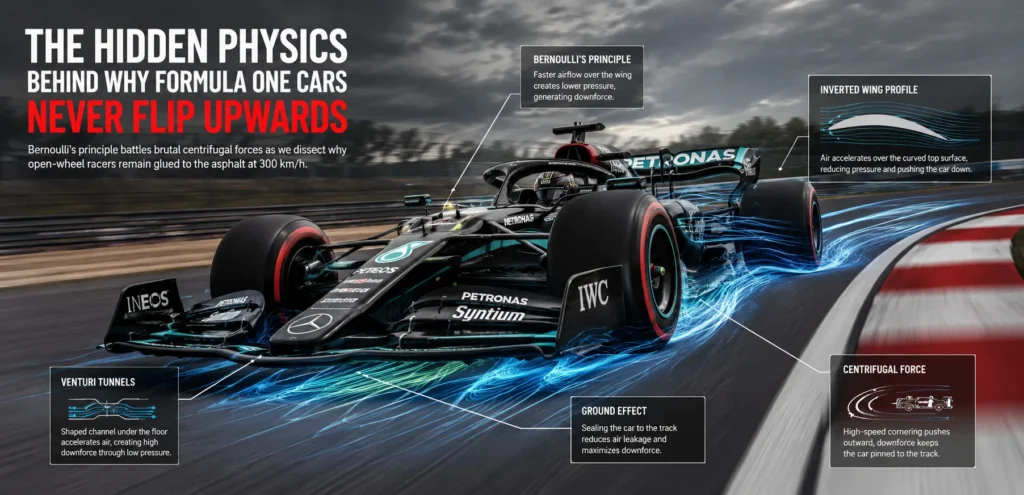

Introduction: The Day the Car Tried to Fly
Imagine you are sitting in a rocket-powered roller skate. That is the only way to describe a Formula One car from the inside. You are strapped in so tight that your helmet touches the carbon fiber roof above your head. There is no cushion. There is no cup holder. There is no radio playing your favorite songs. There is only you, a steering wheel with forty buttons, and the open road.
Your heart is pounding at 180 beats per minute. That is three beats every second. Your hands are sweating inside fireproof gloves. Outside, the world is a blur of gray asphalt and green grass. The engine behind your head is screaming at 15,000 revolutions per minute. It sounds like a banshee having an argument with a chainsaw.
You hit the brakes at 200 miles per hour.
Your eyeballs feel like they are trying to jump out of your head and land in the glove compartment. Your neck muscles strain to keep your head from snapping forward. The carbon fiber brakes glow red hot, then orange, then white. They are hot enough to melt aluminum. The deceleration force is five times normal gravity. That means your body feels five times heavier. Your organs shift inside your chest.
Now, imagine hitting a curb. Just a small bump. The kind of bump you see in a parking lot. At normal speeds, that bump is nothing. You barely feel it. At 200 miles per hour, that bump is like a ramp at a skate park. It is like hitting a speed bump on a highway. The car compresses its suspension, then springs up.
So why don’t Formula One cars go flying into the sky like a crashed video game car? Why do they stick to the road like a wet leaf on a window? Why do they not flip over backwards when they hit a bump at 180 miles per hour?
The answer is not weight. That is the first mistake people make. They think heavy things stay on the ground. That makes sense, right? A school bus is heavy. An elephant is heavy. They do not flip over easily. But an F1 car is surprisingly light. In fact, it weighs less than a Toyota Camry. So if weight is not the answer, what is?
The real hero is invisible. You cannot see it. You cannot taste it. You cannot grab it with your hands. It is the air around us. Every second of every day, we walk through air and never think about it. But at 200 miles per hour, air becomes as thick as honey. It becomes a force that can lift a car or push it down.
This is the hidden story of Bernoulli, who died two hundred years before the first car was built. This is the story of suction cups made of wind. This is the story of tunnels carved into the bottom of race cars that create invisible glue. And this is the story of the battle to keep one thousand horsepower glued to the ground.
So buckle up. Or rather, strap in. Because we are about to dive into the invisible world of air pressure, centrifugal force, and the genius engineering that keeps Formula One cars from becoming flying projectiles.
Part 1: The Big Misunderstanding – Lift vs. Weight
Let us clear something up right away. Most people think that heavy things stay on the ground and light things fly away. That seems logical. A feather floats. A brick drops. A paper airplane glides. A boulder sits still.
But that logic breaks down when you add speed. Speed changes everything. Speed turns air into a weapon or a shield.
Think about a paper airplane. It weighs almost nothing. But you can throw it across a room because air pushes up on its wings. Now think about a jumbo jet. A Boeing 747 weighs over four hundred thousand pounds. That is four hundred thousand pounds of metal, fuel, people, and luggage. And yet it flies through the air like a giant metal bird. How? Because its wings are shaped to create lift. The air pushes up harder than gravity pulls down.
An F1 car is the opposite of a jumbo jet. It is the opposite of a paper airplane. An F1 car is an airplane that is trying to fly upside down.
Let me explain.
An F1 car weighs about 1,800 pounds with the driver and fuel. That is surprisingly light. A Toyota Camry weighs about 3,300 pounds. A Ford F-150 truck weighs about 4,500 pounds. So an F1 car is lighter than a family sedan. It is lighter than a minivan. It is even lighter than some electric cars that have heavy batteries.
So if it is so light, why does it not take off like a paper airplane at high speed? The answer is downforce.
Downforce is invisible weight. You cannot see it. You cannot touch it. But at high speed, it pushes the car into the tarmac with the force of a thousand invisible giants sitting on the roof. Downforce is created by shaping the car so that air pushes down instead of lifting up.
Without downforce, an F1 car would be a death trap. At 200 miles per hour, air would rush underneath the car. That air would get trapped. It would build up pressure. That pressure would lift the car like a hovercraft. The front wheels would lose contact with the road. Then the rear wheels would lose contact. And then you would be a passenger in a flying coffin.
Engineers hate weight. Weight makes you slow in the corners. Weight makes your tires wear out faster. Weight requires more fuel. More fuel means more weight. It is a vicious cycle. But engineers love downforce. Downforce is free weight that only appears when you need it most. When you are going slow in the pit lane, downforce disappears. When you are going fast on the track, downforce appears like magic.
So the secret of Formula One is this: make the car as light as possible, then use the air to push it down at high speed. That way, you get the best of both worlds. Light weight for acceleration and braking. Heavy downforce for cornering and stability.
Part 2: Bernoulli’s Secret Identity – The Janitor of Physics Who Changed Racing Forever
Let me introduce you to a man named Daniel Bernoulli. He was born in Switzerland in the year 1700. That is so long ago that the United States did not exist yet. There were no cars. There were no airplanes. There were no light bulbs. People traveled by horse or by boat.
Daniel Bernoulli was a mathematician and a physicist. He studied how fluids move. Fluids include liquids like water and gases like air. Most people do not think of air as a fluid, but it is. Air flows. Air swirls. Air can be fast or slow. And when air moves, it obeys the rules that Bernoulli discovered.
Here is Bernoulli’s rule in plain English. Write this down if you want to impress your friends.
When a fluid moves faster, its pressure drops. When a fluid moves slower, its pressure goes up.
That is it. That is the whole secret. That one sentence explains why airplanes fly, why shower curtains suck inward, and why F1 cars stick to the road.
Let me give you three examples so you really understand.
Example one: The shower curtain. Have you ever taken a hot shower and noticed the plastic curtain trying to touch your legs? It moves inward toward your body. Why? Because the water from the shower head pulls air with it. That air moves fast. Fast air means low pressure. The air outside the shower curtain is moving slowly, so it has high pressure. High pressure pushes the curtain inward toward the low pressure. Bernoulli wins again.
Example two: The curveball. When a baseball pitcher throws a curveball, they spin the ball. One side of the ball moves forward through the air faster than the other side. Faster air on one side means lower pressure on that side. The ball curves toward the low pressure. That is why batters get confused.
Example three: The atomizer. A perfume bottle with a squeeze bulb works because of Bernoulli. When you squeeze the bulb, air shoots fast across a tiny tube. The fast air creates low pressure. That low pressure sucks perfume up the tube. The perfume turns into a mist. Bernoulli is the reason you can smell nice.
Now let us apply Bernoulli to an F1 car.
An airplane wing is flat on the bottom and curved on top. Air travels faster over the curved top. Faster air means lower pressure on top. Higher pressure below pushes the wing up. Lift happens.
An F1 car does the opposite. The car’s body is shaped so that air moves faster underneath the car than over the top. That creates low pressure under the car. Meanwhile, the air on top of the car is moving slower, so it has higher pressure. High pressure pushes down from above. Low pressure sucks from below.
The car is literally sucked into the ground. Not pushed. Sucked. Like a vacuum cleaner attaching to a carpet.
This is the hidden physics that most people never learn. They think the car is heavy. They think the tires are sticky. But the real hero is Bernoulli, a dead Swiss mathematician who never saw a race car in his life.
Part 3: The Inverted Wing – Driving Upside Down Without Leaving the Ground
Look at the rear wing of an F1 car. It sticks up in the back like a shelf. It has multiple layers, like a wedding cake made of carbon fiber. It looks complicated. It looks aggressive. It looks like something from a science fiction movie.
But the rear wing is actually a very simple device. It is an upside-down airplane wing.
Let me explain how an airplane wing works first. An airplane wing has a curved top and a flat bottom. When air hits the front of the wing, it splits. Some air goes over the top. Some air goes under the bottom. The air that goes over the top has to travel a longer distance because of the curve. To cover that longer distance in the same amount of time, it has to move faster. Faster air on top means lower pressure on top. The higher pressure air below pushes the wing upward. That is lift.
Now flip that wing upside down. The curve is now on the bottom. The flat part is on top. Air hits the front of the wing. Some air goes over the top. Some air goes under the bottom. The air that goes under the bottom has to travel a longer distance because of the curve. That air moves faster. Faster air under the wing means lower pressure under the wing. The higher pressure air above the wing pushes downward.
That is downforce. Pure and simple.
The rear wing on an F1 car is not one wing. It is usually two wings stacked on top of each other. That is called a two-element wing. Some cars have three elements. More elements mean more downforce, but also more drag. Drag is the air resistance that slows the car down. So engineers have to find the perfect balance. Too much downforce and the car is slow on the straights. Too little downforce and the car slides off the track in the corners.
The front wing is even more clever. It looks like a complicated lawn mower blade mixed with a cheese grater. It has flaps, slots, and curved endplates. But its job is simple. Create downforce at the front of the car so the nose does not lift up when you brake.
Think about braking in a normal car. When you hit the brakes, the front of the car dips down. The rear lifts up slightly. That is called dive. In an F1 car, braking forces are five times stronger than in a normal car. Without a front wing creating downforce, the nose would lift up instead of dipping down. That would be terrifying. The front wheels would lose grip. You would not be able to steer. You would go straight into the wall.
So the front wing pushes the nose down into the tarmac. The rear wing pushes the tail down. Together, they create a force that presses the entire car into the ground like a giant invisible hand.
If you have ever driven a shopping cart too fast and the front wheels started wobbling, you know what a light front end feels like. That wobble is death wobble. Now multiply that feeling by one hundred. Add fire. Add noise. Add a concrete wall at the end of the straightaway. That is what happens without a front wing.
So the next time you see an F1 car with its complicated front wing flaps and curved edges, remember that every single curve is there for a reason. Every slot directs air. Every angle creates downforce. Nothing is decorative. Everything is functional. It is a sculpture of survival.
Part 4: The Venturi Tunnel – The Vacuum Cleaner Trick That Changed Everything
This is where the hidden physics gets really weird. And really cool. And really dangerous.
In the 1970s, a genius engineer named Colin Chapman was running a small racing team called Lotus. Colin Chapman was famous for saying, “Simplify, then add lightness.” He believed that the best way to go fast was to remove everything that was not necessary. He was a minimalist. He was a rebel. He was also a genius.
One day, Chapman was looking at the underside of his race car. Most engineers ignored the underside. They thought it was just a flat surface that kept the dirt out. But Chapman saw wasted space. He saw an opportunity.
He started shaping the underside of the car like a Venturi tunnel. What is a Venturi tunnel? It is a tube that gets narrower in the middle, then wider again at the end. Think of an hourglass. Wide at the top, narrow in the middle, wide at the bottom. Air goes in wide, then gets squeezed into a tight neck, then expands out the back.
When air goes through the narrow neck, it has to speed up. Remember Bernoulli. Faster air means lower pressure. That low pressure sucks the car downward. But here is the clever part. When the air expands out the back, it slows down again. Slower air means higher pressure. That high pressure at the back acts like a plug, preventing air from flowing back into the tunnel. The low pressure stays low. The suction stays strong.
Colin Chapman put these Venturi tunnels on the bottom of his Lotus 78 in 1977. The car was instantly dominant. It stuck to the road like glue. Other teams had no idea what was happening. They thought Chapman had found a magic trick. They thought he was cheating. But he was just using physics that had been known for two hundred years.
The Lotus 78 was called the “wing car” because the entire underside acted like one massive inverted wing. The car generated so much downforce that drivers complained about their vision blurring from the G-forces. They said the car felt like it was on rails. They could take corners at speeds that seemed impossible.
But there was a dark side to the Venturi tunnel. A deadly dark side.
The tunnels only worked when the car was close to the ground. If the car bounced or hit a bump, the gap between the car and the road would open up. Air would rush in. The low pressure would disappear. Downforce would vanish instantly. The car would lose grip in the middle of a corner and slide into the wall.
This happened to Lotus driver Mario Andretti. It happened to others. The cars were called “ground effect” cars, and they were terrifying to drive. If the seal between the car and the road broke for even a split second, you were a passenger.
Modern F1 cars still use Venturi tunnels, but they are much more advanced. The floor of the car is a masterpiece of hidden tunnels. You cannot see them when the car is on the ground. They are hidden in shadows. But if you flipped the car over, you would see a maze of channels, curves, sharp edges, and slots. Each channel is shaped to accelerate air in some places and slow it down in others. Each curve is calculated by supercomputers running millions of simulations.
These tunnels are so powerful that at 150 miles per hour, they generate enough suction to hold the car to the ceiling of a tunnel if you drove upside down. Yes, you read that right. In theory, an F1 car with enough downforce could drive upside down. No one has actually done it because the engine oil would stop flowing and the fuel pump would suck air instead of gas. But the math says yes. The downforce exceeds the weight of the car.
At 200 miles per hour, the downforce from the floor alone is greater than the weight of the car. The car could literally stick to an inverted road like a magnet sticks to a refrigerator.
That is why they do not flip upwards. The air is holding them down harder than gravity is pulling them down. Gravity is just one force. Downforce is three forces. Gravity loses.
Part 5: The Centrifugal Monster – Cornering at Six Gs and Holding On
Now let us talk about corners. Straight lines are easy. Any car can go fast in a straight line. Put a big engine in a shopping cart and it will go fast in a straight line. But corners separate the amateurs from the professionals. Corners separate the street cars from the race cars. Corners are where the magic happens.
When you turn a corner in your mom’s minivan at 30 miles per hour, you feel a little push to the side. That is centrifugal force. Technically, centrifugal force is not a real force. It is what physicists call a fictitious force. But it feels real. It feels like something is pushing you away from the center of the turn. That something is actually your own body trying to go straight while the car turns underneath you.
At 30 miles per hour, that force is a gentle nudge. You barely notice it. Your coffee cup does not slide. Your phone stays in the seat.
At 180 miles per hour in an F1 car, that force is a monster. It is a beast. It is a raging giant sitting on your chest.
Formula One cars pull up to six Gs in corners. That means your body feels six times heavier than normal. A 160-pound driver feels like they weigh 960 pounds. That is almost half a ton. Your head alone weighs about 12 pounds normally. At six Gs, your head feels like 72 pounds. That is like carrying a large dog on your neck. That is why F1 drivers have massive neck muscles. They look like they have swallowed a football. They spend hours every day doing neck exercises with weighted helmets.
Here is the scary part. If the car lost downforce in the middle of a corner at six Gs, it would slide off the track like a bar of soap on a wet floor. But it would not just slide. It would lift. It would roll. It would tumble.
Why? Because centrifugal force tries to tip the car over. Imagine you are on a roller coaster going around a sharp turn. Your body leans to the side. The roller coaster car leans to the side. That leaning is the centrifugal force trying to flip you over. In an F1 car, that force lifts the inside wheels off the ground. The inside wheels get light. Then they lift completely. Then the car is riding on only two wheels. That is one step away from rolling over completely.
But downforce saves the day. At the peak of a high-speed corner, the car has so much downward suction that the tires leave black marks on the pavement from the sheer pressure. The car cannot roll over because three thousand pounds of invisible air pressure is sitting on its back. That is three thousand pounds pushing down, holding the car flat, keeping the inside wheels on the ground.
Let me give you a real world example. At the famous Turn 8 at Istanbul Park circuit, F1 cars pull nearly six Gs for several seconds. That is like having a small elephant sit on your chest while you try to breathe. Drivers have to tense their entire bodies to keep blood from rushing out of their brains. They train for this. They condition their bodies. But even with all that training, they see stars. Their vision narrows. They are on the edge of blacking out.
And the car sticks. It sticks because the downforce is there. It sticks because Bernoulli is working overtime. It sticks because the Venturi tunnels are sucking the car down with the force of a thousand vacuum cleaners.
That is the hidden battle of Formula One. It is not driver against driver. It is not team against team. It is downforce against centrifugal force. And downforce usually wins.
Part 6: The Crash Test – Why Chaos Does Not Mean Takeoff
You might be thinking, “Okay, smart guy. That all sounds good in theory. But what about crashes? I have seen videos on YouTube. Cars hit curbs. Cars bump each other. Cars fly into the air. You cannot tell me they never flip.”
You are right. Crashes happen. Cars do go airborne. Kevin Magnussen at Spa in 2023. Zhou Guanyu at Silverstone in 2022. Romain Grosjean at Bahrain in 2020. Those cars flew. Some of them flipped. Some of them tumbled.
But pay close attention to those videos. Watch them frame by frame if you can. The cars do not fly up like rockets. They do not suddenly levitate for no reason. They fly because they hit something that mechanically launched them. They hit a curb that acted like a ramp. They hit another car’s wheel that acted like a stepping stone. They hit a tire barrier that launched them like a ski jump.
In a clean, straight line, without hitting a ramp-shaped object, the car stays down. The physics does not allow it to lift off on its own.
Here is the physics of a crash, broken down into simple steps.
Step one: Loss of downforce. When the car spins sideways, the wings are no longer cutting through clean air. The air is coming at the wings from the side instead of from the front. That is like trying to cut a tomato with the flat side of a knife. It does not work. The air stalls. The wings stop producing downforce. It happens instantly. One moment you have five thousand pounds of downforce. The next moment you have zero.
Step two: Centrifugal energy. The spinning car still has huge sideways energy. That energy has to go somewhere. The car is sliding. The tires are smoking. The driver is a passenger.
Step three: The ramp. If the sliding car hits a curb, that curb acts like a ski jump. The car rides up the curb. The suspension compresses. Then it springs. The car becomes a projectile. It flies into the air. The angle of the curb determines how high it flies. A steep curb launches you high. A shallow curb just gives you a bump.
But here is the key that most people miss. Without the ramp, the car stays on the ground. Even with zero downforce, the car is still heavy enough to stay planted unless something physically lifts it. Physics does not allow spontaneous liftoff. Something has to push the car up. That something is almost always a ramp-shaped object.
Since 2022, Formula One has introduced new rules to make crashes safer. They banned the old floor designs that caused a bouncing effect called porpoising. Porpoising happens when the car sucks itself to the ground so hard that it touches down, loses suction, bounces up, regains suction, and slams down again. It looks like a dolphin swimming. Hence the name. Porpoising was dangerous because it could cause the driver to lose control.
The new rules require a metal skid block on the floor. That skid block sparks when the car bottoms out. It also prevents the floor from sealing too tightly against the road. The new rules also strengthened the floor edges so they do not break off in a crash.
So in a pure physics sense, the car does not want to flip up. The air wants to keep it down. The car wants to stay on the ground. It takes a mechanical intervention, like a curb or a collision, to make it fly. And even then, the car is designed to come back down safely.
Part 7: The Chaotic Collision – Two Cars Touching at 200 Miles Per Hour
Now let us get really scary. Let us talk about the worst-case scenario. Two cars side by side. One driver makes a mistake. A wheel touches a wheel. The speed is 200 miles per hour. The gap between the cars is inches.
Wheels in Formula One are open. They are not covered by fenders like your family car. There is no plastic wheel arch. There is no rubber flap. There is just a naked carbon fiber wheel cover and the tire itself. That is why they are called “open-wheel” racers. IndyCar is also open-wheel. Formula Two is open-wheel. Even go-karts are open-wheel.
Open wheels are dangerous because they hook onto each other.
When two open wheels touch at high speed, they act like gears meshing. One wheel spins clockwise. The other wheel spins counterclockwise. When they touch, the treads interlock. The wheels cannot slide past each other. Instead, one wheel climbs over the other. That climbing action lifts the car instantly. There is no warning. There is no time to react. One second you are racing. The next second you are flying.
This is called a “wheel-to-wheel” launch. It has happened many times. Mark Webber at Valencia in 2010. His car launched into the air, flipped over, and landed upside down. Fernando Alonso at Australia in 2016. His car launched over the top of another car and landed in a gravel trap. Romain Grosjean at Spa in 2012. His car launched over the top of Alonso’s car and nearly took off his head.
In that moment, downforce does not matter. The wings could be the size of barn doors. The Venturi tunnels could be perfect. None of it matters because the car is no longer touching the ground. Downforce only works when air is flowing over the wings. In the air, there is no ground effect. There is no suction. There is only gravity and luck.
But here is the hidden physics that most people miss. Even after the car launches into the air, the shape of the car is designed to come back down nose-first. It is designed not to flip over backward.
Engineers spend millions of dollars on this. They put the heavy stuff low in the chassis. The engine is a massive block of metal. It sits as low as possible, almost touching the ground. The battery pack for the hybrid system sits low. The gearbox sits low. The fuel tank sits low. All of this heavy stuff is below the driver’s hips.
The center of gravity is the imaginary point where all the weight of the car balances. In an F1 car, that point is very close to the ground. It is about six inches above the tarmac. That is incredibly low. A normal SUV has a center of gravity two feet off the ground. An F1 car is like a skateboard. It is almost impossible to tip over.
When the car gets tossed into the air by a wheel-to-wheel collision, the low center of gravity makes it want to rotate forward, not backward. Think of a hammer. Hold it by the handle and toss it in the air. The heavy head wants to go down first. The light handle wants to go up. That is what happens to an F1 car. The heavy engine in the back acts like the hammer head. The light front wing acts like the handle. The car rotates forward. It hits the ground nose-down. Then it slides on its nose cone and roll hoop.
That sliding is violent. It is scary. But it is much safer than tumbling roof-over-roof like a NASCAR stock car. NASCAR cars have roofs and fenders. They are built like tanks. They tumble. F1 cars are built like eggshells. They are not supposed to tumble. They are supposed to slide.
So the air keeps the car stuck during normal driving. The low center of gravity saves the driver during a crash launch. And the carbon fiber cockpit, called the monocoque, keeps the driver alive inside a protective shell that can withstand the force of a collapsing bridge.
Part 8: Why Don’t They Just Make Them Heavier? The Simple Answer
A smart reader would ask this question. If weight keeps things on the ground, and flipping is bad, why not just add five hundred pounds of lead to the floor? Weld some steel plates under the driver’s seat. Make the car heavy. Problem solved, right?
Wrong. Very wrong. Dangerously wrong.
Here is why.
Weight kills cornering speed. It is that simple. Let me explain the math in a way that makes sense.
Imagine you are pushing a shopping cart. An empty shopping cart is easy to push. You can turn it quickly. You can zigzag. You can spin it around. Now put fifty pounds of groceries in the cart. It is harder to push. It is harder to turn. You cannot zigzag as fast. The cart wants to go straight. It resists turning.
That resistance to turning is called inertia. Heavier things have more inertia. More inertia means slower cornering. It is not complicated.
Now add downforce to the equation. Downforce increases with the square of your speed. That means if you go twice as fast, downforce gets four times stronger. If you go three times as fast, downforce gets nine times stronger. Downforce is a rocket ship. It grows fast.
Weight, however, is just weight. It does not change with speed. A pound of lead is a pound of lead at 10 miles per hour and at 200 miles per hour. It does not get stronger. It does not get weaker. It just sits there.
So at low speeds, weight matters a lot. A heavy car feels heavy in slow corners. It understeers. It pushes wide. It feels like a pig.
At high speeds, downforce dominates. A light car with huge downforce will corner faster than a heavy car with the same downforce. Why? Because the light car has less inertia. It changes direction more easily. The downforce provides the grip, and the light weight allows the car to use that grip instantly.
If you add weight to an F1 car, you make it slower in slow corners. You also make it slower in fast corners because the tires have to work harder to change the direction of all that extra mass. The tires heat up faster. They wear out sooner. You have to pit earlier. You lose time.
And there is another problem. More weight means more fuel. The car burns fuel to accelerate that extra weight. Burning fuel adds more weight at the start of the race. That extra weight needs more fuel. It is a death spiral. Engineers call this the “weight spiral” or the “mass penalty.”
So engineers choose light weight and massive downforce. That combination is safer and faster. A light car with downforce can brake later, turn sharper, and accelerate harder than a heavy car with no downforce. It is not even close.
The proof is in the lap times. An F1 car around Monaco, the slowest track on the calendar, is about fifteen seconds faster per lap than a GT3 race car that weighs twice as much. That fifteen seconds comes from downforce, not from engine power. The GT3 car has plenty of power. It just does not have the downforce to use that power in the corners.
So no, they will not make F1 cars heavier. That would ruin the sport. That would make the cars boring. That would take away the magic of a machine that weighs less than a family sedan but generates more downforce than a freight train.
Part 9: The Numbers That Will Blow Your Mind and Impress Your Friends
Let me give you some numbers that make this real. These are not guesses. These are measured facts from Formula One teams and aerodynamicists. Some of these numbers come from wind tunnel tests. Some come from computer simulations. All of them are as accurate as anything in racing.
At 100 miles per hour:
An F1 car produces about 1,100 pounds of downforce. That is roughly the weight of a grand piano pushing down on the car. Imagine a grand piano sitting on the roof of a tiny race car. That is what the air feels like at 100 miles per hour.
At 150 miles per hour:
Downforce jumps to about 2,500 pounds. That is more than the weight of the car itself. The car weighs 1,800 pounds. The air is pushing down with 2,500 pounds. So the car has 700 pounds of net downforce. That means you could flip the car upside down at 150 miles per hour, and it would stay glued to the ceiling.
At 200 miles per hour:
Downforce exceeds 5,000 pounds. That is two and a half tons of air pressure pushing down on a car that weighs less than one ton. The air is pushing down with nearly three times the car’s weight. That is like stacking two more cars on top of the first car.
Let me put that in perspective. If you could lock the brakes at 200 miles per hour, the car would stick to the road so hard that you would need a crane to peel it off. The tires would leave black stripes of rubber on the pavement from the sheer pressure. The suspension would compress almost to the bump stops. The driver would feel like a giant was standing on their chest.
Here is another mind-bender. The downforce is not evenly distributed. About forty percent of the downforce comes from the front wing. About thirty-five percent comes from the floor and Venturi tunnels. About twenty-five percent comes from the rear wing. The front wing works hardest because the front of the car hits clean air first. The rear wing works in dirty air that has already been disturbed by the front wing and the driver’s helmet.
And here is a number that will really surprise you. The drag force on an F1 car at 200 miles per hour is about 1,500 pounds. That is the air resistance trying to slow the car down. The engine produces about 1,000 horsepower to overcome that drag. If you removed the wings and made the car slick like a bullet, it would go much faster in a straight line. But it would crash in the first corner. The tradeoff between downforce and drag is the central battle of F1 aerodynamics.
Now let us talk about the tires. The tires on an F1 car are incredible pieces of engineering. They are not like your car tires. Your car tires last forty thousand miles. F1 tires last forty miles. They are made of soft rubber that turns sticky when hot. At racing temperature, you can stick your hand to an F1 tire like glue.
At peak cornering, each tire carries about 1,700 pounds of load. That is the weight of the car plus the downforce divided by four tires. But that is an average. The outside tires in a corner carry much more load. The outside front tire in a hard corner can see over 2,500 pounds of load. That is a tire the size of a large pizza supporting more weight than a small car.
The contact patch of each tire is about the size of a postcard. That is it. A postcard. That tiny patch of rubber is all that connects the car to the road. That postcard-sized patch must transmit all the braking, turning, and accelerating forces. And it does so because downforce presses it into the tarmac with incredible force.
So the next time you watch an F1 race, look at the tires. They are smoking. They are glowing. They are screaming. And they are doing their job because the air above them is screaming, “STAY DOWN.”
Part 10: The Human Element – What Drivers Feel Inside the Cockpit
We have talked about the car. We have talked about the physics. We have talked about Bernoulli and Venturi and centrifugal force. But we have not talked about the most important part. The human being strapped inside that carbon fiber coffin.
What does it feel like to drive a car that has five thousand pounds of downforce pushing it into the road? What does it feel like to pull six Gs in a corner? What does it feel like to know that invisible air is keeping you alive?
Drivers describe it in words that sound like poetry mixed with a medical report.
Lewis Hamilton, seven-time world champion, says that driving an F1 car is like trying to solve a math problem while someone is hitting you with a pillow. He says your brain is working so fast that time slows down. You see everything in slow motion. You feel every bump. You hear every change in engine note. You smell the brakes burning. You taste the rubber in the air.
But the physical feeling is brutal. At six Gs, blood rushes out of your brain and into your lower body. Your vision narrows. You see a tunnel. The edges of your vision go dark. If the G-forces continue, you will black out. Drivers train to squeeze their leg muscles and stomach muscles to push blood back up to their brains. They wear special G-suits that inflate around their legs, like fighter pilots.
Under braking at five Gs, the blood rushes to your head. That is almost worse. Your face feels swollen. Your eyes feel like they are bulging out of their sockets. You cannot swallow. You cannot blink easily. Your helmet pushes against your forehead.
And through all of this, you have to be precise. You have to hit your braking point within a few feet. You have to turn the steering wheel exactly the right amount. You have to feed the throttle back in smoothly. You cannot make a mistake. A mistake at 180 miles per hour is not a mistake. It is a crash.
Drivers talk about the “downforce sensation.” When you are going slow, the car feels normal. It feels like a go-kart. The steering is light. The car moves around. You can feel the weight shift.
As you speed up, the downforce starts to work. The steering gets heavier. The car feels more planted. It feels like it is on rails. The faster you go, the more it sticks. That is the opposite of a normal car. A normal car feels loose and scary at high speed. An F1 car feels tight and secure. The downforce gives you confidence.
But there is a limit. If you push too hard, the downforce cannot save you. The tires will slide. The car will understeer or oversteer. The driver has to feel that limit. They have to dance on the edge of grip, using every pound of downforce, every ounce of tire, every bit of courage they have.
That is why F1 drivers are special. They are not just athletes. They are not just racers. They are physicists in helmets. They feel Bernoulli’s principle in their fingertips. They sense the Venturi tunnels working under their hips. They know that at 200 miles per hour, the air is their friend. But they also know that if they crash, that same air will do nothing to save them.
Part 11: The Future – Active Aero, Suction Cars, and the Next Generation
Formula One never stops inventing. The moment one team figures out a trick, the other teams copy it. The moment the rules close a loophole, engineers find a new loophole. It is an endless arms race of brains versus brains.
The next generation of F1 cars will have “active aerodynamics.” That means wings that move and change shape while driving. Not just a flap that opens and closes, like the current DRS system. We are talking about wings that morph. Wings that change angle. Wings that flex. Wings that respond to the track, the weather, and the driver’s inputs.
Imagine a car that senses a crosswind and adjusts its front wing flaps in a millisecond to compensate. Imagine a car that opens vents on the straights to reduce drag and increase top speed, then slams them shut in the corners to max out downforce. Imagine a car that talks to the car ahead of it and adjusts its aero to follow more closely without losing grip.
That technology exists today. It is just not allowed by the rules. The rules currently ban movable aerodynamic devices except for DRS. But the rules change every few years. In 2026, new engine rules will come into effect. With those new engines will come new aero rules. Many engineers believe active aero will finally be allowed.
DRS stands for Drag Reduction System. It is a simple flap on the rear wing that opens when the driver presses a button. When the flap opens, the rear wing produces less downforce and less drag. The car speeds up by about 10 miles per hour on the straight. DRS is only allowed when the driver is within one second of the car ahead. It is designed to make passing easier.
But DRS is primitive compared to what is coming. Future active aero could include front wing flaps that adjust corner by corner, side skirts that drop down to seal the floor, and even fans that suck air from under the car.
Wait, fans? Yes, fans.
In 1978, the Brabham team built a car called the BT46B. It had a large fan at the back. The fan was driven by the engine. It sucked air from under the car and blew it out the back. That created massive downforce. The car was incredibly fast. It won its only race by thirty-four seconds. Other teams complained. The fan car was banned after just one race.
But the idea never died. Engineers have always wondered: what if we could use a fan legally? What if we could suck the car to the ground without relying on forward speed? That would create downforce even at low speeds. It would make the car faster in slow corners. It would change everything.
In 2023, a team called Red Bull proposed a fan car concept for the future. The idea was rejected by other teams. But it will come back. These ideas always come back. The fan car is the ghost of Formula One. It haunts the rules meetings. It lurks in the shadows of engineering departments.
The other future technology is “active suspension.” Suspension is the system of springs and shock absorbers that connects the wheels to the car. In a normal car, the suspension is passive. It just reacts to bumps. In an active suspension, computers and hydraulic pumps move the suspension in real time. They can keep the car perfectly level. They can lower the car at high speed to increase downforce. They can raise the car over curbs.
Active suspension was banned in 1993 because it made the cars too fast and too expensive. But the ban could be lifted. The technology is much cheaper now. And active suspension would make the cars safer. It would prevent porpoising. It would keep the floor sealed to the road.
So the future of F1 is active. Active wings. Active suspension. Maybe even active fans. The car will become a living creature, constantly adjusting itself to the track, the speed, and the driver. And through all of that change, one thing will remain the same. The car will never flip upward. The air will hold it down. Bernoulli will be there, invisible and eternal, pushing the car into the ground.
Part 12: Common Myths – What People Get Wrong About F1 Flipping
Let me clear up some myths. People believe all kinds of things about race cars and flipping. Some of these myths are harmless. Some of them are dangerous if you are an engineer.
Myth one: F1 cars flip because they are too light. Wrong. F1 cars are light, but that is not why they flip in crashes. They flip because they hit ramps. A heavy car hitting a ramp will also flip. Weight does not prevent flipping. Low center of gravity prevents flipping. F1 cars have a very low center of gravity, which makes them harder to flip, not easier.
Myth two: Downforce pushes the car down evenly. Wrong. Downforce is not evenly distributed. The front wing works harder than the rear wing at low speeds. The floor works hardest at medium speeds. The rear wing works hardest at high speeds. The distribution shifts constantly as the car accelerates, brakes, and turns. Engineers spend thousands of hours balancing the aero so the car does not understeer or oversteer.
Myth three: A car will flip if it spins backward. Not necessarily. Spinning backward is dangerous because the rear wing is now facing forward. The rear wing is not designed for air coming from behind. It can create lift instead of downforce. That lift can flip the car. But most spins do not end in flips because the car is sliding sideways, not backward. Sideways spins lose downforce but do not create lift.
Myth four: The halo caused more flips. The halo is the titanium bar above the driver’s head. It was introduced in 2018 to protect drivers from debris. Some people claimed the halo made cars flip more because it catches the air. That is false. Wind tunnel tests show the halo has almost no effect on flipping. The halo has saved multiple lives. Romain Grosjean walked away from a fireball crash because the halo kept a metal barrier from crushing his head.
Myth five: F1 cars should have roofs like NASCAR. That would make them safer in some crashes but slower in all corners. A roof would add weight and raise the center of gravity. It would also block the driver’s view. Open cockpits are dangerous, but they are part of Formula One. The drivers accept the risk because they love the purity of open-wheel, open-cockpit racing.
The truth is always more interesting than the myths. F1 cars do not flip because of a combination of low weight, massive downforce, low center of gravity, and careful engineering. It is not one thing. It is everything working together.
Part 13: The Comparison – How F1 Stays Down When Other Cars Fly Up
Let us compare F1 to other types of race cars. This will help you understand why F1 is special.
NASCAR stock cars: These cars are heavy. They weigh about 3,400 pounds. They have roofs, fenders, and steel bodies. They produce very little downforce. They rely on weight and mechanical grip to stay on the track. At high speeds, NASCAR cars can get airborne. They flip easily because their shape is not optimized for downforce. When a NASCAR car spins, it often goes airborne because air gets under the flat floor and lifts it like a kite. NASCAR has added roof flaps to prevent flipping. The flaps pop up when the car spins backward, spoiling the lift.
IndyCar: IndyCars are similar to F1 cars but heavier and with less downforce. They also have open wheels and open cockpits. IndyCars flip more often than F1 cars because they race on oval tracks. On an oval, the car is always turning left. The centrifugal force is constant. If an IndyCar spins on an oval, it often launches into the air because the wheels hook and the car is already leaning from the banking. IndyCar has added an aero screen (a windshield) to protect drivers, but they still flip.
GT3 cars: These are race cars based on road cars like Porsches and Ferraris. They have roofs, fenders, and air conditioning. They produce modest downforce. They are heavy. They do not flip often because their shape is not very aerodynamic. They just slide and crash. Flipping is rare in GT3.
F1 cars: F1 cars flip the least of any major race car category. That is a fact. Despite being the lightest and fastest, they flip the least. Why? Because they produce the most downforce. The downforce holds them down. The Venturi tunnels suck them to the ground. The wings push them into the tarmac. F1 cars are the only race cars that could theoretically drive upside down. That is not a boast. That is physics.
So the next time you watch a race and see an F1 car slide through a gravel trap without flipping, remember that a NASCAR car would have flipped three times already. The downforce is the difference. Bernoulli is the difference.
Part 14: The Safety Evolution – How Crashes Taught Us to Stay Down
Formula One was not always this safe. In the 1960s and 1970s, drivers died every year. They died in fiery crashes. They died in flips. They died because the cars had no downforce and no safety features. They were driving rockets made of tin foil.
The worst year was 1970. Five drivers died, including the world champion Jochen Rindt. Rindt died in practice. He never even made it to the race. His car crashed into a barrier and the front wing broke off. The car lost downforce and lifted into the air. He died on impact.
After Rindt’s death, the sport changed. Engineers started taking downforce seriously. They realized that lift was a killer. They started adding wings. Big wings. Complicated wings. They started shaping the floors. They started studying Bernoulli and Venturi.
In 1976, Niki Lauda had a terrible crash at the Nürburgring. His car caught fire. He was trapped in the burning cockpit for nearly a minute. He survived but was badly burned. Lauda’s crash taught the sport that fire safety was just as important as crash safety. Fuel tanks were moved. Fire suits were improved. Cockpits were made stronger.
In 1994, Ayrton Senna died at Imola. His car crashed into a concrete wall. The front suspension broke and hit his helmet. He died instantly. Senna’s death led to massive safety changes. The cars were made safer. The tracks were redesigned. The medical response was improved.
Each death taught a lesson. Each crash revealed a weakness. Each flip showed engineers where the downforce failed.
Today, F1 is safer than it has ever been. The last driver death was in 2014, and that was a freak accident in rainy conditions. Drivers walk away from crashes that would have been fatal twenty years ago. Romain Grosjean walked through fire. Zhou Guanyu walked away from a rollover. Lewis Hamilton has crashed at over 150 miles per hour multiple times and never broken a bone.
The downforce keeps the car on the road during normal racing. The safety cell keeps the driver alive during crashes. The two work together. One prevents the crash. The other protects the driver when prevention fails.
Part 15: Conclusion – The Invisible Glue That Holds the World’s Fastest Cars to the Ground
So, the next time you watch an F1 race on television, or maybe someday in person, remember what you cannot see.
You cannot see the tunnels under the floor. They are hidden in shadow, carved into carbon fiber, shaped by supercomputers. You cannot see the Venturi effect sucking the car to the ground like a giant vacuum cleaner. You cannot see Bernoulli’s ghost riding shotgun, invisible and ancient, pushing the chassis into the tarmac with the force of three family sedans.
You just see a car that looks like it is defying physics. It goes through corners at speeds that seem impossible. It brakes so late that your brain cannot process it. It accelerates so fast that the wheels spin at 200 miles per hour.
But it is not defying physics. It is using physics so cleverly that the air becomes a partner, not an enemy. The air stops being the thing that slows you down and becomes the thing that holds you up. Or rather, holds you down.
The car never flips upward because the air above it is screaming, “STAY DOWN,” and the air below is whispering, “I’VE GOT YOU.”
And at 200 miles per hour, that whisper is louder than any crash. It is louder than the engine. It is louder than the crowd. It is the sound of Bernoulli winning. It is the sound of engineering triumphing over chaos. It is the sound of a car glued to the road by nothing but wind.
That is the hidden physics. That is the secret. That is why Formula One cars never flip upwards.
They are too busy being pushed down.



Thanks for sharing excellent informations. Your web-site is very cool. I am impressed by the details that you have on this site. It reveals how nicely you understand this subject. Bookmarked this website page, will come back for more articles. You, my friend, ROCK! I found simply the information I already searched all over the place and simply couldn’t come across. What an ideal website.
Really impressed with the bonus offers here. It feels like they actually care about the players. I am sticking with inyono7777 from now on.
Great selection of games and the promotions are actually useful. It is my go-to spot for some weekend fun. Try 291jiliph if you want a reliable site.
I was just searching for this information for some time. After 6 hours of continuous Googleing, at last I got it in your site. I wonder what’s the lack of Google strategy that do not rank this kind of informative web sites in top of the list. Usually the top web sites are full of garbage.
The graphics and sound effects on these slots are amazing. It feels like a real casino experience right from my phone. Love onyxslot
Very satisfied with the withdrawal speed. No long waiting times or weird requirements. Truly a professional platform at vn123win12.