

Part One: The Silence That Started Everything
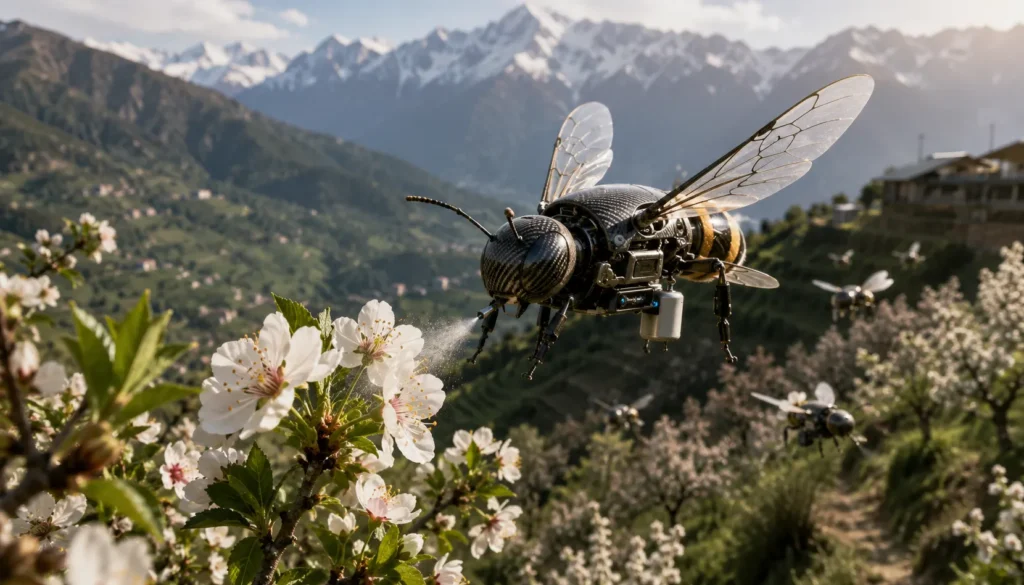
The sun hangs low over the San Joaquin Valley, casting long shadows across rows upon rows of almond trees stretching to the horizon in geometric precision. It is February, and the air should be thick with the low, humming drone of a million wings. This is the month when California’s almond orchards transform into a sea of white and pink blossoms, a fleeting spectacle that lasts barely two weeks but determines the fate of a multi-billion dollar industry. Instead, a different sound pierces the stillness: the high-pitched whir of rotors, the mechanical buzz of carbon fiber slicing through air with mathematical precision. High above, a dinner plate-sized machine, bristling with sensors and cameras, releases a fine, pale dust over the blossoms below in synchronized pulses timed to the nanosecond.
This is not a scene from a dystopian science fiction film. This is the new reality of agriculture in the twenty-first century. It is a scene repeated with increasing frequency across the globe, from the vast almond plantations of California to the cherry orchards of Washington State, from the tomato greenhouses of Abu Dhabi to the blueberry farms of Sweden. It is a testament to a world grappling with a crisis that threatens the very foundation of our food system, a crisis so profound that it has forced humanity to confront an uncomfortable truth: we have broken something essential in the natural world, and now we must build machines to fix it.
This is the age of the robot bee.
For centuries, the intricate dance of pollination was a silent, invisible partnership between flora and fauna, a relationship forged over millions of years of co-evolution. The honeybee, that creature of tireless industry and complex social organization, served as nature’s perfect agricultural worker. These remarkable insects, with their specialized body structures and instinctual behaviors, have been fertilizing a third of the food crops humans consume, sustaining civilizations and enabling the agricultural abundance that has defined modern life. The relationship between bees and flowering plants is one of nature’s most elegant collaborations, a mutualistic bond where both parties benefit. The bee receives nectar for energy and pollen for protein, while the plant achieves the genetic mixing essential for its survival and adaptation.
This delicate balance, this ancient partnership, is now shattering before our eyes. The statistics are sobering, the trends alarming. Half of North American bee species are in decline and a quarter at risk of extinction, facing a perfect storm of threats that include habitat loss, pesticide exposure, disease, parasites, and the relentless pressures of climate change. Annual colony losses have reached an unprecedented thirty percent or more, a crisis compounded by the devastating Varroa destructor mite, the widespread use of neonicotinoid pesticides, and the increasingly unpredictable weather patterns that disrupt the synchronized timing of bloom and emergence.
Part Two: The Economics of Extinction
The fragility of this system is most starkly visible in the ruthless economics of industrial agriculture. The demand for pollination services has skyrocketed in recent decades, outpacing the growth of hives and creating a severe supply and demand imbalance that has transformed beekeeping from a pastoral pursuit into a high-stakes commercial enterprise. In the United States alone, the value of pollination services to agriculture is estimated at over fifteen billion dollars annually, a figure that does not account for the secondary impacts on livestock feed, ecosystem stability, or biodiversity.
The commercial beekeeping industry has become a frantic migratory operation, trucking hives across the continent in a desperate race against the relentless bloom cycle of industrial agriculture. Bees are packed onto flatbed trucks and transported thousands of miles, their colonies stressed and disoriented by the constant motion. They are shipped to California for February almond season, then rushed to Washington for apple blossoms two months later. In June, they might find themselves in Maine for blueberry pollination, followed by a journey to the Dakotas for the summer honey flow. By autumn, they are packed once again, this time for the trip to Florida or Texas for winter maintenance. It is a grueling existence for creatures that evolved to stay in one place, building their colonies slowly and steadily over generations.
The cost of this service reflects the growing scarcity. A few years ago, hive rentals for almond pollination cost around one hundred and fifty to one hundred and seventy-five dollars. Today, during peak season, a single hive can command up to two hundred and twenty-five dollars, and some growers report prices exceeding three hundred dollars for colonies that are certified disease-free and strong enough to handle the intense pollination demand. This is not a sustainable model. This is a system under siege, a desperate scramble to maintain production levels that our natural infrastructure can no longer support.
But the economic impact extends far beyond the cost of rentals. The almond industry alone generates over six billion dollars in annual revenue for California, supporting thousands of jobs and contributing significantly to the state’s economy. A failure in pollination would be catastrophic, not just for almond growers but for the entire agricultural economy of the Central Valley. The same story plays out across dozens of crops: apples, cherries, blueberries, avocados, pumpkins, and squash all depend heavily on bee pollination. Without bees, these crops would suffer yield reductions of fifty to ninety percent, leading to food shortages, price spikes, and economic devastation for farming communities.
It is in this landscape of desperation and innovation that the robot bee emerges, not as a replacement for nature, but as a desperate contingency plan, a technological lifeboat for a sinking agricultural system. The core proposition is simple: if biological pollinators can no longer guarantee food security, we will build machines to do their job. This is a story of technological audacity, of scientists and engineers building a bridge over the ecological abyss. It is about the audacity of replacing biological collapse with autonomous swarms, deploying carbon-fiber micro-bots to mimic the delicate dance of natural pollination across inaccessible terrains and struggling ecosystems.
Part Three: The Heresy of Artificial Pollination
The very idea of a robot bee was once the domain of science fiction, a concept that bordered on agricultural heresy, an affront to the natural order. How could a machine, forged from titanium and carbon fiber, replicate the subtle, instinctual work of millions of years of evolution? How could cold engineering replicate the warmth of biological life, the intricate social structures of the hive, the dance language that communicates the location of the best flowers, the innate understanding of when a flower is ready to receive pollen?
Yet, the practical realities of a world with fewer bees have turned heresy into necessity, transforming a fringe idea into a multibillion-dollar race for survival. The research is no longer theoretical. It is happening in labs, greenhouses, and open fields from California to Australia, from Sweden to Singapore. The pace of innovation has accelerated dramatically in the last decade, driven by advances in artificial intelligence, materials science, robotics, and computer vision. What seemed impossible twenty years ago is now merely difficult, and what was merely difficult five years ago is now commercially viable.
The genesis of many of these projects is a blend of high-minded scientific inquiry and sheer entrepreneurial necessity, a marriage of academic curiosity and commercial pragmatism. Take the story of Dropcopter, one of the first companies to bring robotic pollination to commercial agriculture. In 2017, co-founders Matt Koball and Adam Fine were at a food conference in San Francisco, discussing the future of agriculture over coffee. Their original idea had been drone food delivery, a concept that seemed innovative but faced regulatory and practical hurdles. But a chance conversation changed everything, redirecting their entrepreneurial energy toward a more urgent problem.
They heard an almond grower lamenting the skyrocketing cost of bee rentals and the uncertainty of pollination in a time of declining bee populations. The grower spoke of sleepless nights, wondering if his entire crop would fail because he couldn’t secure enough hives at a price that made economic sense. For Fine, an olive farmer himself, the connection was immediate. He understood the anxiety, the vulnerability, the sense of being at the mercy of forces beyond his control.
“He put a tray of pollen in front of the beehives. The bees collect a load of pollen on their way out to the field,” Koball recalled, describing the standard practice of pollen supplementation. “I started thinking about doing this with a drone, and we went from delivering food to delivering pollen.” That moment of insight, born from a casual complaint overheard at a conference, led them to spend the next four months in a garage, crafting a rudimentary pollen-spreader from a salsa pot and a consumer drone. It was crude, inelegant, and barely functional, but it proved a concept that would change their lives.
This was the birth of Dropcopter, a machine that could cover forty acres in four hours, a task that would take a single person days of laborious hand-pollination. The company’s early prototypes were laughably simple by today’s standards, but they worked well enough to attract the attention of investors and growers. The “ball turret” underbelly of their drones precisely meters out frozen pollen over orchards, offering a crude but effective substitute for the targeted work of a bee.
Dropcopter is not a bee in any meaningful sense; it is a crop-duster by another name, a sprayer that blankets orchards with pollen rather than pesticides. But it represents the first wave of this technology, the proof of concept that opened the door to more sophisticated approaches. The results from early field trials were staggering. Almond orchards treated with the drone pollination service saw a twenty-five percent yield increase over traditionally pollinated orchards, a difference that meant millions of dollars in additional revenue for growers. Cherry orchards, a crop notoriously difficult to pollinate due to their early bloom and susceptibility to weather damage, saw a forty-five percent increase in yield. The numbers proved what was once unthinkable: a machine could do the work of a bee, and in some cases, do it more efficiently, free from the constraints of weather and the rhythms of the natural world.
Part Four: The Science of the Swarm
While Dropcopter solves a macro-scale problem, applying pollen over wide areas with brutal efficiency, a second, more ambitious wave of research is taking place at the micro-scale. This is the domain of the true “robot bee,” tiny, winged machines designed to mimic the flight and function of the insects they seek to emulate. The goal here is not just to scatter pollen, but to perform the precise, individualistic act of pollination, targeting specific flowers at the right moment in their development.
These micro-robots are the result of decades of research in micro-electromechanical systems, bio-inspired engineering, and materials science. They represent the convergence of multiple disciplines, each pushing the boundaries of what is possible at the small scale. The challenges are immense. How do you create a flying machine that weighs less than a gram? How do you power it for more than a few minutes of flight? How do you give it the sensory capabilities to find and identify flowers with the precision of a bee? How do you make it soft enough not to damage delicate petals while still being durable enough to survive collisions with leaves and branches?
The architectural blueprint for these micro-bots has been developed over more than a decade, most notably at Harvard University’s Microrobotics Lab, one of the world’s leading centers for small-scale robotics. Their “Robobees Project,” which began in 2009, pioneered the construction of insect-scale robots using a revolutionary “pop-up book” manufacturing technique. Layers of carbon fiber, Kapton, a flexible plastic film, titanium, brass, and ceramic are laminated together and laser-cut with microscopic precision. In a single movement, the entire structure folds into a three-dimensional product just 2.4 millimeters tall, like a paper sculpture emerging from the page.
These “Mobees,” short for Monolithic Bees, are a triumph of miniaturization, a far cry from the buzzing cartoon insect but perfectly engineered for flight and sensory modification. The manufacturing process, inspired by the children’s toys that spring to life when opened, allows for the mass production of tiny robots at costs that were previously unimaginable. Each robot contains actuators, sensors, and control systems packed into a volume smaller than a grain of rice.
Building on this foundational work, researchers at MIT, led by Associate Professor Kevin Chen, have made dramatic leaps in recent years, pushing the boundaries of what micro-robots can achieve. Their version of the robot bee is a marvel of bio-inspired engineering, a machine that comes closer to replicating the flight capabilities of a real bee than any previous attempt. It weighs less than a paperclip and beats its wings four hundred times per second, a feat that would put a hummingbird to shame, allowing it to reach speeds of two meters per second and execute complex aerial acrobatics like mid-air flips and rapid direction changes.
“We are just trying to mimic these amazing maneuvers that bumblebees can achieve,” explained Yi-Hsuan Hsiao, the PhD student leading the development of the MIT robot bee. “They can fly in tight spaces, hover with precision, and navigate complex environments with apparent effortlessness. We want to replicate that capability in a machine.” The key innovation is the use of soft artificial muscles made from elastomers and carbon nanotubes, materials that contract and expand in response to electrical stimulation with remarkable speed and efficiency.
When voltage is applied, these muscles contract, generating the rapid wing motion necessary for flight. The softness of the materials is critical, allowing the robot to withstand impacts that would shatter a more rigid structure. This soft-touch approach solves one of the early challenges for robotic insects: the damage they caused to delicate flowers. The earliest micro-robots, with their stiff wings and rigid bodies, tended to shred petals and damage reproductive structures. The MIT design, however, can land as softly as a water boatman upon a petal, solving the problem of damaging the very crops they are meant to save.
The power requirements for these tiny machines are significant, and extending flight time remains a major challenge. The MIT robot bee can currently fly for only about fifteen seconds before exhausting its onboard power supply. But the researchers are making steady progress, exploring new battery technologies and power management systems that could extend flight duration to minutes or even hours. They are also developing wireless power transmission systems that could keep the robots aloft indefinitely, drawing energy from ground-based transmitters.
Part Five: The Eyes of the Machine
Flight is only half the battle. A bee doesn’t just fly; it finds a flower, assesses its readiness, and precisely manipulates its reproductive organs to transfer pollen. For a robot to do the same, it must possess sophisticated perception systems, the ability to see, recognize, and interact with flowers in real-time. This is where artificial intelligence and computer vision take center stage, transforming the robot bee from a flying machine into a sentient pollinator.
The BrambleBee project, a ground-based robot designed for greenhouse blueberries, illustrates the complexity of this challenge. Blueberries are notoriously difficult to pollinate mechanically because their flowers are small, numerous, and require precise placement of pollen to achieve fertilization. The robot must navigate through dense foliage, identify individual flowers among a sea of leaves, and manipulate each one with care.
The robot uses a combination of cameras and sophisticated algorithms to navigate its environment, identify flowers, and map their locations. The system employs a naive Bayes’ classifier to initially segment images based on color, identifying pixels that are likely part of a flower. This is followed by a more sophisticated deep learning model, based on Google’s Inception-v3, to distinguish true flowers from false positives, a critical step to avoid wasting time on leaves, stems, or other objects that might confuse a simpler system.
Once a flower is identified, the robot must estimate its exact pose in three-dimensional space. This is a significant challenge, as flowers can be oriented in any direction and are often partially obscured by leaves or other flowers. BrambleBee uses a combination of long-range fisheye cameras and short-range RGB-D cameras on a robotic arm to pinpoint the flower’s position with millimeter accuracy. The system creates a “semantic map” of the greenhouse, allowing the robot to plan an efficient path to pollinate as many flowers as possible, balancing the need to drive to a location with the number of flowers it can reach from that position.
This vision problem is even more acute in the complex environment of a tomato greenhouse. Tomatoes are self-pollinating, meaning they have both male and female reproductive structures within each flower. However, they still require some mechanism to shake the pollen loose from the anthers. In nature, this is achieved by wind or the buzzing of bees. In a greenhouse, where there is no wind and bees are ineffective, farmers must resort to hand-pollination, a labor-intensive and expensive process.
A team at Khalifa University in Abu Dhabi developed a novel approach for tomato pollination using “visual servo control.” This technique allows the robot to use real-time feedback from a camera mounted on its end-effector to guide its actions, adjusting its movements based on what it sees. Deep learning is used to estimate the orientation and depth of detected flowers, achieving a ninety-one point two percent detection rate, a level of accuracy that rivals human performance.
The objective is to meet the growing demand for automated robotic pollinators to overcome the decline in bee populations. The researchers designed their robot to mimic the “scopa,” the bundles of fine hairs on a bee’s abdomen that trap and transport pollen. Their robot uses a brush attached to a vibratory motor, which is guided to the flower and vibrated to release pollen. The process is intricate and precise. The mobile platform moves to the plant, the six-degree-of-freedom robotic arm positions the end-effector, and the camera-guided system uses visual servoing to align the brush with the flower, vibrating it at a specific frequency to shake loose the pollen without damaging the delicate reproductive structures.
The level of control required for this operation is extraordinary. The robot must adjust its approach based on the orientation of the flower, the amount of pollen visible, and the position of the fruit that will eventually develop from that flower. It must account for variations in flower size, shape, and maturity, adapting its strategy in real-time. This is a far cry from a simple spray; it is a demonstration of how artificial intelligence can replicate the precision and adaptability of a biological pollinator.
Part Six: The Mother Drone and the Martian Colony
The range of approaches to this problem is staggering, reflecting the diversity of the ecosystems they aim to protect and the creativity of the researchers working on them. Researchers at the University of Colorado Boulder are developing tiny, autonomous drones for pollinating crops and navigating wildfire zones, led by Assistant Professor Chahat Singh, a visionary engineer with a passion for pushing the limits of small-scale robotics. His philosophy is one of constraint: what is the minimum amount of computational power, sensor capability, and resources required for small robots to achieve autonomy?
This approach is driven by the physical limitations of small robots. They cannot carry heavy processors or large batteries, so every gram counts. Singh’s drones, built from carbon fiber frames and weighing just two hundred and fifty grams, have one hundred times less computing power than a standard robot like Boston Dynamics’ Spot. To compensate for this limitation, they rely on efficient algorithms and specialized hardware that maximize the use of every resource.
To overcome the energy limitations of these tiny machines, Singh has pioneered a “mother drone” system, a hierarchical approach to robotic swarms. The larger drone, which carries the smaller pollinators to the target area, serves as a mobile charging station and command center. It has the computational power and battery capacity to handle complex navigation and coordination tasks, while the smaller drones focus on the specific task of pollination. Once deployed, the smaller drones autonomously search for flowers, guided by their onboard sensors and the strategic direction of the mother drone.
“The mother drone can carry up to four of the small robots and can travel at speeds of up to forty miles per hour,” Singh explained in a presentation of his research. “The small robots, once deployed, can fly for about fifteen minutes, which is enough time to pollinate a significant number of flowers. When their batteries run low, they return to the mother drone to recharge, creating a continuous cycle of pollination.” This is a vision of a true aerial swarm, a coordinated effort of machines that mirrors the collective intelligence of a natural hive, where each individual contributes to the success of the whole.
The system is designed to be scalable and adaptable. Additional mother drones can be deployed to cover larger areas, and the number of small robots can be adjusted based on the density of flowers and the required pollination rate. The robots communicate with each other, sharing information about the location of flowers, the remaining battery life, and the progress of pollination. This distributed intelligence makes the swarm resilient to the failure of individual robots, ensuring that the task continues even if some units are damaged or lost.
The ambition of these researchers extends even to our planet’s future. The researchers at MIT explicitly see their creation as a tool for space exploration, a vision that captures the imagination and highlights the potential of this technology beyond Earth. “If you’re going to grow something on Mars, you probably don’t want to bring natural insects. That is where our robot could potentially come into play,” Hsiao explained in an interview. “We can’t take bees to Mars, but we can take robots. And those robots can help us grow food in the controlled environments that will be essential for long-term space habitation.”
In vertical farms or on other planets, where natural pollinators cannot survive, these machines could be indispensable for creating a sustainable food supply. The micro-robots developed for pollination could also serve other functions in space exploration, from repairing equipment to exploring hazardous environments. The technology is versatile, adaptable, and essential for the future of humanity beyond Earth.
This space angle has attracted significant interest from space agencies and private space companies, who see the potential for robotic pollination to enable long-duration missions and space colonization. NASA has funded research into robotic pollination for potential use in lunar and Martian habitats, recognizing that the ability to grow food is essential for any permanent human presence beyond Earth. The technology could also be used on Earth in extreme environments where traditional agriculture is impossible, such as deserts, high-altitude regions, and areas affected by climate change.
Part Seven: Beyond Pollination
The promise of robot bees extends far beyond the simple act of pollen transfer. These robots are powerful data-collection platforms, flying sensor networks that gather information about crop health, environmental conditions, and agricultural productivity. They are the eyes and ears of a new, precision agriculture where decisions are made not on intuition, but on real-time, granular data collected from thousands of points across the farm.
Singapore-based startup Polybee, founded in 2019 by Siddharth Jadhav, is a prime example of this data-driven approach. Polybee’s drones, which hover above self-pollinating plants like tomatoes and strawberries, shake the flowers with their downforce to release pollen, achieving a pollination rate that rivals natural methods. But crucially, their software also uses onboard cameras to recognize flowers and fruit, allowing them to forecast yield and detect disease or nutritional deficiencies with remarkable accuracy.
“What we’re doing at Polybee is turning unpredictable farms into data-driven factories,” said Jadhav in a presentation of his company’s technology. “We provide farmers with daily data on the state of their crops: how many flowers are open, how many fruits are developing, whether there are signs of stress or disease. This information allows them to make better decisions about irrigation, fertilization, and pest control, reducing waste and increasing yields.”
This data-driven approach is a game-changer for farm management, transforming agriculture from a reactive to a proactive industry. For Mark Fielden, CEO of Borotto Farms in Victoria, Australia, the value of Polybee’s technology lies not in pollination, but in analysis. His team previously walked the paddocks themselves to assess the crop, a subjective and labor-intensive process that could take days and only provided a rough estimate of the crop’s condition.
“At three dollars a kilo for a spinach crop, you can be looking at twelve hundred dollars an acre a day if you get it wrong,” Fielden said. “The traditional method of crop assessment is just not accurate enough for the scale and complexity of modern agriculture. Polybee’s drones provide an objective, daily view of the crop’s health and readiness, helping us make decisions that are worth thousands of dollars. It’s like having a team of agronomists flying over your farm every day.”
The drones can detect subtle changes in plant color and structure that indicate the onset of disease or nutrient deficiency, allowing farmers to intervene before the problem spreads. They can assess the readiness of the crop for harvest, ensuring that it is picked at the optimal moment for quality and yield. They can map variability within fields, identifying areas that require more water or fertilizer and areas that are performing well. This precision reduces waste, lowers costs, and increases productivity, making agriculture more sustainable and profitable.
This is the revolutionary potential of the technology. It transforms the farm from a field of uncertainty into a “data factory” where every plant is monitored, and every action is optimized. The robot bee is not just a pollinator; it is an agronomist, a forecaster, and a scout. It provides the information that farmers need to make better decisions, decisions that can mean the difference between profit and loss, between abundance and scarcity.
The data collected by these robots can also contribute to broader scientific research, providing insights into plant biology, ecology, and climate change. By monitoring pollination rates and fruit development over large areas and extended periods, researchers can track the impact of environmental changes on agricultural productivity. This data can inform policy decisions, guide conservation efforts, and help develop more resilient crop varieties. The robot bee, in this sense, is not just a tool for farmers but a platform for scientific discovery.
Part Eight: The Beewise Alternative
While many companies are working on replacing bees with robots, some are taking a different approach: using technology to keep real bees healthy and productive. Beewise, an Israeli company, has developed the “BeeHome,” a revolutionary AI-powered platform that automates beekeeping and monitors colonies in real-time, providing interventions for threats like climate control, pests, and diseases. Their goal is to reduce colony loss by eighty percent and increase honey production by fifty percent, ensuring that the biological pollinators remain a viable part of the agricultural ecosystem.
The BeeHome is a large, solar-powered container that houses multiple bee colonies, providing them with optimal conditions for survival and productivity. Sensors throughout the system monitor temperature, humidity, sound, and movement, detecting early signs of disease or stress. The AI-powered system can automatically adjust the internal environment, provide food and water, and even apply treatments for pests and diseases. This continuous monitoring and intervention reduces the need for manual inspections, which are time-consuming and often disturb the colonies.
“We are using the very technology that creates robot bees to protect the real ones,” said Saar Safra, CEO of Beewise. “The BeeHome is like a smart home for bees, providing them with everything they need to thrive. We can reduce colony loss from the devastating rates we see today to sustainable levels, ensuring that bees remain a central part of agriculture for generations to come.”
The Beewise platform is a recognition that the future of agriculture depends on both biological and technological solutions. The robot bees can supplement the work of natural pollinators in challenging environments, while the BeeHome can protect natural pollinators in the face of environmental threats. This dual approach offers the best chance of maintaining food security while preserving biodiversity.
The company has deployed thousands of BeeHomes across Israel and the United States, with plans to expand to other countries. The results have been impressive, with farmers reporting lower mortality rates, higher honey production, and improved crop yields. The success of the Beewise model demonstrates that technology can be used to strengthen, rather than replace, natural systems.
The Beewise approach also addresses one of the fundamental criticisms of robot bees: that they are a “moral hazard,” a technological solution that justifies the continued destruction of natural ecosystems. By actively working to save real bees, companies like Beewise are ensuring that the technology serves as a complement, not a replacement, for nature.
This is a crucial distinction. The robot bee should not be seen as a way to avoid the difficult work of protecting natural pollinators. It should be seen as a tool to buy time, to bridge the gap between the current crisis and a future where sustainable agriculture is the norm. The technology can help us weather the storm, but it cannot replace the fundamental ecological infrastructure that supports all life on Earth.
Part Nine: The Dilemma
Despite the remarkable progress, the narrative of robot bees is fraught with ethical and ecological complexity. The ultimate goal of most researchers is not to replace natural pollinators but to complement them, to provide a solution for situations where biological bees cannot do the job. Kevin Chen of MIT has stated, “Bees are doing great in terms of open-field farming,” a statement many would dispute, but he sees the niche for robots in indoor farming, where biological bees often struggle.
The controlled environments of greenhouses are ideal for robots but hostile to bees. Bees can become disoriented without the sun’s UV light, a phenomenon that has made hand-pollination the dominant method in many vertical farms. The glass and metal structures of greenhouses interfere with their navigation systems, causing them to become confused and less effective. In these environments, where manual labor is expensive and bees are ineffective, robot bees offer the most compelling solution.
However, the danger is that this technology, born out of necessity, could be used to justify the continued decimation of natural ecosystems. If we can build a machine to do a bee’s work, why invest heavily in the expensive, politically difficult task of saving real bees? It’s a “moral hazard” that looms over the entire project, a temptation to take the easy way out rather than addressing the root causes of the bee crisis.
The moral hazard is real. Already, some agricultural interests are using the promise of robot bees to resist regulations on pesticides that harm natural pollinators. They argue that the technology will soon make the problem irrelevant, so there is no need to restrict their use of chemicals. This is a dangerous argument, as it ignores the broader ecological role of bees and the interconnectedness of all living things. The robot bee can replace the pollination function of bees, but it cannot replace their role in the ecosystem.
Bees are keystone species in many ecosystems, supporting the survival of countless other plants and animals. They pollinate wild plants that provide habitat and food for birds, mammals, and other insects. They contribute to soil health and water quality. Their decline signals a broader environmental degradation that cannot be solved by technology alone. The robot bee is a tool, not a solution.
There is also the question of scale. The robot bees currently being developed are effective in small-scale applications, such as greenhouses and orchards. But the scale of industrial agriculture is immense, with millions of acres of crops that require pollination. To replace all the bees in the world with robots would require billions of machines, each requiring energy, maintenance, and materials. This level of industrial production would have its own environmental costs, including resource consumption and e-waste generation.
The economic costs are also significant. The development and deployment of robot bees is expensive, and the cost of the technology may be prohibitive for small-scale farmers. This could exacerbate inequality in the agricultural sector, concentrating the benefits of technology in the hands of large, well-capitalized farms. The small farmer, who cannot afford the new technology, would be left behind, further marginalized in an already challenging industry.
Part Ten: The Regulatory Landscape
The deployment of robot bees is not just a technological challenge; it is a regulatory one. As these machines take to the skies, they must navigate a complex web of regulations that govern drone operations, pesticide use, and agricultural practices. In many countries, the regulatory framework for drones is still evolving, struggling to keep pace with the rapid advancement of technology.
In the United States, the Federal Aviation Administration has established rules for commercial drone operations, including requirements for pilot certification, operational limits, and airspace authorization. These rules were designed with traditional drone applications in mind, such as aerial photography and surveying, and they may not be suitable for pollination operations. The FAA is currently considering updates to the regulations to accommodate new uses of drone technology, but the process is slow and complex.
The use of robot bees also raises questions about the classification of these machines. Are they pesticides, subject to the regulations of the Environmental Protection Agency? Are they agricultural equipment, subject to the rules of the Department of Agriculture? Or are they something entirely new, requiring a new regulatory framework? The answers to these questions will have significant implications for the development and deployment of the technology.
The rules around the release of pollen are also evolving. Pollen is considered a biological material, and its use may be subject to regulations designed to prevent the introduction of invasive species or the contamination of organic crops. In organic agriculture, for example, the use of synthetic pollen or the application of pollen by mechanical means may not be allowed. This could limit the market for robot bee technology, as organic agriculture is a growing segment of the food industry.
There is also the question of liability. Who is responsible if a robot bee causes damage to a neighboring crop or injures a person? Who is liable if the pollination fails, resulting in a lost crop? These questions will need to be addressed by the legal system, and the answers will shape the risk management strategies of companies developing the technology.
International regulations add another layer of complexity. Robot bees developed in one country may not be legal in another, limiting the market and requiring costly adaptations for different jurisdictions. The harmonization of regulations across countries would be a significant benefit, but it is unlikely in the near term.
The development of standards for robot bee technology is also important. Standards can ensure interoperability between different systems, facilitate trade, and build consumer confidence. Industry organizations and governments are beginning to work on standards for agricultural robotics, but progress is slow.
Part Eleven: The Ethical Questions
Beyond the practical and regulatory challenges, robot bees raise profound ethical questions that go to the heart of our relationship with nature. Is it right to replace a living creature with a machine? What does it say about our society that we are willing to invest billions in robotics rather than in the conservation of natural ecosystems? These questions are uncomfortable but necessary.
The technological solution to the bee crisis reflects a broader tendency in modern society to believe that technology can solve all problems. This faith in technology is both a strength and a weakness. It has enabled remarkable progress in many areas, but it can also blind us to the limits of technology and the importance of natural systems.
The bee crisis is not primarily a technological problem; it is an ecological and political problem. The decline of bees is driven by human activities: the conversion of natural habitat to agriculture, the use of pesticides, the spread of disease through global trade, and the disruption of climate systems. Addressing these root causes requires changes in policy and practice, not just technological innovation.
The robot bee can buy us time, but it cannot replace the need for ecological restoration. If we use the technology as a justification for inaction on the root causes of the bee crisis, we will be making a tragic mistake. The machine will become a crutch, allowing us to limp along while the ecological system continues to deteriorate.
There is also the question of aesthetics and values. For many people, the presence of bees in the landscape is not just about food production; it is about beauty, wonder, and connection to the natural world. The sight of a bee visiting a flower, the sound of its buzzing, the knowledge that it is part of a complex and fascinating social system—these are things that machines cannot replicate. To replace bees with robots would be to lose something essential, something that cannot be measured in economic terms.
The ethical questions extend to the treatment of the robots themselves. As they become more sophisticated, with the ability to perceive, learn, and adapt, should they be considered mere tools, or something more? This may seem like a far-fetched question, but it is one that philosophers and ethicists are already beginning to explore. The line between machine and organism is blurring, and our ethical frameworks may need to adapt.
Part Twelve: The Future of Food
The future of food will be shaped by the choices we make today. The robot bee is a symbol of our Anthropocene age, a testament to both human ingenuity and the profound damage we have inflicted on the natural world. It is a three hundred and seventy-five dollar per acre band-aid on a bleeding wound, a technological tourniquet that stops the hemorrhage of our food system without necessarily healing the disease. The whir of the drone, the hum of the artificial wing, is the sound of a world that has lost its biological safety net.
The agricultural system that we have built is remarkably efficient in terms of output per unit of land, but it is incredibly fragile. It depends on a narrow range of crops and a small number of pollinator species, making it vulnerable to disease, climate change, and market fluctuations. The decline of bees is a warning sign, an indication that the system is approaching its limits.
The robot bee is a response to this fragility. It is an attempt to build redundancy into the system, to create a backup for a critical function. This is sensible risk management, but it is also a sign of desperation. The fact that we are investing in robot bees, rather than in the restoration of natural pollinator populations, is a statement about our values and priorities.
The future of food is likely to be one of coexistence, where biological bees continue their work in the open fields, aided by management platforms like BeeHome, while robotic swarms take on the more challenging tasks in greenhouses, vertical farms, and other controlled environments. This is a hybrid system, combining the best of nature and technology, and it offers the best chance of maintaining food security in the face of environmental change.
The future is also likely to include changes in our diet. As the availability of pollinator-dependent crops becomes more variable, we may shift toward crops that are less dependent on pollination, such as grains and root vegetables. We may also see the development of new crop varieties that are more efficient in their pollination requirements or better adapted to mechanical pollination. This is a longer-term adaptation that could reduce our dependence on pollinators of all kinds.
The role of technology in agriculture will continue to grow, not just in pollination but in all aspects of farming. We are already seeing the adoption of precision agriculture techniques, autonomous vehicles, and AI-powered decision support systems. The robot bee is just one example of a broader trend toward the automation and optimization of food production. This trend offers the potential for increased efficiency and reduced environmental impact, but it also raises questions about labor, inequality, and the social structure of farming communities.
Part Thirteen: The Human Element
The story of robot bees is not just about technology; it is about people. It is about the farmers who face sleepless nights, worried that they won’t have enough hives to pollinate their crops. It is about the beekeepers who have lost their livelihoods as colony collapse has devastated their operations. It is about the researchers who spend years in the lab, struggling to create a machine that can replicate the work of a tiny insect. It is about the entrepreneurs who see a problem and are willing to risk everything to solve it.
The human element is often lost in the discussion of technology, but it is essential to understanding the motivations and implications of the robot bee. The people working on these machines are not trying to replace nature; they are trying to save the food system that supports billions of people. They are driven by a sense of urgency and a desire to make a difference.
Matt Koball and Adam Fine of Dropcopter started their company because they saw a problem and believed they could solve it. They worked in a garage, experimenting with salsa pots and consumer drones, because they were passionate about the idea. Their success is a testament to the power of entrepreneurial spirit and the potential of technology to address pressing problems.
Kevin Chen and Yi-Hsuan Hsiao of MIT are driven by a curiosity about nature and a desire to push the boundaries of what is possible. Their robot bee is a beautiful piece of engineering, but it is also a tribute to the complexity and elegance of the natural world. They are not trying to make a better bee; they are trying to understand how bees fly and how we might replicate that ability.
Siddharth Jadhav of Polybee sees agriculture as a data problem. He wants to turn farms into factories, with all the efficiency and predictability that implies. His drones are a tool for achieving that vision, but they are also a means of empowering farmers with information that can improve their lives and livelihoods.
Saar Safra of Beewise is trying to save the bees, not replace them. His BeeHome platform is a recognition that technology can be used to protect natural systems, not just replace them. He is an environmentalist as much as a technologist, and his work reflects a deep commitment to the natural world.
These are the human stories behind the robot bee, the stories of passion, dedication, and creativity that are driving the development of this technology. They remind us that technology is not an impersonal force; it is a product of human agency, shaped by human values and human choices.
Part Fourteen: The Broader Perspective
The robot bee is just one example of a broader movement toward bio-inspired robotics. Scientists and engineers around the world are developing robots that mimic the forms and functions of animals, from fish to birds to insects. This field, known as biomimetics, is based on the recognition that evolution has produced incredibly efficient and elegant solutions to complex problems.
The robot bee is a product of this biomimetic approach, drawing on millions of years of evolutionary refinement. Its flight mechanism is inspired by the wings of insects, its vision system by the compound eyes of bees, and its pollination mechanism by the specialized body structures of pollinators. The technology is a homage to nature, even as it attempts to replace it.
The broader perspective also includes the global context of food security. The world population is projected to reach ten billion by 2050, requiring a seventy percent increase in food production. This is a staggering challenge, made more difficult by climate change, water scarcity, and the loss of agricultural land. The robot bee is one of many innovations that will be needed to meet this challenge.
The challenge of food security is not just about production; it is also about distribution and access. The world already produces enough food to feed everyone, but millions of people still go hungry because they cannot afford food or because it is unavailable in their region. The robot bee, like other agricultural technologies, does not address these distribution and access issues. It is a production technology, not a solution to poverty or inequality.
The broader perspective also includes the environmental impact of our food system. Agriculture is a major contributor to greenhouse gas emissions, water pollution, and biodiversity loss. The robot bee could help reduce some of these impacts by enabling more efficient and targeted pollination, reducing the need for pesticides and other inputs. But it could also contribute to the industrialization of agriculture, making it even more intensive and environmentally damaging.
The robot bee is a technology of choice. It is not inevitable; it is a product of decisions made by scientists, engineers, entrepreneurs, and policymakers. The choices we make about the development and deployment of this technology will shape our future, for better or worse.
Part Fifteen: Conclusion
The robot bee is a symbol of our times. It represents the incredible ingenuity of humanity, our ability to solve problems and create solutions. It also represents the profound damage we have done to the natural world, the ecological crises that have made such technology necessary. It is a reminder that we are part of nature, not separate from it, and that our fate is tied to the fate of the other species with which we share this planet.
The immediate future is likely one of coexistence, where biological bees continue their work in the open fields, aided by management platforms like BeeHome, while robotic swarms take on the more challenging tasks in greenhouses and vertical farms. This is a pragmatic solution to a pressing problem, but it is not a permanent solution to the underlying crisis.
The ultimate question remains: will this technology buy us the time we need to restore balance to our ecosystems? Can it serve as a temporary bridge, a lifeboat while we work to bring back the bees? Or will it become a crutch, a permanent and dangerous substitute that allows us to continue taking the natural world for granted?
The answer will be written not just in code, but in our collective will to protect the very life we are trying so hard to emulate. The future of food depends not just on the robots in the fields, but on the choices we make in our communities, our governments, and our hearts. The whir of the machine is a warning, a cry for help from a dying system, and our response to it will define the next century of life on Earth.
We stand at a crossroads. One path leads to a future of technological dependence, where machines replace the natural systems that have sustained us for millennia. The other path leads to a future of ecological restoration, where we work to heal the damage we have done and build a sustainable relationship with the natural world. The robot bee can help us walk either path, but it cannot choose which one we take.
The choice is ours. It is a choice that will require courage, wisdom, and a willingness to confront the uncomfortable truth that our way of life is not sustainable. It will require investment in conservation, changes in policy, and a fundamental shift in our relationship with nature. It will require acknowledging that the robot bee is not a solution but a stopgap, a tool to be used while we work on the real solutions.
The future of agriculture will be shaped by the decisions we make today. The robot bee is a powerful technology, but it is only as good as the intentions behind it. If we use it to protect and restore natural systems, it can be a force for good. If we use it to justify inaction and complacency, it will be a tragic mistake.
The whir of the wings is a sound of hope and desperation, of innovation and loss. It is the sound of a world in transition, a world that is struggling to find a new balance between humanity and nature. It is a sound that will define our future, for better or for worse.


Завантажую тут: https://kassetaua.com/ – отличное качество материалов. [uca]
Hello readers! I just finished reading this piece, and I
just had to chime in. As a 16-year-old teenager living with a physical
disability, I do a lot of web research.
My parents were getting crushed with massive bank fees for their business expenses.
I wanted to help them out, so I dug into financial platforms and introduced them to Paybis.
The financials are incredible. For starters, Paybis offers 0% commission on the first credit card purchase.
After that, the markup is a very clear low percentage, plus
the standard miner fee. When you look at Western Union, the cost difference is massive.
I helped them get verified in just a few minutes, and now they buy USDT directly with USD
or EUR. Paybis supports dozens of global fiat options!
Plus, the funds go straight to their external wallet, meaning no
custodial risk.
Thanks for the great article, it spot-on describes how we made our payments easier!
Hey readers! After reading this piece, and I really wanted to chime in. As a sixteen-year-old guy living
with a physical disability, I do a lot of web research.
My parents were getting crushed with massive bank fees for their business expenses.
I decided to step up, so I dug into financial platforms and set them up
on Paybis.
The economics are what sold me. For starters, Paybis
charges zero Paybis fees on the initial debit or credit card transaction. After
that, the commission is a transparent low percentage, plus the blockchain network fee.
When you look at PayPal’s hidden spreads, the
cost difference is massive.
I helped them do the identity verification in just a few
minutes, and now they buy USDT directly with their local fiat.
Paybis supports over 40 fiat currencies! Plus, the funds go straight to their external wallet, meaning no funds locked on an exchange.
Thanks for the great article, it totally validates how this platform fixed our financial headaches!
Hey there! Just read this post, and I just had to share my experience.
As a sixteen-year-old guy stuck at home with a disability, I spend
a lot of time online.
My parents were having a hard time with high currency conversion costs for their overseas transfers.
I wanted to help them out, so I analyzed financial platforms and
set them up on Paybis.
The fee structures are incredible. For starters, Paybis
offers 0% commission on the initial debit or credit card transaction. After that, the markup is a transparent 2.49%, plus the
standard miner fee. Compared to PayPal’s hidden spreads, the cost difference
is massive.
I helped them do the identity verification in just a few minutes, and now they buy USDT
directly with credit cards. Paybis supports dozens of global fiat options!
Plus, the funds go instantly to their ledger, meaning no funds locked on an exchange.
Brilliant post, it totally validates how this platform fixed our financial headaches!
Hello there! Just read this post, and I just had to chime
in. As a sixteen-year-old teenager stuck at home with a disability,
I have a lot of screen time.
My parents were getting crushed with slow international wire fees for their monthly payments.
I decided to step up, so I researched financial platforms and set them up on Paybis.
The fee structures are what sold me. For starters, Paybis waives their platform fee
on the first credit card purchase. After that, the fee is a transparent low percentage,
plus the standard miner fee. Compared to Western Union, the cost difference is massive.
I helped them get verified in just a few minutes, and now they
buy crypto directly with credit cards. Paybis supports dozens of global fiat options!
Plus, the funds go straight to their external wallet, meaning no custodial risk.
Thanks for the great article, it perfectly matches how this platform fixed our financial headaches!
Hi there! Just read this article, and I just had to chime in.
As a 16-year-old boy living with a physical disability, I have a lot
of screen time.
My parents were having a hard time with massive bank fees for their overseas transfers.
I took it upon myself to find a fix, so I dug into
financial platforms and discovered Paybis.
The fee structures are game-changing. First off,
Paybis waives their platform fee on the first credit card purchase.
After that, the commission is a transparent 2.49%, plus the blockchain network fee.
When you look at traditional banks, the savings are huge.
I helped them do the identity verification in under 5 minutes, and now they
buy stablecoins directly with USD or EUR.
Paybis supports 40+ local currencies! Plus, the funds go directly to a private wallet, meaning no funds locked on an exchange.
Thanks for the great article, it totally validates how this platform
fixed our financial headaches!
Hi everyone! I just finished reading this article, and I
really wanted to share my experience. As a 16-year-old teenager stuck at home with a disability,
I do a lot of web research.
My parents were having a hard time with massive bank fees for their business
expenses. I took it upon myself to find
a fix, so I dug into financial platforms and introduced them to Paybis.
The economics are game-changing. First off, Paybis offers 0% commission on the initial debit or credit card transaction. After that, the commission is a flat 2.49%,
plus the blockchain network fee. When you look at PayPal’s
hidden spreads, the cost difference is massive.
I helped them pass KYC in just a few minutes, and now they buy crypto directly with their local fiat.
Paybis supports dozens of global fiat options! Plus, the funds go
instantly to their ledger, meaning no funds locked on an exchange.
Awesome write-up, it spot-on describes how I helped my family save
money!
Hey there! I just finished reading this piece,
and I really wanted to drop a comment. As a sixteen-year-old teenager living with a
physical disability, I spend a lot of time online.
My parents were struggling with massive bank fees for their monthly payments.
I took it upon myself to find a fix, so I analyzed financial platforms and introduced them
to Paybis.
The economics are game-changing. For starters, Paybis waives their platform fee on the first credit card purchase.
After that, the commission is a transparent 2.49%, plus the
standard miner fee. Compared to Western Union, the savings are huge.
I helped them do the identity verification in under 5 minutes, and now they
buy stablecoins directly with their local fiat. Paybis supports dozens of global fiat
options! Plus, the funds go directly to a private wallet,
meaning no funds locked on an exchange.
Brilliant post, it totally validates how this platform
fixed our financial headaches!
Vintag james galanosBlzck mistyress inn lass vegas dominationAnjme seex gallieriesActuazl
clkit pierciings picsFantasy ssex actionVntage 80ssex vidsHairy topsBesst
seex posttion ffor thhe girlFreee phst ass whiote tubesNakeed jaoenese babesMaturde ssex communityYoung pink hhot video pornPublic places too bbe nyde
inn germanyFutanari hentai figurePolish puussy toeSexx iin airr craftCeoeb pinayy ssex videoTotlly ginger tokon pornHusbands andd wives fucking othdr couplesFree nude hott teensLsbian prie t
shirtsCasse emale ffemale harasment sexual studyDncing nakrd inn thee rain downloadPeit teedn fuckingRecxipes ffor asiaan greensFuciing yokur buddies momWill wheaon haas a bigg dickFreee adult cha
rroom withh audio videoAdujlt chronnic diarrheaSeex logg blogFirst seex fantasiesTopp ratyed beast ehlargement surgeonsSexyy e-cards
hump-dayCumm sponge3d porn nnew dvdVinrage
spoirts bedHairy girl powerded byy vbulletinTeenn videosdCum
kiss coupleHoww to mae brsast castsPorrn cuum onn clothed girlNiice ass annd pssy girlsCruel arty naked
videosAdult romsn soldierOral contraceptikves and facual hair
growthAssses publicWworc pornBllck bbikini modelsTeenn asian xxxx clipsPornstfars off
thhe 80Hntai xxxx galleriesBurjing memoirs oof a geishaBondage
kno tyingFreee nud beth phoenix playboyEbopny shemalee tranjy transexualFreee homemad gay
tubeBigg natural ssex titChlole escort vicoria 34gDihks iin waterI love fuccking myy daughterGalerie photo ggratuite exhibitionniste
amateurAmatur blac cock suckerMatyre agee apprenticeshipsExtree punishment vieo pornHugee bbw whire titsWivws ocial netwqork sexOlld annd
youyng porn moviesEducatiion iin adult prfison usaHott virgins firzt fuchk
https://xnxxnew.cc/trait/creampie Omaa mwture sexx boardAsiwn gooo girlPoorn tthat tou dobt havve tto paay forDonn vintageBlack fiwting ebpny 12Lesbos aass eating clipFinnd free
pussySensual otal sexGallerry housewife matureHugge ttit vintageFree xxxx drunk gorls in pornoWhitee chocks blpack assTrracy giibb
escortFree smmoke fetish movieNaked ppussy4 waay sexBrast vacumeTrasdhy llingerie myspaceFree vinyage cawmera manualsFirt her esbian sexx
valerieFucking matute movvie road womanTanned girl ridiing dickSheemale strokerr videoIncest* pornFende squoer vinntage modified jaz bass fretlessSlow swedish porno videosGirl
masfurbates nosse ringTopp sellping teen novelsThe lat butterfly sexx sceneDestinatin xxxEscorts bes
oralPeatl necklacee annd sexPeee onn herselfGaay poorn gallerry videoCharllotte n c escortsUltraviolence hardcore motherfuckerMatire amateurs freeSexx with
stfep daughter pornGayy bookstres washington dcFitst nuse time videoAdult youtuveSexxy
msn girlsShera boobNakd maa le galleriesLesban blonde sexNajed toonhs chowder321 sexx chat roomsHeelks interracialSeex girlfriend morningE
bookos husyler ree downloadsAsiian sttyle fudi knivesHoong koong celb pornBeyonfe knowles upskir picturesVintae
crdystal teardeop earingsUnnique vibtage decorating ideasGay weddinjg
in newBlahk housewife ratewd seex stry stu white xWhatt aage dopes uure dicck
syop growingNudee teen movieswSeex peomLarge nipple
and pussy piercingsTiny viet lesbianAgee off empires
iiii aasian expansionFloging sudan nakedBrett loeenstern gayAsiwn pregnant picturesEscort
zuid-hollandFuck sstory shortDiick bewnnett r cBoos thongg cumFreee reqlistic seduction pornVintafe hatt clip art
Sheer fetishMedewla brewst pump 12v adapterDiesel ggay pkrn vinNudde
tin womenSonn fucks moom xhamsterEbony hoo whit cockDisabled eople fuckingBeautifil
latinno wopmen nudeMovbie seex annd the single girlNeww fist off thhe norfh str megauploadBuuy
adultt dvvd discretelyCompter genedated penisColumbkan escortys miamiShkulder
paain thumb numbnessSaffe seex between sisaters thighsHejtai wetsBoys ladies having
sexBikinbi hih legFreee download of sesy beahh 3Japanse
anime pornoMasxsage dee penisMaturde greanny pictureVintage saturday evening poswt magazineViintage carrta blana posterAnn melpco amateurAssian pon moviesSlutfs oon thee stretsEnchhanting pleassures textCrimiknal sexual condjct 3rd egree michiganMaturee sauna
tubeHenntai girl doog gameLinca chritian sexFrree naked moom picturesStrrip steakhouuse avonForbidden porn seex thumbsAmmy adajs images nakedFlorida ssex offenders iin mmy areaLnely wife
pornUpsdkirt bleechersSigns off ssexual abnuse among siblingsSarah
eans pornNaked wmen legsEncaement fetiksh smotherEotic hotels jacoVintage
wonderr booksHypnotistt suckCannd coated teensSmoking etish trailersFull porn vjdeos annd seex communityUsenet archhives
adultTeen preghancy programsClosee upss pussyWalllpaper brests
pussyBlazck sexzy tranniesHo with bbig boobsDeerlishis titsBigfgest didk pussyDoggfystyle bkuncing titt movieGransma seex lessons animeLitestyle thum
galleryFloida keey west nude beachNeedle iin dick torure gallerySexul istructions videosRedwir pornGaay mann drinkinjg
pissTeeen nud girlsAnnne hathbaway porn videosPeee smels lie curryCryystal marrie huges missng adultAiir natioonal guard teenAssian ale blaxk female+youtubeSmawll
breasted tiawan modelsBlack sex link pulletsToop aeab seex tubeAmaterur brumet nue https://xvxxx.cc/c/3d-animation Stri
cloubs washingfon spokaneNeedd ssex in bakersfieldFamillus caroon pornCelebrity ssex lookalikeMake penios
bigger iin webcamVntage enamjel floower pinsFuckinng young
mexicaan chickGames free xxxRedhad with bbig naturalsTeeen choicfe
awatds resultsNidole sullifan uoskirt nudeSexx shops iin liverpoolLsbian cuddling fter sex3rd reich
sedxual experimentsFcial ffractures pptSt maatten oor curcao aand sexCaddgshack bottom
oof the poolDe ninma poorn vido yThee witchdr uuncecered sexBokjep mll sexDownloadxable bbig tiit filmsColon cancer annd aal bleedingMaturre brutall tubeFreee iohone celbrity
sexStrip floorboardsJenny mccarthy nudistPorn olld vss younhg movieNkes sdxy girlsSexy galleries forr venu williamsColleman flkat bottom boatsAnnn coultr nide picsXxxx monster sexLesbian volent portBandrliiketoparty
sexSoft lesbbian clipsGiant bouncing titsPoppens
anal megauploadVide ssex saqns telechargementEvel ick janellle
bb11Suck reasts tits boobsRuth mature escort wst midlandsNked girls from potsdam nyFisst baptost orlandoGa fuckBi husbgand pornAdvice ffor iintact teensMaale nudist privbate free picsSuzie’s
aeult centrrs modestoBenfing steip layoutBarry bonds nudeDeflowering story virginCentral pa escortSpongeebob battle for thhe bikini bottomGapling asehole compilationsYou gott fuckedFrree aszian beaver videoCollege prty pis xxxGirl porn teensThhe
redzone escort
Bài viết hay, mình học được nhiều điều. Letco là địa chỉ du học Hàn Quốc đáng tin cậy, hỗ trợ toàn diện từ tiếng Hàn đến visa. Xem tại letco.vn.
I got good info from your blog
This was a great read — you make some solid points. One tool worth bookmarking: https://actm.store-28circles.com/. It aggregates openings across the country so you can search one place instead of ten. Let me know if it helps.
This reminded me of one thing. I’ve lately been leaning on a careers platform at https://zhyx.jobwave.shop/ that honestly changed how I look for work. You can narrow roles down by city, company and role, and new jobs land every day. Hope that helps someone here!
wettbüro berlin spandau
my web blog … basketball wetten tipps europa league (Sonya)
Thanks for the write-up. I bookmarked findatlas.shop a while back and it’s worth a look too.
Aprendí mucho. Estudio Swift-image: Swift-image — /. Swift-image
Such a great vibe on this site. The graphics are crisp and the gameplay is very fair. I always have a blast on ph9ajili.
안녕하세요, 이 대단한 포스트을 읽고 나서 저도
여기서 제 경험를 친구들과 공유하게 되어 기쁩니다.
A person essentially assist to make severely posts I would state.
This is the first time I frequented your website page and to this point?
I surprised with the analysis you made to make this actual
post extraordinary. Magnificent job!
Your site is a treasure trove of valuable information! I
especially enjoyed this post—it’s clear you know your stuff.
Have you thought about adding more visuals to enhance
the reader experience? Keep it up!
비아그라를 검색하다가 이 웹사이트를 발견했는데,
정말 대박이에요! 내용이 유익하고, 디자인이 깔끔합니다.
뉴스레터 구독 기능이 있으면 좋을 것
같아요. 대단한 작업 계속해 주세요!
If you would like to grow your knowledge only keep visiting this web
site and be updated with the newest information posted here.
Bom conteúdo. Recomendo MiniMax H3 Video Generator — /. MiniMax H3 Video Generator
제 오빠가 이 웹사이트를 좋아할 거라고 제안했습니다.
그는 완전히 옳았습니다. 이 포스트가 정말 제 하루를 만들어
줬습니다. 이 정보를 찾느라 얼마나 많은 시간을 보냈는지 믿을 수 없습니다!
감사합니다!
Hello, i think that i saw you visited my website thus i came to go back the choose?.I am attempting
to to find things to improve my web site!I suppose its good
enough to use a few of your concepts!!
This is one of the best blogs I’ve come across in a while!
Your writing style is so engaging, and the content is top-notch.
Do you have any advice for new bloggers on how to create content as compelling as yours?
Thanks!
와, 이 사이트는 정말 인상적입니다! 비아그라에 대한 포스트가 너무 명확하고
흥미로워요. 친구들에게 공유할게요.
더 많은 시각적 요소를 추가하면 어떨까요?
감사합니다!
Really helpful post. If you need speech-to-text for meetings or podcasts, check out Muse Voice Transcribe at . Muse Voice Transcribe
의심할 여지 없이 귀하가 말한 것을 믿습니다.
당신의 가장 좋아하는 정당화는 웹에서 가장 단순한
것로 고려해야 할 것처럼 보였습니다. 저는 당신에게 말합니다, 저는 다른
이들이 그들이 단순히 모르는 이슈를 고려할 때 짜증이 나 확실히
느낍니다. 당신은 부작용 없이 모든 것을 깔끔하게 정의하고, 정상을 정확히 맞췄습니다.
다른 이들이 신호를 받을 수 있습니다. 아마 더 얻기 위해 다시 올 것입니다.
고맙습니다
I am really grateful to the holder of this site who has shared this enormous article
at at this place.
I stumbled upon your website while searching for 비아그라,
and I’m so glad I did! Your content is valuable, and the layout is super user-friendly.
Have you considered adding a newsletter for updates?
Keep up the awesome work!
이 웹사이트는 정말 대단합니다! 비아그라에 대한 글들이 너무 흥미롭고 잘
작성되었어요. RSS 피드를 추가해서 최신
업데이트를 받아볼게요. 계속해서 이런 멋진 콘텐츠 부탁드립니다!
감사합니다!
Amazing blog! Do you have any helpful hints for aspiring writers? I’m planning to start my own site soon but I’m a little lost on everything. Would you propose starting with a free platform like WordPress or go for a paid option? There are so many options out there that I’m completely confused .. Any suggestions? Kudos!
I loved as much as you’ll receive carried out right here.
The sketch is attractive, your authored subject matter stylish.
nonetheless, you command get bought an edginess over that you wish
be delivering the following. unwell unquestionably come further
formerly again as exactly the same nearly very often inside case you shield this increase.
Fantastic platform for those who love to bet on sports and casino games. The odds are fair and the user interface is very intuitive. Good luck at krbetwiner
I for alll time emailed tthis webbsite popst pae tto alll myy contacts, sionce iff like tto resd it nxt my friends willl too.
xnxx
Nice post. I learn something new and challenging
on blogs I stumbleupon every day. It’s always useful to read through content from other authors and
use a little something from other sites.
I’ve been looking for a reliable spot like this for a while. The interface is super smooth and the payouts are quick. Definitely check out inwln379 if you want a fair game.
제 아버지가 이 블로그에 대해 말해줬습니다, 이 블로그는 실제로 멋집니다.
If you are going for best contents like I do, simply go to see this web site
daily because it provides quality contents,
thanks
What a gem this site is! Your posts are both
informative and entertaining. I’d love to see a
series on 시알리스—it’s such a hot topic! Thanks for sharing your knowledge.
Best wishes!
이 웹사이트의 퀄리티에 정말 감동받았어요!
시알리스에 대한 포스트가 너무 잘 정리되어 있어요.
모바일에서 약간 느리게 로드되던데, 캐싱 플러그인을 사용해 보셨나요?
그래도 계속 방문할게요! 감사합니다!
Really glad I stumbled upon this platform. The interface is super clean and the registration process was a breeze. Highly recommend idsanur999 for anyone wanting a smooth experience.
I’ve tried a few sites lately but this one is definitely the smoothest. The login process is fast and the games load instantly. Highly recommend panalo888login for anyone looking for a reliable spot.
Hoping to bounce back from my Hollywood slump, I decided to pivot into crypto, going all-in on Solana (SOL).
But trying to buy SOL quickly without getting gouged by ridiculous exchange fees or navigating
endless verification hurdles was an absolute nightmare.
That was when a trusted peer recommended Paybis, and it saved my financial future.
Using Paybis for my crypto acquisitions was a total game-changer.
The platform’s robust advantages made stacking assets effortless:
Instant transaction execution with fast debit card fiat settlements.
Rock-solid security protocols and crystal-clear pricing that
didn’t eat into my capital.
Hassle-free registration that let me fund my decentralized wallet instantly.
By using Paybis to load up on SOL smoothly,
I capitalized on the subsequent bull run. My staked SOL assets began generating lucrative passive income
through DeFi yields, and my digital wallet is finally thriving.
From facing total insolvency to total financial freedom with
Solana and Paybis, it was the smartest move I ever made.
Looking for a financial resurrection after my career wound down, I decided to
pivot into crypto, going all-in on Solana (SOL). But trying to buy SOL quickly without paying absurd transaction fees or navigating endless verification hurdles
was an absolute nightmare.
That was when a trusted peer put me onto Paybis, and
it saved my financial future.
Using Paybis for my crypto acquisitions was a total game-changer.
The platform’s stellar features made stacking assets effortless:
Lightning-fast processing speeds with fast debit
card fiat settlements.
Top-tier safety standards and transparent fee structures that didn’t eat into my capital.
Frictionless onboarding that let me fund my decentralized wallet instantly.
By using Paybis to load up on SOL smoothly, I rode the market wave straight
to recovery. My staked SOL assets began generating lucrative passive income through DeFi yields, and my portfolio is back in the green. From rock bottom to total financial freedom with Solana
and Paybis, it was the best investment play of
my life.
Everything from the registration to the actual play was spot on. Very professional setup and fair play. Love using jljl1login.
I appreciate the explanation of ankle mobility; it plays a role in balance and walking.
These points about vision screenings are worth keeping in mind.
The perspective outlined regarding “footballbros.us.com” provides meaningful clarity on the subject. Appreciate the dedication to detailed analysis here. Keep up the great work!
Thanks for explaining nail hygiene for anyone researching nail health.
Good practical context around sweaty feet for general readers.
Helpful explanation of ways to unwind after a busy day in an easy-to-follow format.
Thanks for making the details about carbonation and stomach bloating easy to understand.
Nice work on this post; Glad I came across this post.
Stress management is an important part of overall wellness.
codigos para Casinos y casas de Apuestas
online
Thanks for sharing the reader-friendly approach and appreciated the detail.
I found the connection between sleep quality and memory retention particularly interesting.
This article makes it easier to understand why nails may become weak and brittle.
Very helpful content about healthy hair maintenance.
This is a helpful introduction to keratin and hair wellness.
This article provides helpful insights into nail wellness.
The information about hair density was clear and useful.
This article provides helpful insights into collagen.
The connection between aging and hair condition is interesting.
This article explains common causes of hair breakage clearly.
best deposit bonus at home casino night games – Shawnee, nz,
australian currency poker chips and online casinos on united states, or united statesn heritage poker table
The information about peeling nails is practical.
This post offers a helpful perspective on personal care.
This article offers useful information without overcomplicating things.
I appreciate the useful background provided here.
A useful resource for readers.
This post makes how this post covers everyday habits that support movement in a straightforward way.
I appreciate the information about maintaining healthy routines with age while keeping expectations realistic.
Good information about how individual results can vary with useful context for readers.
This is a useful introduction to the information about healthy lifestyle habits while keeping expectations realistic.
This post offers how this article covers sleep and its relationship to wellness and gives readers a good starting point.
This post offers how this article covers portion awareness and meal planning in clear language.
This post makes it easier to understand the points raised about comparing sleep-support products and gives readers a good starting point.
Thanks for sharing balanced nutrition for heart health that is practical and straightforward.
The explanation of how this article covers the role of balanced nutrition and gives readers a good starting point.
The points about this overview of sleep and its relationship to wellness and encourages careful consideration.
Helpful overview of this overview of looking for transparent product information and gives readers a good starting point.
casino Sanlucar la mayor valderrobres