
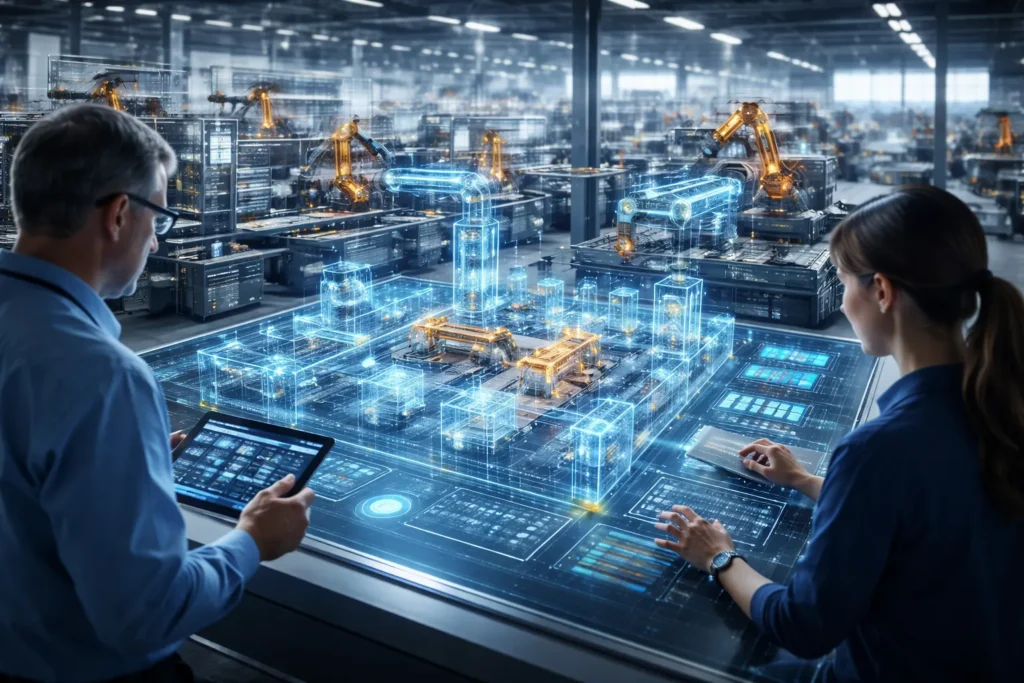

Prologue: The Silent Revolution on the Factory Floor
In the heart of an unremarkable industrial park outside Stuttgart, Germany, something extraordinary was happening without a single worker noticing. At 3:17 AM on a Tuesday, while maintenance crews slept and security made their rounds, a virtual representation of Pump #347 in the cooling system began displaying anomalous vibrations in its digital counterpart. The AI monitoring this system compared 142 different parameters against five years of operational data, consulted with digital twins of similar pumps across three continents, and predicted with 94.7% certainty that a specific bearing would fail within 72 hours. At 6:00 AM, when the plant manager arrived, a work order was already generated, the replacement part was automatically requisitioned from inventory, and a 90-minute maintenance window was scheduled during the next planned production pause. The physical pump continued to operate flawlessly, completely unaware that its digital doppelgänger had just saved the facility from a 14-hour production stoppage that would have cost €237,000 in lost revenue.
This is not a scene from science fiction. This is the reality of modern manufacturing, transformed by a technology that creates living, breathing digital replicas of physical systems—digital twins that learn, predict, and optimize in ways that were unimaginable just a decade ago. The journey from industrial intuition to data-driven certainty represents perhaps the most significant transformation in manufacturing since Henry Ford’s moving assembly line. What follows is a comprehensive exploration of this technological revolution—its origins, mechanics, implementations, challenges, and extraordinary potential to reshape global industry.
Chapter 1: Historical Foundations—From Blueprint to Living Model
The Pre-Digital Era: Drawings, Prototypes, and educated Guesses
To appreciate the radical nature of digital twins, we must first understand what came before. For most of industrial history, manufacturing relied on a sequential, physical-centric development process. Engineers created detailed blueprints—first by hand, then with CAD systems—which served as static instructions for building physical prototypes. These prototypes would be tested, often to destruction, to identify weaknesses. The factory floor itself operated largely on human experience—seasoned machinists could “listen” to a machine and know something was wrong, maintenance followed rigid schedules regardless of actual need, and optimization meant trial-and-error adjustments that might take months to validate.
This approach suffered from fundamental limitations:
- The Prototype Paradox: Each physical prototype was expensive and time-consuming to create, limiting how many design iterations were feasible.
- The Data Desert: Operational knowledge resided primarily in the minds of experienced workers, with little systematic data collection about machine health or process efficiency.
- The Reactive Nature: Problems were addressed after they occurred, causing costly downtime and quality issues.
- The Scale Challenge: Optimizing one machine might inadvertently create bottlenecks elsewhere in a complex production system.
The Digital Precursors: CAD, CAE, and Early Simulation
The first digital revolution in manufacturing began with Computer-Aided Design (CAD) in the 1960s and 1970s, which allowed engineers to create precise digital drawings. This evolved into Computer-Aided Engineering (CAE), which introduced basic simulations—finite element analysis to test structural integrity, computational fluid dynamics to model airflow or liquid behavior. These were valuable tools, but they were fundamentally different from digital twins in several critical ways:
- Static vs. Dynamic: Traditional simulations were one-time calculations based on fixed inputs. A digital twin continuously updates based on real-world data.
- Generic vs. Specific: CAE models represented a “type” of machine or part. A digital twin represents a specific, individual asset with its unique history and characteristics.
- Isolated vs. Connected: Early digital tools existed in isolation. Digital twins are connected to other twins, creating ecosystems of interconnected models.
The Convergence of Enabling Technologies
The digital twin concept, first articulated by Dr. Michael Grieves at the University of Michigan in 2002, only became practically possible through the convergence of several technological trends:
1. The Internet of Things (IoT) Revolution: The proliferation of low-cost, intelligent sensors that could be embedded in virtually any physical object. These sensors evolved from simple temperature or pressure gauges to sophisticated multi-parameter devices measuring vibration spectra, acoustic emissions, thermal gradients, and even chemical compositions in real-time. The cost of these sensors dropped by approximately 80% between 2010 and 2020, while their capabilities increased exponentially.
2. Connectivity Infrastructure: The development of industrial communication protocols (OPC UA, MTConnect), wireless technologies (5G, WiFi 6), and edge computing capabilities that allowed massive data streams to be collected, processed, and transmitted reliably in challenging industrial environments.
3. Cloud Computing and Big Data Platforms: The emergence of virtually unlimited, scalable computing power and storage in the cloud, coupled with specialized platforms for handling time-series industrial data. This eliminated the need for massive capital investments in on-premises computing infrastructure.
4. Advanced Analytics and Artificial Intelligence: Breakthroughs in machine learning algorithms, particularly in anomaly detection, pattern recognition, and predictive modeling, provided the cognitive layer that could make sense of the torrents of data flowing from physical assets.
5. Visualization and Interaction Technologies: The maturation of 3D rendering engines, virtual reality (VR), and augmented reality (AR) created intuitive interfaces through which humans could interact with complex digital models.
This convergence created the perfect technological storm—the sensors to collect data, the networks to transmit it, the platforms to store and process it, the intelligence to understand it, and the interfaces to act upon it. The stage was set for the digital twin to emerge from academic concept to industrial reality.
Chapter 2: The Anatomy of a Digital Twin—A Multi-Layered Architecture
The Fundamental Definition: Beyond Metaphor
A digital twin is not a single piece of software or a simple 3D model. It is best understood as a dynamic, living information model of a physical system that is updated from real-time data and uses simulation, machine learning, and reasoning to support decision-making. This definition, adapted from the Industrial Internet Consortium, captures several essential characteristics:
- Dynamic: The twin evolves as its physical counterpart evolves.
- Living: It continuously learns and adapts based on new data.
- Informational: It contains not just geometric data but performance data, maintenance history, operational parameters, and more.
- Connected: It maintains a bidirectional link with the physical asset.
- Decision-Supporting: Its ultimate purpose is to improve human or automated decision-making.
The Five-Layer Architecture Model
Advanced digital twin implementations typically follow a five-layer architecture, each building upon the previous:
Layer 1: The Physical Asset Foundation
This is the tangible object in the real world—a CNC machine, a wind turbine, an assembly line, or an entire factory. The sophistication of the digital twin is fundamentally constrained by how well-instrumented this physical asset is with sensors, actuators, and connectivity. In “brownfield” implementations (retrofitting existing equipment), this often requires adding sensor packages, communication modules, and sometimes even retrofitted actuators to older machinery. In “greenfield” implementations (new installations), sensors and connectivity are designed in from the beginning.
Layer 2: The Data Acquisition and Connectivity Layer
This layer comprises all the hardware and software that collects data from the physical asset and transmits it to the digital realm. Key components include:
- Sensors: Measuring physical phenomena (temperature, vibration, pressure, flow, etc.)
- Edge Devices: Performing initial data processing and filtering at the source
- Communication Networks: Wired (Ethernet, fieldbuses) and wireless (5G, WiFi, LoRaWAN) networks
- Protocol Converters: Translating between different industrial communication standards
- Data Historians: Capturing and time-stamping high-frequency sensor data
A critical challenge at this layer is dealing with the heterogeneity of industrial systems—a typical factory might contain equipment from dozens of vendors, each with proprietary data formats and communication protocols. Modern implementations increasingly use standardized frameworks like OPC UA (Open Platform Communications Unified Architecture) to create a common language for industrial data exchange.
Layer 3: The Data Integration and Contextualization Layer
Raw sensor data has limited value. This layer transforms streams of numbers into meaningful information through:
- Data Cleaning and Validation: Identifying and correcting sensor errors, filling gaps, and removing outliers
- Data Fusion: Combining data from multiple sensors to create higher-order measurements (e.g., combining vibration data from three axes to calculate overall machine health)
- Contextualization: Tagging data with metadata—which machine it came from, under what operating conditions, what product was being manufactured
- Normalization: Converting data to standardized units and formats for consistent analysis
This layer often employs a “digital thread”—a standardized framework for capturing and maintaining the context of data as it flows through different systems and across the product lifecycle. The digital thread ensures that when an anomaly is detected in operation, one can trace back through design specifications, manufacturing parameters, and maintenance history to understand root causes.
Layer 4: The Digital Model and Analytics Layer
Here we find the virtual representation itself and the intelligence that brings it to life:
The Core Model Components:
- Geometric Model: The 3D representation of the physical asset, often imported from CAD systems but enhanced with operational data.
- Physical/Behavioral Model: Mathematical representations of the physics governing the asset—thermodynamic equations for heat exchange, mechanical equations for stress and strain, control algorithms for automated systems.
- State Model: A representation of the current operating mode, configuration, and health status of the asset.
- Relationship Model: How the asset connects to and interacts with other assets in the system.
The Analytics Stack:
- Descriptive Analytics: Dashboards and visualizations showing what is happening now and what has happened historically.
- Diagnostic Analytics: Root cause analysis tools to understand why something happened.
- Predictive Analytics: Machine learning models forecasting future states—remaining useful life, failure probabilities, quality outcomes.
- Prescriptive Analytics: Optimization algorithms recommending specific actions to achieve desired outcomes.
- Autonomous Analytics: Closed-loop systems where the digital twin directly controls the physical asset based on its analysis.
Layer 5: The User Interaction and Application Layer
This is where humans (and other systems) interact with the digital twin through:
- Web and Mobile Dashboards: Real-time monitoring interfaces accessible from anywhere
- Augmented Reality (AR) Overlays: Digital information superimposed on the physical asset via smart glasses or tablets
- Virtual Reality (VR) Environments: Immersive 3D spaces for training, collaboration, or remote operation
- API Interfaces: Programmatic access for integration with other business systems (ERP, MES, CMMS)
- Natural Language Interfaces: Conversational AI allowing users to ask questions about the asset in plain language
This layered architecture creates what is often called a cyber-physical system—a tight integration of computational algorithms and physical components. The continuous feedback loop between physical and digital creates a virtuous cycle: the physical informs the digital through data, and the digital enhances the physical through insights and control.
Chapter 3: The Taxonomy of Twins—Understanding Different Types and Their Applications
Digital twins exist at multiple scales and serve different purposes. Understanding this taxonomy is essential for planning implementations.
Classification by Fidelity Level
Level 1: Descriptive Twins (Digital Shadows)
These are the simplest form, essentially enhanced data dashboards. They collect and visualize data from the physical asset but have limited analytical capabilities. They answer “What is happening?” but not “Why?” or “What will happen?” Approximately 60% of early digital twin implementations start at this level.
Level 2: Informative Twins
These incorporate basic analytics and historical comparison. They can detect when current operation deviates from historical norms and provide some diagnostic capabilities. They’re valuable for operational monitoring and basic alerting.
Level 3: Predictive Twins
These employ statistical and machine learning models to forecast future states. A predictive twin of a gas turbine might forecast its efficiency degradation over the next 6 months based on current operating patterns and maintenance history. This is where significant ROI begins to materialize through avoided downtime and optimized maintenance.
Level 4: Comprehensive Twins
These integrate physics-based models with data-driven models, creating hybrid systems that combine first-principles understanding (how thermodynamics says the system should behave) with empirical learning (how it actually behaves based on sensor data). This allows for accurate simulation of “what-if” scenarios even in conditions not previously experienced.
Level 5: Autonomous Twins
The most advanced form, where the digital twin doesn’t just inform human decision-makers but directly controls the physical asset through closed-loop automation. An autonomous twin of a building HVAC system might continuously adjust temperatures, airflow, and equipment usage to minimize energy consumption while maintaining comfort, learning and adapting to occupancy patterns and weather forecasts.
Classification by Scope and Scale
Component/Part Twins
These focus on individual components—a bearing, a circuit board, a valve. They’re used primarily for design validation and failure mode analysis. For example, a bearing manufacturer might create digital twins of their products to simulate performance under different load and lubrication conditions, using the insights to improve design.
Asset/Product Twins
These model complete machines or products—a jet engine, an MRI scanner, an industrial robot. They’re used throughout the product lifecycle: for design optimization, for monitoring field performance, and for predictive maintenance. An asset twin contains not just the geometric and physical models but also the “birth record” of that specific instance—how it was manufactured, tested, and configured.
System/Unit Twins
These model collections of assets working together—a production line, a power generation unit, a water treatment plant. System twins capture not just the individual assets but their interactions and interdependencies. This allows for optimization of the entire system rather than sub-optimization of individual components.
Process Twins
These model end-to-end processes that may span multiple systems—a supply chain, a manufacturing process from raw material to finished goods, a customer order fulfillment process. Process twins are particularly valuable for identifying bottlenecks, testing process changes, and optimizing resource allocation across complex workflows.
Enterprise Twins
The most expansive scope, modeling entire factories or even multi-factory networks. These are essentially “digital factories” that mirror all physical operations. They’re used for capacity planning, what-if scenario analysis for new product introductions, sustainability optimization, and strategic planning.
Classification by Industry-Specific Implementations
Manufacturing Operations Twins
Focus on production processes—monitoring equipment health, optimizing production schedules, ensuring quality consistency. These are the most common industrial digital twins.
Product Performance Twins
Follow products after they leave the factory, monitoring how they’re used in the field, identifying usage patterns, and predicting maintenance needs. Common in automotive, aerospace, and heavy equipment industries.
Network Twins
Model complex networks—logistics networks, telecommunications networks, electrical grids. They’re used for routing optimization, congestion management, and resilience planning.
Urban/Infrastructure Twins
Digital replicas of cities or infrastructure systems (transportation, utilities, buildings). Used for urban planning, disaster response simulation, and infrastructure maintenance optimization.
This taxonomy isn’t rigid—a comprehensive digital twin strategy will often involve multiple types working together. A manufacturer might have asset twins of individual machines, system twins of production lines, and an enterprise twin of the entire factory, all feeding data to and receiving insights from each other.
Chapter 4: The Implementation Journey—From Pilot to Enterprise Transformation
Phase 1: Strategic Foundation and Business Case Development (Months 1-3)
The Alignment Workshop
Successful digital twin initiatives begin not with technology, but with business alignment. The first step is convening a cross-functional workshop involving operations, maintenance, engineering, IT, and finance leadership. The goal is to answer fundamental questions:
- What are our most pressing operational challenges?
- Where do we experience the most costly unplanned downtime?
- What quality issues have the greatest financial impact?
- Where are our safety or compliance risks?
- What strategic initiatives (new products, capacity expansion, sustainability goals) would benefit from better simulation capabilities?
The Value Identification Process
From this workshop emerges a prioritized list of potential use cases, each evaluated against criteria:
- Business Impact: Potential financial benefit from solving the problem
- Data Availability: How readily can we access the necessary data?
- Technical Feasibility: Do we have or can we acquire the necessary technical skills?
- Organizational Readiness: Will the affected teams embrace or resist the change?
- Scalability Potential: Can a successful pilot be expanded to other areas?
The “Right-First” Asset Selection
The most critical decision in the entire journey is selecting the initial asset for digital twinning. The ideal candidate has:
- Clear, measurable pain points (e.g., machine with highest downtime)
- Good existing data infrastructure or ability to retrofit sensors
- Supportive operational team open to new approaches
- Potential for significant ROI that can fund further expansion
- Relevance to other parts of the organization (a model that can be replicated)
The Business Case and Roadmap
With a selected use case, a detailed business case is developed quantifying:
- Implementation costs (sensors, software, integration, change management)
- Expected benefits (downtime reduction, quality improvement, energy savings, labor optimization)
- Intangible benefits (safety improvements, knowledge retention, innovation acceleration)
- Risks and mitigation strategies
A phased roadmap is created showing how success with the initial asset can be scaled to related assets, then to production lines, and eventually to enterprise-wide implementation over a 3-5 year period.
Phase 2: Technical Foundation and Data Readiness (Months 3-6)
The Data Landscape Assessment
A thorough technical assessment answers:
- What sensors exist on the target asset? What measurements do they provide?
- What communication protocols are used? Are they accessible?
- What data is already being collected in historians, SCADA systems, or MES?
- What data quality issues exist (missing values, incorrect timestamps, sensor drift)?
- What cybersecurity measures protect the data infrastructure?
The Connectivity Architecture Design
Based on the assessment, a connectivity architecture is designed specifying:
- Sensor Retrofit Strategy: What additional sensors are needed? How will they be powered and connected?
- Edge Computing Requirements: What data processing needs to happen locally versus in the cloud?
- Network Architecture: How will data flow from sensors to the digital twin platform?
- Integration Approach: How will the digital twin connect to existing systems (ERP, MES, CMMS, PLM)?
The Digital Twin Platform Selection
Organizations must choose between:
- Industrial IoT Platforms (PTC ThingWorx, Siemens MindSphere, GE Predix) offering comprehensive capabilities
- Simulation Platforms (Ansys Twin Builder, Dassault Systèmes 3DEXPERIENCE) with strong physics-based modeling
- Cloud Provider Solutions (AWS IoT TwinMaker, Azure Digital Twins, Google Cloud IoT) with strong scalability and AI integration
- Custom Development using open-source frameworks for maximum flexibility
The selection depends on existing technology investments, in-house skills, and specific use case requirements.
The Proof-of-Concept Development
Before full implementation, a limited proof-of-concept is developed focusing on:
- Connecting to a subset of the most critical data sources
- Creating a basic virtual model of the asset
- Implementing one or two key analytics (e.g., simple anomaly detection)
- Creating a basic dashboard for visualization
The PoC validates technical assumptions, demonstrates tangible value, and builds organizational confidence.
Phase 3: Minimum Viable Twin Development (Months 6-12)
The Model Development Process
With technical foundations established, development of the full Minimum Viable Twin (MVT) begins:
- Geometric Modeling: Creating or importing accurate 3D models of the asset
- Physics-Based Modeling: Incorporating equations governing asset behavior
- Data Model Design: Structuring how operational data will be organized and related
- Analytics Development: Building machine learning models trained on historical data
- User Interface Design: Creating dashboards and visualization tailored to different user roles
The Integration Challenge
The MVT must integrate with multiple existing systems:
- Asset Management Systems for maintenance history and work orders
- Manufacturing Execution Systems for production schedules and quality data
- Enterprise Resource Planning for inventory, costs, and planning data
- Product Lifecycle Management for design specifications and engineering data
This integration is often the most complex and time-consuming aspect, requiring careful data mapping and API development.
The Validation and Calibration Process
Before deployment, the digital twin must be rigorously validated:
- Historical Validation: Running the twin “in replay mode” against historical data to see if it would have correctly predicted known past events
- Parameter Calibration: Adjusting model parameters so simulation outputs match actual measured performance
- Edge Case Testing: Testing performance under extreme or unusual operating conditions
- User Acceptance Testing: Having intended users work with the system and provide feedback
The Change Management Foundation
Parallel to technical development, organizational change management accelerates:
- Stakeholder Communication: Regular updates on progress and benefits
- User Training Development: Creating training materials for different user groups
- Process Redesign: Modifying maintenance, operations, or quality processes to incorporate digital twin insights
- Metrics Development: Defining how success will be measured beyond ROI
Phase 4: Deployment, Scaling, and Evolution (Year 2 and Beyond)
The Phased Rollout Strategy
Successful deployment follows a careful rollout:
- Limited Pilot: A small group of expert users begins using the system in parallel with existing processes
- Controlled Expansion: The user base expands with increased support and training
- Full Operational Handover: The digital twin becomes part of standard operating procedures
- Continuous Improvement: Regular feedback cycles refine the models and interfaces
The Scaling Framework
With the first digital twin operational, a framework for scaling is implemented:
- Asset Replication: Applying similar models to similar assets elsewhere in the facility
- Template Development: Creating reusable components and patterns for common asset types
- Center of Excellence: Establishing a dedicated team to support digital twin development across the organization
- Governance Model: Creating standards for data, models, security, and integration
The Evolution Toward Advanced Capabilities
Over time, the digital twin evolves from monitoring to optimization:
- From Detection to Prediction: Expanding from identifying current problems to forecasting future ones
- From Descriptive to Prescriptive: Moving from showing what’s happening to recommending actions
- From Human-in-the-Loop to Autonomous Operation: Implementing closed-loop control for certain functions
- From Isolated to Federated: Connecting multiple twins into systems of systems
The Institutionalization Process
Ultimately, digital twin capability becomes embedded in organizational DNA:
- Skills Development: Incorporating digital twin concepts into training programs
- Process Integration: Making digital twin consultation part of standard decision-making processes
- Strategic Alignment: Linking digital twin capabilities to corporate strategic objectives
- Innovation Culture: Using digital twins as sandboxes for testing innovative ideas without physical risk
Chapter 5: The Business Impact—Quantifying the Value Across Multiple Dimensions
Operational Excellence: The Efficiency Multiplier
Downtime Reduction and OEE Improvement
The most cited and quantifiable benefit of digital twins is reduction in unplanned downtime. Consider a typical automotive assembly line valued at $20,000 per minute of production. Traditional reactive maintenance might experience 15% unplanned downtime annually—approximately 788 hours costing $9.5 million. A digital twin enabling predictive maintenance can reduce this by 30-50%, saving $2.8-$4.7 million annually.
Beyond avoiding catastrophic failures, digital twins optimize Overall Equipment Effectiveness (OEE) through:
- Performance Optimization: Identifying and eliminating micro-stoppages and speed losses
- Quality Improvement: Detecting process deviations before they create defects
- Changeover Optimization: Simulating and optimizing product changeovers to minimize transition time
Energy and Resource Efficiency
Digital twins create comprehensive energy models of production systems. A consumer goods manufacturer used a process twin of their bottling line to optimize compressed air usage—identifying leaks, optimizing pressure settings, and sequencing equipment to avoid peak demand charges. The result was a 22% reduction in energy consumption for that line, saving €180,000 annually with a 5-month payback period.
Labor Productivity Enhancement
By providing operators with augmented reality guidance, digital twins reduce training time and improve work quality. A study at an aerospace manufacturer showed that AR instructions from a digital twin reduced complex assembly time by 35% and error rates by 90% compared to traditional paper-based instructions. For a task performed 5,000 times annually by technicians costing $45/hour, this represented annual savings of $393,000.
Quality Transformation: From Detection to Prevention
The Quality Cost Pyramid
Traditional quality management focuses on detection and correction—identifying defects after they occur. This creates what quality experts call the “1:10:100 rule”: A defect that costs $1 to prevent in design costs $10 to correct in production and $100 to address after reaching the customer. Digital twins fundamentally shift quality upstream through:
Design for Excellence (DfX)
Digital twins enable what’s called “simulation-driven design”—testing thousands of design variations virtually to optimize for manufacturability, reliability, and performance. An industrial pump manufacturer used digital twins to optimize impeller designs for both hydraulic efficiency and vibration characteristics, reducing prototype iterations from 7 to 2 and improving mean time between failures by 40%.
Process Capability Enhancement
By modeling the relationship between process parameters (temperature, pressure, speed) and quality outcomes, digital twins create “golden batch” profiles that can be automatically maintained. A pharmaceutical company used a process twin for a bioreactor to maintain critical parameters within 0.5% of target values, increasing batch consistency and reducing failed batches by 67%.
Root Cause Analysis Acceleration
When quality issues do occur, digital twins dramatically reduce problem-solving time. Instead of days of manual data gathering and analysis, engineers can query the digital twin: “Show me all parameters that deviated from normal in the 24 hours before this defect was detected.” One electronics manufacturer reduced mean time to repair for chronic quality issues from 72 hours to 4 hours using this approach.
Innovation Acceleration: Compressing the Design-Validation Cycle
The Virtual Prototyping Revolution
Digital twins enable what’s called “front-loading” of the development process—resolving more issues digitally before physical prototypes are built. This creates exponential time and cost savings:
| Development Phase | Traditional Approach | Digital Twin Approach | Improvement |
|---|---|---|---|
| Concept Design | 2-3 physical prototypes | 50+ virtual iterations | 10x more design exploration |
| Detail Design | 6-9 month prototype/test cycle | 2-3 month simulation cycle | 60-70% time reduction |
| Process Design | Trial runs on production equipment | Virtual commissioning | 80% reduction in ramp-up issues |
| Field Validation | Limited instrumented field tests | Continuous virtual monitoring | 100x more operational data |
The Democratization of Innovation
Advanced digital twins with intuitive interfaces allow non-experts to explore “what-if” scenarios. At a tractor manufacturer, marketing teams can use a simplified digital twin to configure new features and immediately see the impact on manufacturing complexity and cost, enabling more informed decisions about product offerings.
The Cross-Disciplinary Collaboration Platform
Digital twins become shared spaces where engineering, manufacturing, service, and even customers can collaborate. An aircraft engine manufacturer shares limited digital twin views with airline customers, allowing them to understand how specific operating practices affect maintenance needs and fuel efficiency, creating alignment on optimal operating procedures.
Sustainability and Resilience: The New Competitive Imperatives
Carbon Footprint Optimization
Digital twins are becoming essential tools for decarbonization efforts. They enable:
- Energy Flow Mapping: Creating detailed models of energy consumption across facilities
- Efficiency Scenario Testing: Simulating the impact of equipment upgrades or operational changes
- Renewable Integration: Optimizing how and when to use onsite renewable generation
- Circular Economy Modeling: Simulating product disassembly, remanufacturing, and material recovery
A chemical plant used a comprehensive facility twin to optimize steam trap maintenance, heat exchanger cleaning schedules, and furnace operating parameters, reducing CO2 emissions by 12,000 tons annually while saving €1.8 million in energy costs.
Supply Chain Resilience
By creating digital twins of supply networks, manufacturers can:
- Stress Test Networks: Simulate the impact of supplier disruptions, transportation delays, or demand shocks
- Optimize Inventory: Balance inventory levels against variability and lead times
- Validate Near-Shoring Strategies: Model the operational and financial impact of supply chain reconfiguration
During the COVID-19 pandemic, a medical device manufacturer used a supply chain twin to model over 200 disruption scenarios, identifying critical vulnerabilities and pre-qualifying alternative suppliers, avoiding a potential $45 million revenue impact.
Water and Resource Stewardship
In water-intensive industries, digital twins optimize usage and treatment. A beverage company used process twins across 12 bottling plants to optimize water recovery and reuse, reducing freshwater consumption by 25% while maintaining quality standards—saving 450 million gallons annually across their network.
Financial Performance: The Bottom-Line Impact
The Capital Efficiency Multiplier
Digital twins improve return on existing assets by extending useful life and optimizing utilization. They also improve capital planning for new investments by providing more accurate forecasts of capacity requirements and performance.
The Working Capital Optimizer
Through better production planning and inventory optimization, digital twins reduce working capital requirements. One industrial equipment manufacturer used a production twin to reduce work-in-process inventory by 28% while improving on-time delivery from 82% to 96%.
The Risk Mitigation Tool
By identifying potential failures before they occur and enabling better scenario planning, digital twins reduce operational and financial risk. This can translate to lower insurance premiums and better financing terms.
The Total Value Equation
A comprehensive analysis by the World Economic Forum of early digital twin adopters found an average improvement across key metrics:
- Machine availability: +20%
- Labor productivity: +30%
- Quality improvement: +25%
- Energy efficiency: +15%
- Maintenance cost reduction: -25%
- CO2 emissions reduction: -15%
For a typical $1 billion revenue manufacturer, these improvements could translate to $80-120 million in annual EBITDA improvement—a transformation that justifies significant investment in digital twin technology.
Chapter 6: Industry-Specific Implementations—Deep Dive into Sector Transformations
Aerospace and Defense: The Pioneers of Digital Thread
The Product Lifecycle Integration Challenge
Aerospace companies face perhaps the most complex digital twin challenge: products with 30+ year lifecycles, extreme safety requirements, and millions of components from thousands of suppliers. Their approach has been to develop “digital threads” that connect data across the entire lifecycle.
Airbus: The “Digital Twin, Single Source of Truth”
Airbus has implemented what they call the “Digital Design, Manufacturing & Services” (DDMS) platform—essentially a federation of digital twins covering:
- Design Twins: 3D models with complete bill of materials and engineering specifications
- Production Twins: Virtual factories optimizing assembly of complex aircraft structures
- Airline Performance Twins: Monitoring individual aircraft in service to optimize maintenance
- Fleet Management Twins: Aggregating data across airline fleets to identify trends
For the A350 program, Airbus estimates that digital twins reduced engineering changes during production by 40% and cut assembly time for electrical harness installation by 30%.
Rolls-Royce: The “Power-by-the-Hour” Business Model Transformation
Rolls-Royce’s digital twin strategy is tightly integrated with their service business model. Each jet engine has a digital twin that:
- Monitors Real-Time Performance: Tracking 50+ parameters 10 times per second during flight
- Predicts Maintenance Needs: Forecasting specific component replacements with 95%+ accuracy
- Optimizes Operating Parameters: Recommending optimal throttle settings for different flight phases
- Supports Leasing Decisions: Providing accurate remaining life assessments for engine leasing
This allows Rolls-Royce to offer “Power-by-the-Hour” contracts where airlines pay for thrust rather than owning engines—a business model completely enabled by digital twin technology. The company reports that their digital twin fleet management has improved engine time-on-wing by 25% and reduced unscheduled removals by 40%.
Automotive: The Mass Production Innovators
Tesla: The Fully Digital Factory
Tesla’s approach represents perhaps the most comprehensive digital twin implementation in automotive. Their “Gigafactories” are designed, built, and operated with digital twins at the core:
Design Phase: Factory layout is optimized in virtual reality before construction begins, with thousands of iterations tested for material flow, ergonomics, and efficiency.
Construction Phase: The digital twin serves as the master construction model, with progress tracked daily against the virtual plan using drone imagery and laser scanning.
Operations Phase: Every robot, conveyor, and AGV has its digital twin. Production schedules are simulated and optimized daily. When introducing the Model Y, Tesla used the digital twin to redesign production sequences, reducing the number of robots by 15% while increasing throughput.
Continuous Improvement: The digital twin runs 24/7 “what-if” simulations for process improvements. Proposed changes are validated virtually before implementation. Tesla estimates this approach has reduced production change implementation time by 70%.
Toyota: The Lean Manufacturing Digital Evolution
Toyota, the pioneer of lean manufacturing, has evolved its famed Toyota Production System with digital twins:
Andon System 2.0: The traditional Andon cord that stops the line for quality issues is now integrated with a digital twin that immediately displays the relevant process parameters, maintenance history, and similar past incidents to aid problem resolution.
Just-in-Time Digital Verification: Material delivery schedules are continuously optimized in the digital twin based on real-time production rates and inventory levels, reducing parts inventory by 35% while improving line-side availability.
Human-Robot Collaboration Optimization: Digital twins simulate and optimize task allocation between humans and robots, improving ergonomics and productivity. At one Kentucky plant, this approach increased team member productivity by 22% while reducing ergonomic incidents by 45%.
Pharmaceutical and Life Sciences: The Quality and Compliance Frontier
The Batch Process Digital Twin Revolution
Pharmaceutical manufacturing has been historically conservative due to stringent regulatory requirements. Digital twins are now transforming this landscape:
Process Analytical Technology (PAT) Enhancement
Modern pharmaceutical digital twins integrate with PAT systems to create “continuous process verification.” Instead of testing samples at the end of a batch, the digital twin monitors hundreds of parameters in real-time, ensuring the process remains within its “design space” defined in regulatory submissions. A major vaccine manufacturer used this approach to reduce release testing time from 14 days to 2 days while improving quality consistency.
Scale-Up and Tech Transfer Acceleration
Transferring processes from development to manufacturing or between sites traditionally takes 12-18 months with significant trial batches. Digital twins compress this to 3-4 months by:
- Creating accurate scale-up models that predict performance at different equipment scales
- Virtually commissioning equipment before installation
- Training operators in VR environments before physical equipment is available
Regulatory Submission Enhancement
Regulatory agencies are increasingly accepting digital twin data in submissions. The FDA’s “Case for Quality” initiative explicitly encourages the use of digital twins for demonstrating process understanding and control. One company reduced their Chemistry, Manufacturing, and Controls (CMC) submission preparation time by 40% by using digital twin data to demonstrate process robustness.
Energy and Utilities: The Infrastructure Optimization Challenge
Wind Power: The Predictive Maintenance Pioneer
Wind farm operators were early adopters of digital twins due to the challenging maintenance environment (offshore locations, difficult access). Modern wind turbine digital twins:
Structural Health Monitoring: Using sensor data and physics-based models to assess fatigue damage to blades, towers, and foundations. One operator extended inspection intervals from 6 months to 2 years based on digital twin assessments, reducing access costs by 65%.
Performance Optimization: Continuously adjusting individual turbine yaw and pitch angles based on wind conditions and wake effects from upstream turbines. A 100-turbine offshore wind farm using this approach increased annual energy production by 3.5%—worth approximately €2.8 million annually.
Grid Integration: Optimizing power delivery based on grid requirements and market prices, including predictive curtailment to minimize wear during low-price periods.
Oil and Gas: The Complex System Integrators
Digital twins in oil and gas manage some of the most complex industrial systems:
Subsea Production Optimization: Digital twins of subsea well systems integrate reservoir models, flow assurance models, and equipment health monitoring to optimize production rates while minimizing hydrate formation and wax deposition. One deepwater operator increased production by 7% while reducing chemical injection costs by 30%.
Refinery Digital Twins: Modeling entire refining complexes to optimize crude selection, unit operations, and product slates based on market conditions. A European refinery used this approach to increase margin by $0.50 per barrel—worth $45 million annually on their 90 million barrel throughput.
Pipeline Integrity Management: Creating digital twins of thousands of miles of pipelines, integrating inline inspection data, corrosion monitoring, and ground movement sensors to predict integrity threats and optimize inspection and maintenance schedules.
Consumer Packaged Goods: The High-Volume Efficiency Experts
Unilever: The End-to-End Value Chain Transformation
Unilever has implemented digital twins across its manufacturing network with a focus on sustainability and agility:
Sustainable Sourcing Twins: Digital models of agricultural supply chains that track environmental impact and predict yield based on weather, soil conditions, and farming practices. This helps Unilever meet its commitment to sustainably source 100% of agricultural raw materials.
Flexible Manufacturing Twins: Models of production lines that can quickly simulate changeovers between hundreds of SKUs, optimizing sequences to minimize waste and energy use. This capability was critical during COVID-19 when demand patterns shifted dramatically.
Circular Economy Twins: Models that track packaging through its lifecycle, optimizing designs for recyclability and simulating different collection and recycling scenarios to achieve plastic neutrality goals.
Procter & Gamble: The Productivity Multiplier
P&G uses digital twins to drive productivity across its global network of nearly 100 manufacturing plants:
Virtual Commissioning: New production lines are fully commissioned in the digital twin before installation. For their new diaper production lines, this reduced commissioning time from 12 weeks to 3 weeks.
Cross-Plant Learning: When one plant discovers an optimization, it’s validated in the digital twin and then shared virtually with other plants running similar equipment. This “copy exactly” approach with digital validation has accelerated best practice sharing across the network.
Demand-Responsive Production: Digital twins connected to demand signals automatically adjust production schedules across the network to optimize for service level, cost, and sustainability metrics simultaneously.
Chapter 7: The Human Dimension—Skills, Culture, and Organizational Change
The Emerging Digital Twin Workforce
New Roles and Skill Requirements
The digital twin revolution is creating entirely new roles while transforming existing ones:
Digital Twin Architects: Professionals who design the overall digital twin ecosystem—selecting technologies, defining data models, establishing integration patterns. These individuals need a rare combination of OT knowledge, IT architecture skills, and business process understanding.
Data Curators and Model Stewards: As digital twins become critical assets, dedicated roles are emerging to ensure data quality and model accuracy. These professionals validate sensor data, calibrate models, and document assumptions and limitations.
Simulation Analysts and Data Scientists: Experts who develop and maintain the analytical models within digital twins. They need domain knowledge (e.g., thermodynamics for process plants) combined with data science and simulation skills.
AR/VR Experience Designers: Specialists who create intuitive interfaces between humans and digital twins. They combine 3D design skills with an understanding of human factors and operational workflows.
Change Integration Specialists: Professionals who focus on redesigning business processes to incorporate digital twin insights and ensuring user adoption.
The Upskilling Imperative
For existing workforces, digital twins require significant upskilling:
- Maintenance Technicians become “predictive maintenance analysts” who interpret digital twin alerts and recommendations
- Process Engineers become “simulation engineers” who validate and refine digital twin models
- Operators become “digital collaborators” who interact with AR interfaces and provide feedback to improve twin accuracy
- Managers become “data-driven decision makers” who use twin insights for resource allocation and planning
Forward-thinking companies are implementing comprehensive upskilling programs. Siemens, for example, has trained over 20,000 employees in digital twin technologies through its “Digitalization Academy.”
Cultural Transformation: From Experience-Based to Data-Informed
Overcoming the “Tribal Knowledge” Culture
Traditional manufacturing often relies on experienced workers’ “tribal knowledge”—insights gained through years of working with specific equipment. Digital twins both challenge and enhance this knowledge:
The Validation Opportunity: Digital twins can validate or question long-held assumptions. At one chemical plant, the digital twin revealed that a widely believed “optimal” temperature setting was actually 8°C too high, saving €320,000 annually in energy costs.
The Knowledge Capture Imperative: Before experienced workers retire, digital twins can help capture their expertise. One manufacturer used digital twin “apprenticeship mode” where experienced operators worked with the twin, with their adjustments becoming training data for machine learning models.
Building Trust in the Digital System
Adoption requires trust, which is built through:
- Transparency: Showing how recommendations are generated, not presenting them as “black box” answers
- Gradual Introduction: Starting with advisory recommendations before moving to automated control
- Human Override: Always allowing human operators to override digital twin recommendations
- Explanatory Interfaces: Designing interfaces that explain “why” not just “what”
The Collaboration Culture Shift
Digital twins break down silos by creating shared data environments. Maintenance can see the impact of their decisions on production schedules. Engineering can see how design choices affect serviceability. This requires:
- Cross-Functional Digital Twin Teams with representatives from all affected departments
- Shared Success Metrics that encourage collaboration rather than departmental optimization
- Collaborative Decision Processes that incorporate insights from multiple perspectives
Organizational Structures for Digital Twin Success
The Center of Excellence Model
Most successful organizations establish a Digital Twin Center of Excellence (CoE) with responsibilities including:
- Strategy and Roadmap Development: Creating and maintaining the enterprise digital twin vision
- Standards and Governance: Establishing data standards, model validation protocols, and security policies
- Tool and Platform Management: Selecting and managing digital twin technologies
- Skill Development: Creating training programs and certification paths
- Best Practice Sharing: Facilitating knowledge transfer across business units
The Federated Operating Model
As digital twins scale, organizations typically adopt a federated model:
- Central CoE: Provides platforms, standards, and expertise
- Business Unit Teams: Develop and maintain twins specific to their operations
- Plant-Level Champions: Drive adoption and provide frontline support
The Partnership Ecosystem
Few organizations build digital twin capabilities entirely internally. Successful implementations leverage ecosystems:
- Technology Partners: Providing core platforms (cloud, IoT, simulation)
- Implementation Partners: Bringing industry-specific expertise and implementation resources
- Academic Partners: Conducting research and providing advanced talent
- Industry Consortia: Contributing to standards development and sharing non-competitive learnings
Chapter 8: Technical Challenges and Implementation Barriers
The Data Foundation Challenge
The Legacy Equipment Integration Dilemma
The average age of industrial equipment in developed economies is over 15 years. Most lack modern sensors and connectivity. Retrofitting presents challenges:
- Physical Access Limitations: Equipment in continuous operation with limited shutdown windows
- Power Requirements: Many locations lack convenient power for additional sensors
- Communication Infrastructure: Older facilities lack industrial networks
- Proprietary Interfaces: Equipment with closed control systems that don’t expose data
Solutions include battery-powered wireless sensors, edge computing devices that tap into existing control signals, and strategic upgrades during planned maintenance.
The Data Quality and Consistency Problem
Industrial data is notoriously “dirty”:
- Missing Values: Sensors failing or communications dropping
- Incorrect Timestamps: Systems with unsynchronized clocks
- Sensor Drift: Gradual calibration errors over time
- Context Missing: Data without operational context (what product was running, what settings were used)
Addressing this requires investment in data governance, automated data validation rules, and systematic calibration programs.
The Data Silos and Integration Complexity
Manufacturing data is typically scattered across dozens of systems:
- Control Systems (PLC, DCS, SCADA)
- Manufacturing Execution Systems (MES)
- Enterprise Resource Planning (ERP)
- Product Lifecycle Management (PLM)
- Computerized Maintenance Management Systems (CMMS)
- Laboratory Information Management Systems (LIMS)
- Quality Management Systems (QMS)
Creating a unified digital twin requires integrating these systems, each with different data models, APIs, and ownership.
The Modeling and Simulation Complexity
The Physics-Based Modeling Challenge
Creating accurate physics-based models requires:
- Specialized Expertise: Engineers with deep domain knowledge and modeling skills
- Computational Resources: Complex simulations requiring significant computing power
- Validation Data: Extensive experimental data to validate models
- Simplification Art: Knowing what physics can be simplified without losing accuracy
The Machine Learning Limitations
Data-driven models face different challenges:
- Data Quantity Requirements: Many failure modes occur too rarely to provide sufficient training data
- Changing Conditions: Models trained under certain conditions may not perform well when conditions change
- Explainability Deficit: Complex ML models can be “black boxes” that users don’t trust
- Concept Drift: As equipment ages or processes change, models degrade over time
The Hybrid Approach Imperative
The most successful digital twins combine physics-based and data-driven models:
- Physics-First, Data-Refined: Start with first-principles models, then use operational data to calibrate parameters
- Data-First, Physics-Constrained: Use ML to identify patterns, then apply physical constraints to ensure realistic behavior
- Ensemble Approaches: Run multiple models in parallel, comparing predictions and estimating uncertainty
The Scalability and Performance Hurdles
The Computational Scaling Problem
As digital twins grow from single assets to entire factories, computational requirements grow exponentially. Strategies include:
- Model Fidelity Management: Using high-fidelity models only where needed, simplified models elsewhere
- Distributed Simulation: Breaking large models into smaller components that can run in parallel
- Edge-Cloud Hybrid Architectures: Running time-critical analytics at the edge, complex simulations in the cloud
The Real-Time Performance Requirement
Many applications require near-real-time performance:
- Control Applications: Typically need response times under 100 milliseconds
- Operator Guidance: Should update within 1-2 seconds for AR applications
- Predictive Analytics: Can often tolerate longer timeframes (minutes to hours)
Achieving these performance levels requires careful architecture design, efficient algorithms, and appropriate hardware selection.
The Security and Resilience Imperative
The Expanded Attack Surface
Digital twins significantly expand the cybersecurity attack surface:
- More Connected Devices: Each sensor and edge device is a potential entry point
- Increased Data Flow: More data in motion creates more interception opportunities
- Critical Dependencies: As processes become dependent on digital twins, disruption has greater impact
The Defense-in-Depth Strategy
Effective security employs multiple layers:
- Device Security: Secure boot, hardware-based encryption, regular firmware updates
- Network Security: Segmentation, intrusion detection, encrypted communications
- Platform Security: Identity management, access controls, audit logging
- Data Security: Encryption at rest and in transit, data loss prevention
- Application Security: Secure coding practices, vulnerability testing
The Resilience Planning Requirement
Organizations must plan for digital twin failure scenarios:
- Graceful Degradation: Systems that continue basic operation if the digital twin is unavailable
- Manual Override Capabilities: Clear procedures for human take-over
- Backup and Recovery: Regular backups of digital twin models and configurations
- Incident Response Plans: Specific procedures for digital twin security incidents
Chapter 9: The Future Horizon—Emerging Trends and Evolutionary Paths
The Generative AI Revolution in Digital Twins
The Natural Language Interface Transformation
Generative AI is creating conversational interfaces for digital twins:
- “Ask Your Plant”: Operators can query digital twins in natural language: “Why did reject rate increase on Line 3 yesterday?”
- Automated Report Generation: Digital twins can automatically generate maintenance reports, compliance documentation, and performance summaries
- Proactive Recommendations: AI can not only answer questions but proactively surface insights: “Based on vibration patterns, Bearing A-47 likely needs inspection next week”
The Synthetic Data Generation Breakthrough
Generative AI can create synthetic training data for rare failure modes, addressing one of the biggest challenges in predictive maintenance. By combining physics-based understanding with generative models, digital twins can simulate failure scenarios that have never occurred but are physically plausible.
The Autonomous Optimization Frontier
Advanced AI enables digital twins to not just recommend but implement optimizations:
- Self-Optimizing Processes: Continuous tuning of process parameters to maintain optimal performance as conditions change
- Adaptive Control Systems: Control algorithms that learn and adapt rather than following fixed programming
- Autonomous Problem-Solving: Systems that can diagnose and implement fixes for certain classes of problems without human intervention
The Industrial Metaverse Convergence
The Persistent, Shared Virtual Environment
The industrial metaverse represents the convergence of digital twins with extended reality (XR) and blockchain technologies:
- Collaborative Design and Review: Global teams meeting in virtual factories to review designs and layouts
- Virtual Commissioning and Acceptance: Customers “walking through” and approving production lines before they’re built
- Digital Twin Marketplaces: Secure platforms for sharing and licensing digital twin components and models
The Digital Twin Continuum
In the metaverse, digital twins become persistent entities that exist throughout asset lifecycles:
- Continuity from Design to Decommissioning: A single digital identity that accumulates knowledge across phases
- Cross-Organizational Handoffs: Secure transfer of digital twins between manufacturers, operators, and service providers
- Circular Economy Tracking: Digital twins that track materials and components through multiple lifecycles
The Spatial Computing Integration
Advanced spatial computing technologies enhance digital twin interaction:
- Haptic Feedback: Allowing users to “feel” virtual equipment
- Eye Tracking and Gesture Control: More natural interfaces for manipulating virtual models
- Spatial Audio: Directional sound that enhances situational awareness in virtual environments
The Sustainability and Circular Economy Accelerator
The Carbon-Aware Digital Twin
Next-generation digital twins will incorporate comprehensive carbon accounting:
- Embodied Carbon Tracking: Modeling the carbon footprint of materials and manufacturing processes
- Operational Carbon Optimization: Continuously optimizing processes for minimal carbon emissions
- Scope 3 Emission Visibility: Tracking emissions through supply chains and product use
The Circular Economy Enabler
Digital twins will accelerate circular economy implementation:
- Product Passports: Digital twins that travel with products, containing information on materials, disassembly instructions, and repair history
- Remanufacturing Optimization: Digital twins that assess used products and plan optimal remanufacturing processes
- Material Flow Tracking: Tracing materials through multiple use cycles to optimize recovery and recycling
The Biodiversity and Ecosystem Services Integration
Advanced digital twins will model industrial interactions with natural systems:
- Water Basin Management: Modeling factory water usage within regional water systems
- Ecosystem Impact Assessment: Simulating the impact of emissions on local ecosystems
- Natural Capital Accounting: Quantifying and optimizing the value of ecosystem services
The Democratization and Accessibility Evolution
The Low-Code/No-Code Digital Twin Platform
Future platforms will enable domain experts to create digital twins without extensive programming:
- Visual Modeling Interfaces: Drag-and-drop interfaces for creating digital twin logic
- Template Libraries: Pre-built components for common industrial assets
- Automated Model Generation: AI-assisted creation of models from equipment specifications and historical data
The Cloud-Native, As-a-Service Model
Digital twin capabilities will become more accessible through cloud delivery:
- Subscription-Based Access: Lowering upfront costs through subscription models
- Scalable Resources: Paying only for the computing resources actually used
- Automatic Updates: Continuous improvement of platform capabilities without customer intervention
The Interoperability and Standardization Breakthrough
Industry-wide standards will enable digital twin ecosystems:
- Asset Administration Shell (AAS): Standardized digital representations of assets
- Digital Twin Definition Language (DTDL): Common language for describing digital twins
- Open-Source Reference Implementations: Shared foundations that reduce development costs
Chapter 10: The Strategic Imperative—Why Digital Twins Are Now Non-Negotiable
The Competitive Landscape Transformation
The Efficiency Gap Widening
Early adopters of digital twins are creating significant competitive advantages:
- Cost Structure Advantage: 15-25% lower operational costs through optimized maintenance, energy use, and labor
- Quality Leadership: Consistently higher quality with fewer defects and recalls
- Agility Superiority: Faster response to demand changes and market opportunities
- Innovation Velocity: Shorter development cycles and higher R&D productivity
As these advantages compound, laggards face existential threats. The efficiency gap created by digital twins may become insurmountable within 5-7 years for many traditional manufacturers.
The Business Model Innovation Catalyst
Digital twins enable fundamentally new business models:
- Product-as-a-Service: Selling outcomes rather than products (e.g., thrust hours instead of engines)
- Performance-Based Contracting: Revenue tied to customer outcomes (e.g., crop yield for agricultural equipment)
- Circular Revenue Streams: Revenue from remanufacturing, refurbishment, and material recovery
- Data-Driven Services: New revenue from insights derived from aggregated operational data
Companies that master digital twins can transition from low-margin product sales to higher-margin service and outcome-based models.
The Talent Attraction and Retention Advantage
The next generation of manufacturing talent expects digital-first environments. Companies with advanced digital twin capabilities attract:
- Digital Natives: Younger workers accustomed to data-driven, technology-enabled work
- Cross-Disciplinary Talent: Professionals who combine domain knowledge with digital skills
- Innovation-Oriented Leaders: Executives who want to lead transformation rather than manage decline
The Risk Management and Resilience Imperative
The Supply Chain Volatility Response
In an era of increasing supply chain disruption, digital twins provide:
- Visibility: Real-time insight into supply chain status
- Simulation Capability: Testing response strategies before implementation
- Adaptive Planning: Dynamic adjustment of production based on material availability
- Supplier Integration: Shared digital twins with key suppliers for better coordination
The Regulatory Compliance Enabler
Increasing regulatory complexity requires digital capabilities:
- Automated Compliance Reporting: Generating required reports from digital twin data
- Audit Trail Creation: Comprehensive records of decisions and their basis
- Predictive Compliance: Identifying potential compliance issues before they occur
- Regulatory Scenario Testing: Evaluating the impact of potential regulatory changes
The Climate Risk Adaptation
As climate change creates operational risks, digital twins support:
- Extreme Weather Preparedness: Simulating the impact of weather events on operations
- Resource Scarcity Planning: Modeling operations under water or energy constraints
- Transition Risk Management: Planning the transition to low-carbon operations
- Physical Risk Assessment: Evaluating vulnerability of facilities to climate impacts
The Strategic Choice: Lead, Follow, or Decline
The Investment Decision Framework
Organizations face a clear choice with different strategic paths:
The Leader Path (Invest aggressively):
- Approach: Comprehensive digital twin strategy integrated with business strategy
- Investment: 3-5% of revenue in digital transformation annually
- Focus: Building differentiating capabilities and new business models
- Risk: Significant upfront investment with multi-year payback
- Outcome: Market leadership, premium valuation, ecosystem control
The Follower Path (Invest selectively):
- Approach: Targeted digital twin applications for specific pain points
- Investment: 1-2% of revenue in digital initiatives
- Focus: Efficiency improvements and risk reduction
- Risk: Falling behind leaders, becoming acquisition target
- Outcome: Maintained competitiveness, gradual improvement
The Decliner Path (Minimal investment):
- Approach: Ad-hoc technology projects without strategic vision
- Investment: <1% of revenue in digital capabilities
- Focus: Short-term cost reduction, legacy system maintenance
- Risk: Irrelevance, commoditization, eventual failure
- Outcome: Margin erosion, talent departure, eventual exit
The Timing Imperative
The window for strategic choice is closing. Based on adoption curves:
- 2023-2025: Early majority adoption period—last opportunity to be a leader
- 2026-2028: Late majority period—followers can maintain parity but not leadership
- 2029+: Laggard period—digital capabilities become table stakes, non-adopters face existential threat
The Starting Point Recommendation
For most organizations, the practical path forward includes:
- Immediate Action: Begin with a high-impact pilot to build capability and demonstrate value
- Strategic Planning: Develop a 3-5 year digital twin roadmap aligned with business strategy
- Capability Building: Invest in talent, partnerships, and organizational change
- Progressive Scaling: Expand from pilots to enterprise transformation
- Continuous Evolution: Regularly refresh strategy based on technology advances and business needs
Epilogue: The Manufacturing Renaissance
We return to our starting point—the quiet hum of servers monitoring a sleeping factory. But now we understand the profound transformation represented by that hum. The digital twin is not merely another industrial technology; it is the foundation for a new era of manufacturing—an era of unprecedented efficiency, sustainability, resilience, and innovation.
The journey from the first industrial revolution (mechanization through water and steam power) to the fourth (cyber-physical systems) has brought us to this inflection point. Digital twins represent the culmination of centuries of industrial progress—the point where our physical creations gain digital consciousness, where our factories become learning, adapting systems, and where the boundaries between the physical and digital worlds dissolve into seamless integration.
For manufacturing leaders, the path is clear. The technologies are mature, the business case is proven, and the competitive imperative is urgent. The question is no longer whether to embark on the digital twin journey, but how quickly and comprehensively to do so.
The factories of the future are being built today—not with concrete and steel alone, but with data, algorithms, and virtual models. They are factories that see problems before they occur, that optimize themselves in real-time, that collaborate seamlessly with humans, and that evolve continuously toward perfection.
This is the promise of the digital twin—not just better factories, but better products, better services, better jobs, and a better relationship between industry and our planet. The manufacturing renaissance has begun, and its foundation is digital.



What up everyone, been checking out nohu80. Kinda digging the vibe. Give it a look see if it’s your thing. Check them out!: nohu80
ID888Casino — The website is easy to navigate. And they had many games to select. Here is link id888casino
Yo, check out km88ph! Been using them for a bit now. Site’s slick, games are decent, and I haven’t had any major issues cashing out. Solid option in my book.