
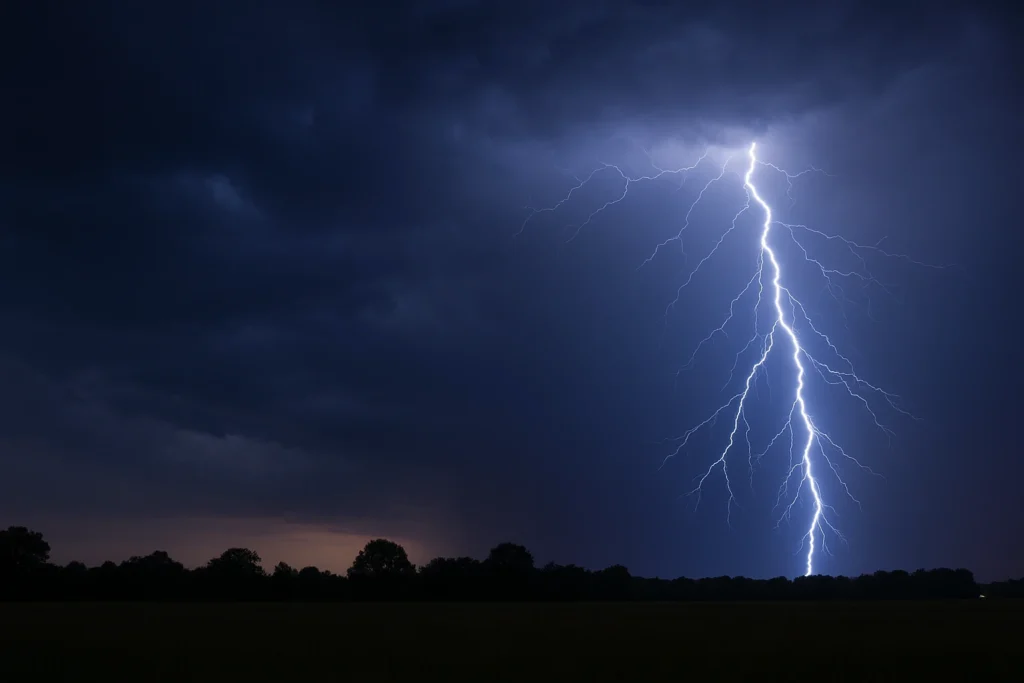

High above the clouds, a spectacular and powerful electrical world, once confined to pilots’ tales, is now being systematically mapped, revealing the complex, invisible shield that protects our planet and the startling power of the electrical environment we live in.
Imagine standing on the International Space Station (ISS) and witnessing a sight that utterly defies conventional meteorology. Below, a massive thunderstorm rages, but instead of the familiar down-to-Earth lightning, colossal, fleeting structures of light are erupting into the blackness of space. These are the Transient Luminous Events (TLEs)—red jellyfish-like sprites, towering blue gigantic jets, and immense, glowing rings called ELVES. For decades, reports from high-altitude pilots and orbital crew members describing these bizarre electrical phenomena were often met with scientific skepticism, relegated to the category of visual artifacts or optical illusions.
Today, the scientific world has embraced the reality of this hidden “zoo” of high-altitude electrical activity. A new generation of highly sensitive research instruments, deployed on the ISS and aboard dedicated satellite networks, are capturing these phenomena with unprecedented clarity, marking a revolution in our understanding of atmospheric and space physics. Simultaneously, a recent and massive solar superstorm delivered a crushing blow to Earth’s primary electrical defenses, providing scientists with invaluable, real-time data on the fundamental processes governing our planet’s vital relationship with the Sun. These discoveries are far from mere academic pursuits; they are critical to mitigating risks to our increasingly interdependent global technology, ensuring the stability of vital communication pathways, and guaranteeing the future safety of both conventional aviation and the burgeoning space travel industry.
The Grand Stage: Earth’s Electrified and Layered Atmosphere
To comprehend the spectacle of the upper atmosphere, one must first appreciate the stage itself. The sky is not a uniform void but a series of distinct layers, each with its own unique properties, culminating in a charged frontier where Earth’s environment meets the vacuum of space.
The Troposphere: The Engine of Life and Storms
This is our world. The troposphere, extending from the surface to about 10-15 kilometers high, is the densest layer of the atmosphere and the stage for all life and weather. Here, the sun’s energy, moisture from the oceans, and the planet’s topography combine to create the dynamic systems we experience daily. It is within this layer that the powerful engines of thunderstorms form. These storms are not isolated events; they are massive heat engines, converting the energy of latent vapor into violent updrafts, torrential rain, and the immense electrical charges that give birth to lightning. The energy contained within a single mature thunderstorm is staggering, often exceeding the yield of a nuclear bomb. It is from the tops of these powerful storms that the tendrils of the hidden zoo reach upward, connecting our world to the realms above.
The Stratosphere and Mesosphere: The Calm and the Cold
Above the weather lies the stratosphere, a more stable layer extending up to about 50 kilometers. This is the home of the ozone layer, a crucial shield that absorbs the sun’s harmful ultraviolet radiation. For aviation, the stratosphere represents smoother air, but during extreme thunderstorms, the cloud tops can punch into this stable layer, a phenomenon known as “overshooting tops,” directly injecting turbulence and energy. Beyond the stratosphere lies the mesosphere, a realm of profound cold and thin air, with temperatures plunging to -90°C (-130°F). This is the domain where meteors burn up, creating shooting stars, and it serves as the canvas for the most vivid displays of sprites.
The Ionosphere: The Sea of Plasma
Beginning around 60 kilometers and extending upwards for hundreds of kilometers is the ionosphere, the atmosphere’s final and most electrically active layer. This is not a neutral gas but a vast, fluctuating sea of plasma—the fourth state of matter.
The Physics of Plasma Creation
Plasma is an ionized gas, a superheated or energized soup of free-floating electrons and positively charged ions. In the ionosphere, this plasma is created continuously by the sun’s intense radiation. High-energy ultraviolet (UV) and X-ray photons smash into atoms of oxygen and nitrogen, ripping electrons away from their nuclei in a process called photoionization. The density of this plasma is not uniform; it forms distinct layers (D, E, and F) that wax and wane with the day-night cycle. At night, without the sun’s energy, electrons and ions slowly recombine, causing these layers to thin and disappear until dawn.
The Ionosphere’s Dual Role: Global Mirror and Agent of Chaos
This charged layer is indispensable to modern technology. It acts as a vast, natural mirror, reflecting high-frequency (HF) radio waves back to Earth, enabling long-distance communication beyond the horizon for everything from amateur radio to maritime shipping. However, this same reflective property makes it a source of technological chaos. The ionosphere is in constant flux, buffeted by solar winds and internal dynamics.
“At night, charged particles from the Sun caught by Earth’s magnetosphere rain down into the atmosphere,” explains one research spotlight. “The impacting particles rip electrons from atoms in the atmosphere, creating both beauty and chaos.” This “rain” of particles can create swirling irregularities and plasma bubbles that scatter radio signals, degrade the accuracy of Global Navigation Satellite Systems (GNSS) like GPS, and induce currents that can threaten satellite electronics. Predicting and navigating this inherent chaos is a primary challenge of space weather science.
A Cosmic Punch: The Gannon Superstorm and the Crushing of a Shield
In May 2024, the sun delivered a stark reminder of its power with the most potent geomagnetic storm in over two decades: the Gannon storm. Triggered by multiple, massive Coronal Mass Ejections (CMEs)—billion-ton clouds of solar plasma and magnetic field launched from a hyperactive sunspot region—this event was more than a beautiful light show; it was a high-stakes stress test of our planet’s electrical defenses.
Earth’s Plasmasphere: The Inner Fortress
The first line of defense against a solar assault is not the atmosphere itself, but a region of space called the plasmasphere. This is a vast, donut-shaped region of relatively cool, dense plasma that co-rotates with Earth, held in place by our planet’s magnetic field. Think of it as a protective plasma shield, a buffer zone that surrounds our world and helps absorb and deflect the initial onslaught of the solar wind.
As the Gannon storm struck, a team led by Dr. Atsuki Shinbori of Nagoya University in Japan was monitoring the situation using the specialized Arase satellite. What they observed was dramatic. The immense pressure from the solar storm violently compressed the plasmasphere, crushing its outer boundary, the plasmapause, from its normal position of about 44,000 kilometers from Earth inward to a mere 9,600 kilometers. This was a collapse of over 75%, leaving a vast swath of space, including the vital orbits of GPS and communication satellites, exposed and unprotected.
The Mystery of the Slow Recovery: The “Negative Storm”
The initial compression was startling, but the storm’s most critical lesson was in its aftermath. Typically, the plasmasphere begins to refill with plasma from the ionosphere within a day or two. After the Gannon storm, this recovery took more than four days. The reason was a profound and prolonged “ionospheric negative storm.”
This invisible phenomenon involves a complex chain of events:
- Atmospheric Heating: The storm’s energy violently heats the upper atmosphere, causing it to expand like a hot-air balloon.
- Composition Change: This expansion pushes heavier, molecular gases (like nitrogen and oxygen) upward, displacing the lighter, atomic oxygen that is more easily ionized to create plasma.
- Electron Scavenging: The heavier molecules cause free electrons to recombine with ions at a much faster rate, effectively “scavenging” them from the system.
The result was a dramatic drop in the ionosphere’s plasma density, cutting off the supply of material needed to replenish the plasmasphere. “This direct, measured link between a powerful negative ionospheric storm and the delayed recovery of our plasmasphere was a finding that immediately rewrites textbooks on space weather resilience,” Dr. Shinbori emphasized. This extended vulnerability window poses a significant threat to satellite infrastructure, highlighting a previously underestimated risk.
The Hunt for Nature’s Fireworks: Cataloging the Atmospheric Menagerie
While the sun assaults from above, our own planet generates spectacular electrical discharges from below. The massive thunderstorms of the troposphere act as powerful batteries, and Transient Luminous Events (TLEs) are the spectacular sparks that jump the gap to the ionosphere.
From Myth to Reality: The History of TLEs
The journey of TLEs from myth to accepted science is a story of technological perseverance. For years, pilots’ reports of “rocket-like” blue flares or “red sprites” were dismissed as fatigue-induced hallucinations. The tide turned definitively in 1989 when physicists at the University of Minnesota, while testing a low-light camera, accidentally captured the first unambiguous image of a sprite. This single piece of evidence cracked the door open, legitimizing the field and inspiring a dedicated global hunt.
The TLE Family Tree
Today, with observatories like the ASIM (Atmosphere-Space Interactions Monitor) on the ISS watching from above, scientists have cataloged a diverse menagerie of these elusive events.
- Sprites: The Red Jellyfish
- Appearance: Massive, reddish-orange structures resembling jellyfish or carrots, with long, dangling tendrils, stretching 50 km or more across.
- Mechanism: They are triggered by the most powerful lightning strikes—positive cloud-to-ground bolts. This type of lightning removes a huge pocket of positive charge from the top of the storm, creating a massive, upward-shooting electric field. The sprite is the visible breakdown of the thin mesospheric air in response to this field, with the tendrils following channels of varying air density.
- ELVES: The Fastest Rings in the Sky
- Appearance: Immense, expanding rings of faint light, up to 400 km across, that form and vanish in less than a millisecond.
- Mechanism: ELVES are not caused by direct electrical current but by the electromagnetic pulse (EMP) from an intensely powerful lightning strike. This pulse travels upward at light speed, and when it hits the base of the ionosphere, it pushes electrons aside, heating them briefly and causing the giant, instantaneous ring.
- Gigantic Jets: The Bridge to Space
- Appearance: Towering, narrow columns of brilliant blue light, the most powerful and direct couplers.
- Mechanism: When a thunderstorm’s electrical charge has no other path to discharge, it can punch directly upward. A gigantic jet forms a continuous, ionized channel from the cloud top (around 15 km) all the way to the ionosphere (about 100 km), effectively creating a lightning bolt that connects the storm to space itself.
- Blue Jets and Trolls: The Supporting Cast
- Blue Jets are cone-shaped fountains of blue light that shoot upward from cloud tops but are less powerful than gigantic jets and do not reach the ionosphere.
- Trolls (Transient Red Optical Luminous Lineaments) are the faint, red afterglows sometimes left behind by jets.
The following table provides a clear overview of this strange atmospheric menagerie:
| Phenomenon | What It Looks Like | Where It Occurs | Key Trigger | Duration |
|---|---|---|---|---|
| Sprites | Red jellyfish or carrots with dangling tendrils | Mesosphere (50-90 km high) | Positive cloud-to-ground lightning | 10-100 milliseconds |
| ELVES | A massive, faint, expanding ring of light | Lower Ionosphere (about 100 km high) | Electromagnetic Pulse (EMP) from lightning | Less than 1 millisecond |
| Gigantic Jets | A towering blue column bridging cloud to space | From cloud tops (15 km) to ionosphere (100 km) | Powerful electrical imbalance in thunderclouds | 100-200 milliseconds |
| Blue Jets | A cone-shaped fountain of blue light | Stratosphere (up to 40-50 km high) | Electrical breakdown at cloud tops | 200-300 milliseconds |
A Scientific Upheaval: Revised Physics and Global Missions
The study of our electrical environment is not just about discovering new things; it’s about correcting fundamental misunderstandings and launching ambitious, collaborative missions to fill the gaps in our knowledge.
The Great Reversal: Rethinking the Magnetosphere’s Engine
For decades, a foundational principle of magnetospheric physics was that the large-scale electric field driving plasma motion had a simple structure: positive on the dawn (morning) side and negative on the dusk (evening) side. This was a cornerstone of models predicting how energetic particles move and threaten satellites.
However, a team from Kyoto University, using high-resolution data from modern satellites and advanced supercomputer simulations, discovered this model was backwards. Their work revealed that the morning side of the magnetosphere carries a net negative charge, while the evening side is positive.
“The electric force and charge distribution are both results, not causes, of plasma motion,” explained Dr. Yusuke Ebihara, the corresponding author. This paradigm shift is akin to discovering a fundamental river on Earth flows uphill. It forces a complete re-evaluation of how energy and dangerous particles are injected into the space around Earth, with direct implications for protecting our vital satellite fleet.
The ELECTRI-FLY Project: A Global Assault on the Unknown
To tackle the multifaceted mysteries of atmospheric electricity—from lightning initiation to TLE formation—a major international collaboration is underway. The ELECTRI-FLY project, coordinated by the French aerospace lab ONERA, brings together the research power of the Netherlands (NLR), Canada (NRC), the United States (NASA), and Japan (JAXA).
This multi-year project employs heavily instrumented research aircraft as flying laboratories. These planes are equipped with next-generation sensors and are flown directly into and around the hearts of thunderstorms. Their mission is to map the three-dimensional electrical structure of storms in unprecedented detail, characterizing charge layers, electric fields, and the dynamics that lead to lightning and TLEs. The data gathered will feed into advanced models to improve severe weather forecasting, optimize flight paths for aviation safety and efficiency, and fundamentally deepen our understanding of how thunderstorms influence the entire global electrical circuit.
Protecting Our Technological World: The Real-World Imperative
The study of atmospheric plasma and space weather transcends academic curiosity; it is a critical discipline for risk management in our technologically dependent civilization. The consequences of ignoring this hidden electrical world are tangible and severe.
The Cascading Consequences of a Solar Storm
The intense solar activity of recent events, like the Gannon storm, provides a clear picture of the potential damage:
- Satellite Operations: Increased radiation and a compressed, heated upper atmosphere pose a dual threat. Energetic particles can cause Single Event Upsets (SEUs)—digital glitches that can corrupt satellite memory or even permanently damage electronics. Simultaneously, increased atmospheric drag at orbital altitudes forces satellites to expend precious fuel to maintain orbit, shortening their operational lifespans and creating collision risks from orbital decay.
- Communications and Navigation: A disturbed ionosphere acts like a broken mirror for radio waves. It can cause complete blackouts of HF radio, vital for transoceanic aviation, while also scattering and delaying GNSS signals. This degrades GPS accuracy from centimeters to meters, disrupting everything from precision agriculture and land surveying to the navigation systems of commercial aircraft and autonomous vehicles.
- Ground Infrastructure: The most dramatic threat is to our power grids. The violent fluctuations of Earth’s magnetic field during a geomagnetic storm can induce powerful Geomagnetically Induced Currents (GICs) in long-distance power lines. These DC currents can overload and saturate high-voltage transformers, causing them to overheat, vibrate violently, and in worst-case scenarios, burn out or explode, leading to widespread, prolonged blackouts. The 1989 Quebec blackout, which left millions without power for hours, stands as a historic example.
The Future: Toward a Resilient and Predictive Future
The path forward is one of integrated observation and advanced modeling. The future will see more dedicated satellites, perhaps even constellations of small “CubeSats,” providing multiple viewpoints of TLEs and solar storm impacts. Artificial intelligence is being deployed to sift through the immense datasets, identifying patterns and rare events that human analysts might miss.
The ultimate goal is a holistic “Sun-to-Mud” model—a comprehensive computer simulation that can accurately represent the entire chain of events, from an explosion on the sun, to the impact on Earth’s magnetosphere and ionosphere, down to the initiation of a lightning bolt and the sprite it triggers. This predictive capability is the key to building a resilient global infrastructure.
Conclusion: A New Respect for the Sky Above
The next time you see a thunderstorm on the horizon, take a moment to look up. Though your eyes may not perceive them, know that in the thin, cold air at the edge of space, a hidden zoo is putting on a silent, spectacular show. The red sprites, blue jets, and glowing elves are more than just atmospheric oddities; they are vivid reminders of the profound complexity and dynamism of our planet.
This exploration has humbled us, forcing rewrites of textbooks and revealing that the boundaries between Earth and space are fluid. The energy of our world’s weather and the fury of our star are locked in a continuous, intricate dance. We are no longer mere observers of this dance. With our powerful new tools and global collaborations, we are now learning the steps, striving to protect our technological society and safely navigate the future in the electrical frontier we call home.
This article is synthesized from recent scientific findings and reports from leading global research institutions and missions, including Nagoya University, Kyoto University, NASA, the European Space Agency’s ASIM, the Arase (ERG) mission, and the International Forum for Aviation Research (IFAR), reflecting the latest understanding in plasma and space weather physics.



Yo, bbjlslotslogin is my go-to spot for some quick slot action! Super easy to get logged in and start spinning. Definitely recommend checking it out for a fun time! bbjlslotslogin
Hey folks, Okiebet’s not bad at all. Simple and easy to use, which I appreciate. Here’s the link: okiebet
DJBajiLive has a great live casino! Feels like you’re actually there. Definitely worth checking if you’re into that kind of thing, get it here: djbajilive
Can you be more specific about the content of your article? After reading it, I still have some doubts. Hope you can help me.
Your point of view caught my eye and was very interesting. Thanks. I have a question for you.