
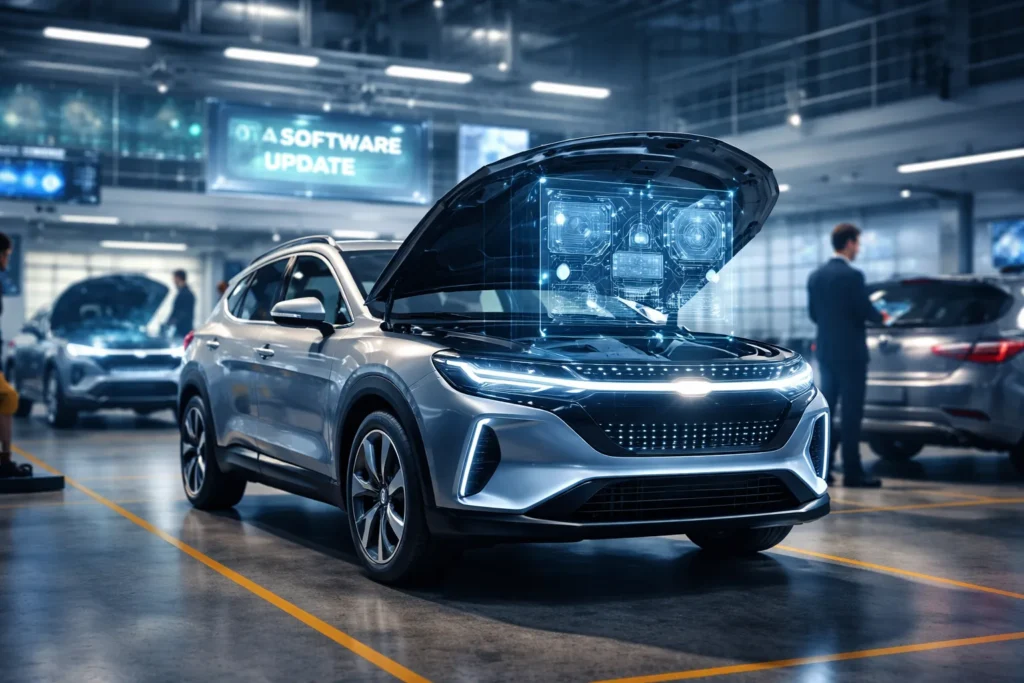

In 2025, a major automaker remotely diagnosed and patched a rare battery management anomaly in 47,000 electric vehicles across 12 countries between midnight and 6 AM—without a single owner visiting a service center. This silent, global repair represents the most profound automotive transformation since Karl Benz filed Patent-Motorwagen 37435 in 1886. Welcome to the age where vehicles don’t just run on software—they evolve through it.
Part I: The Dawn of Digital DNA—When Everything Changed
The Historical Inflection Point
The transformation began not with a bang, but with a software update. In October 2015, Tesla delivered “Version 7.0” of its vehicle software, introducing Autopilot features to existing Model S cars overnight. This single act shattered a 120-year automotive paradigm: that a vehicle’s capabilities were permanently frozen at the factory gate. Owners woke up to find their cars could now steer themselves on highways, automatically change lanes, and parallel park autonomously. The automotive industry experienced what physicists call a phase transition—a fundamental change in the nature of matter itself, from solid to liquid, from hardware-defined to software-defined.
This moment marked the beginning of what industry analysts now call “The Great Unfreezing.” For over a century, automobiles followed what engineers termed “the entropy curve”—a gradual but inevitable decline in capability and relevance from the moment of purchase. Each year brought newer models with better features, rendering existing vehicles comparatively obsolete. The relationship was fundamentally static: you owned a finished product whose destiny was gradual decay.
Today, that relationship has inverted. Modern vehicles now follow what Silicon Valley venture capitalists term “the ascension curve.” Through Over-the-Air (OTA) software updates, connected services, and artificial intelligence, vehicles can now gain capabilities, improve performance, and enhance safety throughout their lifespan. The car you buy today might be safer, faster, and more feature-rich five years from now—a concept that would have sounded like science fiction to every automotive engineer before 2015.
The Numbers Behind the Revolution
The scale of this transformation is visible in the codebase powering modern vehicles:
Table: The Exponential Growth of Automotive Software Complexity
| Year | Lines of Code per Vehicle | Number of ECUs | OTA-Capable Vehicles | Software Value % |
|---|---|---|---|---|
| 2010 | 10 million | 30-50 | 0.1% | 8% |
| 2015 | 50 million | 70-80 | 2% | 12% |
| 2020 | 100 million | 80-100 | 20% | 18% |
| 2025 | 200 million | 50-70 | 65% | 25% |
| 2030 | 500 million+ | 5-10 | 95% | 35% |
This exponential growth in software complexity represents what economists call “a paradigm shift in value creation.” Where traditional automotive value resided in mechanical engineering, metallurgy, and manufacturing prowess, tomorrow’s value creation centers on software architecture, data analytics, and user experience design. The implications ripple through every aspect of the industry.
Part II: The Technical Foundations—Rebuilding the Automobile from First Principles
Architectural Revolution: From Distributed to Domain-Centric
The mechanical automobile was a symphony of specialized components, each performing one function well. The modern vehicle must be an integrated system where components collaborate dynamically. This requires completely rethinking vehicle architecture.
The Legacy Challenge: The “Electronic Spaghetti” Problem
Traditional vehicles contain what engineers derisively call “electronic spaghetti”—a tangled web of 80-100 Electronic Control Units (ECUs) from dozens of suppliers, each running proprietary software on different operating systems with varying communication protocols. These systems evolved incrementally over decades:
- Standalone Systems: Early ECUs managed single functions (engine timing, anti-lock brakes) with minimal interaction
- Networked Systems: CAN bus networks allowed basic communication between systems
- Distributed Intelligence: Functions became more sophisticated but remained siloed
This architecture created fundamental limitations:
- Inflexibility: Adding new features required new hardware
- Complexity: Wiring harnesses grew to 5+ kilometers in length
- Security Vulnerabilities: Each ECU represented a potential attack surface
- Update Nightmares: Coordinating updates across dozens of independent systems proved nearly impossible
The New Paradigm: Centralized Intelligence
The software-defined vehicle adopts a fundamentally different approach organized around powerful domain controllers:
- Powertrain Domain: Manages propulsion systems, energy management, and thermal systems
- Chassis Domain: Controls braking, steering, suspension, and stability systems
- Autonomous Driving Domain: Processes sensor data and makes driving decisions
- Cockpit Domain: Manages infotainment, displays, and human-machine interface
- Body Domain: Controls lighting, doors, windows, and climate systems
Each domain runs on powerful, standardized hardware with a unified software stack. Communication between domains happens through high-speed Ethernet backbones rather than dozens of different networks. This consolidation enables unprecedented capabilities:
- Cross-Domain Optimization: The vehicle can coordinate acceleration, braking, and suspension tuning in real-time for optimal efficiency or performance
- Unified Security: Security can be implemented consistently across the entire system
- Simplified Updates: Software can be updated holistically rather than piecemeal
Case Study: Volkswagen’s “VW.OS” Transition
Volkswagen’s struggle to develop its unified vehicle operating system, initially through its Cariad division, illustrates both the promise and difficulty of this transition. The company discovered that moving from 70+ ECUs across multiple brands to a unified architecture required:
- Retraining thousands of mechanical engineers in software development methodologies
- Reorganizing supply chains around software-first development
- Managing cultural resistance from divisions accustomed to hardware autonomy
- Navigating regulatory hurdles for safety-critical software systems
Despite early setbacks costing billions in delays, Volkswagen’s persistence highlights the industry consensus: there is no alternative to this architectural transformation.
The Silicon Foundation: Chips as the New Horsepower
The hardware enabling this revolution comes from semiconductor companies rather than traditional automotive suppliers:
Table: Key Semiconductor Platforms for SDVs
| Company | Platform | Performance | Key Features | Adoption |
|---|---|---|---|---|
| NVIDIA | DRIVE Thor | 2000 TOPS | Consolidates cockpit and ADAS | Mercedes, Jaguar, Volvo |
| Qualcomm | Snapdragon Digital Chassis | Integrated cockpit, connectivity, ADAS | Scalable across segments | BMW, General Motors |
| Mobileye | EyeQ6 | 128 TOPS | Camera-first autonomous driving | Ford, Volkswagen |
| Tesla | Dojo | Training: 1.1 EFLOP | AI training supercomputer | Tesla only |
| AMD | Versal AI Edge | Adaptable compute | Flexible acceleration | Lucid, Honda |
These platforms represent computing power that rivals small data centers. NVIDIA’s DRIVE Thor, for example, can simultaneously run:
- A Linux-based infotainment system with multiple 4K displays
- A QNX-based functional safety system for vehicle control
- An AI compute cluster processing sensor data for autonomous driving
- Multiple virtual machines isolating different software functions
This consolidation enables what semiconductor engineers call “the data center on wheels”—a mobile computing platform that happens to provide transportation.
Part III: The Connectivity Ecosystem—The Vehicle as Network Node
Beyond the Vehicle: V2X Communication
The true potential of software-defined vehicles emerges not in isolation but in connection. Vehicle-to-Everything (V2X) communication enables cars to perceive beyond their physical sensors:
V2V (Vehicle-to-Vehicle): Cars sharing real-time data about:
- Speed and direction
- Braking status
- Road conditions (ice, oil, potholes)
- Traffic patterns
V2I (Vehicle-to-Infrastructure): Communication with:
- Smart traffic signals
- Digital signage
- Toll collection systems
- Parking structures
V2N (Vehicle-to-Network): Connection to:
- Manufacturer cloud services
- Traffic management centers
- Software update servers
- Entertainment/content providers
V2P (Vehicle-to-Pedestrian): Awareness of:
- Smartphone users at crosswalks
- Cyclists with connected devices
- Emergency responders
This interconnected mesh creates what networking engineers call “collective perception”—a shared awareness that dramatically exceeds any single vehicle’s capabilities. When one car detects black ice, hundreds following behind receive warnings before reaching the hazard. When emergency vehicles approach, traffic lights can automatically clear paths.
Cloud Integration: The Extended Vehicle
Modern vehicles maintain constant connections to manufacturer clouds through integrated telematics systems:
Data Collection & Analytics
- Vehicle health monitoring (thousands of parameters)
- Driving pattern analysis
- Feature usage statistics
- Environmental condition logging
Services Enabled
- Remote diagnostics and predictive maintenance
- Insurance telematics (usage-based pricing)
- Stolen vehicle tracking and immobilization
- Emergency call (eCall) and roadside assistance
Business Model Transformation
- Feature-on-demand subscriptions
- Pay-per-use services (performance upgrades)
- Data monetization (aggregated, anonymized)
- Fleet management services
The economic implications are staggering. McKinsey estimates that data-driven services could generate up to $750 billion annually across the automotive value chain by 2030. This represents an entirely new revenue stream that essentially monetizes the vehicle’s digital exhaust.
Cybersecurity: The Imperative of Trust
This hyper-connectivity creates unprecedented security challenges. Modern vehicles represent what security experts call “expanded attack surfaces” with multiple potential entry points:
- External Interfaces
- Cellular connections (4G/5G modems)
- Wi-Fi and Bluetooth
- USB ports and OBD-II connectors
- Tire pressure monitoring systems
- Key fobs and passive entry systems
- Internal Networks
- Ethernet backbones
- CAN buses
- LIN networks
- Diagnostic interfaces
- Cloud Connections
- Telematics servers
- Update distribution systems
- Remote control APIs
- Third-party service integrations
The automotive industry has responded with multi-layered security frameworks:
- Hardware Security Modules (HSMs): Dedicated cryptographic processors for secure key storage and encryption
- Intrusion Detection/Prevention Systems: Monitoring network traffic for anomalous patterns
- Secure Boot & Measured Boot: Ensuring only trusted software executes
- Over-the-Air Security Updates: Rapid response to newly discovered vulnerabilities
- Ethical Hacking Programs: Bug bounties and penetration testing
Regulatory frameworks like UN R155 (cybersecurity) and UN R156 (software updates) now mandate comprehensive security management systems throughout a vehicle’s lifecycle. Manufacturers must demonstrate:
- Systematic risk assessment methodologies
- Supply chain security management
- Incident response capabilities
- Secure update mechanisms
The result is what cybersecurity professionals term “security by design, not by addition”—a fundamental shift from bolting on security features to architecting secure systems from inception.
Part IV: The Human Experience—Redefining Mobility from the Inside Out
Interface Revolution: Beyond Screens and Buttons
The software-defined vehicle transforms how humans interact with transportation through several converging interface paradigms:
Natural Language Interfaces
Powered by large language models specifically trained for automotive contexts, next-generation voice systems understand:
- Complex multi-step requests (“Find me a charging station with available stalls that has a coffee shop nearby and will get me to 80% charge within 30 minutes”)
- Contextual awareness (“What did she just say?” referring to a podcast passenger)
- Emotional state detection and response (calming tone when detecting stress)
- Proactive assistance (“You usually call your wife at this time on your commute. Would you like me to connect?”)
Haptic & Gestural Interfaces
- Steering wheel sensors detect grip strength and micro-movements
- Gesture recognition allows control without touching surfaces
- Haptic feedback surfaces provide tactile confirmation
- Eye-tracking systems determine focus and attention
Adaptive Displays
- Configurable instrument clusters showing relevant information based on context
- Augmented reality windshields overlaying navigation and hazard information
- Passenger-specific displays offering individualized content
- Context-aware interfaces simplifying options based on situation
The Personalized Vehicle Experience
SDVs create deeply personalized experiences through continuous learning:
Table: Personalization Dimensions in SDVs
| Dimension | Traditional Vehicle | Software-Defined Vehicle |
|---|---|---|
| Performance | Fixed driving modes (Eco, Sport) | Continuously adaptive tuning based on road, weather, and driver state |
| Comfort | Manual seat/mirror adjustments | Biometric recognition auto-configures all systems to individual users |
| Entertainment | Preset radio stations | AI-curated content based on time of day, mood, and journey type |
| Navigation | Static route calculation | Dynamic routing incorporating real-time data, personal preferences, and vehicle state |
| Safety | One-size-fits-all systems | Adaptive assistance based on driver skill, fatigue, and conditions |
This personalization extends to what user experience designers call “the empathetic vehicle”—a car that understands not just what you’re doing, but how you’re feeling and what you need.
Case Study: Mercedes-Benz MBUX Hyperscreen
Mercedes’ MBUX Hyperscreen represents the current pinnacle of software-defined cockpit design. The 56-inch curved glass panel combines multiple displays into a seamless interface powered by artificial intelligence that:
- Learns user routines and anticipates needs
- Dynamically rearranges interface elements based on context
- Provides individualized content for each passenger
- Reduces complexity through predictive assistance
- Creates emotional connection through animated visuals and natural interactions
This system exemplifies the shift from “user-operated” to “user-anticipated” interfaces—the vehicle proactively offers what you need before you ask.
The Third Space: Vehicle as Versatile Environment
As vehicles gain autonomous capabilities, their interiors transform into multi-functional spaces:
Mobile Office
- Rotating seats for face-to-face meetings
- High-bandwidth connectivity for video conferencing
- Integrated productivity software suites
- Noise-canceling zones for focused work
- Wireless device charging and synchronization
Entertainment Hub
- Surround sound audio with individualized zones
- Immersive displays for gaming and movies
- Haptic feedback systems in seats
- Content tailored to journey length and passenger preferences
- Social gaming connecting multiple vehicles
Wellness Sanctuary
- Climate systems simulating natural environments (forest, ocean)
- Advanced air filtration with aromatherapy integration
- Therapeutic lighting following circadian rhythms
- Posture-correcting seats with massage functions
- Meditation and mindfulness guidance
Family Lounge
- Child monitoring systems with entertainment/education
- Inter-vehicle communication for convoy trips
- Shared media experiences across passenger devices
- Journey logging and memory creation features
This transformation turns travel time from “wasted time” into “reclaimed time”—productive, restorative, or connective time that adds value beyond transportation.
Part V: The Economic Transformation—New Business Models and Value Chains
Revenue Model Evolution
The software-defined vehicle enables multiple new revenue streams throughout the vehicle lifecycle:
Table: Software-Enabled Automotive Revenue Streams
| Revenue Type | Description | Examples | 2030 Projection |
|---|---|---|---|
| Vehicle Sales | Traditional purchase/lease | Base vehicle price | $2.8 trillion |
| Post-Sale Features | One-time feature activation | Acceleration boost, enhanced autonomy | $80 billion |
| Subscriptions | Recurring feature access | Autonomous driving, premium connectivity | $60 billion |
| Mobility Services | Pay-per-use transportation | Robotaxi, car-sharing integration | $160 billion |
| Data Services | Aggregated data products | Traffic patterns, road condition data | $30 billion |
| Energy Services | Vehicle-to-grid services | Grid balancing, energy trading | $25 billion |
| Marketplace Commission | Third-party service facilitation | Insurance, parking, charging | $15 billion |
| Advertising | Targeted in-vehicle ads | Location-based offers, sponsored content | $10 billion |
Total Software-Enabled Revenue | | | $380 billion
This represents a fundamental shift from transactional economics (sell once, maintain minimally) to relational economics (continuous engagement, recurring revenue).
The Subscription Controversy
The move toward subscription features has generated significant consumer backlash but reflects deeper economic realities:
Manufacturer Perspective
- R&D Recovery: Developing advanced software features requires massive ongoing investment
- Continuous Improvement: Subscriptions fund continuous enhancement rather than one-time development
- Accessibility: Lower upfront costs with pay-as-you-use options
- Flexibility: Users can add/remove features as needs change
Consumer Concerns
- Perceived “Double Dipping”: Paying for hardware capabilities that are software-locked
- Ownership Erosion: Feeling of renting rather than owning capabilities
- Complexity: Multiple subscriptions creating “death by a thousand fees”
- Long-Term Costs: Potentially paying more over vehicle lifetime
Emerging Compromises
- Tiered Ownership: Lower tiers with basic features, higher tiers with advanced capabilities
- Usage-Based Pricing: Pay-per-mile or pay-per-use for expensive features
- Time-Limited Trials: Extended test periods before subscription commitment
- Lifetime Options: One-time payments for permanent feature access
The resolution of this tension will shape consumer adoption of software-defined vehicles. Successful manufacturers will balance profitability with perceived fairness.
Supply Chain Reconfiguration
The SDV revolution is fundamentally restructuring automotive supply chains:
Traditional Tiered Supply Chain
- OEMs (Original Equipment Manufacturers): Final vehicle assembly and branding
- Tier 1 Suppliers: Complete systems (seats, infotainment, braking systems)
- Tier 2 Suppliers: Components (sensors, displays, ECUs)
- Tier 3 Suppliers: Raw materials and basic parts
Emerging Ecosystem Model
- Silicon Partners: Semiconductor companies providing computing platforms
- Software Platform Providers: Operating systems and development frameworks
- Cloud Infrastructure Providers: Cloud computing and data services
- Application Developers: Feature and service creators
- Content Providers: Entertainment, navigation, information services
- Service Providers: Insurance, maintenance, energy, connectivity
This shift reduces the dominance of traditional Tier 1 suppliers while elevating technology companies to central roles. It also creates new opportunities for software startups and service providers.
Case Study: Tesla’s Vertical Integration
Tesla’s approach represents the most radical supply chain reconfiguration:
- In-house semiconductor design (FSD chip, Dojo training chip)
- Own software stack development (vehicle OS, mobile app, cloud services)
- Direct sales and service model (bypassing dealership networks)
- Vertical battery integration (cell design through pack assembly)
- Proprietary charging network (Supercharger ecosystem)
This vertical integration enables unprecedented speed of innovation but requires massive capital investment and operational complexity. Most traditional manufacturers are adopting hybrid approaches, maintaining some supplier relationships while bringing critical software capabilities in-house.
The New Competitive Landscape
The SDV revolution has blurred industry boundaries, creating competition from unexpected directions:
Technology Companies
- Apple: Persistent rumors of “Project Titan” vehicle development
- Google: Android Automotive OS and autonomous driving technology
- Sony: Partnership with Honda for software-focused vehicles
- Foxconn: Contract vehicle manufacturing for multiple brands
- Baidu: Apollo autonomous driving platform and robotaxi services
Mobility Service Providers
- Uber: Autonomous delivery and robotaxi aspirations
- Didi: Electric vehicle development for ride-hailing optimization
- Zoox: Purpose-built autonomous vehicles for ride-hailing
Energy Companies
- BP/Shell: EV charging networks and energy management services
- NextEra: Renewable integration with vehicle-to-grid services
This convergence means traditional automakers must compete on multiple fronts simultaneously—against established rivals, technology giants, and disruptive startups.
Part VI: The Societal Implications—Beyond Transportation
Urban Planning and Infrastructure
Software-defined vehicles will reshape cities through several mechanisms:
Traffic Flow Optimization
- Network-Level Coordination: Vehicles communicating to optimize overall traffic flow
- Dynamic Lane Management: Virtual lane assignments based on real-time conditions
- Intersection Efficiency: Platooning and coordinated movement through intersections
- Parking Reduction: Autonomous drop-off/pick-up reducing parking demand
Infrastructure Adaptation
- Smart Charging Networks: Dynamic pricing and load management
- V2X-Enabled Infrastructure: Traffic signals, signage, and road sensors communicating with vehicles
- Curbside Management: Dynamic allocation for loading, parking, and mobility services
- Micromobility Integration: Seamless connections with bikes, scooters, and public transit
Land Use Transformation
- Reduced Parking Requirements: Converting parking structures to other uses
- Street Design Changes: Narrower lanes, more pedestrian space
- Distribution Hub Redesign: For autonomous delivery vehicles
- Mobility Hub Development: Integration points for multiple transport modes
Environmental Impact
SDVs, particularly when electric, offer significant environmental benefits:
Direct Emissions Reduction
- Electric Propulsion: Zero tailpipe emissions
- Efficiency Optimization: Software-managed energy use
- Regenerative Braking Enhancement: AI-predicted deceleration patterns
- Thermal Management Optimization: Reduced climate control energy use
Indirect Environmental Benefits
- Traffic Congestion Reduction: Smoother traffic flow reduces stop-and-go emissions
- Maintenance Optimization: Predictive maintenance reduces waste
- Energy Grid Integration: Vehicle-to-grid services enable renewable energy utilization
- Ride-Sharing Efficiency: Higher utilization rates through autonomous fleets
Lifecycle Considerations
- Battery Management: Software extending battery life and enabling second-life applications
- Recyclability Tracking: Digital twins recording materials for end-of-life recycling
- Remote Diagnostics: Reducing unnecessary part replacements
Accessibility and Equity
SDVs present both opportunities and challenges for transportation equity:
Accessibility Improvements
- Autonomous Mobility: Transportation for non-drivers (elderly, disabled)
- Affordable Mobility Services: Robotaxis reducing private vehicle ownership costs
- Rural Connectivity: Autonomous vehicles serving underserved areas
- Universal Design: Software customization for diverse abilities
Equity Challenges
- Digital Divide: Feature access limited by connectivity or affordability
- Data Privacy: Differential privacy protection based on socioeconomic factors
- Workforce Displacement: Impact on professional driving jobs
- Geographic Bias: Service concentration in profitable areas
Addressing these challenges requires proactive policy and inclusive design principles.
Regulatory Evolution
The SDV revolution is forcing regulatory frameworks to evolve:
Safety Regulation
- Functional Safety: ISO 26262 standards for risk reduction
- Expected Safety: New frameworks for AI-driven systems
- Cybersecurity: UN R155 and similar regulations
- Software Updates: UN R156 update management requirements
Data Governance
- Privacy Protection: GDPR-style regulations for vehicle data
- Data Localization: Requirements for where data is stored/processed
- Data Portability: Consumer rights to access and transfer their data
- Algorithmic Transparency: Requirements for explainable AI decisions
Market Regulation
- Interoperability Standards: Ensuring cross-brand compatibility
- Right to Repair: Access to tools and data for independent repair
- Competition Policy: Preventing ecosystem lock-in
- Liability Frameworks: Clarifying responsibility for software decisions
Regulators worldwide are struggling to keep pace with technological change while balancing innovation, safety, and consumer protection.
Part VII: The Future Trajectory—Where Code Takes Us Next
2025-2030: The Standardization Phase
The next five years will see the emergence of de facto standards:
Architectural Standards
- Domain Controller Designs: Converging on similar architectures
- Communication Protocols: Ethernet backbone standardization
- Software Frameworks: Common middleware and development tools
- Security Approaches: Industry-wide security practices
Business Model Convergence
- Feature Packaging: Similar subscription and purchase options across brands
- Data Sharing: Standards for anonymized data exchange
- Third-Party Integration: Common APIs for service providers
- Ownership Models: Hybrid ownership-subscription approaches
Ecosystem Development
- Charging Interoperability: Plug-and-charge across networks
- Insurance Integration: Standard telematics data for usage-based insurance
- Fleet Management: Common platforms for mixed fleets
- City Integration: Standard V2I protocols for municipal systems
2030-2035: The Autonomous Integration Phase
As autonomous capabilities mature, SDVs will transform transportation systems:
Mobility-as-a-Service Dominance
- Robotaxi Fleets: Widespread autonomous ride-hailing
- Subscription Mobility: All-inclusive transportation subscriptions
- Dynamic Routing: AI-optimized multi-modal journeys
- Purpose-Built Vehicles: Specialized autonomous vehicles for different use cases
Infrastructure Symbiosis
- Roadway Communication: Continuous vehicle-infrastructure data exchange
- Energy Grid Integration: Vehicles as distributed energy resources
- Logistics Reconfiguration: Autonomous delivery networks
- Urban Redesign: Cities optimized for autonomous mobility
Social Transformation
- Ownership Decline: Reduced private vehicle ownership in urban areas
- Space Reclamation: Parking land converted to other uses
- Time Reallocation: Commute time transformed into productive/leisure time
- Accessibility Revolution: Mobility access for previously excluded populations
2035-2040: The Sentient Ecosystem Phase
Looking further ahead, SDVs will become elements of intelligent urban ecosystems:
Collective Intelligence
- Swarm Optimization: Vehicles cooperating like flocking birds
- Predictive Ecosystems: Anticipating and responding to urban dynamics
- Self-Healing Systems: Automatic detection and resolution of system issues
- Evolutionary Algorithms: Continuous improvement through machine learning
Human-Machine Symbiosis
- Biometric Integration: Vehicles responding to physiological states
- Cognitive Assistance: AI co-pilots enhancing human capabilities
- Emotional Connection: Vehicles developing “personalities” aligned with owners
- Lifelong Companionship: Vehicles that adapt throughout human life stages
Sustainability Integration
- Circular Economy Participation: Vehicles as components in resource cycles
- Climate Adaptation: Vehicles responding to environmental changes
- Biodiversity Considerations: Routing and operation considering ecological impact
- Resource Optimization: Dynamic efficiency across entire systems
Part VIII: Navigating the Transition—Challenges and Strategies
Technical Challenges
Legacy Integration
- Brownfield Compatibility: Integrating new systems with legacy vehicles
- Data Migration: Transferring vehicle histories to new platforms
- Skill Transition: Retraining workforce for software-centric development
- Toolchain Evolution: Developing new development and testing tools
System Complexity Management
- Software Validation: Testing exponentially more code paths and scenarios
- Update Coordination: Managing updates across millions of vehicles
- Failure Mode Analysis: Understanding complex system interactions
- Performance Optimization: Balancing features with system resources
Security Assurance
- Supply Chain Security: Ensuring security across complex supply chains
- Long-Term Vulnerability Management: Supporting vehicles for 15+ years
- Incident Response: Coordinating responses across ecosystems
- Regulatory Compliance: Meeting evolving global requirements
Organizational Challenges
Cultural Transformation
- Silicon Valley Mindset: Adopting agile, iterative approaches
- Failure Tolerance: Accepting and learning from software failures
- Cross-Disciplinary Collaboration: Breaking down engineering silos
- Continuous Learning: Ongoing skill development at all levels
Talent Acquisition and Retention
- Competitive Compensation: Matching technology company salaries
- Meaningful Work: Providing challenging software projects
- Modern Work Environments: Adopting flexible, tech-forward workplaces
- Career Pathways: Creating progression in software roles
Partner Ecosystem Management
- Strategic Partnerships: Choosing and managing technology partners
- Open Innovation: Balancing proprietary development with open collaboration
- Startup Engagement: Working with innovative smaller companies
- Academic Collaboration: Partnering with research institutions
Strategic Imperatives for Success
Based on industry analysis and expert interviews, successful navigation of the SDV transition requires:
Software-First Mindset
- Leadership commitment to software as core competency
- Investment in software talent and tools
- Organizational structures supporting software development
- Metrics focused on software quality and velocity
Strategic Architecture Decisions
- Choosing the right level of vertical integration
- Selecting technology partners and platforms
- Defining software/hardware boundaries
- Planning for evolution and upgradability
Ecosystem Positioning
- Identifying unique value propositions in evolving value chains
- Building defensible moats through data, network effects, or integration
- Creating compelling developer platforms
- Establishing standards leadership where possible
Customer-Centric Approach
- Balancing innovation with usability
- Transparent communication about data and subscriptions
- Designing for inclusivity and accessibility
- Building trust through security and privacy
Conclusion: The Road Ahead
The software-defined vehicle represents more than a technological evolution—it is a fundamental reimagining of personal mobility that touches every aspect of society. From how we build vehicles to how we move through cities, from economic models to environmental impact, the implications are profound and far-reaching.
The companies that thrive in this new era will be those that understand they are no longer just manufacturing physical products but orchestrating digital experiences, managing data ecosystems, and building ongoing relationships. They will balance technological capability with human needs, innovation with responsibility, and competition with collaboration.
For consumers, the promise is extraordinary: safer, more efficient, more personalized, and more accessible mobility. The challenges are equally significant: navigating new business models, protecting privacy, and ensuring equitable access.
As the lines between transportation and technology dissolve, one certainty remains: the journey has just begun. The vehicle of the future will be defined not by its cylinders or horsepower, but by its code, its connectivity, and its capacity to improve—not just our travel, but our lives. The road ahead is being written in software, and we are all part of its unfolding story.



**back biome official**
Mitolyn is a carefully developed, plant-based formula created to help support metabolic efficiency and encourage healthy, lasting weight management.