
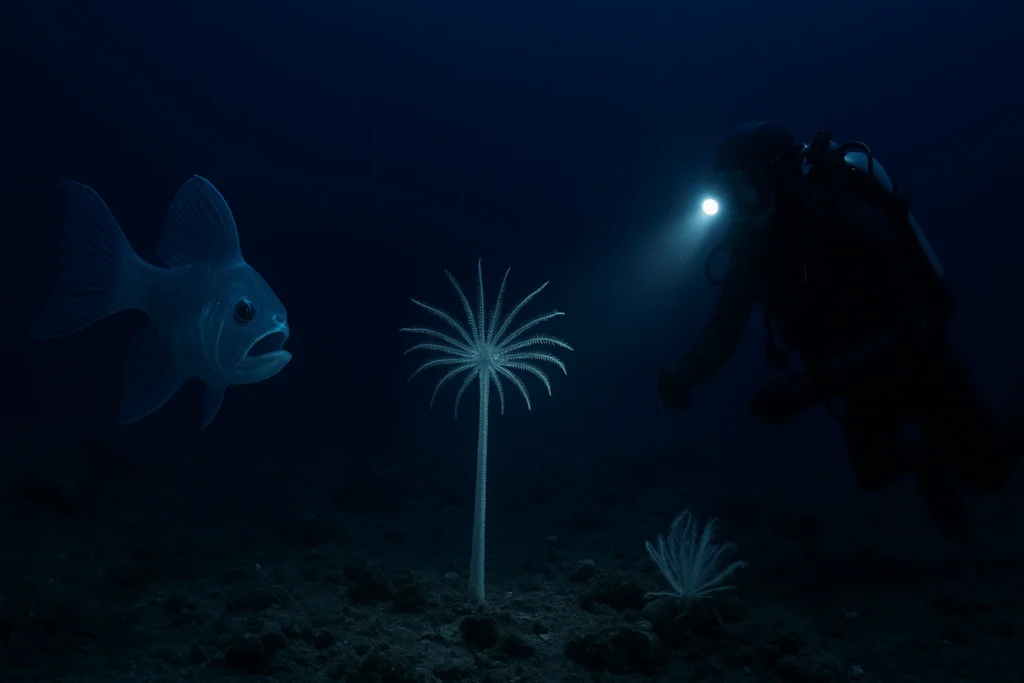

The sky at dawn was a watercolor wash of rose and gold, but for the scientists crowding the decks of the R/V Aethelstan, their gaze was fixed on the waters below—a profound, restless indigo that stretched to the curvature of the Earth. This vessel, a 200-meter titan of steel and science, was the nerve center for Project Nekton Ascendant, the most ambitious deep-sea biological survey ever mounted. Its mission transcended national interest, targeting the Clarion-Clipperton Zone and the Southwest Indian Ridge, areas of the global commons holding both unimaginable biological diversity and staggering mineral wealth. For the interdisciplinary crew of 180—a tapestry of molecular biologists, geochemists, robotics engineers, and even historians of science from 35 nations—this was a pilgrimage to the planet’s final terra incognita. What follows is not merely a catalog of discoveries, but an epic narrative of life’s tenacity in the face of absolute extremity, and the pivotal moment of choice their findings present to all of humanity.
The Cathedral of Science: Engineering a Presence in the Abyss
The sheer physics of the target environment demanded a technological leap. The abyssal plains lie between 4,000 and 6,000 meters deep, where pressures reach 1,100 atmospheres—a force that compresses water by nearly 5% and would crumple conventional submarines like tin cans. Temperatures are a stable, chilling 2° Celsius (35.6°F), and nutrient availability is a thousand times scarcer than in surface waters. To even observe this realm required tools of unparalleled sophistication.
The Aethelstan was not a ship; it was a logistics platform for deep-space exploration on Earth. Its aft deck housed two launch bays. The starboard bay held “Cartographer” AUVs—torpedo-like drones that executed silent, pre-programmed missions, mapping the seafloor with multibeam echosounders and sub-bottom profilers with a vertical resolution of five centimeters. The port bay was the domain of “Behemoth”, the project’s primary ROV. A marvel of hydraulics and optics, it weighed 12 tons in air and was tethered to the ship by 11 kilometers of electro-optical-mechanical cable containing fiber optics for data and power lines conducting 10,000 volts. Its manipulator arms could apply the force to crush granite or the delicacy to pick up a single amphipod. Its sensor suite included a laser-induced breakdown spectrometer (LIBS) for instant geochemical analysis and a hyperspectral imaging system that revealed biological pigments invisible to the human eye.
Each deployment was a four-hour symphony of coordination. The ROV team, working in a control room nicknamed “The Cathedral” for its wall of 40 monitors, performed final diagnostics. Pilots tested the haptic feedback systems on the manipulators, allowing them to “feel” objects grasped at depth. Engineers monitored the pressure-compensated hydraulic systems, where even a micron-sized leak could spell disaster. On the bridge, the dynamic positioning system fired its thrusters continuously, holding the 20,000-ton ship within a two-meter radius over the dive site against wind and current—a feat akin to balancing a skyscraper on a pinhead over a target miles below.
The Descent Through Time: Crossing the Oceanic Strata
The launch of Behemoth was a ritual of controlled violence. The A-frame crane swung it out over the heaving swells, and with a final check, it was released, vanishing into the foam. In The Cathedral, the main screen switched to the vehicle’s descent camera. The journey that followed was a vertical transect through evolutionary time and ecological adaptation.
The first 200 meters—the Epipelagic Zone—was a sun-drenched savanna. Phytoplankton blooms painted swirling greens, and tuna streaked past. This was the engine room of the conventional ocean, powered by photosynthesis. Crossing the thermocline at 200 meters, the world cooled and dimmed rapidly. Entering the Mesopelagic Zone (200-1000m), the blue faded to perpetual twilight. Here lived the architects of the largest daily migration on Earth: trillions of lanternfish, krill, and jellies that ascended at night to feed and descended by day to hide. Behemoth’s lights sparked explosions of bioluminescence—the living strobes of dinoflagellates and the complex lures of anglerfish—a private fireworks display in the void.
Passing 1,000 meters marked the entry into the Bathypelagic Zone, the true beginning of the abyss. Sunlight was now a memory. The temperature stabilized near freezing. The pressure mounted with every meter. For the next three hours, the vehicle fell through a seemingly empty column, the monotony broken only by the occasional “marine snow”—a slow, ceaseless blizzard of decaying organic matter from the world above. This was the primary nutrient source for the deep, a meager but constant rain that has fallen for eons. The silence in The Cathedral was profound, punctuated only by the hum of equipment and the occasional status report. It was a meditation on scale, a humbling reminder that the water column they were traversing represented the largest contiguous living space on the planet.
Oasis of Chemical Fire: The Hydrothermal Vent Metropolis of “Hephaestus’ Anvil”
The first major discovery zone was a hydrothermal field on the ultra-slow spreading Southwest Indian Ridge, which preliminary mapping had dubbed “Hephaestus’ Anvil”. As Behemoth settled onto the basaltic crust at 2,800 meters, the cameras revealed a landscape of surreal beauty and violence. Towering “black smoker” chimneys, some over 30 meters tall, belched superheated (up to 400°C), nanoparticle-laden fluid that precipitated into delicate, porous spires of chalcopyrite and sphalerite. The ambient water was 2°C; the vent fluid was hot enough to melt lead. The contrast created shimmering heat hazes, distorting the video feed.
Life here was not just present; it was riotous, fueled by chemosynthesis. The dominant macrofauna was a forest of “Gilt-Rooted Tubeworms” (Radicaster aureus). These were not worms in a true sense but colonies of animals in chitinous tubes. They had no mouth or gut. Instead, a specialized organ called a trophosome made up 70% of their body mass, packed with chemosynthetic bacteria. The worm’s spectacular red plume absorbed hydrogen sulfide and oxygen from the vent effluent, transporting it via a unique hemoglobin—that also carried sulfide, a poison to most hemoglobins—directly to the bacteria. In return, the bacteria fed the worm. Their root-like “holdfasts” were embedded deep in the sulfide rock, shimmering with a pyrite-like coating, hence their name.
Scuttling among the tubeworm bases were the “Anvil Crabs” (Regiope anchoralis). Their carapaces were thick with mineral deposits, camouflaging them perfectly. One oversized claw was not for combat, but for “plug-feeding.” The ROV captured high-resolution footage of a crab using the flat, spoon-like claw to stopper a small fissure emitting warm fluid. It would remain motionless for hours, likely allowing chemosynthetic symbionts on its carapace and claw to metabolize the chemicals, or perhaps to absorb dissolved organic matter directly—a form of microbial farming never before documented.
But the apex predator of the vents was a new species of “Scaleworm” (Polynoidae). Dubbed the “Vent Dragoon,” it was 25 centimeters long, covered in iridescent, overlapping scales that gleamed like oil on water. It was observed actively hunting, using heat-sensing pits along its head to locate the warm bodies of shrimp and smaller worms against the thermal gradient of the vent field. Its bite, captured in startling detail, injected a paralytic venom, allowing it to consume prey much larger than itself.
The Methane Seeps: Cold, Slow Fountains of Life
Twenty kilometers from the fiery vents, Behemoth explored a cold seep, where methane and hydrogen sulfide percolated slowly from buried organic deposits. The seafloor here was not rock, but a thick, living carpet of microbial mats—a consortium of bacteria and archaea forming a rubbery, white-and-orange biofilm that processed the gases. From this mat rose colonies of “Methane Scepter Clams” (Vesicomya sceptrum). Their stark white shells, up to 40 centimeters long, lay half-buried. Extending from their foot was a “rhizome”—a fleshy, branching root system that tunneled meters into the sediment, tapping into the seep’s chemical reservoirs to feed the symbiotic bacteria in their gills. These clams could live for over 200 years, their growth bands recording the seep’s chemical history like tree rings.
Sharing this seep was a creature that blurred taxonomic lines: the “Gelatinous Forager” (Myxoechinoderma lento). It resembled a translucent, pulsating bag, slowly oozing across the mat. Genetic analysis later confirmed it was a highly derived, skeleton-less sea star. It moved via peristaltic waves through its gelatinous body. Its feeding strategy was extracellular: it secreted potent enzymes onto the microbial mat, digesting the biofilm externally, and then absorbed the nutrient soup through its integrument. It was life stripped to its most efficient, pressure-resistant form.
The Abyssal Plain: A Desert of Supreme Adaptation
Leaving the chemical oases, Behemoth ascended onto the vast abyssal plain at 4,500 meters. This was the deep sea’s true face: an immense, flat, and hauntingly monotonous expanse of fine red clay sediment, stretching beyond the reach of the strongest lights. Food here was not just scarce; it was a statistical improbability. Organisms existed on a knife’s edge of energy balance, evolving breathtaking strategies for efficiency.
The “Abyssal Paddler” (Remipes abyssus) was a newly discovered holothurian (sea cucumber). Instead of inching along the sediment, it had modified five of its tube feet into long, flat “oars.” It used a slow, rhythmic rowing motion to glide centimeters above the bottom, preventing it from stirring up blinding sediment clouds. Its mouth was surrounded by a crown of feathery, ultrasensitive tentacles that individually tasted and captured each particle of marine snow, a process of selective feeding that maximized energy return.
Perhaps the plain’s most enigmatic resident was the “Crystal Tunicate” (Vitreus pellucidus). It was a solitary, transparent sphere 15 centimeters in diameter, anchored by a single, thin stalk. Its entire body—a gelatinous tunic—was crystal clear. Inside, its organs (a simple heart, gut, and pharyngeal basket) glowed with a soft, constant endogenous blue bioluminescence. The leading hypothesis was that this was the ultimate camouflage in a world of sinking particles. By being transparent and matching its internal light to the faint, down-welling background bioluminescence from above, it became virtually invisible to both upward-looking predators and downward-looking prey—a living Klein bottle of light and form.
The Seamount Citadel: An Island of Biodiversity in the Deep
Seamounts are the rainforests of the abyss. The project surveyed “Mount Aethelstan,” a dormant volcano rising 3,000 meters from the plain. Its hard substrate and enhanced currents supported a riot of filter-feeders. A new genus of “Spiral Gorgonian” (Helicogorgonia infinita) grew in a precise Fibonacci spiral, a space-saving architecture that maximized feeding surface in strong currents. But the predator here was a masterpiece of biomechanics: the “Sonic Pistol Shrimp” (Alpheus tonitru). Its modified claw possessed a “cavitation bubble” weapon. When snapped shut, it fired a jet of water at 100 km/h, creating a low-pressure bubble that immediately collapsed with a flash of light and a shockwave of 230 decibels, stunning or killing prey over a meter away. Behemoth’s hydrophones recorded the snap as a distinct “crack,” and high-speed cameras captured the imploding bubble’s lethal flash—a stunning example of harnessing physics for predation.
In a seamount crevice, the lights revealed a “Living Fossil”: a population of “Vampire Squid” (Vampyroteuthis infernalis), a relic from the Cretaceous period. Unlike its aggressive name, it is a detritivore, using two long, sticky filaments to capture marine snow. Its body is covered in photophores it can control to create complex disorienting displays. Finding it in the Indian Ocean expanded its known range dramatically and provided living tissue for studies of “neotenous evolution,” where an organism retains juvenile features into adulthood.
The Whale Fall: A Century-Long Banquet in Seven Acts
Sonar detected a large organic mass. Investigation revealed a “whale fall”—the skeleton of a sperm whale resting at 3,000 meters. A whale fall is a “pulse” ecosystem that goes through distinct, decades-long stages. This one was in the “sulfophilic stage,” where its lipid-rich bones supported specialized life. The bones themselves were riddled with “Bone-Eating Worms” (Osedax). The females, with their root-like “osmensia” digging into the bone, hosted symbiotic bacteria that digested collagen and lipids. The males were microscopic dwarfs living inside the female’s tube, a reproductive strategy ensuring fertilization in the vast emptiness.
But the new discovery was the “Osedax Gardener” (Copepoda osedacis). This tiny copepod did not eat the bone. Instead, it cultivated “gardens” of bacteria on the root tissues of the Osedax worms themselves, grazing on this secondary microbial growth. It was an ecosystem upon an ecosystem, a hyper-specialized niche within a niche, demonstrating the incredible layered complexity of deep-sea food webs.
The Symphony of the Deep: Acoustic and Chemical Landscapes
Beyond the visuals, Project Nekton Ascendant deployed acoustic recorders and in-situ mass spectrometers. The findings revolutionized understanding of deep-sea perception. The abyss is not silent. It is a cacophony of biological noise: the crackle of shrimp, the drumming of fish, the low-frequency moans of whales. The team identified over 50 new acoustic signatures, likely used for communication and navigation in the dark.
The water was also a soup of chemical signals. The mass spectrometers detected complex plumes of dimethyl sulfide (DMS), trimethylamine (TMA), and other infochemicals released by predation, death, and reproduction. Animals like the “Barbel-Nosed Grenadier” fish, with vestigial eyes and enormous olfactory bulbs, were likely navigating this “landscape of smell” with a sensitivity millions of times greater than a bloodhound.
The Biological Codex: Deciphering the Blueprint for Extreme Life
Every sample returned to the ship’s “Clean Labs”—positive-pressure environments to prevent contamination—was a biological Rosetta Stone.
The Pressure-Proofing Suite: While TMAO was known, the team discovered new families of “piezolytes”: small molecules like ectoine and hydroxyectoine that act as “chemical nano-shocks” within cells, protecting proteins and membranes from pressure-induced distortion. Different species had unique piezolyte cocktails, tailored to their specific depth.
The Longevity Gene Cluster: Genomic analysis of a 4,000-meter “Abyssal Sea Urchin”, estimated via radiocarbon dating to be over 400 years old, revealed remarkable adaptations. Its DNA repair mechanisms, particularly the “Nucleotide Excision Repair (NER)” pathway, were hyper-efficient. Telomerase activity was regulated not to promote endless division, but to meticulously maintain chromosomal ends. Its cells also showed a unique process called “autophagic precision,” recycling damaged components with near-perfect accuracy. These were not genes for immortality, but for perfect, sustained maintenance.
Bioluminescence as a Language: Spectral analysis of bioluminescent displays showed they were not simple glows. The “Crystal Tunicate” pulsed its internal light in a species-specific Morse code. The “Scaleworm” used rapid flashes along its flanks for complex mating displays. The deep sea, it was revealed, is a world of “light-language,” with dialects and syntax we are only beginning to decipher.
The Looming Industrial Shadow: The Machinery of Abyssal Extraction
The expedition’s triumph was shadowed by a stark geopolitical reality. The Clarion-Clipperton Zone is the prime target for deep-sea nodule mining. Behemoth’s cameras documented not just life, but the “nodule pavement”—dense fields of manganese nodules that are the ecosystem’s foundational substrate. The proposed mining technology is brutal: “Nodule Collectors”—300-ton, tracked vehicles that would scrape the top 15 cm of seafloor, sucking up nodules and biota. A “Riser System” would pump this slurry to a surface vessel, with processed wastewater discharged as a “mid-water plume.”
The expedition’s own plume-dispersion modeling, using dyes released by Behemoth, showed these sediment clouds could travel over 1,000 kilometers, blanketing and suffocating life far beyond the mining site. The direct mining track would be a sterile scar, but the plume impact is an “ecological stroke” affecting an entire ocean basin. For organisms with generation times of centuries, this is an extinction-level event in a single human season.
Dr. Elias Vance, the project’s chief scientist, summarized the dilemma in a ship-wide address: “We have spent these months translating the first illuminated page of an epic written in the genome. The author is four billion years of evolution. The plot is survival against all odds. The ink is living chemistry. And we now have confirmed that a consortium holds a license to pulp the entire library to extract the metallic flecks in the punctuation. The value is not in the flecks. The value is the story. And we are on the verge of burning the only copy.”
The Legal and Ethical Crossroads: A Global Moment of Reckoning
The findings of Project Nekton Ascendant landed at a historic inflection point in international law. The International Seabed Authority (ISA) was finalizing regulations that could permit commercial mining. Simultaneously, the UN High Seas Treaty (BBNJ Agreement) achieved its 60th ratification, entering into force in January 2026. This created a potent legal tension.
The expedition provided the scientific bedrock for action under the new treaty. Their data was used to formally propose the first “High Seas Marine Protected Area (MPA)” in the Clarion-Clipperton Zone, invoking the treaty’s provisions for “Area-Based Management Tools.” The case was built on “Ecological Vulnerability” and “Irreversibility of Harm.” They argued that nodule mining is not “harvesting”; it is “habitat obliteration.” The slow-growing sponges and corals on the nodules are not “bycatch”; they are the “primary residents.”
The ethical argument was equally powerful. The deep seafloor is the “common heritage of humankind,” a principle enshrined in international law. This, scientists and philosophers on the expedition argued, confers not a right to exploit, but a “duty of custodianship.” Do we, as a species, have the right to erase unique lineages that took tens of millions of years to evolve, for minerals that could be sourced through recycling and technological innovation? The deep sea forces us to confront “intergenerational ethics” on a geological scale.
A New Vision: From Extraction to Stewardship
The expedition concluded by proposing an alternative paradigm: “The Abyssal Stewardship Initiative.” This calls for:
- A Global Moratorium on commercial-scale deep-sea mining, leveraging the new High Seas Treaty.
- A Decade of Discovery—a globally funded, open-science campaign to map and catalog deep-sea biodiversity, modeled on the Human Genome Project.
- Investment in a Circular Economy to reduce primary mineral demand, and in “Deep-Sea Provenance” technology to trace and certify recycled metals.
- Development of Non-Invasive Research Technology, including more advanced AUVs, deep-sea genomic sequencers, and permanent seafloor observatories.
Epilogue: The Light We Carry Forward
The R/V Aethelstan returned to port, its hull a testament to salt and storm, its data servers a digital ark of the abyss. Project Nekton Ascendant had identified over 500 putative new species, mapped 150,000 square kilometers of seafloor in unprecedented detail, and rewritten textbooks on extremophile biology.
But its ultimate legacy is a shift in human perspective. The abyss is no longer a void. It is a “living continent” of breathtaking complexity, resilience, and fragility. Its inhabitants, from the pressure-proofed urchin to the light-speaking tunicate, are not monsters or oddities. They are emissaries from a parallel Earth that exists within our own, holding secrets to medicine, longevity, and the very limits of life.
The expedition’s lights did not just reveal new species; they illuminated a fundamental truth about our time. We are the first generation with the technology to destroy the deep sea, and the first generation with the knowledge to understand why we must not. The choice is no longer between development and preservation, but between short-term extraction and long-term wisdom. The dark, silent continent has spoken through the language of science. It has shown us its wonders and its vulnerability. Our response will define not only the future of the abyss, but the moral and ecological legacy of the human epoch. The greatest discovery was not in the depths of the ocean, but in the reflection it held up to us: we are the stewards of a living planet, all the way down.



**mitolyn reviews**
Mitolyn is a carefully developed, plant-based formula created to help support metabolic efficiency and encourage healthy, lasting weight management.
hp88top, heard some chatter about this one. Figured I’d check it out and see if it lives up to the hype. Hope it’s a winner!hp88top
Alright, Arizona folks! Casino Arizona, you say? Had a spin there recently. Solid selection of games, not gonna lie! Definitely worth checking out for some local gambling fun. casinoarizona
SP88, been hearing good things! Going to check it out and see if my luck changes. Fingers crossed! sp88