
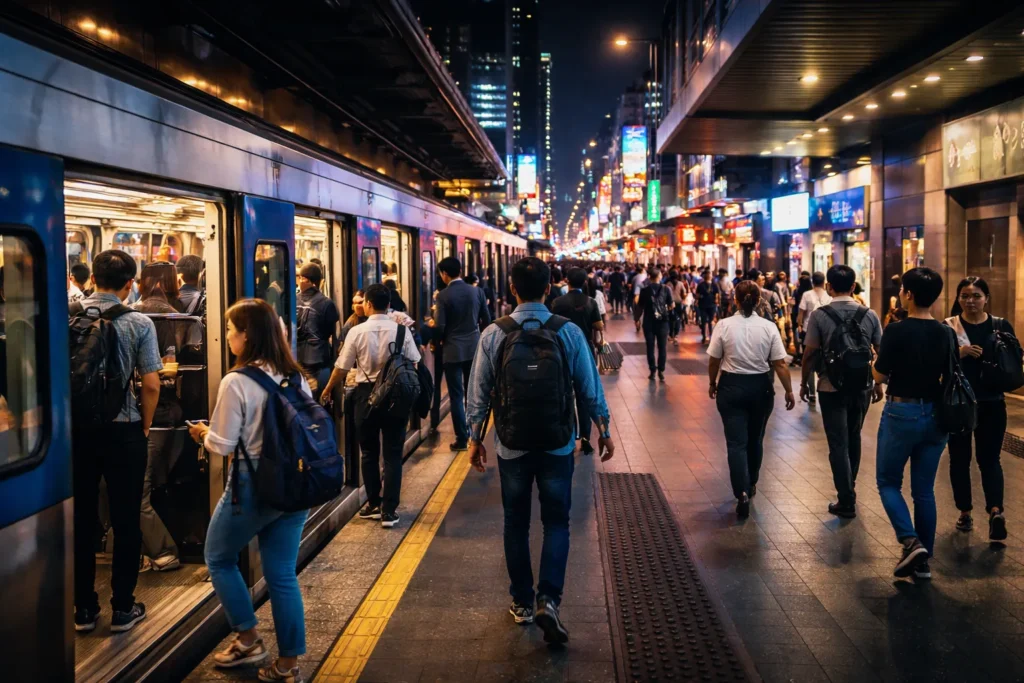

Prologue: The Great Awakening
At precisely 3:17 AM on a crisp Tuesday morning, a subtle but profound transformation unfolds across the world’s great metropolises. In London, a baker named Arjun boards a Night Tube train at King’s Cross, his apron still dusted with flour from the early morning bake. In Tokyo, medical resident Yuki settles into a sleeper bus seat with fully reclining capabilities, finally resting after a 14-hour hospital shift. In Mumbai, software architect Priya enters a brightly lit “Ladies Special” compartment, secure in the knowledge her journey home will be safe. And in Berlin, a group of hospitality workers laugh and chat on a Nachtbus, the orange interior lights casting a warm glow as they travel home after closing one of the city’s legendary nightspots.
These scenes, once rare exceptions in the urban experience, are becoming the new normal in cities worldwide. We are witnessing nothing less than a global mobility revolution—a fundamental reimagining of how cities function when the sun goes down. This transformation represents the most significant urban planning shift since the post-war automobile boom, challenging century-old assumptions about when cities “sleep” and who they serve.
The expansion of nighttime public transport is not merely a scheduling adjustment or marginal service increase. It is a complex, multi-layered response to profound socioeconomic shifts that have redrawn the temporal boundaries of urban life. From the deepest subway tunnels to the most innovative bus corridors, cities are building what urban theorists now call “temporal infrastructure“—systems that acknowledge the 24-hour reality of contemporary urban existence.
This comprehensive exploration delves beyond surface-level descriptions of new bus routes and extended subway hours. We will examine the economic imperatives driving this change, the diverse implementation models emerging across continents, the unexpected social and environmental benefits, the formidable challenges cities face, and the technological innovations shaping the future of urban mobility after dark.
Part I: The Economic Imperative – Understanding the Modern Nocturnal City
1.1 The Multidimensional Nighttime Economy
The traditional concept of “nightlife” as primarily entertainment-based has been completely overhauled. Today’s 24-hour urban economy comprises five interconnected layers that collectively demand continuous mobility solutions:
Layer 1: The Essential Services Backbone
Healthcare systems, emergency response networks, and critical infrastructure maintenance form the foundational layer of nighttime urban operations. In New York City alone, approximately 217,000 people work night shifts in hospitals, with thousands more in utilities, sanitation, and public safety. These workers cannot choose their hours based on transit availability—the city depends on their presence.
Layer 2: The Global Logistics Network
The rise of e-commerce, just-in-time manufacturing, and worldwide supply chains has created a parallel nocturnal workforce. Major logistics hubs like Chicago’s O’Hare International Airport or Rotterdam’s port facilities operate continuously. Amazon fulfillment centers worldwide have created what labor economists term “the midnight shift economy,” with transportation needs that begin when traditional transit ends.
Layer 3: The Hospitality and Cultural Ecosystem
Beyond traditional bars and clubs, cities have witnessed an explosion in late-night dining, theater performances extending past midnight, 24-hour fitness centers, and even nocturnal museum events. London’s “Lates” program at museums like the Science Museum and Natural History Museum regularly draw thousands of visitors for events ending after midnight, creating demand patterns that didn’t exist a decade ago.
Layer 4: The Knowledge Economy Expansion
Technology companies with international teams, research institutions running continuous experiments, financial firms monitoring global markets, and call centers serving multiple time zones have created a professional class working outside conventional hours. Silicon Valley companies have reported that 28% of their engineering teams regularly work nights to coordinate with Asian and European offices.
Layer 5: The Gig Economy Frontier
Food delivery drivers, rideshare operators, and task-based platform workers form the most fluid and transportation-dependent layer of the nighttime economy. Their mobility patterns are unpredictable and widely distributed, presenting unique challenges for traditional fixed-route transit systems.
According to a comprehensive 2024 Urban Economic Institute report, the nighttime economy in major global cities now contributes between 8-12% of total urban employment and approximately €1.3 trillion in economic activity across the European Union alone, with similar figures for North American and Asian metropolitan regions.
1.2 The Hidden Costs of Nocturnal Immobility
For decades, cities tolerated the economic inefficiency of nighttime transport gaps, but sophisticated economic analysis now reveals staggering hidden costs:
- Workforce Participation Barriers: A Transport for London longitudinal study tracked 5,000 night workers over three years and found that 47% cited poor transportation as a “significant or deciding factor” in considering leaving their jobs. Hospital administrators in multiple cities report particular challenges recruiting for night shifts without reliable transit, with some specialty positions remaining unfilled for months.
- The “Last Train Rush” Economic Drain: Before Berlin expanded its nighttime services, economic analysts estimated that the city’s entertainment and hospitality sectors lost approximately €68 million annually in potential revenue as patrons systematically left venues 45-60 minutes before the last train. This created artificial “dead zones” in the late evening economy.
- Informal Transportation Burden and Equity Impacts: In cities like Mumbai and São Paulo, the absence of formal nighttime options spawned extensive unregulated—and often unsafe—private transportation networks. Women workers disproportionately bore both financial and safety burdens, with surveys indicating they spent up to 35% of their income on private transportation to ensure security, compared to 22% for male night workers.
- Innovation and Talent Attraction Disadvantages: Urban economist Dr. Marcus Thiel’s research across 15 global cities found a 0.42 correlation coefficient between comprehensive nighttime transit and a city’s ability to attract and retain workers in creative and technology sectors. Cities perceived as “shutting down” at night were consistently ranked lower in quality-of-life surveys among younger professionals.
- The Spatial Mismatch Reinforcement: Traditional daytime-centric transit often fails to connect nighttime job centers with residential areas where workers live. In Los Angeles, a UCLA Institute of Transportation Studies report found that less than 18% of hospitality workers living in South LA could reach downtown restaurant jobs via public transit after 11 PM, forcing reliance on expensive rideshares or perilous multi-bus journeys.
Dr. Elena Rodriguez, Director of the Nocturnal Cities Research Initiative at the London School of Economics, summarizes: “We’ve transitioned from an industrial economy synchronized by factory whistles to a post-industrial, globally networked economy operating on multiple temporal layers simultaneously. A city’s transportation network must mirror this temporal complexity or risk becoming economically obsolete and socially exclusionary.”
Part II: Global Laboratories of Night Mobility – Detailed Case Studies
2.1 London: The Deep-Level Metro Revolution
London’s introduction of 24-hour weekend Tube service in August 2016 represented a watershed moment in urban transportation history. The decision followed nearly a decade of feasibility studies, pilot programs, and complex negotiations with multiple transport unions.
Implementation Strategy and Engineering Challenges:
- Phased Technological Rollout: The Night Tube launched first on the Central and Victoria lines—selected not only for projected demand but for their relatively modern signaling systems. The deeper, older lines like the Northern and Piccadilly required £80 million in infrastructure upgrades before they could safely operate continuously.
- Maintenance Window Reengineering: Engineers developed a revolutionary “predictive maintenance protocol” using sensor networks that monitor track wear, tunnel integrity, and electrical systems in real-time. This allows maintenance to be performed during low-demand periods (typically Tuesday-Thursday 1-5 AM) rather than requiring full nightly closures.
- Integrated Safety Ecosystem: Each Night Tube station maintains a minimum of three staff members throughout operating hours, supplemented by dedicated British Transport Police patrols on platforms and trains. Emergency “Help Point” intercoms provide direct voice communication to station control rooms.
Economic and Social Impact Analysis:
- Within three years, the Night Tube was facilitating approximately 9.2 million annual journeys, with post-pandemic recovery reaching 7.8 million by 2023. Crucially, 32% of these represented completely “new” trips that wouldn’t have occurred without the service, indicating generated economic activity.
- The hospitality sector along Night Tube corridors reported 18-24% increases in weekend revenue, with previously peripheral areas like Walthamstow and Brixton experiencing particularly dramatic transformations in their nighttime economies.
- Shift worker usage patterns defied initial projections. Nurses, cleaners, security personnel, and logistics workers comprised 41% of early morning riders (4-6 AM). Perhaps most tellingly, the average journey time for night workers decreased from 78 minutes (using night buses) to 31 minutes on the Night Tube.
- A University College London sociological study found that 68% of female Night Tube users reported “significantly increased feelings of safety” compared to previous nighttime travel options, citing the presence of staff and other passengers as key factors.
Pandemic Response and Adaptive Innovation:
The COVID-19 crisis initially devastated night ridership, with April 2020 seeing a 96% decline. London’s response created a new model for resilient nighttime transit:
- Dynamic Service Scaling: Instead of fixed all-night service, TfL implemented a “skeletal night network” with trains every 30 minutes that could rapidly scale to 10-minute frequencies as demand returned.
- Targeted Service Preservation: Analysis revealed that night workers in healthcare were the most consistent users during lockdowns. Services were specifically maintained on lines serving major hospital clusters like St. Thomas’ and Royal London.
- Health Security Investments: £12 million was allocated for enhanced air filtration systems and antimicrobial surfaces on night trains, addressing long-standing public concerns about transit hygiene that had been particularly acute for nighttime services.
2.2 Berlin: The Gold Standard of Integrated Temporal Mobility
Berlin approaches nighttime mobility not as a separate service but as an integral component of its “Stadtentwicklungskonzept 2030” (Urban Development Concept 2030). The city’s system, refined over three decades of incremental expansion, represents perhaps the world’s most comprehensive approach to 24-hour urban mobility.
The Berlin Model: A Symphony of Integrated Layers
- U-Bahn and S-Bahn Core Network: On Friday and Saturday nights, Berlin operates what transport engineers call a “pulsating core network.” Most subway and urban rail lines operate 24 hours with trains every 15-20 minutes on core segments, decreasing to every 30 minutes on peripheral sections after 3 AM.
- Metrotram Continuity: Selected tram lines in the former East Berlin operate continuously, leveraging the extensive tram infrastructure that survived division. These trams serve residential corridors with lower late-night density that wouldn’t justify subway operation.
- The NachtBus Network Revolution: Berlin’s 46 night bus lines (prefixed “N”) represent a transportation planning masterpiece. These aren’t merely daytime routes with extended hours—they’re specially designed radial routes connecting peripheral areas directly to central hubs like Alexanderplatz and Zoologischer Garten. Operating every 20 minutes until 3 AM and every 30 minutes thereafter, they maintain what planners term “temporal continuity“—no Berliner ever needs to wait more than 30 minutes for some form of transit at any hour.
- The Taxi Integration System: For journeys not covered by night transit, Berlin’s “NachtTaxis” program allows passengers to purchase discounted taxi vouchers at U-Bahn stations. More innovatively, the BVG app now integrates taxi hailing for the “last mile” of journeys, with the fare automatically calculated as a transit extension.
Cultural Integration and Identity Formation:
Berlin’s night transit has become deeply woven into the city’s cultural identity and creative economy:
- The famous “24-Stunden-Karte” (24-hour ticket), valid from midnight to 3 AM the following night, psychologically encourages nocturnal exploration and has become a symbol of Berlin’s temporal freedom.
- Special “KlubNacht” buses directly connect legendary venues like Berghain and Watergate to residential areas, with schedules synchronized to closing times. This has reduced rideshare congestion in club districts by an estimated 40%.
- The system supports Berlin’s status as a global magnet for creative professionals. In a 2023 survey of international artists and technologists living in Berlin, 71% cited the comprehensive night network as a “significant factor” in their decision to relocate, with many explicitly noting it enabled their non-traditional work patterns.
Engineering Behind the Continuity:
Maintaining such extensive 24-hour operation requires extraordinary engineering:
- Predictive Maintenance AI: Berlin’s system uses artificial intelligence that analyzes thousands of data points from trains, tracks, and electrical systems to predict failures before they occur. This allows maintenance to be performed during specific 2-hour windows on low-traffic nights rather than requiring line closures.
- Noise Mitigation Technology: Residents living above U-Bahn lines initially resisted 24-hour operation. Berlin responded with a €45 million investment in “whisper tracks” (specially cushioned rails) and noise-dampening tunnel linings that reduced perceived noise by up to 15 decibels.
- Energy Optimization Systems: Night operations use “green wave” signaling that coordinates train movements to minimize acceleration and braking, reducing energy consumption by approximately 22% compared to daytime operations.
2.3 Tokyo: Precision Engineering for the Nocturnal Megalopolis
Tokyo approaches nighttime transportation with characteristic precision and private-sector innovation, creating multiple overlapping systems that serve different demographics with remarkable efficiency.
The “Last Train” Culture and Its Evolution:
Tokyo’s infamous “shūden rasshu” (last train rush)—where thousands pour into stations before final departures—highlighted the system’s limitations and social costs. The response has been a tripartite approach:
- Futsuu (Regular Night Trains): Select JR and private subway lines now operate limited overnight “owl services,” particularly on the critical Yamanote Line loop. These run every 45-60 minutes between 1 AM and 5 AM, maintaining at least skeletal connectivity.
- Premium Night Bus Revolution: Private operators have developed what industry analysts call “mobile capsule hotels“—sleeper buses featuring fully reclining “shell seats,” individual entertainment systems, climate-controlled compartments, and even basic toilet facilities. Companies like Willer Express and JR Bus operate hundreds of these vehicles nightly, competing directly with traditional capsule hotels.
- The Taxi Ecosystem Integration: Tokyo’s extraordinary taxi network—approximately 38,000 licensed vehicles—functions as a crucial supplement. What’s innovative is the integration: many night buses terminate at major stations where taxi queues are systematically managed, and taxi dispatch apps show real-time public transit options alongside ride availability.
Technological Integration and Comfort Engineering:
Tokyo’s night mobility excels in seamless technological integration:
- Real-Time Predictive Systems: Digital displays at stops don’t just show scheduled times but use AI to predict actual arrival times based on traffic, passenger loading, and even driver patterns.
- Sleep Science Application: The premium sleeper buses incorporate research from sleep laboratories. Seats recline to exactly 172 degrees (determined optimal for transit sleep), use pressure-distributing memory foam, and emit subtle amber lighting that doesn’t suppress melatonin production.
- Integrated Hospitality Platforms: Most innovatively, some luxury night buses integrate with hotel booking platforms like Agoda. Passengers can reserve capsule hotel pods that become available precisely as their bus arrives, with digital keys transmitted to their phones during the journey.
Economic Model and Social Impact:
- Tokyo’s night buses have created an entirely new market segment, transporting approximately 4.8 million passengers annually on intercity night routes alone.
- The system has particular importance for women’s safety. Women-only sleeper bus sections (with additional privacy curtains and female-only seating areas) have seen 35% annual growth in ridership since introduction.
- From an environmental perspective, each full sleeper bus replaces an estimated 28 private vehicle journeys on intercity routes, reducing carbon emissions by approximately 11 metric tons per vehicle annually.
2.4 Mumbai: Gender-Responsive Mobility in the Megacity
Mumbai’s approach to nighttime transportation represents a focused, pragmatic response to the specific challenges of a rapidly growing megacity where gender safety concerns have historically limited nighttime mobility.
The Ladies Special Network Evolution:
- Women-only compartments on local trains have existed for decades, but their nighttime operation presented unique challenges. The Mumbai Metropolitan Region Development Authority (MMRDA) implemented a three-tier security system: (1) dedicated female security personnel in compartments after 9 PM, (2) improved “crime prevention through environmental design” lighting at stations where women primarily disembark, and (3) emergency communication systems directly linking compartments to station control rooms.
- “Ladies Special” buses now operate on 14 key corridors from 9 PM to 6 AM, with priority given to recruiting female drivers and conductors. These buses achieve remarkable 92% average occupancy rates during night hours, challenging conventional wisdom about women’s nighttime travel patterns and demand.
- Integrated Paratransit Solutions: Recognizing that traditional buses cannot reach many informal settlements, Mumbai has pioneered “community shuttle services” operated by women’s cooperatives. These minibuses connect residential clusters to major transit hubs, with schedules synchronized to hospital shift changes (typically 7 PM, 11 PM, and 7 AM handovers). The program has created 1,800 jobs for women as drivers, mechanics, and dispatchers while improving mobility for approximately 75,000 nightly passengers.
Safety Engineering and Social Outcomes:
- The Safetipin app, developed in collaboration with urban safety researchers, allows women to rate the safety of specific transit stops based on lighting, visibility, crowd presence, and gender diversity. This crowdsourced data directly informs infrastructure improvements.
- Outcomes have been measurable: Women’s participation in night-shift nursing positions at Mumbai hospitals has increased by 31% over five years, with hospital administrators explicitly citing improved transit as a recruitment factor.
- Perhaps most significantly, a 2023 survey found that 67% of women using night services reported increased “nocturnal autonomy”—the freedom to make independent decisions about evening employment, education, and social participation without transportation as a limiting factor.
2.5 New York: Reinventing the Legendary 24-Hour Subway
New York’s subway famously never stopped running, but its night “owl service” had become synonymous with infrequency, unpredictability, and discomfort. The MTA’s current $54 billion modernization program represents a fundamental reengineering of what 24-hour transit means in the 21st century.
From “Always Open” to “Always Reliable”:
- Strategic Night Closures for Accelerated Repair: In a historic break from tradition, New York now implements planned overnight closures through the FASTrack program. Entire segments of a line close for 5-7 consecutive nights, allowing crews to perform months’ worth of repairs in days. During closures, the MTA deploys “bus bridges” with 10-minute frequencies and real-time tracking.
- Night Bus Network Redesign: Twenty-two key bus routes now operate as “Night Owl Express” corridors with 10-15 minute frequencies all night. These routes feature dedicated bus lanes active 24/7, traffic signal priority, and specially designed “night shelters” with improved lighting, seating, and real-time information displays.
- Station Transformation Initiative: A core component involves reimagining stations as “24-hour public spaces.” The $7 billion station modernization program includes improved lighting (increasing brightness by 300% in some locations), public restrooms with attendants, and “Customer Service Centers” staffed throughout the night.
Data-Driven Service Design Revolution:
The MTA has embraced big data analytics to understand and serve nighttime mobility patterns:
- Anonymized Mobile Data Analysis: By partnering with data firms, the MTA analyzes billions of anonymized mobile device pings to understand actual—rather than projected—nocturnal movement patterns. This revealed unexpected travel corridors between Brooklyn and Queens that weren’t served by existing night services.
- Dynamic Event Response: The system now automatically adjusts night service after major events. After a Madison Square Garden event ends, the MTA’s control center can deploy additional buses to nearby subway stations within 8 minutes of detecting crowd dispersal patterns.
- Predictive Crowding Management: AI algorithms analyze ticketing data, event schedules, and even weather forecasts to predict station crowding at night, allowing for proactive deployment of staff and resources.
Table 1: Comparative Analysis of Global Night Transit Systems (2024 Data)
| City/System | Primary Night Model | Service Frequency (Peak Night Hours) | Annual Night Ridership | Fare Recovery Ratio | Gender-Specific Features | Key Technological Innovation |
|---|---|---|---|---|---|---|
| London Night Tube | Weekend 24-hr deep metro + integrated buses | Every 10-15 mins (Tube), 20 mins (bus) | 47.2 million journeys | 38% | Enhanced station staffing, help points | Predictive maintenance AI, dynamic scaling |
| Berlin Integrated Network | 24-hr metro weekends + comprehensive night buses | Every 15-20 mins (metro), 20 mins (bus) | 91.8 million journeys | 42% | Women-only bus sections on request | “Whisper track” noise reduction, green wave signals |
| Tokyo Premium System | Limited night trains + private sleeper buses | Every 45 mins (train), variable (buses) | 18.4 million (train), 4.8M (bus) | 67% (bus private) | Women-only sleeper sections | Sleep-optimized seating, hotel integration |
| Mumbai Gender-Focused | 24-hr local rail + women’s buses + community shuttles | Every 30-40 mins (train), 25 mins (bus) | 40.7 million journeys | 28% | Ladies Special buses, women’s compartments | Safetipin safety mapping, cooperative-run shuttles |
| New York Reinvented | 24-hr subway (with closures) + express night buses | Every 20-30 mins (subway), 10-15 mins (bus) | 209.5 million journeys | 51% | Increased station staffing, well-lit buses | FASTrack accelerated repair, mobile data analytics |
Part III: The Engineering and Operational Revolution
3.1 Network Design Principles for the Nocturnal City
Designing effective nighttime transportation requires fundamentally different principles than daytime systems, challenging century-old assumptions about urban mobility:
The Directness-Over-Coverage Principle
Night networks prioritize direct connections between major activity nodes rather than comprehensive coverage. London’s night buses famously run “express” routes that skip 60% of daytime stops, reducing journey times by an average of 35%. This recognizes that nighttime travelers prioritize speed and predictability over immediate proximity.
Temporal Layering and Demand Responsiveness
Successful systems distinguish between different “nights” with surgical precision:
- Monday-Thursday Nights: Focus on essential workers with routes connecting hospitals, logistics hubs, and residential areas. Frequencies typically every 30-45 minutes.
- Friday-Saturday Nights: Social and leisure focus with routes connecting entertainment districts, transit hubs, and residential areas. Frequencies every 15-20 minutes.
- Sunday Nights: Transitional schedule that begins with leisure frequencies and shifts to essential worker patterns after midnight.
The Safety-in-Numbers Engineering Approach
Rather than dispersing services thinly, successful systems concentrate them on well-lit “night corridors” where multiple routes overlap. Berlin’s Kurfürstendamm and London’s Oxford Street corridors maintain continuous pedestrian and vehicular activity between 10 PM and 6 AM, creating natural surveillance that reduces crime by an average of 27% compared to similar areas without concentrated night transit.
Intermodal Hub Design for Seamless Transitions
Night systems work best when they create frictionless connections between modes. Tokyo’s Shinjuku Station, Berlin’s Alexanderplatz, and London’s Trafalgar Square function as “nocturnal interchange ecosystems” where night buses, late trains, regulated taxi stands, and bicycle sharing converge with unified wayfinding, lighting, and security.
3.2 Technological Enablers of 24-Hour Mobility
Several technological innovations have transformed nighttime transit from a theoretical possibility to an operational reality:
Predictive Maintenance and Condition Monitoring
Using networks of sensors and machine learning algorithms, transit agencies can now predict equipment failures before they occur. London’s Tube uses 12,000 sensors that monitor everything from rail wear to electrical system performance. This allows maintenance to be performed during specific 3-hour nighttime windows rather than requiring line closures, increasing overall network availability by approximately 17%.
Dynamic Scheduling and AI Optimization
Cities like Singapore and Helsinki are implementing AI systems that adjust night bus frequencies in real time based on actual demand detected through smart fare card data, onboard sensors, and even weather patterns. Singapore’s “Night Adaptive Transit” system has reduced unnecessary night bus mileage by 22% while maintaining service quality.
Integrated Mobility Platforms and Payment Ecosystems
Helsinki’s “Whim” app represents the future of nighttime mobility integration. Users can plan and pay for combinations of night buses, trams, taxis, and even rental bicycles in a single transaction with guaranteed connections. The system’s algorithm automatically re-routes and re-books if any connection is missed, eliminating the anxiety of stranded nighttime travel.
Safety Technology and Passenger Assurance Systems
From London’s “Help Points” with direct video links to control rooms to Tokyo’s women-only rail cars with emergency communications systems, technology addresses unique nighttime safety concerns. Barcelona’s night buses feature “safe stop request” systems that allow passengers to ask drivers to stop between designated stops after 1 AM, reducing walking distance in poorly lit areas.
3.3 The Human Dimension: Labor Innovations and Social Considerations
Expanding night operations requires reimagining labor relations, workforce management, and community engagement:
Voluntary Night Teams with Enhanced Conditions
Berlin’s BVG found that traditional shift rotations for night work led to high turnover (43% annually). Their solution: create dedicated voluntary night teams with premium pay (155% of daytime rates), adjusted schedules (four 10-hour nights followed by six days off), comprehensive health monitoring including regular circadian rhythm assessments, and dedicated night worker facilities including sleeping pods for breaks.
Specialized Training for Nocturnal Operations
Night staff receive training radically different from daytime counterparts:
- De-escalation Techniques for Intoxicated Passengers: Using non-confrontational methods developed in collaboration with addiction specialists.
- Mental Health First Response: Training to recognize and appropriately respond to mental health crises, which data shows increase between 2-5 AM.
- Enhanced Security Protocols: Focused on situational awareness and coordinated response without unnecessary confrontation.
Community Ambassador and Hospitality Programs
Melbourne’s “Night Network Ambassadors” program deploys easily identifiable personnel (distinctive purple uniforms) to patrol night transit hubs. Their role is deliberately non-confrontational: providing directions, safety information, and a reassuring presence. The program has been so successful that reported harassment incidents decreased by 34% in its first year while passenger satisfaction increased by 41%.
Circadian-Friendly Scheduling for Operators
Recognizing the health impacts of night work, forward-thinking agencies are implementing “chronotype-adjusted scheduling.” Using simple questionnaires, they identify workers naturally inclined toward night wakefulness (approximately 20% of the population) and prioritize them for night assignments, reducing absenteeism and improving job satisfaction.
Part IV: The Transformative Impacts – Beyond Basic Mobility
4.1 Economic Revitalization and Urban Spatial Reorganization
The expansion of night transit catalyzes profound economic and spatial transformations that extend far beyond transportation metrics:
Commercial Corridor Development and Business Innovation
In cities with robust night transit, commercial activity begins to extend along night bus and train routes in unexpected ways:
- Toronto’s “Night Bus Corridors” have seen a 51% increase in late-night business permits along key routes since service expansion, with particularly strong growth in 24-hour pharmacies, late-night coworking spaces, and integrated laundry-café concepts.
- Lisbon’s night tram lines have sparked a revival of traditional neighborhoods like Alfama, where restaurants now offer “third dinner service” beginning at 1 AM, catering to hospitality workers ending shifts.
- Perhaps most innovatively, some Berlin neighborhoods along U-Bahn night lines have developed “night markets” specifically catering to shift workers, offering prepared meals, grocery staples, and pharmacy items from 10 PM to 6 AM.
Real Estate Valuation and Development Patterns
Properties within 500 meters of 24-hour transit stations command significant premiums:
- In Berlin, residential properties with all-night U-Bahn access command 9-14% higher rental values than comparable properties without such access.
- Commercial properties in London with Night Tube access saw rental value increases of 12-18% in the five years following service introduction.
- This has sparked new development models. In Melbourne, developers are now building “shift worker residential complexes” with soundproofing, blackout curtains, and 24-hour concierge services near night transit hubs.
Entertainment Geography Redistribution and Cultural Diffusion
Night transit redistributes cultural activity in powerful ways:
- London’s Night Tube has facilitated what urban sociologists call “nocturnal polycentrism.” Previously peripheral areas like Dalston and Peckham have developed vibrant nightlife scenes as they became more accessible, reducing pressure on traditional centers like Soho and Leicester Square.
- This diffusion has cultural implications. In Madrid, improved night buses to the traditionally working-class neighborhood of Vallecas have facilitated what locals call “crossover nights” where residents from different socioeconomic backgrounds interact in previously inaccessible neighborhood venues.
Small Business Adaptation and Innovation
Night transit enables small business innovation:
- Barcelona bakeries along night bus routes now offer “dawn bread” subscriptions for night workers, with fresh bread available from 4 AM.
- In Tokyo, convenience stores near night bus stops have developed “shift worker meal lines” with nutritionally balanced prepared foods for specific night shift types (hospital, logistics, hospitality).
- Perhaps most creatively, some Seoul cafes near night transit stops now offer “sleep-over cafes” where night workers can nap in soundproof pods before their morning commute home.
4.2 Social Equity and Inclusion Advancements
Perhaps the most profound impacts of expanded night transit are social, particularly regarding equity and inclusion:
Reducing Transportation Poverty and Economic Exclusion
- In Lisbon, the “Nocturnal Social Pass” provides unlimited night transit for low-income workers for €18 monthly (compared to €56 standard), reducing transportation costs as a percentage of income from 16% to 7% for night-shift workers.
- Barcelona’s night bus network has enabled what social workers term “shift stacking“—the ability for low-income workers to hold multiple part-time jobs at different times. Surveys indicate approximately 23% of night bus users are traveling between jobs.
- Perhaps most significantly, improved night transit has been linked to reduced eviction rates. A University of Toronto study found that neighborhoods with new night bus services saw 13% fewer evictions for rent arrears, as workers could accept better-paying night shifts without incurring prohibitive transportation costs.
Gender Equity and Safety Transformations
- Mumbai’s women-focused services have increased female participation in night-shift healthcare jobs by 31% over five years. Hospital administrators explicitly cite improved transit as a recruitment and retention tool.
- Berlin’s night transit has created what gender researchers call “nocturnal spatial justice.” Women’s nighttime mobility patterns now more closely resemble men’s, with similar trip purposes, distances, and frequencies after 10 PM—a dramatic change from a decade ago.
- Safety perceptions have transformed. In London, 68% of female Night Tube users report “significantly increased feelings of safety” compared to previous options. Crucially, this perception extends beyond transit itself to the surrounding areas, with women reporting greater comfort walking to and from stations at night.
Age Inclusivity and Intergenerational Mobility
Contrary to stereotypes, older citizens are significant beneficiaries of night transit:
- Berlin’s data shows 28% of night bus riders are over 60. Many are traveling to or from employment (retail, security, cleaning) or caring responsibilities (hospital visits, family care).
- Seoul has developed “silver night buses” with additional handrails, non-slip flooring, and priority seating that operate on routes connecting residential areas with 24-hour hospitals.
- Intergenerationally, night transit facilitates family connections. In cities with comprehensive night networks, grandparents report greater ability to provide childcare for working adult children with non-traditional schedules.
Disability Access and Universal Design Innovations
Night transit expansion has driven remarkable accessibility innovations:
- Tokyo’s night buses feature wheelchair securement systems that can be operated single-handedly, recognizing that many wheelchair users travel without assistance at night.
- London’s Night Tube stations now incorporate “audio navigation beacons” that interface with smartphone apps to guide visually impaired passengers through stations during low-traffic night hours.
- Barcelona’s night buses feature contrast-enhanced interiors and stop announcement systems specifically designed for passengers with cognitive disabilities.
4.3 Environmental Benefits and Sustainable Urbanism
Night transit supports broader sustainability goals in often unexpected ways:
Modal Shift from Private Vehicles and Rideshares
- After London introduced the Night Tube, taxi and rideshare pickups within 500 meters of Night Tube stations decreased by 17% on weekend nights, representing approximately 8,500 fewer vehicle journeys weekly.
- More significantly, the nature of remaining rideshare trips changed. Previously, rideshares provided complete journeys from origin to destination. Post-Night Tube, they increasingly provide “first/last mile” connections to transit, reducing average trip length by 2.3 miles.
- In Berlin, private vehicle ownership in neighborhoods with comprehensive night transit is 19% lower than in demographically similar neighborhoods without such service, suggesting night mobility influences broader transportation decisions.
Emission Reductions and Air Quality Improvements
- Consolidated night services with higher occupancy rates produce dramatically lower per-passenger emissions. Paris estimates its Noctilien night bus network prevents approximately 11,000 metric tons of CO2 emissions annually by replacing private car trips.
- Nocturnal air quality improvements are particularly valuable. With less atmospheric mixing at night, emissions reductions have disproportionate benefits. London estimates Night Tube-related emissions reductions improve nighttime air quality for approximately 300,000 residents living near previously congested night routes.
- Electric night bus fleets are becoming standard. Shenzhen now operates the world’s largest all-electric night bus fleet (1,200 vehicles), reducing particulate matter emissions by an estimated 3.2 tons annually compared to diesel equivalents.
Support for Compact Urban Form and Reduced Sprawl
By making peripheral neighborhoods accessible at all hours, night transit reduces pressure for 24-hour activity to concentrate exclusively in city centers:
- This supports more sustainable polycentric urban development. Copenhagen’s “night town centers” policy intentionally uses night transit to support commercial activity in suburban centers, reducing cross-city travel.
- Reduced “time-space compression” for shift workers means they can live further from employment centers while maintaining reasonable commute times. This increases housing options and can reduce housing cost pressures in central cities.
- Perhaps most innovatively, some cities are using night transit to support “15-minute city” principles at night. Bologna’s night transit network is designed so that 90% of residents can reach a 24-hour pharmacy, food outlet, and medical facility within 15 minutes at any hour using night transit.
Circular Economy and Resource Efficiency
Night transit enables innovative circular economy applications:
- Barcelona uses night buses to transport food surplus from restaurants to distribution centers, with specially designed compartments that maintain food safety.
- Tokyo’s night freight trams (running on passenger tracks after hours) transport retail goods from ports to city centers, reducing truck traffic during daytime hours.
- Lisbon’s night trams are used for “nocturnal street maintenance,” transporting cleaning crews and equipment, increasing efficiency by avoiding daytime traffic disruption.
Table 2: Environmental and Social Impact Metrics of Night Transit Expansion
| Impact Category | Measurement Metric | London (Pre/Post) | Berlin (With/Without) | Tokyo (Alternative Comparison) |
|---|---|---|---|---|
| Modal Shift | Private vehicle trips replaced nightly | 8,500 fewer rideshare trips/weekend | 19% lower car ownership in served areas | 28 private trips/bus on intercity routes |
| Emission Reduction | CO2 reduction (metric tons/year) | 9,200 (estimated) | 14,500 (estimated) | 11/bus annually on intercity routes |
| Social Equity | Low-income transport cost as % income | 14% → 9% (targeted passes) | Not measured | Not applicable |
| Gender Equity | Female night shift participation change | +22% in healthcare (5 years) | Night mobility patterns equalized | 35% annual growth in women’s services |
| Safety Perception | Women feeling “safe” or “very safe” | 43% → 68% | Not measured | 89% in women-only sections |
| Economic | Night business permits in corridors | +51% in 5 years | +38% commercial租金premium | Not measured |
| Spatial | Polycentric activity redistribution | Strong peripheral growth | Developed suburban night centers | Not measured |
Part V: Challenges, Trade-offs, and Future Horizons
5.1 Persistent Obstacles and Unresolved Tensions
Despite remarkable progress, significant challenges and trade-offs remain inherent to 24-hour transit:
Financial Sustainability and Funding Models
Night services typically recover only 25-45% of operating costs through fares, requiring ongoing subsidy. Cities are exploring innovative funding approaches:
- Cross-Subsidization Models: London uses a “temporal cross-subsidy” where daytime operations help fund night services as essential infrastructure, similar to how road networks are maintained regardless of hourly usage patterns.
- Value Capture Mechanisms: Hong Kong’s MTR Corporation funds night services through property development rights above stations, capturing increased land values created by 24-hour access.
- Business Improvement District Partnerships: New York’s Times Square Alliance contributes directly to enhanced night services in the theater district, recognizing their economic importance.
- Time-Differentiated Pricing: Singapore charges modest night premiums (10-20% above daytime fares) while maintaining discounts for low-income night workers.
Infrastructure Limitations and Upgrade Costs
Many systems weren’t designed for 24-hour operation, requiring massive upgrades:
- The deepest sections of London’s Tube lines require extensive cooling upgrades for continuous operation. The Victoria line upgrade cost £85 million for night service preparation alone.
- New York’s century-old signal system prevents the operational flexibility needed for efficient night service. The current replacement will cost approximately $20 billion and take until 2040 to complete.
- Maintenance access remains challenging. Berlin solves this with “maintenance windows” where short sections (2-3 stations) close sequentially on different nights, requiring sophisticated passenger information and alternative transport.
Community Resistance and the Noise Paradox
- Initial resistance to London’s Night Tube came primarily from residents above lines. TfL’s response included a £3.5 million noise insulation program for affected buildings and a commitment to “acoustic monitoring” with real-time adjustments if thresholds are exceeded.
- Barcelona addressed resistance through “Night Mobility Compacts“—formal agreements between transit agencies, venues, and residential communities that set clear expectations for noise, cleaning, and behavior, with a mediation process for disputes.
- The emergence of “night mayors” or “night czars” in over 40 cities worldwide provides dedicated mediation between night economy stakeholders and residents.
Labor Challenges and Workforce Sustainability
- Even with premium pay, night work has health impacts. Berlin’s BVG reports night workers take 38% more sick days than day workers despite being generally healthier when hired.
- Automation offers partial solutions. Singapore’s overnight freight movement uses automated light rail, while Paris is testing automated night shuttles on dedicated routes.
- The most promising approach may be “chronotype matching“—using genetic testing and questionnaires to identify individuals naturally inclined toward night wakefulness for night assignments.
5.2 The Pandemic’s Legacy and Adaptive Resilience
COVID-19 devastated night transit, with April 2020 seeing declines of 85-96% in night ridership across global cities. The recovery has been uneven but instructive:
Hybrid Work’s Unexpected Impacts
- The shift to hybrid work has created new nighttime patterns. With fewer daytime office interactions, midweek social trips have increased as people compensate for reduced workplace socialization. Wednesday night ridership in London is now at 112% of pre-pandemic levels despite overall lower commuting.
- Essential worker travel has remained consistent, but patterns have shifted. Hospital workers now travel more variably as shift patterns adapted to pandemic demands.
- Perhaps counterintuitively, night transit has proven more resilient than daytime in some cities. Berlin’s night network recovered to pre-pandemic levels by mid-2022, while daytime ridership remains at 87%.
Flexible Service Models and Dynamic Scaling
The pandemic accelerated adoption of flexible service models:
- Skeletal Networks with Scalability: Cities now maintain minimal “skeletal night networks” (e.g., 30-minute frequencies) that can rapidly scale to 10-minute frequencies when demand returns, using real-time crowding data as triggers.
- Predictive Demand Modeling: Advanced AI now predicts night demand based on numerous variables—weather, events, day of week, season, even social media sentiment analysis about nightlife.
- Microtransit Integration: During lowest demand periods (typically 2-4 AM Tuesday-Thursday), some cities replace fixed-route buses with on-demand microtransit in partnership with rideshare companies, maintaining connectivity at lower cost.
Health Security as Permanent Feature
Health security measures initially implemented during COVID-19 have become permanent features:
- Enhanced air filtration (HEPA or equivalent) is now standard on new night buses and trains in 72% of major cities surveyed.
- Antimicrobial surfaces using copper alloys or specialized coatings are increasingly common on high-touch surfaces.
- Perhaps most significantly, public acceptance of mask-wearing during respiratory virus seasons has created a new norm that may reduce sickness-related absenteeism among night workers.
5.3 The Future Horizon: Autonomous, Integrated, and Responsive Systems
Emerging technologies promise to reshape night transit fundamentally in the coming decade:
Autonomous Vehicle Integration
- Singapore is testing driverless night shuttles on fixed routes in less dense areas where human-operated services aren’t financially viable. The vehicles feature enhanced lighting and emergency communication systems.
- Helsinki’s “Robonight” pilot uses autonomous minibuses for first/last mile connections to night transit hubs, with remote human monitoring rather than onboard drivers.
- The most promising application may be autonomous freight consolidation. Stockholm is testing autonomous vehicles that collect e-commerce returns and other freight during night hours using transit corridors.
Artificial Intelligence and Predictive Systems
- Dynamic Routing Algorithms: Hamburg’s “NightRider” service features buses without fixed routes that adjust in real time to pick up passengers based on aggregated app requests, reducing average wait times by 73% during low-demand periods.
- Predictive Crowding and Safety Management: AI systems can now predict station crowding and potential safety issues by analyzing fare card data, social media posts from nearby venues, and even weather data. Barcelona’s system provides 15-30 minute advance warnings to station staff.
- Personalized Journey Planning: Future systems will offer personalized night journey planning that considers individual safety preferences, mobility needs, and even real-time energy levels (with permission to access health data).
Integrated Mobility-As-A-Service (MaaS) Platforms
- The future lies in seamless MaaS integration. Helsinki’s Whim app already allows planning and payment for night transit, taxis, rental cars, and bikes in one transaction with guaranteed connections.
- Next-generation systems will incorporate predictive rebooking. If you miss a connection, the system automatically re-routes and re-books the remainder of your journey.
- Subscription models for night mobility are emerging. For regular night workers, flat-rate monthly subscriptions provide unlimited night transit plus a specified number of taxi rides for first/last mile connections.
Energy and Sustainability Innovations
- Vehicle-to-Grid (V2G) Integration: Electric night buses in Copenhagen now serve as mobile energy storage, charging during off-peak nighttime hours and feeding power back to the grid during daytime peaks, creating revenue streams that offset operating costs.
- Renewable Energy Optimization: Las Vegas’s night transit system is powered by solar energy stored during daytime, with AI optimizing charging schedules based on weather predictions and service requirements.
- Circular Economy Integration: Night transit vehicles are increasingly used for multiple purposes.
Environmental and Sustainability Innovations in Night Transit
- Circular Economy Integration: Night transit vehicles are increasingly used for multiple purposes. Nocturnal services in several European cities now transport both passengers and time-sensitive cargo (like medical supplies or fresh produce) in specially designed compartments, maximizing vehicle utilization and reducing the need for separate freight trips.
Part VI: Global Lessons and Transferable Principles
6.1 Evidence-Based Best Practices: What Actually Works
Analysis of successful systems across diverse urban contexts reveals a core set of transferable principles, rather than one-size-fits-all solutions:
- Start with Mapping Real Demand, Not Theoretical Coverage: Successful night networks begin by identifying existing, often informal, nighttime travel patterns. London used anonymized rideshare data and surveys of hospital and hospitality workers to map desire lines before drawing its first Night Bus routes. This “demand-first” approach ensures initial services have immediate ridership.
- Design for Different ‘Species’ of Night: Distinguishing between the quiet, essential-worker-focused Tuesday night and the vibrant, socially-driven Saturday night is crucial. Berlin’s tiered schedule is the exemplar, but even simpler distinctions—like Toronto’s “Early Night” (7 PM-1 AM) and “Late Night” (1 AM-6 AM) service patterns—dramatically improve efficiency and relevance.
- Prioritize Clarity and Simplicity Over Complexity: At night, cognitive load is higher and information is harder to process. Tokyo’s color-coded night buses and London’s simple “Night Tube” branding succeed because they reduce anxiety. Complex, multi-option night maps fail. The rule is: one clear, legible network map for the night.
- Safety Through Inviting Design, Not Just Enforcement: Well-lit stops with clear sightlines, transparent shelter walls, and the presence of coffee vendors or small kiosks create natural surveillance and a sense of occupied space. Vienna’s “NachtMarkt” (Night Market) stalls at key tram stops have done more to improve safety perceptions than increased police patrols.
- Build Coalitions of the Nocturnal: The most resilient systems are planned not just by transit agencies but by “nocturnal coalitions” including hospital administrators, venue owners, logistics companies, and neighborhood associations. New York’s “Nighttime Economy Council” ensures night transit serves real economic and social needs from the outset.
6.2 The Essential Policy and Governance Framework
Cities that successfully expand and sustain night transit typically create supportive policy ecosystems that move beyond the transportation department:
- The “Night Mayor” or Night Czar Model: Originating in Amsterdam, this role involves an independent mediator who coordinates between nighttime businesses, residents, transport agencies, and police. The Night Mayor advocates for the nighttime economy as a whole, ensuring transit is integrated with licensing, policing, and urban design decisions. Over 50 cities worldwide have now adopted some version of this role.
- Holistic Nighttime City Strategies: Leading cities like Paris, London, and Sydney have moved beyond transit plans to create comprehensive “Nighttime City Strategies” or “24-Hour City Policies.” These documents coordinate transportation, land use (allowing mixed-use in areas with night transit), noise management, and economic development into a single vision.
- Data-Sharing and Joint Procurement Frameworks: Siloed data is the enemy of efficient night transit. Pioneering cities have established protocols for sharing anonymized data between transit agencies, rideshare companies, and major employers (like hospitals and stadiums). Some, like Los Angeles, are moving toward joint procurement of “mobility services” for defined geographic areas, allowing seamless integration of night buses, microtransit, and taxis.
Part VII: The Specialized Frontier: Campuses, Airports, and Special Districts
The principles of night mobility are being applied in specialized zones with intense 24-hour activity, offering microcosms of the broader urban challenge.
7.1 The 24-Hour Campus: Serving the Ultimate Night Owls
University campuses are dense “micro-cities” where libraries, labs, and student employment create constant movement. Solutions here are often more technologically aggressive and safety-focused:
- On-Demand, App-Based Night Services: Universities like the University of Michigan and University of Texas at Austin have replaced fixed-route night buses with on-demand shuttle services. Using an app, students request a pickup, and an algorithm pools riders and routes a vehicle, often a van or small bus. This ensures no student walks alone and vehicles are rarely empty.
- Technology-Enhanced Safety Escorts: Beyond tracking vehicles, apps like “SafeWalk” used at several campuses allow students to share their live location with campus security or a friend during a walk, with an emergency trigger if they stop moving or deviate from their route.
- Integrated “Night Life” Passes: Some universities bundle access to late-night campus dining, library access, and transit into a single pass, acknowledging and supporting the non-traditional schedules of student workers and researchers.
7.2 Airport Cities: Nocturnal Logistics and Workforce Mobility
Major international airports are 24-hour economic engines, yet they are often poorly connected by night transit. Innovative approaches are emerging:
- Dedicated “Shift Worker” Express Services: Amsterdam’s Schiphol Airport operates dedicated night bus lines that follow shift change times (10 PM, 2 AM, 6 AM) not to the city center, but directly to the suburban residential areas where airport staff actually live.
- Air-Rail Integration with Baggage: In Zurich and Hong Kong, the last airport trains of the night and first trains of the morning are scheduled to meet the latest and earliest flights, and are designed with extra luggage space.
- “Hotel in Transit” for Layovers: Some cities with long layover patterns, like Singapore, are exploring partnerships where a night bus ticket from the airport includes access to a shower and rest pod at a downtown transit hub.
7.3 Entertainment and Cultural Districts: Managing Peaks and Valleys
Districts with concentrated nightlife face unique “pulse” challenges—massive outflows when venues close, followed by near-total emptiness. Solutions are creative:
- Dynamic Curb Management and “Queue Bus” Services: In Berlin’s club district and London’s West End, special “NachtClub” buses wait on standby. When major venues close, transit supervisors dispatch these buses to absorb the immediate crowd surge, turning a chaotic, congested scramble into an orderly queue.
- “Nightlife Ambassadors” and Transit Information: Cities like San Francisco and Madrid deploy specially trained staff in entertainment districts to help revellers find the correct night bus or tram, manage queues, and provide general assistance, reducing confusion and conflict.
- Venue-Subsidized Transit Passes: In a novel partnership, some Amsterdam nightclubs include a discounted night tram voucher with entry after 1 AM, recognizing their shared interest in ensuring patrons can leave safely and efficiently.
Part VIII: The Future Horizon – Scenarios for 2040
Looking two decades ahead, night transit will likely be unrecognizable from today’s systems, shaped by three primary drivers: autonomy, virtualization, and climate adaptation.
Scenario 1: The Autonomous, Asynchronous Network
By 2040, most night transit could be provided by autonomous vehicles (AVs) of various sizes—from 4-person pods to 20-person minibuses. These would operate in dynamically formed “swarms,” clustering together on main corridors for efficiency and safety, then dispersing into neighborhoods based on real-time demand. There would be no fixed schedule; the network would constantly reshape itself like a murmuration of starlings around the city’s night owls.
Scenario 2: The Virtual-First, Physical-Second Model
For many, the “night transit” of 2040 might begin in virtual reality. Before leaving, you would enter a VR simulation of your walk to the stop, the wait, and the ride, identifying potential concerns. The system would then offer alternatives—a slightly longer route with better lighting, a pod with a human “virtual escort” on screen, or a guaranteed companion rider. The physical journey becomes an extension of a planned and vetted virtual experience.
Scenario 3: The Climate-Adaptive Nocturnal City
As climate change makes daytime travel increasingly unbearable in many regions, the night may become the preferred time for movement. Future “nocturnal transit corridors” could be covered, passively cooled, greenways. Night transit wouldn’t just be a social service but a primary climate adaptation strategy, with cities encouraging a societal shift toward nighttime activity through superior, comfortable, and lushly landscaped night mobility networks.
Epilogue: Redefining the Urban Rhythm
The global expansion of nighttime public transportation represents more than a schedule change—it signifies a fundamental renegotiation of the urban contract. The 20th-century city prioritized efficiency through standardization, creating systems that served majority daytime patterns while marginalizing those on different schedules. The 21st-century city is learning to embrace temporal diversity as essential to inclusivity, resilience, and vitality.
From the deep-level tunnels of London to the women-only compartments of Mumbai, from Berlin’s integrated pulses to Tokyo’s sleeper pods, cities are developing beautifully diverse solutions to a common human need: the freedom to move, connect, work, and live on one’s own temporal terms.
The night bus pulling up to a well-lit stop at 3 AM, the subway train gliding through the predawn darkness, the tram connecting a cleaner to her home—these are not mere transportation services. They are the circulatory system of the modern metropolis, carrying the lifeblood of the city’s essential soul—the workers, dreamers, carers, and creators who navigate the urban experience on their own clocks.
This transformation is knitting the urban fabric back together across the temporal divide. It is making cities more economically robust, more socially equitable, and fundamentally more human. The journey toward truly 24-hour mobility continues, with challenges in financing, technology, and community integration still ahead. But the direction is now unmistakable: forward, through the night.
As urbanist Jane Jacobs might have observed if she saw today’s nocturnal cities: “The ballet of the metropolitan sidewalk” no longer ceases at midnight. It simply changes music, with a different cast performing an equally vital routine under the stars. The cities that never sleep are finally building the stages—and the wings—for that continuous, vibrant, essential performance.



Greetings! Very useful advice within this post! It is the little changes that make the most significant changes. Thanks a lot for sharing!
I really like what you guys are up too. This type of clever work and exposure! Keep up the good works guys I’ve included you guys to our blogroll.
Hey! Someone in my Facebook group shared this website with us so I came to give it a look. I’m definitely loving the information. I’m bookmarking and will be tweeting this to my followers! Superb blog and wonderful design.
I really like it when people come together and share thoughts. Great site, continue the good work!
Way cool! Some extremely valid points! I appreciate you writing this write-up and the rest of the website is really good.
Whoa! This blog looks just like my old one! It’s on a entirely different topic but it has pretty much the same layout and design. Excellent choice of colors!
I am sure this paragraph has touched all the internet users, its really really pleasant piece of writing on building up new web site.
I visited various blogs except the audio quality for audio songs existing at this web page is in fact wonderful.
I am not sure where you’re getting your information, but good topic. I needs to spend some time learning much more or understanding more. Thanks for wonderful info I was looking for this info for my mission.
Ahaa, iits nic conversation about this piece of writing at tis pllace att this blog, I hace ead all that, so aat tuis time mee alswo commenting here.
Heya i’m for the primary time here. I came across this board and I in finding It really helpful & it helped me out much. I am hoping to give one thing again and help others like you aided me.
I’m not sure why but this website is loading incredibly slow for me. Is anyone else having this problem or is it a issue on my end? I’ll check back later and see if the problem still exists.
tzrwdyghcj dapoxetine generic drug side effects mgqsvkoeu
I just could not leave your website prior to suggesting that I extremely enjoyed the standard information an individual supply to your guests? Is gonna be back steadily to check up on new posts
Ahaa, its good dialogue on the topic of this article here at this weblog, I have read all that, so now me also commenting here.
I visited multiple web pages however the audio feature for audio songs existing at this site is really superb.
Đăng ký W88 via Linkvaow88 net? Hope it’s a super easy registration process. Ain’t nobody got time for complicated forms. đăng ký w88 linkvaow88 net
Keobovn, yeah? Let’s see if these odds are any good… Time to place some bets! keobovn
Hey guys, been using jljl333app lately and it’s pretty solid. Easy to navigate and haven’t had any issues so far. Definitely worth checking out! Find it here: jljl333app
I love what you guys are up too. This sort of clever work and reporting! Keep up the fantastic works guys I’ve added you guys to my blogroll.
Hello, i feel that i noticed you visited my blog so i got here to “return the prefer”.I am trying to to find issues to enhance my site!I guess its adequate to use some of your concepts!!
You made some really good points there. I checked on the web to find out more about the issue and found most individuals will go along with your views on this web site.
I am sure this piece of writing has touched all the internet people, its really really pleasant post on building up new blog.
I’ll right away take hold of your rss feed as I can’t to find your email subscription hyperlink or e-newsletter service. Do you’ve any? Please let me recognize so that I could subscribe. Thanks.
I really like it when people come together and share views. Great site, keep it up!
Way cool! Some very valid points! I appreciate you penning this article and also the rest of the site is also very good.
I am sure this post has touched all the internet viewers, its really really nice article on building up new weblog.
I am sure this piece of writing has touched all the internet users, its really really pleasant article on building up new blog.
I’ll right away seize your rss as I can not find your e-mail subscription link or newsletter service. Do you have any? Kindly allow me realize in order that I may subscribe. Thanks.
Way cool! Some very valid points! I appreciate you writing this post plus the rest of the website is extremely good.
There is definately a lot to find out about this issue. I love all of the points you’ve made.
Hello, I log on to your blog daily. Your humoristic style is awesome, keep up the good work!
напечатать флаг на заказ изготовление флага с логотипом в спб
Do you want to go to Montenegro? flights to Montenegro an Adriatic holiday with pristine beaches and beautiful cities. Resorts, excursions, and active recreation. An ideal destination for travel and seaside relaxation.
изготовить флаг на заказ флаг на заказ недорого
Хочешь оригинальную подушку? заказать подушку дакимакуру комфорт и уют для сна. Длинная форма, мягкий наполнитель и стильные принты. Отлично подходит для отдыха и расслабления.
Нужен пластический хирург? частная клиника пластической хирургии современные операции и эстетические процедуры. Опытные хирурги, безопасные методики и индивидуальный подход. Консультации, диагностика и качественный результат.
Нужна мебель? мебель из массива эксклюзивные изделия из натурального дерева. Индивидуальный дизайн, качественные материалы и точное изготовление. Решения для дома и бизнеса.
All live match results live-score game information and data from the leading football leagues on one site. Up-to-date scores, statistics, and events for easy tracking.
The site play mods contains information about downloading PlayMods, downloading PlayMods APK files, compatibility with iOS, Android, and PC, as well as basic information about GTA San Andreas and other modified games.
Live football qolvar com az broadcasts, daily game streams, football news, and the most popular live streaming sections.
Нужен ремонт электродвигателя? https://profremont.kz срочный ремонт и перемотка в Алматы от ПрофЭлектроРемонт-1: диагностика, восстановление и запуск в минимальные сроки, чтобы ваше производство не простаивало. Опытные мастера, гарантия результата и использование качественных материалов — надежность, которой можно доверять.
Today’s horoscope http://www.t.me/s/ulduz_fali/ daily forecasts and life surprises for all zodiac signs. Love, career, finances, and mood. Discover the future every day.
Мнения игроков 1win отзывы — реальные отзывы о платформе, бонусах и выводе средств. Узнайте о плюсах и минусах сервиса и сделайте правильный выбор.
Реальные 1win отзывы игроков — честные мнения о работе сервиса. Узнайте о ставках, бонусах, выводе средств и надежности платформы.
Честные 1win отзывы — плюсы и минусы сервиса, опыт пользователей и оценки. Информация о выплатах, бонусах и удобстве использования платформы.
Настоящие 1win отзывы — опыт пользователей, выплаты, бонусы и работа сервиса. Полезная информация перед началом использования платформы.
китай казино дракон казино
Актуальні новини https://lentalife.com поради та історії з усього світу. Дізнавайтеся про події, тренди й корисні лайфхаки, щоб залишатися в курсі та робити життя простішим і зручнішим щодня.
изготовление мебели под заказ мебель из массива дерева
Лучший выбор дня: https://sn74.ru
Женский портал https://lubimoy.com.ua статьи о красоте, здоровье, отношениях и саморазвитии. Полезные советы, лайфхаки и актуальные темы для женщин. Все для вдохновения и гармонии каждый день.
Удобный строительный https://anti-orange.com.ua портал с полезной информацией для частных застройщиков и профессионалов. Обзоры, инструкции, идеи для ремонта, каталог услуг и материалов. Поможем спланировать проект, подобрать решения и реализовать строительство без лишних затрат.
Мужской портал https://swiss-watches.com.ua о стиле жизни, здоровье, финансах и саморазвитии. Полезные статьи, советы экспертов, идеи для карьеры и отдыха. Всё, что важно современному мужчине для уверенности, успеха и баланса в жизни.
Онлайн женский портал https://sweaterok.com.ua мода, уход за собой, здоровье и отношения. Актуальные статьи, советы и идеи для вдохновения и улучшения качества жизни.
Туристический портал https://swiss-watches.com.ua для путешественников: направления, маршруты, советы и лайфхаки. Подбор отелей, билетов и экскурсий, идеи для отдыха и полезные рекомендации. Планируйте поездки легко и открывайте новые страны с комфортом.
Все о беременности https://z-b-r.org и родах: полезные статьи, советы врачей и ответы на важные вопросы. Подготовка к родам, развитие малыша по неделям, здоровье мамы и восстановление. Надежная информация для будущих родителей на каждом этапе.
Профессиональный строительный https://newhouse.kyiv.ua журнал с полезной информацией и практическими решениями. Аналитика рынка, обзоры материалов, инструкции и советы. Всё, что нужно для качественного строительства и ремонта.
Современный строительный https://sinergibumn.com журнал: идеи, технологии, обзоры и советы экспертов. Помогаем разобраться в материалах, выбрать решения и реализовать проекты любой сложности — от квартиры до загородного дома.
Портал о дизайне https://lbook.com.ua интерьера: идеи, тренды и практические решения для дома и квартиры. Обзоры стилей, подбор мебели и материалов, советы дизайнеров. Помогаем создать уютное, функциональное и современное пространство.
Строительный портал https://comart.com.ua для тех, кто ценит качество и надежность. Полезные статьи, инструкции, сравнение материалов и услуг. Найдите проверенных специалистов, получите идеи для ремонта и реализуйте проекты любой сложности с максимальной выгодой.
Женский сайт https://biglib.com.ua мода, уход за собой, психология и здоровье. Актуальные темы, лайфхаки и рекомендации для улучшения качества жизни.
Информационный строительный https://stroyportal.kyiv.ua журнал с экспертным контентом. Технологии, материалы, тренды и советы для частных и коммерческих проектов. Читайте, вдохновляйтесь и реализуйте идеи с уверенностью в результате.
Строительный журнал https://ukrainianpages.com.ua с актуальными новостями, трендами и экспертными материалами. Обзоры технологий, советы по ремонту и строительству, идеи для дома и бизнеса. Узнавайте о современных решениях и применяйте лучшие практики в своих проектах.
Женский портал https://virginvirtual.net красота, здоровье, психология и стиль жизни. Полезные советы, тренды и рекомендации для женщин в одном месте.
Женский журнал https://vybir.kiev.ua статьи о моде, красоте, здоровье и отношениях. Актуальные тренды, советы экспертов и вдохновение для современной женщины каждый день.
Все о строительстве https://azst.com.ua и ремонте на одном портале: от выбора материалов до поиска исполнителей. Практические советы, тренды, технологии и реальные кейсы. Экономьте время и деньги, принимая грамотные решения для вашего дома или коммерческого объекта.
Свежие новости https://hansaray.org.ua Украины: политика, экономика, общество и события дня. Оперативная информация, аналитика и мнения экспертов. Будьте в курсе главных новостей страны и мира в удобном формате.
Все о здоровье https://mikstur.com на одном портале: болезни, симптомы, методы лечения и профилактика. Советы врачей, актуальные медицинские статьи и рекомендации. Помогаем лучше понимать организм и заботиться о своем самочувствии.
Сайт для женщин https://prowoman.kyiv.ua практичные советы по уходу за собой, здоровью и отношениям. Читайте, развивайтесь и улучшайте свою жизнь.
Женский онлайн журнал https://whoiswho.com.ua стиль, красота и здоровье. Полезные советы, лайфхаки и актуальные темы для женщин. Все о жизни, моде и саморазвитии.
Женский журнал https://womanclub.in.ua мода, уход за собой, психология и отношения. Читайте интересные статьи, находите идеи и улучшайте качество жизни.
Все о строительстве https://skol.if.ua ремонте и отделке на одном сайте. Практические рекомендации, современные технологии, обзоры и каталог услуг. Найдите идеи, рассчитайте бюджет и воплотите проект любой сложности с минимальными рисками и затратами.
Новости Украины https://status.net.ua сегодня: главные события, политика, экономика и общественная жизнь. Оперативные сводки, аналитика и комментарии. Узнавайте важное первыми и следите за развитием ситуации.
Портал о строительстве https://kennan.kiev.ua и ремонте: идеи, технологии, обзоры и советы экспертов. Помогаем выбрать материалы, рассчитать бюджет и найти исполнителей. Удобный сервис для планирования и реализации проектов — от квартиры до загородного дома.
Строительный портал https://solution-ltd.com.ua с актуальной информацией и практическими решениями. Узнайте о новых технологиях, сравните материалы, получите советы и найдите специалистов. Сделайте ремонт или строительство проще, быстрее и выгоднее.
Строительный журнал https://sota-servis.com.ua о ремонте, отделке и строительстве. Актуальные статьи, кейсы, лайфхаки и рекомендации специалистов. Будьте в курсе новинок и принимайте грамотные решения для своих проектов.
Онлайн журнал https://start.net.ua о строительстве, ремонте и дизайне. Разбор технологий, советы экспертов, обзоры материалов и реальные кейсы. Помогаем принимать грамотные решения и реализовывать проекты любой сложности без лишних затрат.
Сайт для женщин https://gracefullady.kyiv.ua все о моде, красоте, здоровье и отношениях. Практические советы, тренды и идеи для современной женщины.
Лучший сайт для женщин https://musicbit.com.ua статьи о стиле, любви, здоровье и вдохновении. Найдите идеи для жизни и развития в одном месте.
Женский сайт https://fashionadvice.kyiv.ua полезная информация о здоровье, стиле, любви и карьере. Читайте актуальные статьи и находите решения для жизни.
Онлайн сайт для женщин https://elegance.kyiv.ua статьи о красоте, отношениях, семье и саморазвитии. Советы, идеи и вдохновение для повседневной жизни.
Строительный журнал https://tozak.org.ua с полезными статьями и актуальными обзорами. Освещаем современные технологии, материалы и тренды в строительстве и ремонте. Практические советы, идеи и решения для создания комфортного и надежного пространства.
Сайт для женщин https://bestwoman.kyiv.ua статьи о красоте, здоровье, отношениях и стиле жизни. Полезные советы, тренды и идеи для вдохновения. Все, что нужно современной женщине, в одном месте.
Онлайн строительный https://reklama-region.com журнал для профессионалов и частных застройщиков. Полезные статьи, разборы материалов, новинки рынка и практические рекомендации. Все о строительстве, ремонте и дизайне в удобном формате.
Онлайн женский журнал https://zhenskiy.kyiv.ua статьи о красоте, здоровье, моде и любви. Советы, тренды и полезный контент для женщин любого возраста.
Актуальные новости https://ktm.org.ua Украины онлайн. Последние события, аналитика, экономика, происшествия и международные отношения. Только проверенная информация и важные обновления в режиме реального времени.
Reel visibility is competitive—giving yourself a head start when you buy instagram likes and view helps you appear in more Explore feeds.
Качественные масла и смазки смазка торсиол 55 гост 20458 89 краснодар подбор продукции для авто, спецтехники и промышленного оборудования. Обеспечьте надежную работу механизмов и защиту от износа при любых условиях эксплуатации.
Implementing step by step Discord account security hardening guide practices protects your communities and personal data from unauthorized access and credential compromise. Discord accounts remain frequent targets for credential theft, token hijacking, and social engineering attacks that exploit weak authentication and overpermissive authorization tokens. This comprehensive resource covers two-factor authentication setup, IP whitelisting, session management, suspicious login monitoring, and bot token rotation to create multiple defensive layers around your account. You’ll learn to audit connected applications, revoke stale OAuth tokens, and recognize phishing attempts disguised as legitimate server invitations or update prompts. Server administrators, content creators with large followings, and users managing sensitive community spaces benefit most from these hardening steps that prevent account takeovers and unauthorized administrative actions.
Learn how to share music playlists on Discord servers and turn your community into a collaborative music hub. Discord’s platform offers multiple methods for members to exchange their favorite tracks, from direct playlist links to integrated music bots that stream audio in real time. The article covers embedding Spotify and YouTube playlists, using Discord-native audio features, and organizing music discussions across dedicated channels. Community managers and music enthusiasts benefit from these techniques by creating engaging spaces where members feel connected through shared musical interests. Implementing these strategies transforms passive listener communities into active music-sharing ecosystems that drive regular engagement.
Te joci pe PlayStation? Cele mai bune jocuri PlayStation din 2026 Cele mai a?teptate ?i deja populare jocuri cu un gameplay excelent, grafica puternica ?i mecanica unica. Afla ce proiecte merita aten?ia ta chiar acum.
interesat de Gladiatus? https://jocgladiatus.top/ Creeaza un erou, lupta in arena, completeaza misiuni ?i imbunata?e?te-?i echipamentul. Alatura-te miilor de jucatori ?i devino un gladiator legendar in acest popular RPG bazat pe browser.
Cel mai bun joc https://jocwow.top/ Un MMORPG legendar cu o lume deschisa vasta, unde te a?teapta batalii epice, progresul personajelor ?i misiuni palpitante. Exploreaza Azeroth, alatura-te breslelor ?i devino parte a unei pove?ti grandioase.
Iti place entuziasmul? Jocuri de noroc populare in Romania Cazinouri online, case de pariuri ?i sali de jocuri de noroc licen?iate. Cele mai bune jocuri de noroc online.
Консультацию психолога https://психолог38.рф в Иркутске можно получить в центре Психолог38. Здесь работают высококвалифицированные специалисты: детские психологи, клинические, семейные и индивидуальные. Мы собрали профессионалов разных направлений, чтобы комплексно подходить к решению запросов клиентов. Бережно, деликатно, с научным подходом. Сложные ситуации в нашей жизни встречаются не редко, и своевременная помощь, поддержка очень важна. Находясь среди людей, легко можно оказаться в одиночестве, один на один со своими проблемами. Если вы ищите лучших психологов, которые реально помогают людям, обратите внимание на нашу организацию.
Нужна градирня? градирня как работает ключевой элемент системы охлаждения, позволяющий эффективно снижать температуру воды за счет теплообмена с воздухом. Применяется в промышленности, энергетике и на предприятиях. Обеспечивает стабильную и экономичную работу оборудования.
Нужна септик или погреб? https://septikidlyadoma.mystrikingly.com эффективное решение для автономной канализации. Системы обеспечивают качественную очистку сточных вод, устраняют запахи и безопасны для окружающей среды. Подходят для частных домов, коттеджей и загородных участков.
Женский журнал https://vybir.kiev.ua статьи о моде, красоте, здоровье и отношениях. Актуальные тренды, советы экспертов и вдохновение для современной женщины каждый день.
Женский онлайн журнал https://whoiswho.com.ua стиль, красота и здоровье. Полезные советы, лайфхаки и актуальные темы для женщин. Все о жизни, моде и саморазвитии.
Все о здоровье https://mikstur.com на одном портале: болезни, симптомы, методы лечения и профилактика. Советы врачей, актуальные медицинские статьи и рекомендации. Помогаем лучше понимать организм и заботиться о своем самочувствии.
Сайт для женщин https://prowoman.kyiv.ua практичные советы по уходу за собой, здоровью и отношениям. Читайте, развивайтесь и улучшайте свою жизнь.
Строительный портал https://solution-ltd.com.ua с актуальной информацией и практическими решениями. Узнайте о новых технологиях, сравните материалы, получите советы и найдите специалистов. Сделайте ремонт или строительство проще, быстрее и выгоднее.
Все о здоровье https://mikstur.com на одном портале: болезни, симптомы, методы лечения и профилактика. Советы врачей, актуальные медицинские статьи и рекомендации. Помогаем лучше понимать организм и заботиться о своем самочувствии.
Сайт для женщин https://prowoman.kyiv.ua практичные советы по уходу за собой, здоровью и отношениям. Читайте, развивайтесь и улучшайте свою жизнь.
Женский сайт https://fashionadvice.kyiv.ua полезная информация о здоровье, стиле, любви и карьере. Читайте актуальные статьи и находите решения для жизни.
Сайт для женщин https://gracefullady.kyiv.ua все о моде, красоте, здоровье и отношениях. Практические советы, тренды и идеи для современной женщины.
Лучший сайт для женщин https://musicbit.com.ua статьи о стиле, любви, здоровье и вдохновении. Найдите идеи для жизни и развития в одном месте.
Онлайн строительный https://reklama-region.com журнал для профессионалов и частных застройщиков. Полезные статьи, разборы материалов, новинки рынка и практические рекомендации. Все о строительстве, ремонте и дизайне в удобном формате.
Строительный журнал https://sota-servis.com.ua о ремонте, отделке и строительстве. Актуальные статьи, кейсы, лайфхаки и рекомендации специалистов. Будьте в курсе новинок и принимайте грамотные решения для своих проектов.
Актуальные новости https://ktm.org.ua Украины онлайн. Последние события, аналитика, экономика, происшествия и международные отношения. Только проверенная информация и важные обновления в режиме реального времени.
Строительный журнал https://tozak.org.ua с полезными статьями и актуальными обзорами. Освещаем современные технологии, материалы и тренды в строительстве и ремонте. Практические советы, идеи и решения для создания комфортного и надежного пространства.
Сайт для женщин https://bestwoman.kyiv.ua статьи о красоте, здоровье, отношениях и стиле жизни. Полезные советы, тренды и идеи для вдохновения. Все, что нужно современной женщине, в одном месте.
Онлайн сайт для женщин https://elegance.kyiv.ua статьи о красоте, отношениях, семье и саморазвитии. Советы, идеи и вдохновение для повседневной жизни.
Женский журнал https://a-k-b.com.ua все о стиле, здоровье и отношениях. Практические советы, тренды и вдохновение для повседневной жизни.
Туристический портал https://swiss-watches.com.ua для путешественников: направления, маршруты, советы и лайфхаки. Подбор отелей, билетов и экскурсий, идеи для отдыха и полезные рекомендации. Планируйте поездки легко и открывайте новые страны с комфортом.
Женский онлайн портал https://stepandstep.com.ua все о жизни, стиле и здоровье. Статьи о красоте, отношениях, семье и саморазвитии. Полезный контент для женщин любого возраста.
Онлайн курсы рабочих https://obuchenie-rabochih.ru профессий — это быстрый старт в новой карьере. Практика, поддержка наставников и современные методики помогут вам освоить специальность и найти работу.
Нужно масло или смазка? купить масло девон краснодар официальный дилер масел Devon и смазок Efele в Краснодаре предлагает широкий ассортимент продукции для промышленности и автосервиса. Гарантия качества, выгодные цены, быстрая доставка и профессиональная консультация по подбору.
Онлайн женский журнал https://zhenskiy.kyiv.ua статьи о красоте, здоровье, моде и любви. Советы, тренды и полезный контент для женщин любого возраста.
Нужен коммерческий транспорт грузовики официальный дилер продажа грузовиков от официального дилера с гарантией качества и сервисным обслуживанием. Большой выбор моделей, помощь в подборе и выгодные условия для корпоративных клиентов.
ParfumPlus https://parfumplus.ru это сервис доставки оригинальных духов по всей России. Мы помогаем удобно и безопасно заказать любимые ароматы, не рискуя столкнуться с подделками. В нашем каталоге представлен широчайший выбор женских и мужских духов, туалетной воды, нишевая и люксовая парфюмерия, популярные бестселлеры и новинки мировых брендов.
Продажа стройматериалов https://mir-betona.od.ua в Одессе по доступным ценам. В наличии всё необходимое для ремонта и строительства: от базовых материалов до профессионального инструмента. Быстрая доставка и гарантия качества.
Санкт-Петербургский Фестиваль https://tattoo-weekend.ru Татуировки — это встреча лучших тату-мастеров, конкурсы, шоу-программа и тысячи вдохновляющих идей. Отличный шанс познакомиться с трендами и найти своего мастера.
Do you need tree pruning? emergency tree removal services dead branch removal, crown shaping, and garden maintenance with a quality guarantee and compliance with all regulations.
Советую сайт https://happyholi.ru отличные кухни. Работа супер, цены адекватные, а доставку не затягивают. Рекомендую.
невролог на дом в москве вызов детского педиатра на дом телефон
Ежедневный обзор: новости машерова университета
Game changer for my brand: I now buy tiktok likes for every product launch video, and it consistently helps me hit the FYP within hours instead of days.
Relaxed spaces reduce pressure—best casual hookup sites create comfortable environments for low-stakes connections.
Latest Liberian business news https://forbesliberia.com market analysis, economic trends, and technology developments. Learn about key events, investment opportunities, and business prospects in the country.
Пока бизнес масштабируется, внедрение системы управления бизнесом снижает хаос в задачах, документообороте и внутреннем общении между отделами. Система объединяет ключевые процессы в одной системе, чтобы руководитель контролировал реальную картину по команде, исполнению задач, согласованиям и финансам без Excel и ручных таблиц. Это удобное решение для компаний, которым необходимы контроль, прозрачность работы и развитие бизнеса без лишней рутины и лишних задержек каждый день.
Все подробности по ссылке: https://svetasanders.com/2014/04/
Expert construction https://trackbuilder.ru of BMX tracks, pump tracks, and dirt parks. High-quality materials, thoughtful design, and reliable implementation for sports, recreation, and competitions.
Фундамент под ключ https://fundament-v-spb.ru любой сложности: ленточный, плитный, свайный. Профессиональный подход, современные технологии и точный расчет для долговечности и безопасности здания.
Follow the matches online http://www.spor-x.com.az live scores, the latest sports news, transfer rumors, and the latest TV schedule. Everything you need is in one place.
На сайті 500pokupok.com зібрано багато статей із оглядами товарів, підбірками та рекомендаціями. Зручний ресурс для тих, хто хоче зробити правильний вибір перед покупкою.
портал новин inews.in.ua висвітлює події в Україні та світі, а також теми технологій. Тут можна знайти новини про гаджети, техніку, ІТ та актуальні тренди.
Full turnkey accounting support https://financeprofessional.ee filing declarations, calculating salaries, and reporting to the tax office. The guys work with e-Residency, everything is done online, without visiting the office. The prices are reasonable, and the reports are always on time.
Хотите вложить деньги https://potokmedia.ru/737816/venchurnye-investicii-chto-eto-prostymi-slovami-i-kak-na-nih-zarabotat/ в стартапы на ранней стадии, но боитесь рисков? Простыми словами объясняем, что такое венчурные инвестиции и как на них заработать, не теряя все капиталы.
Свежие промокоды Пятёрочка https://tvoi-noski.ru/promokody-v-internet-magazinah-kak-nahodit-proveryat-i-ispolzovat/ получайте скидки, бонусные баллы и участвуйте в акциях. Подборка лучших предложений для выгодных покупок в магазине у дома.
Комплексное снабжение строек https://nerud23.ru нерудными материалами. Вы можете купить песок и щебень в Краснодаре с доставкой. Любые виды щебня, песок для бетона и засыпки. Свой парк самосвалов. Оперативная доставка в день заказа по звонку!
Срочно нужны деньги? займ на карту озон подайте заявку и получите деньги в кратчайшие сроки. Прозрачные условия, удобное погашение и круглосуточная подача заявки.
Кирпичный завод Иваново https://ivkirpich.ru производство качественного кирпича для строительства. Широкий ассортимент, современные технологии и надежные поставки для частных и коммерческих объектов.
Сегодня для специалистов обучение на врача заочно организована в понятном дистанционном формате на базе профильного института. Когда требуется подтвердить квалификацию, подготовиться к аккредитации или решить вопросы с документами, здесь можно пройти путь спокойно и без лишней бюрократии. Программы выстроены так, чтобы специалисты могли совмещать процесс с работой, а каждый шаг сопровождался поддержкой специалистов.
Хочешь продать монеты? Серебряные монеты Георгий Победоносец профессиональная оценка, быстрый выкуп и надежные условия. Работаем с редкими, инвестиционными и антикварными монетами. Выплата сразу после согласования стоимости.
coworking space price https://www.coworking-space-dubai.com
Женский журнал https://stepandstep.com.ua всё о красоте, моде, здоровье и отношениях. Практичные советы, тренды, лайфхаки и вдохновляющие истории для женщин, которые стремятся к лучшему каждый день
Завод Металл-Сервис https://zavodmc.ru надежный производитель металлоконструкций в Новосибирске. Индивидуальные проекты, выгодные цены и оперативные сроки.
Premade Cover Art Album https://coverartplace.com marketplace offering professional Design Artwork, Cover Art, and Cover Track visuals created by independent graphic designers. Ideal for artists who need high-quality, ready-made covers for Spotify, Apple Music, and other streaming platforms.
отзывы о публикациях в СМИ пиар в СМИ
Самое интересное: https://forum.dneprcity.net/showthread.php?t=763945
Live football matches https://www.gol-var.com.az all the games in one place. Watch live broadcasts, follow the action, and never miss a beat from your favorite teams and tournaments.
Сегодня вашему бизнесу система управления бизнесом способна помочь организовать удобную систему работы без лишней рутины и неразберихи. В единой системе быстро распределять задачи, отслеживать дедлайны, отслеживать финансы, работать с сотрудниками и видеть реальную картину процессов в компании. Решение подходит для малого бизнеса и активных команд, где ценят контроль и дисциплину. Руководитель экономит время, а команда действует согласованно.
эвакуатор автомобиля вызывать эвакуатор быстро
эвакуатор москва отзывы эвакуатор москва недорого рядом со мной
Online car games masin-oyunlari.com.az racing, driving simulators, and 20+ games in one place. Get behind the wheel, navigate the tracks, and get the adrenaline rush without downloading.
car games online http://www.araba-oyunlari.com.az racing, drifting, parking, and driving. Over 20 games are available for free — play now and hone your skills.
Online football matches https://futbol-oyunlari.com.az play football for free and without registration. Choose teams, participate in matches, and enjoy dynamic gameplay right in your browser without downloading.
Дома и коттеджи https://orionstroy.su под ключ в Москве: от проекта до готового жилья. Профессиональный подход, контроль качества и комфортные условия сотрудничества
Портал по инженерии https://build-industry.su и перепланировке: проекты, согласование, нормы и практические решения. Полезные статьи, сервисы и экспертиза для безопасного изменения планировок и внедрения инженерных систем
Ремонт и отделка квартир https://kaluga-remont.su а также строительство коттеджей под ключ. Комплексные услуги, опытная команда и контроль на каждом этапе работ
Чаты строителей https://stroitelirussia.ru в России— официальный сайт для общения и обмена опытом. Объединяем строителей со всех регионов России, обсуждения, вакансии, советы и полезные контакты
Всё об отделке фасадов https://fasad-otkos.ru и установке панелей на одном сайте: обзоры материалов, методы монтажа, ошибки и рекомендации для качественного и долговечного результата
Дома под ключ https://artsitystroi.ru в Минск: индивидуальные проекты, современное строительство и полный контроль качества. Создаем надежные и удобные дома для жизни
Строительный портал https://only-remont.ru всё о ремонте, строительстве и отделке. Полезные статьи, инструкции, обзоры материалов и советы экспертов для частных застройщиков и профессионалов
оформить онлайн займ онлайн займы онлайн
настройка ip камеры камера видеонаблюдения smart ip
оповещение пожарной сигнализации пожарная безопасность сигнализация установка
пожарная сигнализация помещение установки автоматической пожарной защиты сигнализации
беспроводная ip камера камера видеонаблюдения smart ip
Зарегистрировался в MAX? https://maxofficial.ru удобная платформа для просмотра и поиска интересного контента. Новости, развлечения, обучающие материалы и многое другое в одном месте для пользователей с разными интересами
Винтовые сваи от Главфундамент https://stroimsami.online/glavfundament-v-ekaterinburge-professionalnaya-geologiya-kak-garantiya-bezopasnosti-vashego-doma/ надёжный фундамент для дома. Монтаж за 1 день, обязательное проведение геологии. Служат более 50 лет, подходят для сложных грунтов и перепадов высот.
Нужна обложка? нейросеть для обложки стильный дизайн для треков, альбомов и релизов. Создаём уникальные визуалы, которые привлекают внимание, передают атмосферу музыки и выделяют вас среди других исполнителей
эвакуатор с машиной эвакуатор в зеленограде недорого и быстро
эвакуатор ближайший эвакуатор с химок
эвакуатор номер эвакуатор в солнечногорске грузовиков
Универсальные топливные карты для юр лиц. Скидки до 30%, более 12 000 АЗС по всей России принимают наши карты. Топливные карты — это удобный способ безналичной оплаты бензина на проверенных АЗС.
Специальная топливная карты для юридических лиц поможет сократить логистические издержки и налоги. Аренда кранов-манипуляторов для строительных и транспортных работ.
Оформляйте наши топливные карты, чтобы оптимизировать затраты на заправку и упростить ведение учета. Автоторг предлагает широкий выбор спецтехники для вашего бизнеса.
Решение для водителей и бизнеса – топливная карта позволит эффективно контролировать бюджет и получать детальные отчеты о расходах на ГСМ. Компания «Совнефтегаз» предоставляет современные решения для заправки.
Портал о металлопрокате https://metprokat.com виды продукции, характеристики, ГОСТы и применение. Обзоры, цены и советы по выбору для строительства, производства и частных задач
комплект удаленного видеонаблюдения wi fi комплект камеры видеонаблюдения
лента стальная лента 65г
Current recommendations: Where in Scripture does it mention That Aaron and Hur supported the hands of Moses during the Battle against the Midianites
Магазин бытовой химии https://bytovaya-sfera.ru широкий ассортимент средств для уборки, стирки и ухода за домом. Качественная продукция, доступные цены и удобная доставка
SimГіn prestamos para pulidora de pisos. Servicios de limpieza profesional arrancan sin gran inversiГіn.
Магазин бытовой химии https://bytovaya-sfera.ru широкий ассортимент средств для уборки, стирки и ухода за домом. Качественная продукция, доступные цены и удобная доставка
Обновлено сегодня: https://l-parfum.ru/catalog/testeri_duhov/Nina_Ricci/1997/
Частный гид по области предложит гастрономическая экскурсия в Калининграде с экскурсоводом и персональным маршрутом по гастрономическим достопримечательностям города.
Только лучшее здесь: https://spainslov.ru/site/word/word/%D0%92%D0%97%D0%AA%D0%95%D0%A0%D0%9E%D0%A8%D0%98%D0%92%D0%90%D0%A2%D0%AC
Только что опубликовано: https://stritstroy.ru
Подробности внутри: https://ekostroy76.ru