
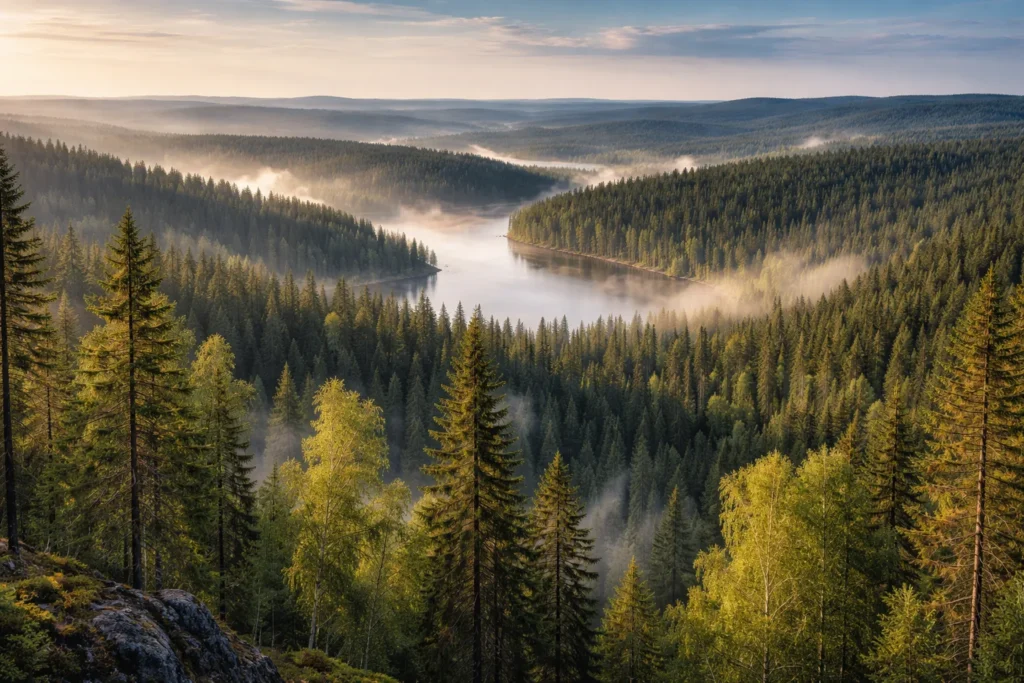

Introduction: The Secret Beneath the Northern Lights
Imagine standing in a forest so vast that you could walk for a year and never see its edge. A forest where the trees stretch their arms toward a sky that glows with the green fire of the aurora borealis in winter, and hums with the endless energy of the midnight sun in summer. The air is so clean and cold that each breath feels like drinking liquid crystal. The ground beneath your feet is spongy, built from thousands of years of decaying needles and moss that never fully rotted away. The silence is so complete that you can hear the blood moving through your own veins. This is not a fantasy landscape from a novel. This is not a scene from a movie about imaginary worlds. This is the Taiga.
For most of us, when we hear the words world’s largest forest, our brains immediately conjure images of the Amazon. We picture jaguars sliding through humid undergrowth, their spotted coats blending with dappled sunlight. We hear the chatter of monkeys echoing through multiple layers of canopy, a constant symphony of life. We feel the thick, wet air of the tropics that sits heavy in your lungs like a warm, damp blanket. We see documentaries about colorful macaws and poison dart frogs, hear stories about undiscovered tribes and mysterious plants that could hold cures for diseases that plague humanity. School textbooks reinforce this image. Conservation campaigns focus almost entirely on tropical rainforests, with their charismatic megafauna and their obvious, immediate beauty. The message is clear and repeated endlessly: save the Amazon, save the world. The Amazon is the lungs of the planet. The Amazon is the green heart of the Earth.
But that is only half the story. There is a giant sleeping in the north, a giant so large that it makes the Amazon look small by comparison. It doesn’t scream for attention like the tropics. It doesn’t dress in bright colors and flashy feathers to catch the eye. It whispers in the cold wind that sweeps down from the Arctic. It wears a cloak of deep green and white that blends into the snow and ice, hiding its true size from those who don’t bother to look closely. It is the Taiga, also known as the boreal forest. Spanning over 17 million square kilometers across the top of the globe through Russia where it is called the taiga, through Canada where it is known as the boreal, through Scandinavia, through Alaska, and even through parts of Scotland and Iceland, it forms a green crown upon the head of the Earth. It is bigger than the Amazon. It is bigger than all the tropical rainforests combined. It is so astronomically large that if you could magically lift it and place it over the continental United States, it would cover the entire country from the Atlantic to the Pacific, from Canada to Mexico, and would still spill over into the ocean on all sides.
Yet this immense forest, this green crown of the north, remains one of the planet’s best-kept secrets. Most people have never heard its name. Those who have often know nothing about its true importance. The Taiga suffers from a public relations problem. It is cold, and humans naturally gravitate toward warmth and sunshine. Its animals are elusive, hiding in deep forests and vast wetlands where cameras cannot easily follow. Its winters are harsh, making it difficult and expensive to film dramatic nature documentaries without crews freezing their equipment and themselves. For centuries, the people who lived there were considered remote and disconnected from the main currents of Western civilization, their stories untold, their knowledge unappreciated. The Taiga has been silent not because it has nothing to say, but because we have not been listening.
But in this silence, the Taiga is working. It is working every minute of every day, every day of every year, every year of every century. It is producing massive amounts of the oxygen we breathe, quietly carrying out photosynthesis even when the sun barely rises above the horizon in the depths of winter. It is holding onto a stockpile of carbon so huge that if it were ever released, it would accelerate climate change beyond our wildest nightmares, beyond anything our doomsday scenarios have imagined. It is filtering freshwater for millions of people, providing clean drinking water for communities across the Northern Hemisphere. It is regulating weather patterns across the entire planet, influencing rainfall in Africa, temperatures in Europe, storm tracks in North America. It is providing a home for some of the most resilient creatures on Earth, animals that have evolved over millions of years to thrive in conditions that would kill a human in hours.
This is the story of that forest. This is the story of the silent, frozen giant that keeps our planet alive. This is the tale of the Emerald Crown, the boreal forest, the Taiga.
H2: What Exactly is the Taiga? Defining the Biome in Comprehensive Detail
To understand the Taiga, you first have to forget everything you know about a normal forest. You have to erase from your mind the images of jungles and woodlands that you have absorbed from movies, from books, from photographs. You have to start fresh, with an open mind, ready to learn about a completely different kind of place.
You will not find a dense tangle of vines here. The cold would kill any vine before it could establish itself, freezing the water in its cells and bursting them open like overfilled balloons. You will not find a thousand different species of trees competing for light in a single acre. Only a handful of tree species have evolved the tools necessary to survive these conditions, and they have the place mostly to themselves. You will not find monkeys swinging through branches or toucans calling from the canopy. The energy costs of being a warm-blooded animal in this environment are simply too high for such extravagant lifestyles. Every calorie counts. Every movement must have a purpose. Waste is not just inefficient here. Waste is death.
The Taiga is a biome. This is a scientific term that means a major life zone, a large geographic area characterized by its climate, its plants, and its animals. The Taiga sits just south of the treeless, frozen Arctic tundra, where the ground is permanently frozen and only the hardiest mosses and shrubs can survive. It sits north of the temperate deciduous forests, where trees lose their leaves in the fall and winters are cold but manageable. It occupies a specific band of latitude around the top of the world, a belt of green that circles the entire Northern Hemisphere. It is the largest land biome on Earth, covering roughly 11 percent of the planet’s total land surface. To put that in perspective that is easy to grasp, that is more land area than Brazil, the United States, and Australia combined. That is more land area than the entire continent of South America. That is more land area than the moon’s surface.
If the Amazon is a chaotic, bustling city of life with constant noise and activity, with traffic jams of insects and crowded neighborhoods of competing species, then the Taiga is a quiet, disciplined military outpost where everything has its place and nothing is wasted. The trees here are mostly coniferous. This means they bear cones and have needle-like leaves. The dominant species are spruce, fir, pine, and larch. They are built for war, a war against the cold that has been raging for millions of years and will continue for millions more.
They do not have broad leaves like maple or oak. Broad leaves would freeze solid in the first hard frost. The water inside them would expand as it froze, tearing apart the delicate cell walls and turning the leaf into a brown, withered rag. Instead, they have needles. These needles are long and thin, with a small surface area that loses less water than a broad leaf. They are dark green, almost black in some species like the black spruce. This dark color helps them absorb what little sunlight there is during the short winter days when the sun barely crests the horizon. They are coated with a waxy substance called cutin. This wax is waterproof. It seals the needle and prevents water from escaping, which is crucial when the ground is frozen solid and the roots cannot absorb any moisture from the soil. And they do not all fall off in the winter. Deciduous trees, like maples and oaks, drop their leaves in the fall to avoid the cost of maintaining them through the winter. But conifers keep their needles for several years. This is a huge advantage. When a warm day arrives in late winter or early spring, the tree can start photosynthesizing immediately. It does not have to wait for new leaves to grow. It is ready to go at a moment’s notice, grabbing every possible minute of sunlight to produce energy.
But it is not just the trees that define the Taiga. The forest floor tells its own story, a story written in layers of organic matter that have accumulated over thousands of years. In tropical forests, a dead leaf hits the ground and within weeks, sometimes days, it has been consumed by armies of insects, fungi, and bacteria. The nutrients are rapidly recycled, pulled back into the living system. In the Taiga, a fallen needle might lie on the ground for decades. It might be there for fifty years, a hundred years, slowly accumulating in a thick layer of organic matter that never fully decomposes. This layer, called the duff layer by scientists, can be several feet deep in places. It is spongy and acidic, with a pH so low that most plants cannot tolerate it. And it stores enormous amounts of carbon, dead plant matter that has been locked away from the atmosphere for centuries.
Beneath that lies the soil, which in many parts of the Taiga is permanently frozen. This is the permafrost, a layer of ground that remains at or below freezing for at least two consecutive years. In the far north of the Taiga, the permafrost can be hundreds of meters deep. It acts like a concrete barrier, a solid floor that prevents water from draining away. This is why the Taiga is dotted with millions of lakes, ponds, and bogs. The water from melting snow and summer rains has nowhere to go. It cannot soak into the frozen ground. It just sits there, pooling in every depression, creating a landscape that from the air looks like a giant puzzle of green land and blue water. In some parts of the Canadian Shield, lakes cover more than half of the total surface area. You cannot walk in a straight line for more than a few hundred meters without encountering water.
The Taiga is a land of extremes, a place where the normal rules of life do not apply. In the winter, temperatures can plummet to minus 50 degrees Celsius. That is minus 58 degrees Fahrenheit. At those temperatures, a cup of boiling water thrown into the air will freeze before it hits the ground, turning into a cloud of ice crystals that sparkles in the weak sunlight. Your breath freezes on your eyelashes, building up into tiny icicles that can freeze your eyes shut if you are not careful. Trees crack with sounds like gunshots as the sap inside them freezes and expands, splitting the wood with reports that echo through the silent forest. The ground freezes so hard that it rings like iron under your feet. A steel bar struck against the earth will bounce off without leaving a mark. In the summer, the same spot can see temperatures climb to 30 degrees Celsius, or 86 degrees Fahrenheit. The difference between winter and summer temperatures can be 80 degrees or more. Mosquitoes emerge in clouds so thick that they can actually suffocate animals if the wind dies down. There are stories of caribou being driven mad by the swarms, of bears retreating to mountain slopes to escape the biting insects. It is a world of fire and ice, of light and darkness, of abundance and scarcity. Life here has learned to grab what it can when it can and hold on tight through the long, dark, frozen winter.
H2: Location, Location, Location: A Detailed Journey Around the Top of the World
Let us take a mental flight together. Close your eyes and imagine you are in a small airplane, the kind with high wings that give you a good view of the ground below. You are sitting in the co-pilot’s seat, looking out the window as the landscape unfolds beneath you. We are going to travel around the entire Northern Hemisphere, following the belt of green that circles the top of the world.
We begin in Scandinavia. If you were to fly north from Berlin, Germany, you would soon leave the farmlands and cities behind. The patchwork of fields, some golden with wheat, some green with corn, would gradually give way to rolling hills covered in mixed forests. Then the first scattered stands of pine would appear, signaling your entry into the boreal zone. Below you, a carpet of deep green would spread out, stretching to the horizon in every direction. This is the Scandinavian Taiga, covering much of Sweden, Finland, and Norway. You fly over Sweden, where the forest is broken occasionally by the silver gleam of a lake or the winding course of a river. You can see logging roads cutting through the trees, straight lines scratched into the green carpet. You see clear-cuts, patches where the forest has been harvested, looking like bald spots on a furry animal. You cross into Finland, the land of a thousand lakes, though from up here it looks more like a hundred thousand. The lakes are everywhere, connected by narrow channels, forming a labyrinth of water and land that stretches as far as the eye can see. Keep flying east.
You cross the Ural Mountains, that ancient spine of rock that has divided Europe from Asia for millions of years. The mountains themselves are worn down by eons of erosion, their peaks rounded and gentle compared to the jagged Alps or Himalayas. But they still stand as a gateway, a marker that you are leaving one world and entering another. On the western side, the forest is familiar, European. On the eastern side, you enter Siberia. And still the forest is there, unbroken, unending, stretching away in every direction like a green ocean. You fly over the vast Yenisei River, one of the great rivers of the world, flowing northward for thousands of miles toward the Arctic Ocean. It winds like a silver serpent through the endless green, its channel braided with sandbars and islands. You cross the Lena River, even larger than the Yenisei, flowing through a valley carved over millions of years. You fly for hours, then days in our imaginary flight, and you are still looking at trees. There are no cities down there, no towns, no roads. Just trees, lakes, and rivers. This is the Russian Taiga, the largest continuous forest on the planet. It covers an area larger than the entire United States, including Alaska. In some parts of central and eastern Siberia, you could fly for a thousand miles and never see a road, a town, or any sign that humans have ever been there. It is one of the last great wilderness areas on Earth, a place where the only sounds are the wind and the animals.
Now, let us fly west across the Atlantic Ocean. We cross the North Atlantic, leaving the coast of Norway behind and heading toward Greenland. Below us, the ocean is gray and cold, dotted with whitecaps. We cross the southern tip of Greenland, with its massive ice cap gleaming in the sun, and continue west. After hours over water, we sight land again. This is Newfoundland, the easternmost edge of North America. The forest here meets the cold Labrador Current, which flows down from the Arctic, bringing icebergs even in summer. The trees are stunted by the wind and cold, but they persist. This is the beginning of the Canadian Boreal Forest.
From Newfoundland, the green stretches west across the entire continent. It covers the rocky spine of the Canadian Shield, that ancient bedrock that forms the core of North America. The trees here are thinner, struggling to find purchase in the thin soil that covers the rock, but they persist. The forest wraps around the northern shores of the Great Lakes, though the lakes themselves are too far south to truly be part of the Taiga. It continues through northern Ontario, where the rock is scraped bare by ancient glaciers, leaving behind thousands of lakes. It spreads across Manitoba, through Saskatchewan and Alberta, covering millions of acres of rolling terrain. It extends all the way to the Rocky Mountains, that great wall of stone that divides the continent. This is the Canadian Boreal Forest, covering more than half of Canada’s total landmass. It contains some of the largest untouched wilderness areas left on Earth, places where you can stand on a ridge and see nothing but trees and sky in every direction, places where the only footprints are those of animals.
These two massive forests, the Russian and the North American, are actually connected by a thin bridge of forest across the Bering Strait in Alaska. During the last ice age, when sea levels were lower by hundreds of feet, this connection was a land bridge called Beringia. It allowed plants and animals to move freely between continents. Mammoths crossed here. The ancestors of today’s caribou crossed here. The first humans to reach the Americas crossed here, following the herds into a new world. Today, the Bering Strait separates them, a narrow strip of water about 50 miles wide. But the forests on both sides are so similar that a person transported between them might not notice the difference. The same species of spruce grow, their needles dark against the sky. The same moss carpets the ground, soft and spongy underfoot. The same berries ripen in the brief summer, blueberries and cranberries and cloudberries. The connection is invisible now, but it is still there in the genes of the plants and animals, a shared heritage from a time when the world was different.
This global position is the key to understanding the Taiga’s importance. Because it is located at these high latitudes, between roughly 50 and 70 degrees north, the Taiga experiences dramatic changes in daylight that shape everything about how life works here. In the far north of the biome, the sun does not rise for weeks in the winter. This is called polar night. Imagine not seeing the sun for a month. Imagine waking up day after day to darkness, going about your business by starlight or by the glow of the aurora. The world is reduced to shades of gray and black. In the summer, the opposite happens. The sun does not set for weeks. This is called midnight sun. Imagine daylight at 2 a.m., the sun circling overhead instead of dipping below the horizon, painting the sky with colors that last all night. Imagine never seeing the stars for weeks on end. Life here has to be ready for everything. It has to be flexible enough to handle months of darkness followed by months of constant light. The rhythms of life are different here. Sleep cycles change. Animal behavior changes. Everything is tuned to the extreme rhythm of the sun.
H2: The Oxygen Factory: More Than Just a Lung in Comprehensive Detail
We often call the Amazon the lungs of the world. This phrase is repeated so often that it has become a cliché, a shorthand for the idea that rainforests are essential to the air we breathe. School textbooks repeat this phrase without question. Environmental campaigns use it as a rallying cry to raise money and awareness. The image is powerful and easy to understand. The lungs breathe in carbon dioxide and breathe out oxygen, just like we do. It makes intuitive sense.
The reality, however, is more complicated and far more fascinating. It turns out that the Amazon is not the oxygen factory we imagine it to be. While the Amazon does produce a tremendous amount of oxygen through photosynthesis, its own ecosystem consumes most of it through the processes of respiration and decomposition. Think of the Amazon as a city. It produces a lot of goods, but it also consumes a lot of goods. The balance between production and consumption is roughly equal. The Amazon is more of a closed loop, a balanced system where oxygen production and oxygen consumption are in equilibrium.
The Taiga, however, operates on a completely different model. It is not a balanced system. It is a system with a massive surplus. And the reason for this surplus is simple: the cold.
Because of the cold, decomposition happens at a pace that can only be described as glacial. When a tree dies in the Amazon, armies of insects, fungi, and bacteria descend upon it immediately. Within months, sometimes weeks, the dead tree has been broken down and recycled into the system. The carbon in its wood is released back into the atmosphere as carbon dioxide. The oxygen that was released when that carbon was originally captured is consumed in the process of decomposition. It is a closed loop.
When a tree dies in the Taiga, the story is completely different. It does not rot away quickly. It might lie on the ground for decades, preserved by the cold like a natural freezer. The wood remains solid. The bark remains attached. The needles might even stay on the branches for years. The tree might eventually be buried by snow and moss, becoming part of the accumulating organic layer that builds up over centuries. The decomposers are there, waiting, but they are frozen solid for most of the year. In the brief summer, they wake up and begin to work, but before they can make much progress, the cold returns and they freeze again.
This has profound implications for the global oxygen balance. It means the forest is constantly producing oxygen through photosynthesis in its living trees. The trees are working every day that the sun shines, converting carbon dioxide into wood and releasing oxygen as a byproduct. But the forest is not using nearly as much oxygen to break down dead matter. The decomposers are essentially inactive for much of the year. They are frozen in place, waiting for warmth that never lasts long enough for them to complete their work. Year after year, decade after decade, century after century, the organic matter piles up. And with it, the oxygen that was released during its creation remains in the atmosphere, available for us to breathe.
Scientists have spent decades trying to quantify exactly how much oxygen the Taiga produces. It is a difficult question to answer because oxygen moves around the planet so easily. You cannot put a fence around the Taiga and measure what comes out. But using satellite data, atmospheric models, and ground-based measurements, researchers have estimated that the Taiga produces a staggering percentage of the world’s oxygen. While the exact numbers vary depending on the methodology used, it is widely accepted that the Taiga contributes significantly to the atmospheric oxygen we breathe. It is often cited as a major source for the entire Northern Hemisphere, where most of the world’s population lives.
Think about this the next time you take a breath. The oxygen molecules you inhale right now, as you read these words, may well have been produced by a spruce tree in Siberia five years ago. Or by a fir tree in northern Canada last summer. Or by a pine tree in Scandinavia this morning. Those molecules were released into the air, caught by the wind, and carried across oceans and continents. They traveled thousands of miles, over mountains and plains, over cities and farms, until they found their way into your lungs. You are breathing the Taiga. You are connected to it with every breath.
It is not just producing oxygen for itself. It is not just meeting its own needs. It is exporting oxygen to us, to the rest of the planet. Think of it this way: the Taiga is like a massive, quiet factory running 24 hours a day, 7 days a week, 365 days a year. The production line never stops, even in the depths of winter when the sun is weak. The trees are evergreens. They keep their needles. They are ready to grab whatever light is available, even on the shortest, darkest days of December. But the recycling department, the part of the factory that would normally consume the products, is on a permanent coffee break. It is frozen solid, unable to do its job. The result is a net surplus, a profit of the stuff we need to survive. It is a gift from the cold north to the rest of the planet, a gift that keeps on giving year after year.
This oxygen production happens through photosynthesis, a process that is worth understanding in some detail because it is the foundation of life on Earth. The trees take in carbon dioxide from the air through tiny pores in their needles called stomata. These pores can open and close to regulate gas exchange. They take in water through their roots, drawing it up from the soil through a complex system of vessels. Using energy from sunlight captured by the green pigment chlorophyll, they combine these ingredients to create simple sugars. These sugars are the fuel that powers the tree’s growth. They are used to build new cells, to repair damage, to produce seeds and cones. The waste product of this process is oxygen, which the tree releases back into the air through the same stomata. It is one of the most elegant and essential chemical reactions in all of nature, and it is happening billions of times every second across the vast expanse of the Taiga.
H2: The Planet’s Carbon Vault: Why the Soil Matters More Than the Trees in Comprehensive Detail
If the oxygen production makes the Taiga a factory, its role in carbon storage makes it a vault. And it is the most important vault on the planet when it comes to fighting climate change. This point cannot be overstated. It must be repeated and emphasized because it is so crucial to understanding why the Taiga matters. The carbon stored in the Taiga dwarfs the carbon stored in tropical rainforests. It dwarfs the carbon stored in temperate forests. It dwarfs the carbon stored in grasslands, in savannas, in all the other terrestrial ecosystems combined.
When we talk about forests storing carbon, we usually think of the trees. This makes intuitive sense. You look at a massive trunk, hundreds of years old, and you can imagine all the carbon it has pulled from the atmosphere over its long life. A single large tree can contain as much carbon as is released by driving a car for an entire year. Multiply that by the billions of trees in the Taiga, and you are talking about an astronomical amount of carbon. The trees themselves are a significant carbon reservoir.
But in the Taiga, the real hero is what is under your feet. The soil is the star of this story. The ground beneath the forest holds secrets that dwarf the trees above.
Remember how we said decomposition is slow in the Taiga? Because it is so cold for so much of the year, dead leaves, needles, moss, and even entire fallen trees do not fully rot. They pile up. They accumulate. Over thousands of years, since the last ice age retreated about 10,000 years ago, this has created a deep layer of organic matter. In some places, this layer is many meters deep. You could dig down and find layers of plant material that died centuries ago, still recognizable, still holding the carbon they captured when they were alive.
This organic matter is called peat when it is mostly composed of moss and other plants that grew in wetlands. Peat forms in bogs and fens where the waterlogged conditions slow decomposition even further. It is dark brown or black, spongy, and can be cut into bricks and burned as fuel. It has been used for heating homes in northern countries for centuries. In other areas, the organic matter is mixed with mineral particles to form what scientists call organic soil. Whatever you call it, it is packed with carbon. It is dead plant matter that never got the chance to release its carbon back into the air through decomposition. It is carbon that has been locked away, removed from the atmosphere, stored safely in the ground.
Scientists have spent decades trying to accurately measure how much carbon is stored in the Taiga’s soils. It is a difficult task because the Taiga is so vast and the soils are so deep. But using core samples, satellite data, and modeling, they have arrived at estimates that are staggering. It is estimated that the Taiga stores nearly twice as much carbon as all the world’s tropical rainforests combined. Some estimates put the number even higher. We are talking about something like 1.2 trillion tons of carbon. That is 1,200,000,000,000 tons. To put that number in perspective, humans have released about 600 billion tons of carbon into the atmosphere since the beginning of the Industrial Revolution in the 1700s. The Taiga holds twice that amount. Twice as much carbon as all the coal, oil, and gas we have burned in the last 300 years. It is just sitting there, frozen, out of circulation, locked away in the cold ground.
This is the danger. This is the reason scientists lie awake at night worrying about the Taiga. This is the nightmare scenario that keeps climate researchers up at 3 a.m., staring at the ceiling, running the numbers in their heads. The vault is beginning to warm.
As global temperatures rise due to climate change, the permafrost, which is permanently frozen ground, begins to thaw. It does not happen all at once, of course. It is not like a switch being flipped. It starts at the edges, in the southern parts of the Taiga where the warming is most pronounced. It gradually works its way north, year by year, decade by decade. But when the permafrost thaws, all that organic matter that has been frozen for thousands of years suddenly becomes available to decomposers. The bacteria and fungi that have been waiting there, dormant, frozen in place for centuries, spring into action. They wake up. They start to feed. And when they decompose that organic matter, they release two powerful greenhouse gases: carbon dioxide and methane.
Methane is particularly concerning. It is about 25 times more potent as a greenhouse gas than carbon dioxide over a 100-year period. It traps heat much more effectively. And the thawing permafrost releases both gases, carbon dioxide from some types of decomposition, methane from others, especially in wetlands where decomposition happens without oxygen. The Taiga could, in a terrifying twist of fate, switch from being a carbon sink, which means it absorbs carbon, to being a carbon source, which means it emits carbon. This is called a positive feedback loop. Warming causes thawing. Thawing releases greenhouse gases. Those gases cause more warming. More warming causes more thawing. You can see where this is going. It is a spiral, and once it starts, it is very difficult to stop.
There is also the issue of wildfires, which we will discuss in more detail later. Fire is a natural part of the Taiga’s life cycle. But climate change is making these fires more frequent, larger, and more intense. When the Taiga burns, it releases its stored carbon rapidly, in a matter of days or weeks, instead of slowly over centuries. A single intense fire can release as much carbon as the forest had absorbed over decades. And these fires are burning deeper into the organic soil layer, releasing carbon that has been stored for millennia. They are burning the peat, which can smolder underground for months, even through the winter, releasing carbon continuously. It is like setting the vault on fire.
H2: Masters of the Cold: The Resilient Wildlife of the Boreal in Comprehensive Detail
A forest this size, spanning continents and climate zones, has to be home to some incredible creatures. And it is. The Taiga is not empty. It teems with life, though much of it is hidden, camouflaged, or active only at certain times. Because the environment is so harsh, the animals that live here are masters of adaptation. They are the survivors, the ones who figured out how to make a living where others would perish. Their stories are tales of ingenuity, endurance, and sometimes, sheer luck.
The undisputed king of the Taiga, in terms of raw power and majesty, is the Siberian tiger. Specifically, this subspecies lives in the Russian Far East, in the easternmost reaches of the Taiga, in the Primorsky Krai and Khabarovsk regions near the Sea of Japan. Unlike their warmer-climate cousins in India and Southeast Asia, who live in steamy jungles, these tigers have adapted to the cold in remarkable ways. Their fur is thicker and longer, with a dense undercoat that traps air and provides insulation against the bitter cold. They have a layer of fat beneath their skin that can be several inches thick, serving both as insulation and as an energy reserve for lean times when prey is scarce. Their paws are larger and furrier than those of other tigers, with extra fur between the toes. They act like natural snowshoes, distributing the tiger’s weight and preventing it from sinking into the deep snow. They roam vast territories, sometimes hundreds of square miles, hunting deer, wild boar, and even bears through the deep snow. There are only about 500 of them left in the wild, making them one of the rarest and most endangered big cats on Earth. To see one in its natural habitat, padding silently through the snow-covered forest, its orange and black stripes blending with the shadows, is to witness one of nature’s greatest masterpieces. It is an experience that stays with you for life.
Then there is the moose, the giant of the deer family. A full-grown bull moose can stand seven feet tall at the shoulder, which is taller than most basketball players. It can weigh over 1,500 pounds, as much as a small car. With their long legs, they can easily wade through snowdrifts that would stop other animals in their tracks. Those same legs allow them to wade into ponds and lakes to feed on aquatic plants, which provide essential minerals like sodium that are scarce in their terrestrial diet. They can swim for miles, crossing large lakes and rivers with ease. Their broad, palmate antlers, which can span six feet from tip to tip and weigh as much as 40 pounds, are grown and shed each year. This is the fastest-growing animal tissue on the planet. In the fall, during the mating season called the rut, the forests echo with the calls of bulls. It is a sound somewhere between a grunt and a bellow, a deep, resonant noise that carries for miles through the crisp autumn air. It is a sound that speaks of power and competition, of life continuing in the face of the coming winter.
In Canada and Alaska, the woodland caribou migrate in enormous herds across the boreal forest. These are the same species as the reindeer of Eurasia, though the name changes depending on where you are and whether they are wild or domesticated. Their hooves are specially adapted for the conditions. They are large and concave, like big scoops, which helps the animal dig through snow to find the lichen underneath. They spread wide to support the animal on snow and soft ground in the winter. They contract to provide better traction on hard-packed ice. When they walk, their tendons make a clicking sound, audible from a considerable distance. Scientists believe this clicking helps the herd stay together in poor visibility, like during snowstorms or in the dim light of the polar night. It is a form of communication, a way of keeping track of neighbors when you cannot see them. The sound of a caribou herd passing by, thousands of animals clicking in unison as they move through the forest, has been described by those lucky enough to hear it as one of the most haunting and beautiful sounds in all of nature. It is the sound of migration, of ancient pathways, of life on the move.
The Taiga is also home to the wolverine, a creature that looks like a small bear with a bushy tail but is actually the largest member of the weasel family. Wolverines are famous for their strength and ferocity relative to their size. They have been known to take down prey much larger than themselves, including moose that are mired in deep snow and cannot defend themselves effectively. They are primarily scavengers, using their powerful jaws and teeth to crush through frozen bone and hide to get at the meat inside. Their jaws are so strong that they can crush a frozen moose bone like a dog cracking a biscuit. But they are also capable hunters, taking small mammals and birds when they can catch them. They roam enormous territories, sometimes hundreds of square miles, in search of food. They are solitary and elusive, rarely seen by humans, but their tracks in the snow tell the story of their passage. A line of wolverine tracks through the winter forest is a sign that a powerful and determined creature is abroad.
And we cannot forget the smaller creatures, the ones that form the foundation of the food web. The Canada lynx, with its huge, fluffy paws that act like natural snowshoes, silently stalks the snowshoe hare through the forest. The lynx’s broad paws allow it to run on top of deep snow, distributing its weight so it does not sink. The hare, with its smaller feet, sinks down into the snow, giving the lynx a significant advantage in the chase. The populations of these two animals are famously linked in a cycle that has fascinated biologists for centuries. When hare numbers are high, lynx numbers go up as they have plenty to eat and raise more kittens. When hare numbers crash, due to overbrowsing of their food plants or disease, the lynx numbers crash as well, as they starve or produce fewer young. This cycle, which takes about 10 years to complete, plays out across millions of square kilometers, a synchronized pulse of life and death that ripples through the entire ecosystem.
The birds of the Taiga deserve their own mention. The great gray owl, the largest owl in North America by length, hunts in the open bogs and clearings of the forest. It has an incredibly sensitive sense of hearing. It can hear a vole moving beneath two feet of snow and plunge down to catch it with deadly accuracy, breaking through the crust with its talons. Its facial disc, the round shape of its face, acts like a satellite dish, funneling sound toward its ears. The spruce grouse, a chicken-like bird, eats spruce needles, of all things. It digests them in a specially adapted gut that can break down the toxic resins that would kill other animals. It is a specialist, adapted to a food source that no one else wants. And during the summer, the Taiga becomes a nursery for millions of migratory birds. Warblers, thrushes, flycatchers, sparrows, they fly north from South and Central America, from Mexico and the Caribbean, to take advantage of the explosion of insects that comes with the brief northern summer. They nest, raise their young, and then fly south again, completing a round trip of thousands of miles each year.
H2: A Year in the Taiga: The Four Seasons of Extremes in Comprehensive Detail
To truly understand this forest, you have to feel its seasons in your bones. You have to understand that it is not like living in a temperate climate where the changes are gentle and gradual, where spring merges smoothly into summer and summer fades slowly into fall. In the Taiga, the seasons are distinct, dramatic, and unforgiving. Each one demands a different strategy for survival from every living thing in the forest.
Winter, which lasts from October to April, is the long reign of the ice king. This is the dominant season, the one that defines the character of the entire biome. For half the year, the forest is locked in ice. The world is reduced to white and black, with occasional touches of gray where bare branches show against the sky. The silence is profound. Snow muffles every sound so completely that you can hear your own heartbeat, your own breathing. A shout is swallowed by the air before it travels ten feet. The trees themselves are silent, their branches heavy with snow that does not move. Animals have either migrated south, like most of the birds, or hibernated, like the bears, curling up in dens to sleep through the worst of it. Others have adapted with white coats for camouflage, like the snowshoe hare and the ptarmigan, a type of grouse that turns white in winter to blend with the snow. The trees, heavy with snow, creak and groan in the frigid air when the temperature drops suddenly. These sounds carry unnaturally far in the dense, cold atmosphere, seeming to come from everywhere and nowhere at once. A day might only last four or five hours. The sun hangs low on the horizon, never rising high enough to offer real warmth, just a pale, watery light that casts long blue shadows across the snow. At night, if the skies are clear, the aurora borealis might dance across the sky. It is a silent spectacle of green and purple light that shifts and shimmers like a living thing, curtains of light that ripple and flow across the stars. The display is caused by charged particles from the sun interacting with the Earth’s magnetic field, but to those who live beneath it, it feels like magic, like the spirits of the ancestors playing in the heavens. It is a reminder that even in the deepest cold, there is beauty.
Spring, which is really just the month of May, is not gentle here. It is not a slow awakening. It is an explosion. The snow melts rapidly, not gradually over weeks, but in a rush of running water. Warm rains come, eating into the snowpack. The entire forest turns into a giant swamp. Every depression fills with water. Every stream becomes a torrent. Rivers swell with meltwater, overflowing their banks and carving new channels through the trees. The ice on the rivers breaks up with sounds like thunder, huge sheets of ice cracking and grinding against each other before finally breaking apart and flowing downstream. The air is filled with the sound of dripping water, the gurgle of countless small streams, the roar of rapids where the water is moving fast. The first migrating birds return, arriving in waves. They fill the air with song after the long silence of winter, a chorus of sound that grows louder with each passing day. It is muddy, wet, and messy. There is no dry ground. But it is also a brief but frantic period of rebirth where the forest shakes off its frozen sleep and prepares for the short summer ahead. Plants push up through the saturated soil, eager to catch the light.
Summer, from June to August, is a frantic race against time. The sun barely sets. In the northern parts of the Taiga, it circles overhead without dipping below the horizon, providing 24 hours of daylight for weeks on end. This is the midnight sun. The forest explodes with life in a way that seems impossible after the long winter. Plants grow at an almost visible rate, desperate to complete their life cycles before the cold returns. You can almost see them growing, adding inches in a single day. Insects, especially mosquitoes and black flies, swarm in numbers that are difficult for someone from the south to comprehend. They rise from every puddle, every patch of damp ground, in clouds so thick they can darken the sky. People who work in the north wear head nets to keep them out of their faces. For birds, it is a feast beyond imagining. Millions of migratory birds arrive to nest and feed their young on the insect buffet. The forest floor is carpeted with berries. Blueberries, lingonberries, cloudberries, cranberries, they ripen in a succession that provides food for bears, birds, and people. Bears gorge themselves on these berries, packing on fat for the winter ahead. A bear can gain several pounds a day during berry season. The days are long and warm, sometimes hot, with temperatures reaching into the 80s Fahrenheit. The forest hums with the sound of life, the buzz of insects, the songs of birds, the rustle of animals moving through the undergrowth.
Autumn, which is September, is a time of preparation. The forest prepares for the long sleep ahead. The days get shorter, noticeably so, shrinking by several minutes each day. The sun drops lower in the sky. A hard frost settles over the landscape in the mornings, painting the leaves and needles with a coating of ice crystals that sparkle in the low sun. The larch trees, one of the few conifers that are actually deciduous, meaning they lose their needles, turn a brilliant gold color before dropping them in a shower of yellow. For a few weeks, the forest is lit with this golden glow. The animals are frantically foraging for the last meals before the snow flies. Squirrels gather cones and store them in hidden caches, burying them for later retrieval. They will remember where they buried them, using spatial memory and smell to find them under the snow. Bears eat constantly, consuming up to 20,000 calories a day, feeding on berries, salmon if they can catch them, and anything else they can find. The last of the migrant birds gather in flocks, circling and calling to each other before heading south. Their calls fill the air, a sound of farewell. Then, one day, the first snow falls. It might be light at first, just a dusting that melts by afternoon. But eventually, a real snow comes, the kind that sticks, that covers the ground and stays. And with that snow, the silence returns. The birds are gone. The bears are in their dens. The insects are dead or frozen. The long reign of the ice king has begun again.
H2: The People of the Forest: Indigenous Cultures and Deep Roots in Comprehensive Detail
The Taiga is not an empty wilderness, a blank spot on the map waiting to be filled by explorers and settlers. This is a common misconception, born of maps that show vast empty spaces in the north. But for thousands of years, since the last ice age ended and the glaciers retreated, the Taiga has been home to Indigenous peoples who have learned not just to survive, but to thrive in its challenging environment. Their cultures, their languages, their spiritual beliefs are deeply intertwined with the forest. They are shaped by its rhythms and dependent on its health. They are not visitors to the Taiga. They are part of it.
In Scandinavia and the Kola Peninsula of Russia, the Sámi people have lived in harmony with the boreal forest and the adjacent tundra for millennia. Their traditional territory, called Sápmi, stretches across northern Norway, Sweden, Finland, and into Russia. It is a vast area, larger than many European countries. Their culture is deeply tied to the semi-domesticated reindeer. For the Sámi, reindeer are not just a food source, not just a commodity. They are the center of the universe. The Sámi follow the herds on their seasonal migrations, moving from winter grazing grounds in the forest to summer calving grounds in the mountains and back again. This nomadic lifestyle has shaped every aspect of their culture. They use every part of the animal. The meat is for food, fresh in summer, dried or frozen for winter. The hides are for clothing and bedding, soft and warm. The sinew is for thread, strong and durable. The antlers are for tools and ceremonial objects, carved into knives and combs and ornaments. Their traditional clothing, the gákti, is brightly colored with blues, reds, and yellows. It varies by region and family, a visual language that tells the story of who a person is and where they come from. The patterns and colors identify their home valley, their family, sometimes even their marital status. Their unique vocal tradition, the yoik, is one of the oldest continuous musical traditions in Europe. It is not a song about something or someone. It is an attempt to capture the essence of that thing or person in sound. There are yoiks for people, for animals, for places, for the wind and the water. To yoik a person is to honor them, to bring them into the sound. It is a deeply spiritual practice.
Across the Atlantic in Canada, the story is similar but different. The Cree, the Dene, the Innu, the Naskapi, and many other First Nations groups call the boreal forest home. For them, the forest is not a resource to be exploited, not a collection of commodities to be extracted and sold. It is a living entity, a relative. It is a library, containing knowledge accumulated over generations about the properties of plants, the behavior of animals, the patterns of weather. This knowledge is not written down in books. It is passed down orally, through stories told around fires, through lessons learned on the land. It is a pharmacy, providing medicines for everything from headaches to infections, from upset stomachs to spiritual malaise. Every plant has a use, if you know what it is. It is a grocery store, stocked with meat from moose and caribou, with fish from the countless lakes and rivers, with berries and roots and greens that appear in their season.
The waterways were their highways. In the summer, they traveled by canoe, made from birch bark stretched over a cedar frame. These canoes were masterpieces of engineering, light enough to carry over a portage between lakes, strong enough to carry a family and all their possessions for hundreds of miles. In the winter, they traveled by snowshoe and toboggan, following frozen rivers and animal trails. The snowshoes distributed their weight so they could walk on top of deep snow without sinking. The toboggans carried their gear, sliding easily over the surface.
Their knowledge of the forest was, and is, encyclopedic. They could read the weather by watching the wind ruffle the fur of a sleeping animal. They knew which plants were safe to eat after the first frost, when the toxins had broken down. They understood the cycles of the lynx and the hare, the moose and the wolf, in a way that Western science is only beginning to appreciate. They lived in the forest, not apart from it. They were part of the ecosystem, another species making a living, and they understood their place in the web of life.
These cultures hold a deep, accumulated knowledge of the forest’s rhythms, a body of understanding that is often called Traditional Ecological Knowledge by scientists. It is not static, not stuck in the past. It is not a museum piece to be preserved and admired. It is a living system of observation and adaptation, passed down through generations by story, by practice, by living on the land. It evolves as the environment changes. It incorporates new observations. For these Indigenous peoples, the idea of the Taiga being a secret is strange. It is not a secret. It is not remote or unknown. It is the center of their universe, a living, breathing relative that provides for them, teaches them, and challenges them. Their survival depends on its health, a lesson modern society is only beginning to understand as we face the consequences of our own disconnection from the natural world.
Today, many of these Indigenous communities are on the front lines of defending the Taiga. They are fighting against logging companies that want to clear-cut their ancestral territories. They are fighting against mining operations that threaten to poison their rivers with heavy metals and acid drainage. They are fighting against hydroelectric projects that would flood vast areas of forest, drowning the land and releasing methane from decaying vegetation. They are using modern tools, like Geographic Information Systems mapping and social media, combined with traditional knowledge, to make their case in courtrooms and in the court of public opinion. They are reminding the world that the forest is not just a carbon vault or an oxygen factory. It is not just a resource to be extracted. It is a home.
H2: Threats to the Emerald Crown: Fires, Logging, and the Thaw in Comprehensive Detail
Despite its immense size and the resilience of its inhabitants, the Taiga is under serious threat. The very factors that make it unique, its cold temperatures, its frozen soils, its slow cycles of growth and decay, also make it vulnerable to rapid change. The threats are many, and they are interconnected, forming a web of pressure that could fundamentally alter this ecosystem in ways we are only beginning to understand.
Climate change is the biggest threat, the one that amplifies all the others. The Arctic and subarctic regions are warming faster than the rest of the planet. This is a phenomenon known as Arctic amplification. There are several reasons for this. One is the ice-albedo feedback. White ice and snow reflect sunlight back into space. When they melt, they reveal darker land or water, which absorbs more sunlight and warms up, causing more melting. Another reason is that the atmosphere is thinner in the Arctic, so it takes less energy to warm it. Whatever the reasons, the result is clear: while the global average temperature has risen by about 1.2 degrees Celsius since pre-industrial times, parts of the Taiga have warmed by two or even three times that amount. This warming is causing the permafrost to thaw. As we discussed earlier, this releases greenhouse gases, but it also physically changes the landscape in dramatic and sometimes bizarre ways. When permafrost thaws, the ground sinks and buckles. This is called thermokarst. Trees that were rooted in stable frozen ground suddenly find themselves leaning at crazy angles, creating what are called drunken forests. They look like they have had too much to drink, tilting this way and that. Lakes can drain completely when the frozen ground that held them in place thaws and allows the water to seep away. In a matter of days, a lake that has existed for thousands of years can disappear, leaving behind a dry depression. The land becomes unstable, making it difficult for anything built on it, from animal burrows to human infrastructure like roads and buildings, to remain intact.
Wildfires are a natural part of the Taiga’s life cycle. In fact, some tree species, like the jack pine and the black spruce, have evolved to depend on fire. Their cones are serotinous. This is a fancy word that means they are sealed with a tough resin that only melts when exposed to the intense heat of a fire. The cones can hang on the trees for years, waiting. When a fire comes through, the heat melts the resin, the cones open, and the seeds are released onto the freshly cleared, ash-fertilized ground. Without fire, these trees cannot reproduce. Their populations would decline. Fire is essential to their life cycle. But climate change is making these fires more frequent, larger, and more intense. The fire season is longer, starting earlier in the spring and lasting later into the fall. The snow melts sooner, leaving the forest dry and vulnerable. The fires themselves burn hotter, consuming not just the trees but the deep organic layer of the soil. These are called megafires. They burn so hot that they can create their own weather, generating pyrocumulus clouds that can spawn lightning and start more fires. They can kill the soil itself, sterilizing it and destroying the seed bank that would normally allow the forest to regenerate. After such a fire, the forest may not come back. It may be replaced by grassland or shrubland, a permanent shift in the ecosystem. And when these fires burn through peatlands, they can smolder underground for months, even through the winter, releasing carbon continuously. They are difficult to detect and almost impossible to put out.
Industrial logging is another major threat to the Taiga. The trees of the boreal forest are highly prized for making paper and lumber. The wood is strong, straight-grained, and abundant. It has been used for centuries to build houses, to make furniture, to print books and newspapers. Large-scale clear-cutting, especially in parts of Canada and Russia, removes the forest cover over vast areas. A clear-cut is exactly what it sounds like. Every tree in an area is cut down, leaving a barren landscape that looks like a battlefield. While logging can be done sustainably, with careful planning and regeneration, it often is not. The economic pressure to produce cheap wood quickly leads to practices that damage the ecosystem for decades, if not centuries. Clear-cutting fragments the habitat for animals like the woodland caribou, which need large, undisturbed areas of old-growth forest to thrive. They avoid clear-cuts and the young forests that grow back after logging. It destroys the delicate soil structure, leading to erosion and the loss of nutrients. The heavy machinery used in logging compacts the soil, making it harder for new trees to establish. It changes the hydrology of the area, affecting streams and wetlands. Replanting a monoculture of one type of tree, planted in straight rows like a crop, does not replace the complex, ancient ecosystem that was destroyed. A planted forest is not a forest in the ecological sense. It is a tree farm, with none of the diversity of species, none of the complex structure, none of the ecological functions of a natural forest.
Resource extraction for oil, natural gas, and minerals is also a major pressure on the Taiga. The boreal forest sits on top of a treasure trove of resources. In Alberta, Canada, the boreal forest covers the oil sands, one of the largest oil deposits on Earth. Extracting this oil is not like drilling a well in Texas. It requires stripping away the forest and digging up the ground, creating massive open-pit mines that can be seen from space. The oil is mixed with sand and clay, and separating it requires huge amounts of hot water and energy. The tailings ponds, where the contaminated water is stored, cover an area larger than the city of Vancouver and are visible from space. They are toxic to anything that touches them. In Russia, there are enormous deposits of natural gas on the Yamal Peninsula, and the infrastructure to extract it is being built across the tundra and forest. There are deposits of nickel, copper, and diamonds. The Norilsk mining complex in Siberia is the world’s largest producer of nickel and palladium, but it is also one of the most polluted places on Earth, with sulfur dioxide emissions that have devastated the surrounding forest for miles. The quest to extract these resources carves roads into previously untouched areas, bringing with them pollution, noise, and human activity. These roads open up the forest to further development, to hunters, to poachers, to settlers, to all the pressures that come with access. Even when the extraction is done and the mines are closed, the scars on the land remain, slow to heal in the cold climate.
All of these threats are interconnected. Climate change dries out the forest, making it more flammable, which leads to more intense fires. Fires release carbon, which worsens climate change. Logging removes the trees that could absorb carbon and also dries out the soil. Resource extraction brings roads that make it easier for loggers to access new areas and for fires to spread. It is a cascade of pressures that together threaten the integrity of the entire biome. It is not one threat acting alone. It is all of them, acting together, reinforcing each other, pushing the Taiga toward a tipping point from which it may not recover.
H2: Why We Must Care: The Global Connection in Comprehensive Detail
It is easy to think of the Taiga as a faraway place that does not affect us. This is a natural human tendency. We focus on what is near, on what we can see and touch. If you live in a city in the southern United States, or in Europe, or in Southeast Asia, why should you care about a frozen forest in Siberia or northern Canada? It is thousands of miles away. You will probably never visit it. You do not know anyone who lives there. It does not appear in your news feed. Why should it matter to you?
The answer is simple, and it is based on science, not on sentiment. The Taiga is a global system. It does not recognize political borders. It does not care about our distinctions between here and there, between us and them. It is connected to everything, and everything is connected to it. We are all part of the same planet, breathing the same air, drinking the same water, sharing the same climate.
The air you breathe is partly cleaned by those distant spruce trees. The oxygen molecules produced in the Taiga are carried by global wind patterns, the jet stream and the trade winds, across oceans and continents. They mix with the atmosphere and circulate around the world. The oxygen you inhale with your next breath may have been released by a tree in Siberia last summer. It may have traveled across the North Pole, down through Canada, across the Atlantic, and into your lungs. The carbon dioxide you exhale may end up being absorbed by a fir tree in Canada next year, or by a pine in Scandinavia, or by a larch in Russia. We are breathing the same air, sharing the same atmosphere, with every living thing on this planet. There is no separation. There is only connection.
The climate that grows your food is stabilized by the carbon locked in that northern soil. The food on your plate, whether it is wheat from the American Midwest, rice from Vietnam, corn from Brazil, or soy from Argentina, depends on a stable climate. Agriculture is entirely dependent on predictable weather patterns, on temperatures that stay within certain ranges, on rainfall that comes at the right times. If the Taiga releases its carbon, if it switches from being a sink to a source, it will accelerate climate change in ways that will affect agriculture everywhere. More extreme weather, more droughts, more floods, more heat waves, more unpredictable seasons. The stability that farmers depend on, that our entire global food system depends on, will be undermined. Crop failures will become more common. Food prices will become more volatile. People will go hungry. This is not speculation. This is already happening, and it will get worse.
The water cycles that bring rain to farmlands and fill the reservoirs that supply our cities are influenced by the vast wetlands of the boreal. The Taiga acts like a giant sponge, absorbing water in the spring melt and releasing it slowly throughout the summer. This regulates the flow of rivers that eventually reach the oceans. It smooths out the peaks and valleys of the water cycle. Changes in the Taiga affect weather patterns far to the south. Scientists have drawn connections between the health of the boreal forest and the timing of the monsoon in Asia, the frequency of hurricanes in the Atlantic, the amount of snowfall in the mountains that provides water for cities like Los Angeles, Denver, and Salt Lake City. When the Taiga changes, the whole system changes with it.
The Taiga is also home to biodiversity that is irreplaceable. The species that live there, the Siberian tiger, the woodland caribou, the wolverine, the great gray owl, the lynx, are the product of millions of years of evolution. They are masterpieces of adaptation, finely tuned to their environment. If we lose them, we lose them forever. There is no getting them back. Extinction is permanent. And biodiversity is not just about pretty animals that we might want to see in a zoo. It is about the health of the entire system. Every species plays a role, like a thread in a tapestry. When you start pulling out threads, the whole thing becomes unstable. Eventually, it unravels. We do not know which species are essential and which are not. We do not know what we are losing until it is gone.
Protecting the Taiga is not just an act of charity for some far-off wilderness. It is not about being nice to trees or feeling good about ourselves, though those are not bad things. It is an act of self-preservation. It is about protecting the systems that keep us alive. When we protect the Taiga, we are protecting the Earth’s air conditioner and its primary carbon vault. We are safeguarding the habitat for species that are wonders of evolution. We are respecting the rights and cultures of Indigenous peoples who have been its guardians for centuries. We are investing in our own future, in the stability of the climate that our children and grandchildren will inherit. We are making a choice about the kind of world we want to live in.
The good news is that solutions exist. They are not easy. They require effort, money, and political will. But they are possible. We can support sustainable forestry practices that mimic natural disturbances rather than destroying the land. This means logging in ways that leave some trees standing, that protect soil and water, that maintain habitat for wildlife, that allow the forest to regenerate naturally. It costs more, but it preserves the forest for the future. We can push for the creation of massive protected areas. Canada has committed to protecting 30 percent of its land by 2030, an initiative that would safeguard millions of acres of boreal forest. We can support Indigenous-led conservation efforts, recognizing that the people who have lived in the forest for thousands of years are often its best stewards. They have knowledge that we do not. They have incentives that we do not. We can tackle climate change at its source by reducing our dependence on fossil fuels, by transitioning to renewable energy like solar and wind, by using energy more efficiently, by making different choices in how we live and move and consume.
H2: The Hidden World of the Boreal: Plants You Have Never Heard Of in Comprehensive Detail
When most people think of the Taiga, they picture endless stands of spruce and fir marching to the horizon. And that is accurate as far as it goes. The conifers are the dominant feature of the landscape. But the plant life of the boreal forest is far more diverse and fascinating than just the dominant trees. The forest floor is a world unto itself, a miniature landscape of incredible complexity, filled with species that most people have never heard of but that play essential roles in the ecosystem.
Take the reindeer lichen, for example. Despite its name, it is not a plant at all but a lichen. A lichen is a symbiotic partnership between a fungus and an alga. The fungus provides structure and protection, holding water and minerals. The alga performs photosynthesis, producing food that both partners share. It is one of the great success stories of evolution, a collaboration that has allowed these organisms to colonize environments where neither could survive alone. Reindeer lichen grows in low, bushy clumps that carpet the forest floor in pale green or gray. From a distance, it looks like a miniature forest of tiny trees. It is incredibly slow-growing, adding only a few millimeters per year. A single clump can be hundreds of years old, a living link to the past. For caribou and reindeer, it is a crucial winter food. They can smell it through several feet of snow and dig down to reach it, using their hooves to clear the snow away. Without reindeer lichen, the great caribou herds could not survive the winter. They would starve. This one inconspicuous organism, unnoticed by most humans, is the foundation of the entire caribou-based ecosystem.
Then there are the orchids. Yes, orchids grow in the Taiga. They are not the large, showy tropical orchids you might buy at a florist, with their extravagant colors and complex shapes. They are small and delicate, easily overlooked. But they are orchids nonetheless. The calypso orchid, also known as the fairy slipper, sends up a single delicate pink and purple flower in the spring. It is named for the Greek nymph Calypso, who hid herself away on a remote island, because the orchid hides in the deep shade of the forest. It is one of the most beautiful sights in the boreal spring, a flash of unexpected color in a landscape of brown and green. Finding one is like finding a hidden treasure, a reminder that beauty exists even in the cold north. The yellow lady’s slipper is another orchid, with a slipper-shaped pouch that traps insects, forcing them to crawl through the flower and pick up pollen before escaping.
The bogs and fens that dot the Taiga are home to carnivorous plants. In these waterlogged, acidic environments, nitrogen is scarce. Nitrogen is an essential nutrient for plants, a key component of proteins and DNA. Most plants get it from the soil, but in bogs, the soil is poor. Some plants have solved this problem by supplementing their diet with insects. The round-leaved sundew is one of them. It spreads its leaves like tiny plates, each one covered in glistening hairs tipped with a sticky substance that looks like dew. An insect that lands on the leaf, attracted by the sparkle, becomes trapped in the sticky goo. The more it struggles, the more stuck it gets. The leaf slowly curls around it, secreting enzymes that digest the prey and release the nitrogen the plant needs. It is a slow and patient death, but an effective one. The pitcher plant takes a different approach. Its leaves are shaped like trumpets or pitchers that fill with rainwater. Insects, attracted by the color and sometimes by a sweet scent, crawl inside and find themselves trapped by downward-pointing hairs that prevent them from climbing out. They fall into the water at the bottom and drown. They are slowly digested by bacteria and enzymes that the plant produces. It is a pitfall trap, simple but effective.
The Labrador tea plant is a low-growing shrub with leaves that are woolly on the underside. This fuzz is an adaptation to prevent water loss and protect against the cold. It traps a layer of air next to the leaf, insulating it. Its leaves have been used for centuries by Indigenous peoples to make a medicinal tea. The tea is rich in vitamin C, which prevented scurvy, and it has a slightly narcotic effect, which may have been used in ceremonies. The name comes from early European settlers in Labrador who learned the practice from the local people. They adopted it and spread it to others.
And everywhere, there are the mosses. More than 200 species of moss grow in the Taiga. They form a thick, spongy carpet that covers the ground, the rocks, the fallen logs. They hold moisture, regulate temperature, provide habitat for tiny invertebrates. Sphagnum moss, in particular, is the builder of the boreal world. It can hold up to 20 times its weight in water, like a sponge. It creates the conditions for peat formation. As it grows, it slowly raises the water table, creating bogs that can persist for thousands of years. It is acidic, which slows decomposition even further. Dead sphagnum accumulates as peat, layer upon layer, building up over centuries. The mosses are the foundation upon which much of the rest of the ecosystem is built. Without them, the Taiga would be a very different place.
H2: The Boreal Forest and Freshwater: An Invisible Service in Comprehensive Detail
We have talked about oxygen and carbon, about the role of the Taiga in the atmosphere and in the climate system. But there is another service the Taiga provides that is just as essential to life, just as critical to human civilization. That service is freshwater. The boreal forest is one of the largest sources of unfrozen freshwater on the entire planet.
Think about the numbers for a moment. Let them sink in. The Taiga contains millions of lakes. Some are small, just ponds really, shallow depressions filled with water. But others are enormous, comparable to the Great Lakes in size. Great Bear Lake and Great Slave Lake in Canada’s Northwest Territories are among the largest lakes in the world. Great Bear Lake is the eighth largest lake in the world by surface area. It is so large that it has its own weather systems. Lake Winnipeg in Manitoba is the tenth largest freshwater lake on Earth. And these are just the big ones, the ones that show up on maps. Scattered across the landscape are countless smaller lakes, each one a reservoir of fresh water, each one connected to the others by streams and rivers.
Then there are the rivers. The Mackenzie River in Canada is the largest river in North America north of the Rio Grande. It drains an area of 1.8 million square kilometers, carrying water from the Rocky Mountains all the way to the Arctic Ocean. Its delta is one of the largest in the world, a maze of channels and lakes that provides habitat for millions of birds. In Russia, the Ob, the Yenisei, and the Lena rivers are among the longest rivers on Earth. Each one flows for thousands of miles, from the mountains of southern Siberia northward to the Arctic Ocean. They are massive, powerful rivers that carry enormous volumes of water. Together, these three rivers discharge more freshwater into the Arctic Ocean than all the rivers in the rest of the world combined. Think about that. More water than the Amazon, more than the Mississippi, more than the Congo, more than all of them put together.
And then there are the wetlands. The Taiga is dotted with bogs, fens, and marshes, collectively known as peatlands. These wetlands cover vast areas, especially in the West Siberian Lowland, which contains the largest peatland complex on Earth. It is bigger than France and Germany combined, a vast expanse of waterlogged ground that stretches for hundreds of miles. These peatlands act like giant sponges. They absorb water during the spring snowmelt, when the rivers are flooding and the landscape is saturated. They hold that water, releasing it slowly throughout the summer, regulating the flow of rivers and preventing both floods and droughts downstream. They smooth out the peaks and valleys of the water cycle, providing a steady supply of water even in dry periods.
This freshwater is not just sitting there, unused, doing nothing. It is part of the global water cycle, the endless circulation of water between the oceans, the atmosphere, and the land. Water evaporates from the surface of lakes and wetlands, rises into the air, forms clouds, and falls as rain or snow, sometimes thousands of miles away. The moisture from the Taiga influences weather patterns across the entire Northern Hemisphere. It helps to cool the planet, as water evaporation absorbs heat, like sweat cooling a body. It provides drinking water for communities downstream, some of them far to the south. The city of Los Angeles gets some of its water from rivers that originate in the mountains of the West, which are fed by moisture that came from the north.
The quality of this water is also exceptional. The Taiga acts as a natural filter, purifying the water as it moves through the landscape. As water moves through the forest, it passes through layers of moss and soil that trap pollutants and sediments. The plants take up excess nutrients. The acidic conditions in the peatlands kill many harmful bacteria. The water that emerges from the Taiga is often so pure that it requires little to no treatment before it can be drunk. It is naturally clean, naturally filtered. This is a service with enormous economic value, providing clean water for free that would otherwise cost billions to produce through treatment plants. It is an invisible subsidy to every community downstream.
H2: The Global Economy and the Taiga: Resources and Conflicts in Comprehensive Detail
The Taiga is not just an ecological treasure. It is not just a wilderness to be preserved in a glass case. It is also an economic treasure, a storehouse of resources that have driven development, created wealth, and sparked conflicts for centuries. Understanding this economic dimension is crucial to understanding why the forest is under threat and why protecting it is so difficult. The forces that want to exploit the Taiga are powerful. They have money, influence, and political connections. They are not going to go away just because we ask nicely.
The most obvious economic product of the Taiga is wood. The boreal forest supplies a significant portion of the world’s timber and pulp for paper. The trees are tall, straight, and abundant. They are perfect for making lumber for construction, for making plywood, for making paper. Countries like Canada, Russia, Sweden, and Finland have massive forest products industries that employ hundreds of thousands of people and generate billions of dollars in export revenue. For these countries, the forest is a major part of the national economy. In some regions, it is the entire economy. This creates a powerful incentive to log, to cut down trees and turn them into products. The jobs depend on it. The tax revenue depends on it. The political support depends on it. The challenge is to balance this economic activity with the long-term health of the forest, to find a way to use the resource without destroying it.
Then there are the minerals. The Canadian Shield, which underlies much of North America’s boreal forest, is one of the richest mineral regions on Earth. It is ancient rock, billions of years old, and it contains vast deposits of gold, silver, copper, zinc, nickel, and iron ore. The town of Sudbury, Ontario, is built around one of the largest nickel mining complexes in the world. The impact of a meteorite billions of years ago concentrated the minerals there, and now the landscape is scarred by mines and smelters. Further north, the Raglan Mine extracts nickel and copper from the tundra, shipping the ore south by ice-breaking ships. In Russia, the Norilsk mining complex is the world’s largest producer of nickel and palladium. It is also one of the most polluted places on Earth. The smelters have emitted so much sulfur dioxide over the decades that the surrounding forest is dead for miles in every direction. Nothing grows there. It is a lunar landscape, a reminder of what happens when extraction is prioritized over everything else.
The oil and gas deposits are equally significant, and perhaps even more controversial. The Alberta oil sands, which lie beneath the boreal forest in western Canada, contain an estimated 168 billion barrels of recoverable oil. That is the third largest proven reserve in the world, after Saudi Arabia and Venezuela. Extracting this oil is an industrial process on a massive scale. It is not like drilling a well in Texas or Saudi Arabia, where the oil flows freely. Here, the oil is mixed with sand and clay, a tarry substance called bitumen. Getting it out requires either mining it, which means stripping away the forest and digging up the ground, or injecting steam into the ground to heat the bitumen so it will flow. Both methods use huge amounts of energy and water. The tailings ponds, where the contaminated water is stored after the oil is separated, cover an area larger than the city of Vancouver. They are toxic to anything that touches them. Birds that land on them die. Leaks contaminate groundwater. In Russia, the Yamal Peninsula is being developed for natural gas extraction. Pipelines are being built across the tundra and forest, carrying gas to Europe. The infrastructure is massive, and it fragments the habitat for reindeer and other animals.
These economic activities create jobs and generate wealth. They provide the resources that modern society depends on. They heat our homes, power our cars, build our buildings. But they also come with enormous environmental costs. And often, the benefits flow south, to cities and corporations, to shareholders and consumers, while the costs are borne by the local environment and the Indigenous communities who live there. This creates conflict, sometimes violent conflict. Indigenous groups, environmental organizations, and local communities find themselves pitted against powerful corporate and government interests. The fate of the Taiga is being decided in these conflicts, in courtrooms and boardrooms, in protests and negotiations, in elections and international agreements.
H2: Stories from the Forest: A Glimpse into Life in the Taiga in Comprehensive Detail
To make the Taiga real, to move it from abstract statistics and scientific terminology to a living, breathing place, it helps to hear the stories of those who know it best. These are glimpses into a way of life that is increasingly rare, but that holds lessons for all of us about connection, resilience, and the meaning of home.
There is the story of the old Cree trapper in northern Quebec. He is in his 80s now, his face weathered by decades of wind and cold. He still spends his winters on the trapline, the traditional territory where his family has trapped for generations, going back to a time before Europeans arrived. He travels by snowshoe and dog team, though he also has a snowmobile for longer trips. He checks his traps for marten and beaver, setting them in places he learned from his father, who learned from his father before him. He sleeps in a canvas tent heated by a wood stove, the smoke rising through a hole in the roof. He reads the forest like a book, noticing the tracks, the signs, the subtle changes that tell him where the animals are and what they are doing. He knows when the lynx have passed through, when the wolves have made a kill, when the moose are moving to their winter yards. He says the winters are not what they used to be. The ice on the rivers freezes later and melts earlier. The snow is not as deep. The animals are behaving differently. He worries about what the young people will inherit, whether there will be anything left for them to trap. He worries that the old ways are dying.
There is the story of the Sámi reindeer herder in northern Sweden. He is in his 40s, part of a generation caught between tradition and modernity. He follows his herd of 3,000 reindeer on their seasonal migrations, using a snowmobile now instead of skis, but the knowledge is the same. He knows the grazing grounds where the lichen is thick, the calving grounds where the females go to give birth in safety, the places where the reindeer will be safe from predators like wolverines and eagles. He watches the weather constantly, knowing that a sudden freeze can lock the lichen under a layer of ice, preventing the reindeer from reaching it. He participates in the spring roundup, when the calves are marked with the ear cuts of their owners, a tradition that goes back centuries. Each family has its own pattern, registered and recognized. He sells some of the meat to southern markets, trying to make a living in a modern economy while maintaining a traditional way of life. He fights against proposed wind farms and mining projects that would fragment the grazing lands and disrupt the migrations. He is a businessman and a traditional herder, a modern man and a guardian of ancient ways.
There is the story of the firefighter in northern Alberta. She is in her 30s, strong and capable. Every summer, she and her crew are dropped by helicopter into remote parts of the forest to fight wildfires. They carry chainsaws to cut firebreaks, pumps to move water, hose to spray it. They work 16-hour days in intense heat and smoke, their faces blackened with soot. They sleep on the ground, wrapped in fire-resistant blankets, eating dehydrated food and drinking from streams. They have seen fires that create their own weather, generating pyrocumulus clouds that can spawn lightning and start more fires. They have seen fires that burn so hot they melt the sand into glass, turning it into a substance called fulgurite. They have seen entire forests consumed in hours. They know they are fighting a losing battle against climate change. The fires are getting worse every year. But they do it anyway, protecting communities and infrastructure, trying to buy time, trying to save what they can.
There is the story of the biologist studying permafrost in Siberia. She spends her summers in remote field camps, drilling cores into the frozen ground to study what is there. She finds ancient plants, perfectly preserved, that have been frozen for thousands of years. She finds the bones of mammoths and other extinct creatures. She measures the temperature of the permafrost, documenting how fast it is warming. She publishes papers that are read by scientists around the world, papers that document the changes underway. She knows that what she is studying is disappearing, that the permafrost she drills into today may be gone in a few decades. She feels a sense of urgency, a need to document it before it is gone forever.
These stories remind us that the Taiga is not just a concept, not just a statistic in a report. It is a place where people live and work and raise their families. It is a place of beauty and danger, of tradition and change. It is a place that matters, not just for what it does for the planet, but for what it is in itself. The people who live there have names and faces and hopes and fears, just like us. Their stories are part of the larger story of the forest.
H2: What You Can Do: Making a Difference from Afar in Comprehensive Detail
It is easy to feel helpless when faced with a problem as large as the fate of the world’s largest forest. What can one person do, sitting in a city thousands of miles away, going about their daily life? The problem seems so big, so remote, so beyond individual control. But the answer is: quite a lot. The forces that threaten the Taiga, climate change, industrial logging, resource extraction, are driven by consumer demand. They are driven by the choices we make every day. Changes in our behavior, multiplied by millions of people, can shift markets and influence policy. Our individual actions matter. They add up.
You can start by being an informed consumer. When you buy wood products, whether it is lumber for a home improvement project, furniture for your living room, or paper for your printer, look for certification from the Forest Stewardship Council. This means the wood was harvested in a way that meets strict environmental and social standards. It means the forest was managed sustainably, with attention to wildlife habitat, water quality, and the rights of Indigenous peoples. Avoid products from unknown sources. Ask questions at the store. Where did this come from? How was it produced? If the salesperson does not know, that is information in itself. Choose recycled paper products whenever possible. Every ton of recycled paper saves trees.
You can reduce your carbon footprint. Every ton of carbon dioxide you do not emit is a ton that will not contribute to warming the permafrost. Drive less. Walk, bike, take public transit. Fly less. Air travel is a major source of emissions for many people. Use energy efficiently in your home. Turn off lights when you leave a room. Unplug electronics when they are not in use. Switch to LED light bulbs. Insulate your home better. Eat less meat, especially beef. The meat industry is a major source of greenhouse gases. Support renewable energy. If you can, install solar panels on your roof. Choose an electricity provider that uses wind or solar power. These actions add up. They also send a signal to policymakers and corporations about the direction we want society to go. When enough people make sustainable choices, the market responds.
You can support organizations that work to protect the Taiga. There are many groups, from large international NGOs like the World Wildlife Fund and Greenpeace to smaller, Indigenous-led organizations that are doing important work on the ground. They need funding. They need visibility. They need public support. A donation, even a small one, helps. It pays for legal fees to fight bad projects. It pays for research to document what is happening. It pays for education to spread the word. Sharing their content on social media helps. Writing to your elected representatives to express your concern helps. Showing up at rallies and protests helps.
You can educate yourself and others. Share what you have learned about the Taiga. Talk to your friends and family. Correct the misconception that the Amazon is the world’s largest forest. Spread the word about the importance of the boreal. The more people know, the more pressure there will be to protect it. Write letters to the editor of your local newspaper. Post on social media. Give a talk at your school or community center. Every person you reach is one more person who cares.
You can support Indigenous rights. Many of the strongest voices for protecting the Taiga come from Indigenous communities. They have been fighting for their land for generations. They have legal claims, treaty rights, and moral authority. Supporting their struggles for land rights and self-determination is one of the most effective ways to protect the forest. When Indigenous peoples have secure tenure over their traditional territories, when they have the legal right to say no to development, they tend to manage those lands sustainably. They have a long-term interest in the health of the forest. They are not going anywhere.
You can vote. In democratic countries, elections matter. They determine who makes the laws, who enforces them, who signs the trade deals, who appoints the judges. Vote for candidates who take climate change seriously, who support environmental protection, who respect Indigenous rights. Your vote is a voice. Use it. Pay attention to local elections as well as national ones. Local officials make decisions about land use, about zoning, about development. They matter too.
The Taiga is vast, but it is not invulnerable. It is ancient, but it is changing rapidly. It is far away, but it is connected to everything. The choices we make, every day, ripple outward and have consequences, even in the silent, frozen forests of the north. We are all part of this story. The question is, what part will we play?
H2: The Future of the Emerald Crown: Hope and Uncertainty in Comprehensive Detail
What will the Taiga look like in 50 years? In 100 years? In 500 years? These are questions that scientists are trying to answer, using computer models, field studies, and paleontological data from past climate changes. The honest answer is that they do not know for sure. There are too many variables, too many feedback loops, too many unknowns. The future is not written. It is being created every day by the choices we make. But the models give us a range of possibilities, from hopeful to terrifying.
In some scenarios, the Taiga shrinks. As the climate warms, the southern edge of the forest, where it meets the temperate forests and grasslands, will become too warm and dry for spruce and fir. These trees are adapted to cold, moist conditions. They cannot tolerate heat and drought. They will be replaced by broadleaf trees like aspen and poplar, which are more tolerant of warmer conditions, or by grassland. The forest will retreat northward, following the climate it needs. The southern Taiga will become something else.
In other scenarios, the Taiga expands northward onto the tundra. As the permafrost thaws and the soils warm, trees will be able to grow in places where they could not before. The tree line, the boundary between forest and tundra, will move north. The tundra, with its unique plants and animals, its caribou and muskoxen, its Arctic foxes and snowy owls, will shrink as the forest advances. The Arctic will become greener, but at the cost of losing a unique and fragile ecosystem. Species that depend on tundra will be squeezed against the Arctic Ocean, with nowhere left to go.
In still other scenarios, the Taiga does not so much move as transform. Fires become so frequent and intense that the forest cannot regenerate. The trees that burn are replaced by grasses and shrubs. The forest becomes a different kind of ecosystem, perhaps a scrubland or a grassland. The carbon stored in the soil is released, accelerating climate change further. This is the nightmare scenario, the one that keeps scientists up at night.
But there are also scenarios of hope. Scenarios where humanity gets serious about climate change and reduces emissions rapidly, drastically, starting now. Scenarios where large areas of the Taiga are protected from logging and development, set aside as parks and reserves where the forest can function naturally. Scenarios where Indigenous knowledge is respected and incorporated into management plans, where the people who have lived in the forest for millennia have a say in its future. Scenarios where we learn to live in balance with this magnificent forest, using its resources sustainably, protecting its ecological functions, valuing it for what it is as well as for what it provides.
The future is not predetermined. It is not fixed. It is being created right now, in the choices we make, in the policies we support, in the products we buy, in the votes we cast. The Taiga has been here for thousands of years, since the last ice age ended and the glaciers retreated. It has weathered changes before. It has survived ice ages and warm periods, droughts and floods. But it has never faced anything like the current combination of rapid warming, industrial pressure, and human impact. Whether it survives, and in what form, depends on us. The Emerald Crown is in our hands.
H2: Conclusion: Listening to the Silence
The Taiga does not shout. It does not have the loud, colorful spectacle of the tropics, with its screaming monkeys and brilliant macaws. Its beauty is not obvious. It must be sought. It must be appreciated. It is in the silence, in the resilience, in the scale. It is a forest of whispers. The whisper of wind through endless needles. The whisper of snow falling in the deep winter, each flake landing softly on the accumulating layers. The whisper of a lynx padding softly through the shadows, its huge paws silent on the snow. The whisper of a caribou herd moving across the lichen, thousands of animals clicking softly as they go. The whisper of a river flowing under the ice, still moving, still alive, even in the depths of winter.
It has been called a secret, but it should not be. It should not be unknown. It is the largest terrestrial ecosystem on Earth, covering more of the planet’s land surface than any other single biome. It is quietly holding the planet together, performing essential services that keep us alive. Producing oxygen. Storing carbon. Regulating climate. Filtering water. Providing a home for life that has learned to thrive in the cold. It is the Emerald Crown of the Earth, and it deserves to be known.
The Amazon deserves its fame and its protection. The tropical rainforests are magnificent, irreplaceable, essential. But so is this northern giant. The two are not in competition. They are not rivals for our attention and our care. They are both essential. The health of the planet depends on both the noisy, colorful tropics and the silent, green north. We need both. We cannot choose one and abandon the other. We must protect them all.
The next time you take a deep breath, think of the Taiga. Think of the cold, silent forests of the north, working in the long winter twilight to provide the air that fills your lungs. Think of the spruce and fir, the pine and larch, doing their work in the dim light, converting carbon dioxide into oxygen, molecule by molecule, breath by breath. Think of the carbon locked in the frozen soil, keeping our climate stable, holding back the worst effects of our own pollution. Think of the caribou moving through the snow, the lynx watching from the shadows, the old trapper reading the land, the Sámi herder following the reindeer, the firefighter battling the flames, the biologist documenting the change.
The Emerald Crown of the Earth is fragile, but it is not yet broken. It is vast, but it is not infinite. It is resilient, but it has limits. It is up to us to ensure that its story continues, not as a secret whispered in the wind, but as a celebrated cornerstone of life on Earth. The silence of the Taiga is not an absence of life. It is not emptiness. It is a presence so deep and so vast that it does not need to shout. It only asks that we listen. And if we listen, truly listen, we will hear not silence, but the sound of the living world, doing its work, sustaining us all.

Boostaro is a purpose-built wellness formula created for men who want to strengthen vitality, confidence, and everyday performance.
HeroUP is a premium mens wellness formula designed to support sustained energy, physical stamina, and everyday confidence.
ProDentim is a distinctive oral-care formula that pairs targeted probiotics with plant-based ingredients to encourage strong teeth, comfortable gums, and reliably fresh breath.
Mitolyn is a carefully developed, plant-based formula created to help support metabolic efficiency and encourage healthy, lasting weight management.
PurDentix is a revolutionary oral health supplement designed to support strong teeth and healthy gums. It tackles a wide range of dental concerns
The bodys natural process of skin cell renewal is essential for preserving a smooth, healthy, and youthful-looking complexion.
Gluco6 is a natural, plant-based supplement designed to help maintain healthy blood sugar levels.
Maintaining prostate health is crucial for men’s overall wellness, especially as they grow older. Conditions like reduced urine flow, interrupted sleep
Arialief is a carefully developed dietary supplement designed to naturally support individuals dealing with sciatic nerve discomfort while promoting overall nerve wellness.
InsuLeaf is a high-quality, naturally formulated supplement created to help maintain balanced blood glucose, support metabolic health, and boost overall vitality.
Prosta Peak is a high-quality prostate wellness supplement formulated with a comprehensive blend of 20+ natural ingredients and essential nutrients to support prostate health
Manergy is an advanced male vitality supplement created to help support healthy testosterone levels
NerveGenics is a naturally formulated nerve-health supplement created to promote nerve comfort, cellular energy support, antioxidant defense
ProstAfense is a premium, doctor-crafted supplement formulated to maintain optimal prostate function, enhance urinary performance, and support overall male wellness.
GL Pro is a natural dietary supplement formulated to help maintain steady, healthy blood sugar levels while easing persistent sugar cravings.
NerveCalm is a high-quality nutritional supplement crafted to promote nerve wellness, ease chronic discomfort, and boost everyday vitality.
Kerassentials is an entirely natural blend crafted with 4 potent core oils and enriched by 9 complementary oils and vital minerals.
AquaSculpt is a high-quality metabolic support supplement created to help the body utilize fat more efficiently while maintaining steady, reliable energy levels throughout the day.
Prostadine concerns can disrupt everyday rhythm with steady discomfort, fueling frustration and a constant hunt for dependable relief.
Prosta Peak is a high-quality prostate wellness supplement formulated with a comprehensive blend of 20+ natural ingredients and essential nutrients to support prostate health
Nitric Boost Ultra is a daily wellness formula designed to enhance vitality and help support all-around performance.
AquaSculpt is a high-quality metabolic support supplement created to help the body utilize fat more efficiently while maintaining steady, reliable energy levels throughout the day.
MounjaBoost is a next-generation, plant-based supplement created to support metabolic activity, encourage natural fat utilization
NativeGut is a precision-crafted nutritional blend designed to nurture your dog’s digestive tract.
Backbiome is a naturally crafted, research-backed daily supplement formulated to gently relieve back tension and soothe sciatic discomfort.
Nitric Boost Ultra is a daily wellness formula designed to enhance vitality and help support all-around performance.
ViriFlow is a dietary supplement formulated to help maintain prostate, bladder, and male reproductive health. Its blend of plant-based ingredients is designed to support urinary comfort and overall wellness as men age.
Visium Pro is an advanced vision support formula created to help maintain eye health, sharpen visual performance, and provide daily support against modern challenges such as screen exposure and visual fatigue.
Yo, superrich07 popped up on my radar. Gave it a try, and it’s got some interesting stuff. Nothing too crazy, but it’s worth a look if you’re bored. The layout’s a bit basic, but hey, it works. See what you think! superrich07
Orionplaylogin, heard some stuff in one of the live streams, some people are saying it is good. I’ll check it out later. Explore orionplaylogin now: orionplaylogin
PHSuperlinklogin, it’s my go-to! Easy navigation and keeps things interesting. Check it out if you’re looking for some fun! phsuperlinklogin