
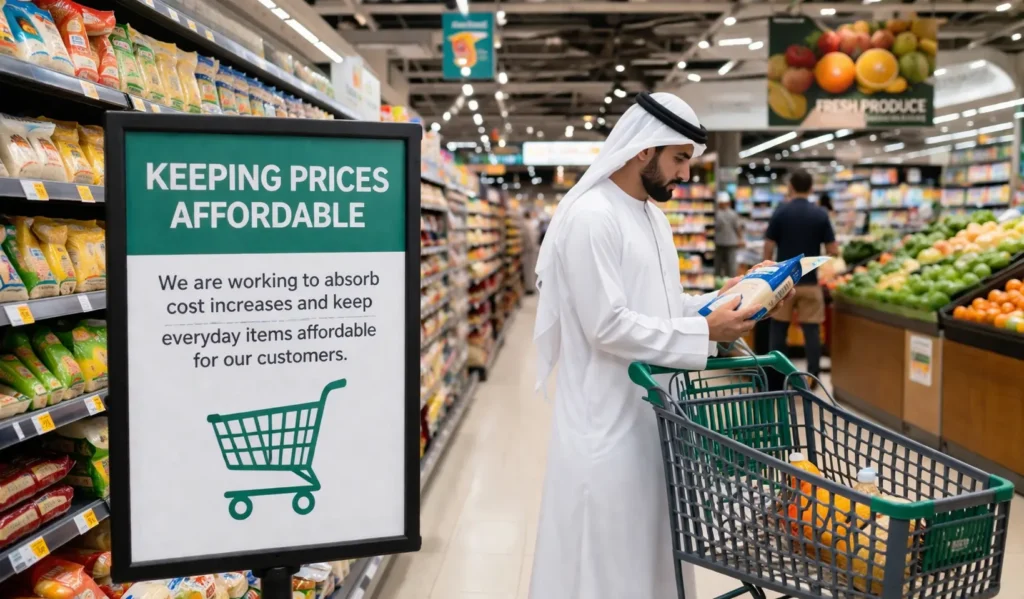

DUBAI/ABU DHABI – For the past few months, Ahmed Al Marzouqi, a truck driver for a major grocery chain, has started his day with the same small ritual. Before he turns the key in the ignition of his refrigerated truck, he says a quiet prayer. Not for safety on the road—though that matters too—but for the price on the pump.
In April, his prayer went unanswered. The cost to fill his truck’s diesel tank jumped by more than seventy percent overnight. What used to cost him roughly 270 dirhams now costs nearly 470 dirhams.
“I drive the same route from Jebel Ali to Sharjah,” Ahmed says, wiping sweat from his forehead at a fueling station. “But my salary doesn’t buy the same kilometers anymore. Something has to give.”
That “something” is now creeping toward your kitchen table.
As the US-Israel-Iran conflict pushes global oil prices higher, the UAE raised fuel prices for April. Petrol went up by 80 fils per liter. But diesel—the lifeblood of the nation’s logistics network—soared from 2.72 dirhams to 4.69 dirhams. That is not a small bump. That is a jolt.
And now, supermarket owners across the country are facing a difficult question: How much of this pain can they hide from their customers?
This is not just a story about numbers on a government spreadsheet. This is a story about every single product you put in your shopping cart. It is about the invisible network of roads, trucks, warehouses, and fuel tanks that make modern life possible. When that network suddenly becomes 70 percent more expensive to run, nothing stays the same.
Let us take a long, deep walk through that network. By the time you finish reading, you will understand exactly why your supermarket manager looks tired these days—and what you can do about it.
H2: The Silent River of Diesel Behind Every Shopping Cart
Let us pause here and think about how a box of strawberries reaches your villa in Dubai Hills. First, a farmer picks it in South Africa or Spain. A diesel-powered ship carries it to Jebel Ali Port. Then, a diesel truck hauls it to a central warehouse in Dubai Industrial City. Another diesel truck moves it to your local supermarket. Finally, a diesel-powered refrigerated unit keeps it cold while you browse the aisles.
Diesel touches almost every single product in your cart. From the frozen peas to the bag of rice to the bottle of cooking oil.
When diesel goes up 70 percent, the cost of moving goods goes up by almost the same amount. Supermarkets are now standing in the middle of this storm. On one side, they have suppliers raising their prices. On the other side, they have families who are already watching every dirham.
“We are trying to be heroes for our customers,” says Ramesh K., the operations manager for a mid-sized supermarket chain in Al Nahda. “But heroes also have to pay their electricity bills. We cannot absorb every single increase forever. That is not realistic.”
Let me give you a concrete example. A standard delivery truck in the UAE drives about 250 kilometers per day. At the old diesel price of 2.72 dirhams per liter, a truck that burns 30 liters per 100 kilometers would spend about 204 dirhams daily on fuel. At the new price of 4.69 dirhams, that same truck costs 352 dirhams per day. That is an extra 148 dirhams every single day. Multiply that by a fleet of 50 trucks, and you are looking at an extra 7,400 dirhams per day. Over a month, that is more than 222,000 dirhams in extra fuel costs.
That money has to come from somewhere. It does not magically appear. It either comes out of the supermarket’s profit, or it comes out of your pocket.
H2: ‘We Are Not a Charity’ – The Hard Math of Grocery Margins
To understand why supermarkets are speaking out, you have to look at the numbers on a spreadsheet most shoppers never see.
A typical grocery store in the UAE runs on very thin profit margins. On everyday items like cooking oil, flour, eggs, and milk, the store might make only 1 to 3 percent profit. Yes, that is correct. For every 10-dirham bag of rice you buy, the store keeps maybe 20 to 30 fils after paying for the rice, the rent, the salaries, the electricity, and—now—the diesel.
When diesel jumps 70 percent, the cost to restock that rice climbs. If the supermarket absorbs all of it, they start losing money on every bag sold. That is a fast road to closing doors.
“People think we are greedy,” says Fatima Al Zaabi, who runs a family-owned grocery in Al Ain. “But last month, my transport bill went up by 8,000 dirhams. My landlord did not lower my rent. My cashiers did not ask for less salary. So where does that 8,000 come from? Either I raise some prices, or I shut down.”
This is the uncomfortable truth. Supermarkets want to keep you happy. Loyal customers are how they survive. But physics and economics do not care about feelings. A truck cannot run on good intentions.
Let us break down a typical supermarket’s monthly budget to see where the money goes. For a medium-sized store doing 2 million dirhams in monthly sales, here is a rough picture:
- Cost of goods sold (paying suppliers): 1,400,000 dirhams (70 percent)
- Staff salaries and benefits: 300,000 dirhams (15 percent)
- Rent and utilities: 150,000 dirhams (7.5 percent)
- Logistics and transport (including diesel): 80,000 dirhams (4 percent)
- Marketing and other expenses: 40,000 dirhams (2 percent)
- Remaining profit before taxes: 30,000 dirhams (1.5 percent)
Now, if the logistics line suddenly jumps by 70 percent, that 80,000 dirhams becomes 136,000 dirhams. That extra 56,000 dirhams has to come out of the profit line. Suddenly, the store is making negative 26,000 dirhams. They are losing money every month.
You can see why “absorbing all costs” is not realistic. It would mean operating at a loss until the store goes bankrupt. No business can do that for long.
H2: What Stays Cheap? The ‘Loss Leader’ Strategy
If you walk into a major UAE supermarket today, you will notice something strange. Some items are still very cheap. Maybe milk is still 4 dirhams. Maybe bread is still the same price as last month. How is that possible?
Retailers use an old trick called the “loss leader.” They take a few important items that you buy every week—milk, eggs, bread, bananas—and they keep those prices low even if it costs them money. Why? Because those cheap items pull you into the store. Once you are inside, you will also buy yogurt, cheese, meat, and maybe a box of cookies. The profit from those other items helps cover the loss on the milk.
“We are protecting the heart of the family’s budget,” explains Tariq Hussein, a category manager for a hypermarket chain. “We know that if diesel forces us to raise the price of milk, a mother with three children will feel that immediately. So we eat that cost on milk. But we might have to quietly adjust the price of imported cheese or premium crackers. Those are not daily necessities.”
This is how supermarkets are surviving the diesel shock without causing public anger. They are choosing their battles carefully. The essential items stay steady. The “nice to have” items might climb a little.
But even this strategy has limits. If diesel stays high for many months, the loss leader becomes a loss everything.
Let me give you a real example from a supermarket in Abu Dhabi. They kept their price of fresh milk at 4.50 dirhams even though their supplier raised the wholesale price by 0.40 dirhams. That means the store is losing 0.40 dirhams on every carton of milk. If they sell 500 cartons per day, that is a loss of 200 dirhams per day just on milk. Over a month, that is 6,000 dirhams lost on a single product. They make up some of that loss when customers buy higher-margin items like fresh juice or pastries. But if too many people come in only for the cheap milk and leave, the store bleeds money.
That is why you sometimes see limits like “maximum two cartons per customer” on loss leader items. The store wants to attract you, but they do not want you to clean them out.
H2: The Domino Effect – From Truck to Shelf to Your Wallet
Let us follow a single product to see how diesel prices travel through the economy. Consider a one-liter carton of Italian olive oil.
- Step 1 – Port to Warehouse: A truck carries 2,000 cartons from Jebel Ali to a warehouse. Old diesel cost: 100 dirhams. New diesel cost: 170 dirhams.
- Step 2 – Warehouse to Store: Another truck moves 500 cartons to your local supermarket. Old cost: 40 dirhams. New cost: 68 dirhams.
- Step 3 – Refrigeration: The olive oil does not need cold storage, but the cheese next to it does. The store’s total electricity bill goes up because diesel powers backup generators in some areas. That cost is shared across all products.
By the time the olive oil reaches the shelf, the store has paid about 0.20 dirhams more per carton just in extra diesel-related costs. That does not sound like much. But multiply that by 10,000 products in the store. Add in higher supplier costs because their diesel bills went up too.
Then, the supermarket has a choice. Raise the olive oil by 0.50 dirhams, or keep the price and lose money on every bottle sold.
“Most stores will take a small increase,” says Ramesh. “Maybe 20 or 30 fils here, 50 fils there. The customer might not even notice on a single item. But over a full shopping cart of 30 items, you might pay an extra 10 or 15 dirhams. That adds up over a month.”
Now let us follow a second product: frozen chicken from Brazil. This is a longer journey. The chicken is frozen on a farm in southern Brazil. It travels 200 kilometers by diesel truck to the port of Santos. Then it crosses the Atlantic Ocean on a container ship that burns heavy fuel oil—similar to diesel. It arrives at Jebel Ali, where another diesel truck takes it to a cold storage warehouse. Finally, a refrigerated diesel truck delivers it to your local supermarket.
Every single step of that journey just got more expensive. The Brazilian farmer pays more for diesel to run his freezers. The shipping line pays more for fuel. The UAE trucking companies pay 70 percent more. By the time that chicken breast hits the refrigerated shelf, the total extra cost could be 1 or 2 dirhams per kilogram. That is why you might see chicken prices creeping up even though there is no shortage of birds.
H2: Suppliers vs. Retailers – Who Blinks First?
Behind the scenes, a quiet war is happening. Food suppliers and distributors are calling supermarket buyers every day asking for higher prices. The retailers are pushing back.
“My chicken supplier said he needs 8 percent more because his feed costs went up, and his delivery trucks use diesel,” says Fatima. “I told him, ‘My customers will not pay 8 percent more for chicken. Meet me at 3 percent.’ We argued for three days. Finally, we settled on 4.5 percent.”
These negotiations happen for hundreds of products every week. The final price you see on the shelf is the result of these small battles.
But some suppliers are not willing to negotiate. Small importers who bring in specialty goods—like organic quinoa or gluten-free pasta—often have very thin margins themselves. They may simply stop selling certain products if diesel makes them unprofitable.
That is another hidden effect of the diesel spike. Some items might simply disappear from shelves, not because of a shortage, but because it no longer makes financial sense to ship them.
Let me tell you about a real case. A small importer of Greek olive oil and honey based in Umm Al Quwain used to bring in one shipping container every month. His total transport costs from Piraeus port to his warehouse were about 12,000 dirhams. After the diesel hike, those costs jumped to nearly 20,000 dirhams. He asked his supermarket customers for a 15 percent price increase. Every single supermarket said no. So he stopped importing. Now, that Greek honey is simply not available in those stores anymore. Customers will never know why. They will just see an empty shelf and assume the store ran out.
This is the invisible side of inflation. Not everything goes up in price. Some things just vanish.
H2: How Other Countries Compare – Putting UAE Prices in Context
It helps to look outside the UAE for a moment. In Europe, diesel prices have been high since the war in Ukraine began. Many supermarkets there have already gone through this pain. In countries like Germany and the UK, grocery prices rose by 15 to 20 percent over two years.
The UAE is trying to avoid that same shock. By allowing diesel to rise in steps—rather than all at once—the government and retailers hope to spread the pain over time. But a 70 percent jump in one month is not a small step. It is a leap.
In the United States, diesel prices are about 30 percent higher than last year. American supermarkets are also warning about higher food costs. In India, diesel price hikes have led to protests from truck drivers.
The UAE is actually handling it better than most. Why? Because the country has large fuel reserves and a very efficient logistics system. The ports, roads, and warehouses here are world-class. That efficiency absorbs some of the shock. But not all of it.
“We are lucky to live in a country that plans ahead,” says Tariq. “But we are not magic. Diesel at 4.69 dirhams hurts. It hurts everyone from the fisherman to the baker to the cashier.”
Let us do a quick global comparison table in words. In the European Union, diesel taxes are very high, so the pump price can reach 7 or 8 dirhams per liter. In the United States, diesel is around 3.50 to 4 dirhams per liter depending on the state. In Saudi Arabia, diesel is still heavily subsidized at around 1.50 dirhams per liter. The UAE sits in the middle. The government removed most fuel subsidies a few years ago, so prices follow global markets more closely. That means when global oil jumps, UAE prices jump. The good news is that when global oil falls, UAE prices fall too. The bad news is that no one knows when the current conflict will end.
H2: What Can Shoppers Do? Practical Tips to Beat the Creep
If you are a family trying to keep your grocery bill under control, you do not have to just sit and accept higher prices. Here are twelve practical moves that smart shoppers are using right now.
1. Buy store brands (private labels). Supermarkets make higher profits on their own brands, so they are more willing to absorb diesel costs on those items. The generic rice or canned tomatoes are often a better deal than the big-name brands. In fact, store brands can be 20 to 30 percent cheaper for the exact same quality. Many are made in the same factories as the big brands, just with a different label.
2. Shop the perimeter of the store. Fresh produce, dairy, and meat are usually on the outer walls. These items turn over quickly, so supermarkets keep prices competitive. The expensive, heavily processed snacks in the middle aisles are where hidden price increases often appear first. If you stick to the perimeter for most of your shopping, you will avoid the worst of the creeping increases.
3. Look for bulk buys on non-perishables. If rice, lentils, oil, or flour are on sale, buy a little extra. Diesel prices might go up again next month. Locking in today’s price for a 10kg bag of rice is a small hedge against tomorrow’s trucking costs. Just make sure you have proper storage. A sealed plastic bin keeps bugs out and rice fresh for months.
4. Adjust your shopping days. Many supermarkets run “loss leader” promotions on specific days of the week—usually Tuesday or Wednesday when traffic is slower. That is when you will find milk, eggs, and bread at below-cost prices. Some stores also have “morning hours” specials right after opening. Ask your local store manager about their promotion schedule.
5. Use loyalty apps. Stores track what you buy. If you scan your loyalty card, they see that you are a steady buyer of certain items. Many apps now offer personalized digital coupons on exactly the staples that are facing cost pressure. Let the algorithm work for you. Over time, the app learns that you buy eggs every week and will send you a coupon for 1 dirham off.
6. Compare unit prices, not shelf prices. That big 5kg bag of rice might look expensive at 25 dirhams, but the unit price is 5 dirhams per kilo. The small 1kg bag at 6 dirhams has a unit price of 6 dirhams per kilo. The bigger bag is cheaper per kilo even if the total price is higher. With transport costs rising, bigger packages usually offer better value because they take less truck space per unit of food.
7. Consider frozen over fresh. Frozen vegetables and fruits are often cheaper than fresh ones, especially when diesel is high. Why? Because frozen goods are shipped in massive bulk containers and can sit in warehouses for months without spoiling. Fresh goods need fast, expensive refrigerated transport. If diesel is expensive, fresh becomes much more expensive than frozen.
8. Join a community buying group. In many neighborhoods, groups of families pool their orders to buy directly from wholesalers. A 25kg bag of rice from a wholesaler might cost 80 dirhams. Split five ways, that is 16 dirhams for 5kg—much cheaper than the supermarket. The rise of WhatsApp and Telegram has made these buying groups very popular. Ask your neighbors if one exists in your building.
9. Reduce food waste. The average UAE family throws away about 15 to 20 percent of the food they buy. That is like taking 20 dirhams out of your wallet and throwing it in the bin every time you shop for 100 dirhams. When prices are rising, wasting food hurts twice as much. Plan your meals for the week. Make a shopping list and stick to it. Use leftovers for lunch the next day. Freeze bread and meat before they go bad.
10. Switch to cheaper proteins. Chicken and eggs are usually cheaper than beef or lamb. Beans, lentils, and chickpeas are even cheaper. A bag of dried chickpeas costs a few dirhams and can make multiple meals. With diesel making animal feed more expensive, meat prices will rise faster than plant proteins. This is a good time to try one or two vegetarian meals per week.
11. Shop at discount grocers. Stores like Viva, Nesto, and Day to Day have built their entire business model on low prices. They keep costs down by having fewer fancy displays, simpler store layouts, and a smaller selection of products. These savings are passed to you. During times of high diesel prices, discount grocers often shine because their margins are already razor-thin, and they cannot afford to raise prices as much as fancy hypermarkets.
12. Talk to your store manager. This might sound strange, but many supermarket managers have the power to order specific products for loyal customers. If you buy a certain brand of rice every month and the price just jumped, ask the manager if there is a similar product at a lower price. Sometimes they will order a different size or a different brand just for you. It never hurts to ask politely.
H2: A Day in the Life of a Supermarket Supply Chain
To really understand the diesel problem, you have to walk through an entire day in the life of a supermarket supply chain. Let us follow a single pallet of canned tuna from the port to your shopping cart.
4:00 AM – Jebel Ali Port. A shipping container from Thailand is lifted off a cargo ship. Inside are 2,000 cartons of tuna, each containing 48 small cans. The container is loaded onto a chassis pulled by a diesel truck driven by a man named Sajid. Sajid has been driving for 12 years. He watches the fuel gauge nervously. His boss told him that any extra fuel use will come out of his bonus this month.
6:30 AM – Central Warehouse in Dubai South. Sajid backs the container into a receiving bay. Warehouse workers unload the cartons onto wooden pallets. Each pallet holds 100 cartons. A forklift—also running on diesel—moves the pallets into a storage rack. The warehouse manager scans each pallet into the computer system. The system calculates that the diesel cost to move this container from port to warehouse has increased by 340 dirhams compared to last month.
9:00 AM – Order Picking. A store in Sharjah sends an order for 10 pallets of tuna. A diesel-powered forklift pulls those pallets from the rack and moves them to the loading dock. Another diesel truck, driven by a man named Khalid, backs up to the dock. Khalid loads the 10 pallets carefully. He knows that rough driving can damage cans, but gentle driving also saves diesel. He chooses the gentle route.
11:30 AM – Delivery to Store. Khalid arrives at the supermarket in Sharjah. The store manager checks the delivery against the invoice. Everything is correct. The store’s backroom staff use a hand truck—no diesel here—to move the pallets into the storage room. But the storage room is kept cool by a refrigeration unit that runs on electricity. That electricity comes from the grid, which is partly generated by… you guessed it, diesel and natural gas.
1:00 PM – Stocking the Shelves. A shelf stocker named Maria opens a carton of tuna and places the cans on the shelf. She notices that the price tag has changed. Last week, a can was 3.50 dirhams. This week, it is 3.75 dirhams. A customer walking by sees the new price and sighs. She puts one can in her cart instead of the two she had planned.
6:00 PM – The Checkout. The customer reaches the cashier. Her total bill is 178 dirhams. Last week, the same items cost 168 dirhams. She cannot point to any single item that jumped dramatically. But everything went up by a little bit. The tuna went up by 0.25. The bread went up by 0.50. The yogurt went up by 0.30. The bananas went up by 0.40 per kilo. These small increases add up to 10 dirhams. She pays and leaves, feeling vaguely uneasy.
This is how diesel inflation works. It is not a single big shock. It is a thousand tiny cuts.
H2: The Future – Will Diesel Come Back Down?
Here is the question everyone wants answered. Will diesel drop back to 2.72 dirhams?
The honest answer is: probably not soon.
Global oil prices are driven by politics and war, not by what UAE families need. The conflict involving the US, Israel, and Iran shows no sign of cooling down. As long as that tension continues, oil traders will keep prices high. In fact, some analysts predict that if the conflict spreads to the Strait of Hormuz—a narrow passage through which much of the world’s oil travels—prices could double again.
However, the UAE government has a history of stepping in to protect citizens. In the past, when fuel prices hurt too much, subsidies appeared. There is no official announcement yet, but analysts say that if diesel stays above 4.50 dirhams for three months, we could see some relief measures. These might include direct subsidies for food transport trucks, reduced tolls on highways for delivery vehicles, or temporary price caps on essential items.
There is another factor to watch: the summer driving season. In the UAE, summer means air conditioning, and air conditioning means more electricity demand. Power plants burn diesel and natural gas. If demand spikes in July and August, prices could go even higher. Some energy experts predict diesel could touch 5.50 dirhams per liter by August if the conflict continues and summer heat arrives.
But there is also reason for cautious hope. The UAE is investing heavily in clean energy and alternative fuels. Some logistics companies are already testing electric trucks for short delivery routes. Others are switching to compressed natural gas, which is cheaper and cleaner than diesel. A few forward-thinking supermarkets are installing solar panels on their warehouse roofs to reduce reliance on diesel-generated electricity.
In the meantime, supermarkets are doing what they have always done. They are adapting. Some are switching some trucks to cleaner, cheaper compressed natural gas. Others are reorganizing delivery routes to drive fewer kilometers. A few are even experimenting with electric delivery vans for short trips.
“Necessity is the mother of invention,” says Ahmed the truck driver. “I cannot change the price at the pump. But I can drive more smoothly, keep my tires inflated, and avoid rush hour traffic. Every drop of diesel I save is one drop of profit for my boss and one drop of stability for the customer.”
Ahmed has also started using a smartphone app that shows him the cheapest diesel stations along his route. He saves about 15 dirhams per day this way. It is not much, but over a month, that is 450 dirhams. Over a year, more than 5,000 dirhams. Small savings add up.
H2: A Story From the Stockroom – Meet Priya, the Inventory Manager
To really understand the diesel problem, you have to walk into a supermarket stockroom after hours. Let me introduce you to Priya, an inventory manager at a medium-sized store in Deira.
Priya starts her shift at 5 AM. Her first job is to check the “out of stock” report. Lately, that report has been getting longer. Not because products are unavailable in the country, but because her store is trying to order smaller, more frequent deliveries to save on storage costs. That sounds smart. But smaller deliveries mean more trucks. More trucks mean more diesel.
“It is a circle,” Priya says, pointing at her whiteboard. “If I order a full truck once a week, I pay one diesel fee. But I need a big warehouse. If I order half a truck twice a week, I pay two diesel fees. My boss told me to save on warehouse rent. But now I am spending more on diesel.”
Priya has started using a simple rule. For heavy, cheap items like bottled water and soft drinks, she orders full trucks. For light, expensive items like baby formula and coffee, she orders smaller trucks. It is not perfect, but it helps.
“Yesterday, a customer asked me why baby milk went up by 1 dirham,” she says. “I wanted to explain about diesel, about port fees, about the supplier. But she was tired. She just wanted her baby to eat. So I just said, ‘I am sorry.’ And I meant it.”
That moment—the tired mother, the apologetic manager, the silent truck driver—is the real story of the 70 percent diesel hike. It is not about numbers on a screen. It is about the small, daily negotiations that families make to put food on the table.
Priya has also noticed that some of her regular customers have changed their behavior. One elderly Syrian man used to buy fresh bread every morning. Now he comes every other day. A Filipino family used to buy a whole roasted chicken twice a week. Now they buy it once a week and stretch it with more rice. A young Egyptian couple used to buy expensive imported cheeses. Now they buy local cheese, which is cheaper because it travels shorter distances.
“People are adapting,” Priya says. “That is what humans do. We adapt. But adaptation takes time. And it is tiring. Everyone is a little more tired than they were last month.”
H2: The Ripple Effect Beyond the Supermarket
It would be a mistake to think that only supermarkets feel the diesel squeeze. The effects ripple outward into every corner of the economy. Let me give you a few examples.
Restaurants and Cafes. A small cafeteria in Al Quoz that delivers sandwiches and coffee to offices now pays 70 percent more to keep its delivery motorcycles running. Some cafes have added a small “delivery fee” to orders. Others have raised menu prices by 1 or 2 dirhams per item. A few have stopped delivering to faraway areas altogether.
Bakeries. A bakery in Ajman uses diesel ovens. Yes, many commercial ovens run on diesel or natural gas. When diesel jumps, the cost of baking a loaf of bread jumps too. Some bakeries have started baking earlier in the morning when diesel is slightly cheaper (prices vary by time of day in some commercial contracts). Others have switched to electric ovens, but that requires expensive rewiring.
Farms. A dairy farm in Al Ain uses diesel pumps to water its cows and diesel trucks to collect milk. The farm’s monthly fuel bill went from 15,000 dirhams to 25,000 dirhams. The farm owner says he will have to raise the price of fresh milk by 0.20 dirhams per liter. That increase will show up in your supermarket within weeks.
Schools. Many private schools in the UAE use diesel buses to transport students. Those schools are now facing higher transport costs. Some schools have sent letters to parents saying that bus fees will increase next term. Others have absorbed the cost but warned that fees will rise in the fall.
Hospitals and Clinics. Hospitals rely on diesel generators for backup power. They also use diesel-powered ambulances and medical supply trucks. A private hospital in Dubai says its monthly fuel bill has jumped by 40,000 dirhams. That money will have to come from somewhere—either higher patient fees or cuts to other services.
Construction. Building a new villa or apartment tower requires diesel for excavators, cranes, concrete mixers, and transport trucks. Construction companies are already adding fuel surcharges to their contracts. That means new homes and apartments will cost more to build, and those costs will eventually be passed on to renters and buyers.
You see the pattern. Diesel is not just about your groceries. It is about almost everything in modern life.
H2: Government and Industry Responses – What Is Being Done?
The UAE government is not sitting idle. Several measures are already being discussed or implemented to ease the pressure.
Temporary Subsidies. According to industry sources, the Ministry of Economy is considering temporary diesel subsidies for essential food transport. Trucks carrying milk, bread, eggs, and rice could receive a fuel card that caps their diesel price at 3.50 dirhams per liter. The government would pay the difference to the fuel stations. This would cost the government millions but would protect the most essential foods.
Toll Reductions. The Salik toll system in Dubai and the Darb toll system in Abu Dhabi could offer discounts for commercial trucks during off-peak hours. If trucks can avoid the most expensive toll times, they save money. Those savings could be passed on to supermarkets and then to customers.
Port Fee Waivers. The ports of Jebel Ali, Khalifa, and Sharjah could waive or reduce fees for food import containers. This would lower the total cost of bringing food into the country, offsetting some of the diesel increase.
Price Caps. In extreme cases, the government could impose temporary price caps on essential items. This has been done before during the COVID-19 pandemic. Supermarkets would be legally prohibited from raising the price of milk, bread, cooking oil, and rice above a certain level. The government would compensate supermarkets for their losses. This is a last resort but remains on the table.
Public Awareness Campaigns. The government could launch a campaign encouraging families to reduce food waste, buy local produce, and use public transport for their own shopping trips. Less waste means less demand, which means lower prices over time.
Industry groups are also taking action. The UAE Supermarket Owners Association has formed a task force to share best practices for reducing diesel consumption. Members share tips on route optimization, truck maintenance, and driver training. One member saved 12 percent on diesel just by teaching drivers to avoid hard braking and rapid acceleration. Another saved 8 percent by installing wind deflectors on truck roofs.
H2: The Human Face of the Diesel Hike – Three Stories
Let me tell you about three real people whose lives have changed because of the diesel price jump.
Story 1 – Youssef, the Delivery Driver. Youssef works for a grocery delivery app. He uses his own small van to deliver orders to customers in Dubai Marina and JLT. Before the diesel hike, he spent about 600 dirhams per week on fuel. Now he spends over 1,000 dirhams. His earnings have not changed. He is now working 12-hour days instead of 8-hour days just to make the same amount of money after fuel. He has not seen his children awake in two weeks because he leaves before sunrise and returns after they are asleep. “I am tired,” he says simply. “But what can I do? I have bills.”
Story 2 – Layla, the Single Mother. Layla lives in Sharjah and works in Dubai. She has two children in school. She used to do her grocery shopping once a week at a large hypermarket near her office. Now she shops twice a week at a small grocery near her home. The small grocery is more expensive on some items, but she saves on transport because she does not have to drive as far. She has also stopped buying fresh juice and premium yogurt. “Those are luxuries,” she says. “We can live without them.” Her children do not understand why their favorite snacks are gone. Layla does not have the heart to explain diesel prices to a six-year-old.
Story 3 – Sanjay, the Small Grocery Owner. Sanjay runs a corner grocery store in a working-class neighborhood in Ras Al Khaimah. His customers are mostly laborers and low-income families. He has not raised a single price in three months, even though his costs have gone up. Instead, he has cut his own salary to zero. He lives off his savings. “These people cannot pay more,” he says, gesturing at the street outside. “If I raise prices, they will hate me. And I have to live here. I would rather be poor than hated.” Sanjay does not know how much longer he can last. His savings are running out. He is hoping for a miracle.
These three stories—Youssef, Layla, and Sanjay—represent millions of people across the UAE. They are not statistics. They are human beings trying to survive a difficult time.
H2: Looking Ahead – Six Months from Now
What will the world look like six months from now if diesel stays high? Let me paint a realistic picture.
Supermarkets will look different. You will see more store brands and fewer international brands. The shelves will have more local produce and fewer imported fruits and vegetables. The fresh seafood section might shrink because fishing boats burn diesel. The bakery section might offer fewer fancy pastries and more basic bread.
Restaurants will change their menus. Many restaurants will quietly remove expensive imported items and replace them with cheaper local alternatives. That Italian restaurant might start serving Egyptian olive oil instead of Italian. That steakhouse might offer more chicken dishes and fewer beef dishes. Some restaurants will add a small “fuel surcharge” to your bill, usually 2 to 3 percent.
Your shopping habits will evolve. You will become a smarter shopper. You will buy more frozen food, more bulk items, and more store brands. You will waste less food. You will plan your meals. You might even start a small herb garden on your balcony to save on fresh herbs.
The government might step in. If public pressure grows, the government could announce a diesel subsidy for essential goods. This would be expensive but popular. Elections are not a factor in the UAE, but social stability is. The government has a strong interest in keeping food affordable.
Global events will decide everything. If the US-Israel-Iran conflict de-escalates, oil prices could fall quickly. Diesel could drop back to 3 dirhams or even lower. If the conflict escalates, diesel could go to 6 or 7 dirhams. No one can predict geopolitics. The only certainty is uncertainty.
H2: The Bottom Line – Honesty Is Better Than Silence
After speaking with a dozen supermarket owners, managers, drivers, and customers, one message comes through clearly: they do not want to surprise you.
The worst thing a store can do is raise prices quietly, hoping you will not notice. Customers always notice. And when they feel tricked, they leave.
That is why so many retailers are speaking publicly now. They are saying, “We are trying to absorb what we can. But we cannot absorb everything. Please understand.”
It is an uncomfortable conversation. No one likes to talk about money getting tighter. But hiding the truth is worse.
So the next time you see that a box of your favorite cereal costs 50 fils more than last week, do not assume greed. Assume diesel. Assume a truck driver named Ahmed, a manager named Ramesh, and a stockroom worker named Priya. They are all doing their best to keep your grocery bill from exploding.
And for now, that best is still pretty good. Most everyday essentials remain affordable. The loss leaders are still leading. And the UAE’s supermarkets are still some of the most competitive in the world.
But if global tensions continue and diesel stays high, do not be surprised if that “not realistic” warning becomes a reality. The checkout line is where the global economy meets your kitchen table. Right now, that meeting is getting a little more expensive.
The question is not whether prices will rise. They already have. The question is how we respond. Will we panic? Will we blame each other? Or will we adapt, help each other, and remember that most of us are just trying to feed our families?
I choose adaptation. I choose help. And I choose to believe that the people running our supermarkets—the Ahmeds, the Rameshes, the Priyas, the Fatimas—are doing their honest best.
That is worth something. In fact, in a world of rising diesel prices, honesty might be the most affordable thing left.
H2: Key Takeaways – What to Remember
- Diesel jumped 70% in April (from 2.72 to 4.69 dirhams per liter) due to global oil price spikes from the US-Israel-Iran conflict.
- Supermarkets have thin margins (1-3% on staples) and cannot absorb all higher transport costs forever. They are not being greedy; they are being realistic.
- Loss leaders like milk, eggs, and bread are being protected, but other items may see small increases of 20 to 50 fils.
- Every product on the shelf is touched by diesel—from shipping to warehousing to refrigerated trucks to the checkout scanner.
- The domino effect means that even a small diesel increase eventually becomes a small price increase on hundreds of items.
- Smart shopping habits (store brands, bulk buys, loyalty apps, perimeter shopping, frozen over fresh, reduced waste) can help families save 10 to 20 percent on their grocery bills.
- Restaurants, bakeries, farms, schools, hospitals, and construction are all feeling the diesel squeeze. The effects go far beyond the supermarket.
- The government is considering help in the form of diesel subsidies, toll reductions, port fee waivers, or temporary price caps on essential foods.
- The future depends on global politics. If the US-Israel-Iran conflict eases, diesel may drop. If tensions rise, prices could go higher. Summer heat will also push prices up.
- Real people are struggling. Delivery drivers are working longer hours. Single mothers are changing their shopping habits. Small shop owners are cutting their own salaries.
- Honesty is the best policy. Supermarkets that communicate openly with customers will keep their loyalty even during hard times.
- Adaptation is possible. Families that plan, buy smart, and reduce waste can weather this storm without dramatic changes to their quality of life.
Final word from a cashier in Al Barsha: “Last week, a little boy put a chocolate bar on the counter. His mother looked at the price, sighed, and put it back. She said, ‘Maybe next week.’ That is what 70 percent diesel looks like. It is not a crisis. Not yet. But it is a thousand small ‘maybe next weeks.’”
Another cashier in Abu Dhabi told me something similar. An elderly man came through her line with a basket of the cheapest items in the store—a bag of rice, some canned beans, a small bottle of oil, and a single tomato. He paid with exact change, counted it twice, and walked out slowly. She never saw him buy fresh meat or vegetables again.
These are not stories of disaster. No one is starving. No one is rioting. But there is a quiet sadness creeping into the aisles. People are making choices they did not have to make before. They are crossing things off their lists not because they do not want them, but because they cannot justify the cost.
That is the real measure of the diesel hike. It is not about inflation percentages or economic models. It is about the chocolate bar that stays on the shelf. The tomato that becomes a luxury. The second can of tuna that goes back in the cooler.
We will get through this. The UAE has weathered many storms before. But getting through it does not mean pretending it is not happening. It means acknowledging the pain, helping where we can, and making smart choices with our dirhams.
So the next time you fill up your car or push your cart through the supermarket doors, remember the silent river of diesel that flows beneath everything. It is wider and deeper than most of us ever imagined. And right now, that river is running fast and expensive.
But rivers can be navigated. With patience, with knowledge, and with a little bit of help from each other, we will find the way through.



This design is incredible! You definitely know how to keep a reader amused. Between your wit and your videos, I was almost moved to start my own blog (well, almost…HaHa!) Fantastic job. I really loved what you had to say, and more than that, how you presented it. Too cool!
Sweet internet site, super layout, real clean and employ genial.
Quick installation and the app is very light on memory. Everything is optimized for a great experience. Get it now at luky888download.
Finally found a login page that actually works without any glitches. The app is fast and the games load instantly. Highly recommend pwin777applogin for anyone tired of laggy sites.
The login is seamless and the games load instantly. It is perfect for quick sessions during my break. Visit fh777login for a smooth ride.