
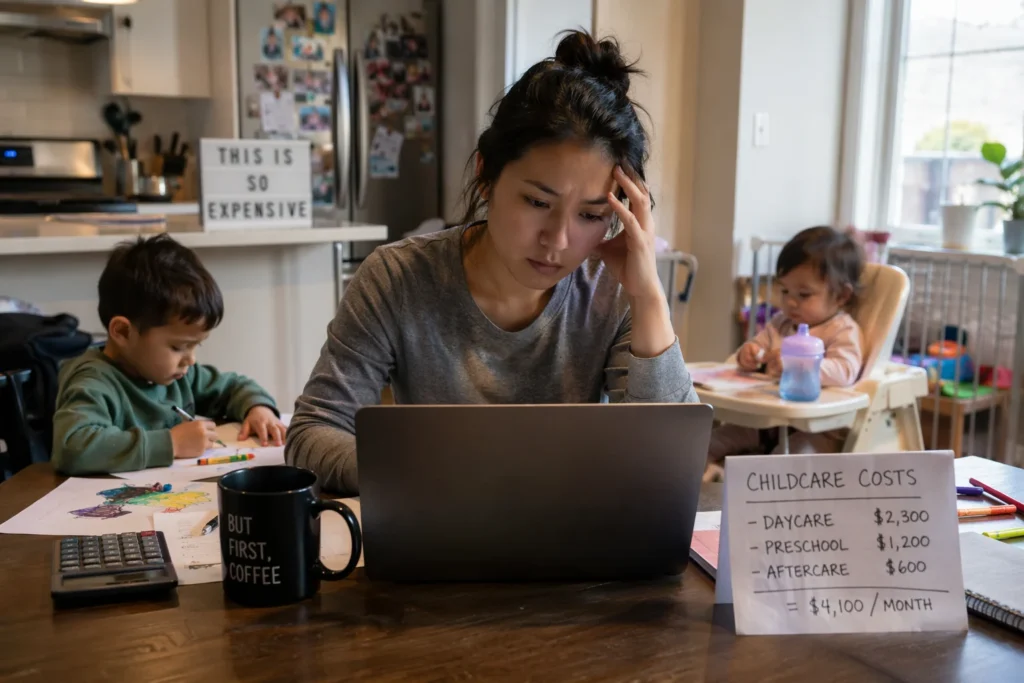

The first time Maria added up the numbers, she thought she had made a mistake. She was sitting at her kitchen table in San Jose, a calculator in one hand and a coffee that had gone cold in the other. On her screen, she had two columns: what she brought home every month from her marketing job, and what two daycare centers had quoted her for her toddler and infant.
She ran the math three times. Each time, the answer was the same. Her take-home pay was $4,200. The daycare bill would be $3,800.
“I actually laughed out loud,” Maria says. “Then I cried.”
Maria, who asked us to use only her first name to protect her family’s privacy, is not alone. Across the nine counties that make up the San Francisco Bay Area, thousands of parents sit down at kitchen tables just like hers every year. They do the same math. And they reach the same painful conclusion: one parent might as well stay home.
This isn’t a story about lazy parents or bad budgets. It’s a story about a system that has quietly broken. Child care in the Bay Area now costs more than rent in most American cities. It costs more than a year of college at a state university. And for many families, it costs so much that the second paycheck barely covers the gas to drive to work.
Let’s walk through what is happening, why it got this way, and what families are actually doing to survive. This is not a small problem. It touches nearly every family with young children in this region. And the stories you are about to read are real. The names have been changed, but the pain is authentic.
The Shocking Math of a Second Paycheck
Let’s get specific with the numbers, because that is where the story gets real. Too often, people talk about child care being “expensive” without explaining what that actually means. So let’s spell it out.
In 2025, the average cost of full-time child care for an infant in San Francisco is over $2,500 per month. In some centers, it pushes $3,200. For a toddler, you are looking at $2,200 to $2,800. If you have two kids, one infant and one preschooler, you are easily paying $4,500 to $5,500 per month.
Now, compare that to take-home pay. The median household income in the Bay Area is high—around $130,000 per year. But that is before taxes. After federal taxes, state taxes (California has one of the highest rates), Social Security, and health insurance premiums, a $130,000 salary brings home roughly $7,500 per month.
If child care eats up $5,000 of that, you have $2,500 left for rent, food, car payments, gas, utilities, and everything else. In the Bay Area, the average one-bedroom apartment rents for $2,800.
Do you see the problem? The numbers don’t fit. They literally do not fit.
That is why so many parents look at their second paycheck and realize it is already spent before they even earn it. They are working full-time just to hand the money directly to a daycare center. Some parents call this “working for free.” Others call it what it is: a trap.
Let’s break down a typical month for a family making $150,000 a year. That sounds like a lot of money to someone living in Ohio or Mississippi. But in the Bay Area, it is solidly middle class. Here is how the numbers shake out.
Gross monthly income: $12,500. Taxes and deductions: roughly $4,000. Take-home pay: $8,500. Rent for a two-bedroom apartment: $3,200. Child care for two kids: $4,800. That leaves $500 for groceries, gas, utilities, car insurance, phone bills, and everything else. One trip to the emergency room or one car repair can wipe out an entire family’s finances.
And here is the kicker. That $4,800 for child care? That is not the fancy center with the language immersion program and the organic meals. That is the average center. The one with the waiting list. The one where the teachers are overworked and underpaid.
When parents look at these numbers, they do not feel angry at first. They feel confused. They feel like they must have done the math wrong. Then they feel numb. Then they start making impossible choices.
One Family’s Story: “I Stayed Home Longer Than I Planned”
Take James and Priya. They live in Oakland in a small two-bedroom apartment near Lake Merritt. James works as a project manager for a tech company. He is good at his job. He has been there for seven years. Priya was a dental hygienist. She loved her work. She loved the steady hours and the fact that she was helping people.
When their daughter Maya was born, they planned for Priya to take four months of leave and then go back to work three days a week. They had it all mapped out on a whiteboard in their kitchen.
“We had it all figured out,” Priya says. “My mom said she could help two days a week. We found a small in-home daycare for the other three days. The price was $1,900 for part-time. We thought, okay, that’s high but we can manage.”
Then life happened. Priya’s mom had a health scare. It was her heart. She needed surgery and months of recovery. She could no longer watch Maya. The part-time spot at the daycare fell through because another family took it. The only full-time spot they could find cost $2,600 per month.
Priya’s take-home pay as a hygienist working four days a week was $3,100. After paying $2,600 for child care, she would have $500 left. That $500 had to cover her commute ($180 for BART and gas), her work lunches ($100), her professional license fees ($50 per month averaged out), and her work clothes ($50). In the end, she would be taking home less than $200 per month for forty hours of work.
“I sat down with James and I said, ‘Honey, I am literally working for two hundred dollars a month.’ That’s less than minimum wage. That’s less than nothing. I would make more money staying home and walking the neighbor’s dog.”
So Priya stayed home. She cried about it for three days. Then she packed up her work bag, put it in the back of her closet, and tried to be grateful. She planned to go back when Maya started kindergarten. But then Maya turned five, and kindergarten in Oakland is only six hours a day. Before and after school care for those extra hours cost another $1,200 per month.
Priya is still at home. Her career as a hygienist has been on hold for four years now. She has lost her continuing education credits. Her network has moved on. The dental office where she worked hired someone else, and that person has already been promoted twice.
“I don’t regret being with my daughter,” she says. “I really don’t. Those years were precious. But I do regret that I didn’t have a real choice. I regret that the system forced my hand. I regret that my skills are now rusty and that going back feels impossible.”
Priya is now studying to become a medical billing specialist. It is a job she can do from home. It pays half what she used to make. But it fits around her kids’ school schedule. “I had to reinvent myself,” she says. “At forty-two years old. That was not the plan.”
It’s Not Just Moms: Dads Are Feeling the Squeeze Too
We tend to talk about child care as a “mom problem.” And it’s true that women still take on most of the caregiving. But in the Bay Area, a growing number of fathers are also stepping back from work, or stepping out entirely. This is a quiet shift. You do not see it in the headlines. But it is happening in neighborhoods across the region.
Carlos is a former electrician who lives in Hayward. He is thirty-eight years old. He has calloused hands and a quiet way of speaking. He and his wife Lisa both worked full-time. Lisa earned more as a nurse, so when their son’s daycare raised its rates by 15 percent in one year, they had a hard conversation.
“Lisa said, ‘You make forty dollars an hour, but after taxes and daycare for two kids, you’re bringing home maybe fifteen dollars an hour. That’s not worth the stress.’ She was right. I hated it, but she was right.”
Carlos now stays home with their two boys, ages two and four. He does some handyman work on weekends when Lisa is off. He fixes leaky faucets and patches drywall. He says the hardest part is not the money—they make it work by cutting everything to the bone. No eating out. No new clothes. No vacations. They drive a 2008 minivan with 180,000 miles.
The hardest part is the feeling of invisibility.
“At the park, I’m the only dad. Moms look at me like I’m lost. People ask what I ‘do,’ and when I say I’m a stay-at-home dad, they ask when I’m going back to ‘real work.’ It’s lonely. I have no dad friends. There is no playgroup for guys like me.”
Carlos also struggles with the loss of identity. He was proud to be an electrician. He liked fixing things. He liked the respect that came with a trade. Now he spends his days wiping noses, making peanut butter sandwiches, and breaking up fights over toy trucks.
“I love my boys more than anything. But I miss being good at something. I miss the feeling of solving a problem. The biggest problem I solve now is which cartoon to put on so I can pee in peace.”
But Carlos also sees the upside. “My boys know me. Really know me. They run to me when they fall down. They tell me their secrets. That’s worth something. But I wish we had a choice. I wish staying in my career had been an option. I wish the math had worked out differently.”
Carlos is not alone. Data from the U.S. Census Bureau shows that the number of stay-at-home fathers has doubled over the past twenty years. In the Bay Area, that number is growing even faster. Some of these dads chose the role. Many more fell into it because child care was simply too expensive.
The Hidden Cost: Losing Years of Career Growth
Here is what the monthly payment doesn’t show you. The real cost of leaving the workforce is not just the money you lose today. It is the money you lose forever. It is the promotions you never get. The retirement savings you never build. The social security credits you never earn.
When a parent stays home for three, four, or five years, they don’t just miss those paychecks. They miss raises. They miss promotions. They miss 401(k) matching. They miss Social Security credits. And when they try to go back, their skills have aged out. Their network has moved on. Their resume has a gap that employers question.
Economists call this the “motherhood penalty.” It’s real, and it is brutal. Studies have shown that mothers are offered lower starting salaries than fathers with the same resume. They are less likely to be called back for interviews. They are seen as less committed, even when they are working just as hard.
One study from the Center for American Progress found that a woman who leaves the workforce for three years loses, on average, nearly $500,000 in lifetime earnings. For a high-earning professional in the Bay Area, that number can easily top one million dollars. That is not a typo. One million dollars.
Jenny, a former software engineer in Sunnyvale, stayed home for five years with her twins. When she tried to return, she found that the coding languages she knew were no longer in demand. She knew Python and Java. Employers wanted React and cloud computing. She applied for 200 jobs. She got three interviews. She eventually took a position making half her old salary.
“I used to lead teams,” Jenny says. “I managed projects with twelve engineers. Now I’m a junior developer again at age forty-four. My manager is twenty-eight. He asks me to take notes in meetings. It’s humiliating. But I had to start somewhere.”
Her husband still works at the same tech company. He got promoted twice while she was home. Their retirement accounts show the difference clearly: his is full; hers is empty. She will have to work an extra ten years to catch up, if she ever catches up at all.
Jenny has advice for younger women: “Do not leave the workforce completely. Even if you have to work part-time. Even if you have to take a lower-paying job. Stay connected. Keep your foot in the door. Because the door closes faster than you think.”
But even part-time work is hard to find in the Bay Area. Many tech companies do not offer part-time engineering roles. And the part-time jobs that do exist often come without benefits. No health insurance. No 401(k). No paid time off. So parents are forced into an all-or-nothing choice. And many choose nothing.
Why Is Child Care So Expensive Here? Let’s Break It Down.
You might be thinking: why does child care cost so much? It’s just watching kids, right? But running a legal child care center in California is not like running a babysitting circle. The costs are enormous. Let me walk you through the real economics.
First, there is rent. A daycare center needs space. Not just any space. It needs a building with bathrooms, a kitchen, outdoor play areas, and emergency exits. In the Bay Area, commercial real estate is some of the most expensive in the world. A center might pay $15,000 to $30,000 per month just for the building. Some pay even more.
Second, there are workers. California law requires a certain number of teachers per child. These are called ratios. For infants, it is one teacher for every four babies. That means a room with eight babies needs two full-time teachers. Those teachers need to be paid. In the Bay Area, a living wage for a child care teacher is at least $25 to $30 per hour. But many earn less than that, which is a whole other problem we will get to.
Third, there are regulations. Licensed centers must follow strict rules about safety, cleaning, food preparation, outdoor space, and background checks. These rules keep kids safe, but they also cost money. Every toy must be sanitized. Every outlet covered. Every staff member trained in CPR. Every meal planned to meet nutritional guidelines. The paperwork alone takes hours each week.
Fourth, there is insurance. Liability insurance for a child care center has skyrocketed in recent years. One small center in Berkeley told us their insurance bill went from $8,000 a year to $22,000 in just two years. They did not have any claims. The insurance companies just raised rates across the board.
Fifth, there are the small costs that add up. Diapers. Wipes. Crayons. Paper towels. Cleaning supplies. Snacks. Nap mats. Art supplies. Replacement toys. These things do not seem expensive on their own. But when you are buying them for twenty or thirty kids every single week, the bill is huge.
Add it all up, and the average cost to run a child care center in the Bay Area is around $15,000 per child per year. That is before any profit. Most centers run on razor-thin margins. Many close. According to the California Child Care Resource and Referral Network, the state has lost nearly 3,000 licensed child care centers in the past five years. That is not a typo. Three thousand.
When a center closes, the families who used it are left scrambling. They call other centers. Those centers have waiting lists. Some waiting lists are two years long. So parents end up taking whatever they can find, even if it is far from home or more expensive than they can afford.
The Provider’s Pain: Why Daycare Owners Are Struggling Too
We hear a lot about parents. But what about the people running these centers? They are not getting rich. Most are barely getting by. And their stories are just as heartbreaking as the parents’ stories.
Maria Elena Garcia runs a small home-based daycare in East San Jose. She is licensed for eight children. She has been doing this for eighteen years. She charges $2,200 per infant. That sounds like a lot of money. But let’s look at her real numbers.
She brings in about $14,000 per month in tuition. Out of that, she pays rent on her home ($3,500). She has to rent a house with a big backyard and a safe play area. That costs more than a regular apartment. She buys food for the kids ($1,200). She buys supplies and toys ($500). She pays for insurance ($500). She pays one part-time helper ($2,000). She also pays for her own health insurance ($800) and sets aside money for taxes ($2,000).
After all that, she takes home about $3,500 per month. For a job that starts at 7 a.m. and ends at 6 p.m., with no lunch break and no sick days. She changes diapers, wipes noses, teaches the alphabet, cleans up vomit, and breaks up fights. She has not had a raise in five years.
“Parents think I’m rich,” she says. “They see the tuition and they think I drive a nice car. I drive a 2012 Honda with a broken air conditioner. I haven’t taken a vacation in six years. I love these kids like my own, but I am exhausted.”
Maria Elena is thinking of closing her daycare next year. She is fifty-seven years old and her body hurts. Her knees are bad from sitting on the floor. Her back is bad from lifting toddlers. She has carpal tunnel in both wrists from cutting up grapes and apple slices.
When she closes, eight families will lose their child care spot. And there are no new centers waiting to take their place. The families will have to find something else. Some will find spots at more expensive centers. Some will have to leave the workforce. Some will move away.
Maria Elena feels guilty about closing. “I know I am hurting those families. But who is going to take care of me? I have no retirement. I have no pension. If I keep doing this until I am sixty-five, I will be in a wheelchair.”
Her story is not unique. Across the Bay Area, child care providers are aging out of the workforce. The average age of a family child care provider is over fifty. Young people are not entering the field. Why would they? The pay is terrible. The hours are long. The stress is high. And there is no respect.
Until we solve the provider’s pain, we will not solve the parent’s pain. They are two sides of the same coin.
When Grandparents Become the Safety Net (And What That Costs Them)
In many Bay Area families, especially in immigrant communities, grandparents are the unspoken solution to the child care crisis. Abuela, Nana, Po Po, Dada—these grandparents watch the kids for free, or for a small amount of cash. They are the invisible backbone of the child care system.
But this “free” care comes with its own costs. Heavy costs. Physical costs. Emotional costs. Financial costs.
Take the Rodriguez family in San Francisco’s Mission District. Both parents work full-time in restaurants. The dad is a line cook. The mom is a server. Their incomes are too high for government assistance but too low to pay $2,500 a month for daycare. So Grandma Rosa watches the kids. She is seventy-two years old. She has arthritis in her knees. She watches three grandchildren under the age of five, five days a week, ten hours a day.
“I love them more than anything,” Rosa says through a translator. “But I am tired. I cannot see my friends. I cannot go to my church group. My knees hurt so much at night that I cannot sleep. But what can I do? If I stop, my daughter loses her job.”
Rosa has not seen her sister in two years. Her sister lives in Sacramento, only ninety minutes away. But Rosa cannot leave because she has the kids. She has not been to the doctor for her arthritis because she cannot take time off. She has gained weight because she eats whatever the kids leave on their plates.
Grandparents across the Bay Area are quietly sacrificing their retirement, their health, and their social lives to fill the gap left by the broken child care system. Some studies show that grandparents who provide full-time child care have worse health outcomes and higher rates of depression. They are doing a job that should be handled by a system. And they are paying for it with their bodies.
There is another cost too. Many grandparents are draining their own retirement savings to help their adult children. They buy diapers. They buy formula. They pay for doctor visits. They do this because they love their families, but it leaves them vulnerable. One medical emergency or one stock market downturn could wipe them out.
“My mother watches my son three days a week,” says David from San Rafael. “She is seventy years old. She has a small pension. I know she is tired. I know she is sacrificing. But what am I supposed to do? I cannot afford daycare. I cannot afford to quit my job. So I just say thank you and try not to think about it.”
David’s honesty is refreshing. Most people do not talk about the guilt. The guilt of asking an aging parent to watch a toddler. The guilt of knowing you are shortening their retirement years. The guilt of being unable to pay them anything close to what their time is worth.
The Government Programs That Could Help (If You Can Get In)
California has a program called subsidized child care. It is designed to help low-income families pay for care. In theory, it is a lifeline. In practice, it is a lottery.
The program works like this: you apply. You get on a waitlist. Then you wait. And wait. And wait. In some Bay Area counties, the waitlist for a child care subsidy is over 18,000 families long. In Santa Clara County, the wait is two years or more. By the time your number comes up, your child is already in kindergarten.
Even families who qualify for help often cannot get it because there are not enough slots. The government sets aside money, but not nearly enough. In 2024, California expanded eligibility to more families, but they did not expand the number of actual slots. So now more people are fighting for the same small pie.
And here is the cruelest part: to qualify for most subsidies, parents must prove they are working or in school. But they cannot work without child care. And they cannot get child care without the subsidy. It is a circle that cannot be broken.
“I was on the waitlist for eighteen months,” says Tanya from Fremont. “I called every month. They told me the same thing every time: ‘You’re still on the list.’ Meanwhile, I was turning down job interviews because I had no one to watch my son. The system is broken.”
Tanya eventually got a subsidy. It took twenty-two months. By then, her son was already in preschool. She used the subsidy for six months before he started kindergarten. It helped, but it came too late.
There are other government programs too. Head Start is a federal program for low-income children. It is excellent. But it serves only a fraction of the kids who need it. In the Bay Area, Head Start has waiting lists in every county. Some lists have hundreds of names.
California also has the Transitional Kindergarten program, which is free for four-year-olds. But TK is only six hours a day. It does not cover before-school care, after-school care, or school breaks. Parents still need to patch together care for the other hours. And TK does nothing for children under four.
The bottom line is this: government programs exist. They help some families. But they are not nearly enough. They are like putting a bandage on a broken leg. They cover the wound, but they do not fix the underlying problem.
The Waitlist Nightmare: How Parents Are Left in Limbo
Let me tell you about the waitlists. They are a nightmare. A quiet, bureaucratic nightmare that swallows families whole.
When you call a daycare center in the Bay Area, the first question they ask is not “How old is your child?” It is “When are you due?” Because the waitlists are that long. Some parents put their names on lists before the baby is even born. Some put their names on lists before they are even pregnant.
I spoke with a woman named Lisa in Palo Alto. She is a lawyer. She is organized. She is the kind of person who has color-coded spreadsheets for everything. When she was twelve weeks pregnant, she started calling daycare centers. She called fifteen centers. Every single one had a waitlist of at least a year.
“One center told me they had eighty families on the waitlist for six infant spots,” Lisa said. “Eighty families for six spots. Do the math. Most of those families will never get in. They are just paying application fees for nothing.”
Lisa put her name on four waitlists. She paid $50 to $150 per application. She toured three centers. She sent follow-up emails. She called every month. When her daughter was born, she still did not have a spot. She had to take twelve weeks of unpaid leave (her firm did not offer paid family leave). Then she hired a nanny at $35 per hour, which cost more than her mortgage.
“I cried in the parking lot of my office more times than I can count,” she said. “I had a great job. I had a healthy baby. I had everything I was supposed to want. And I was falling apart because I could not find someone to watch my child while I worked.”
The waitlist problem is worse for infants than for older kids. Many centers simply do not offer infant care. It is too expensive. The ratios are too strict. The liability is too high. So families with babies are competing for a tiny number of spots.
Some centers have tried to solve the waitlist problem by holding lotteries. You put your name in. They pull names out of a hat. If your name is not pulled, you are out of luck. That is how you get child care in one of the wealthiest regions in the world: blind luck.
Creative Solutions: What Bay Area Parents Are Actually Doing
When the system fails, families invent their own solutions. Some are clever. Some are desperate. All of them are exhausting. Here is a tour of what parents are actually doing to survive.
Nanny Shares. Two or three families hire one nanny and split the cost. If a nanny costs $35 per hour, three families each pay about $12 per hour. That is still expensive, but cheaper than a center. The hard part is finding families who want the same schedule, live near each other, and share the same parenting style. One family wants the kids to watch TV? Another family says no screens. One family is fine with junk food? Another family wants organic only. It can be done, but it takes work.
Cooperative Daycares. A small but growing number of parents are starting co-ops. They rent a space, hire one professional teacher, and then take turns assisting in the classroom. Each family works one or two days per week in the center. This cuts costs dramatically, but it requires parents to have flexible jobs. Most don’t. It also requires parents to be good at working with young children. Not everyone is.
Shifting Schedules. Some couples work opposite shifts. One parent works 6 a.m. to 2 p.m. The other works 3 p.m. to 11 p.m. They pass the kids like a baton in a relay race. These couples rarely see each other. Their marriages suffer. They are exhausted all the time. But they save $30,000 a year in child care. For many, that trade-off is worth it.
Moving Away. A surprising number of Bay Area parents are simply leaving. They move to Sacramento, to Oregon, to Texas. Places where child care costs half as much and rent is actually affordable. One family we spoke with moved from San Mateo to Spokane, Washington. Their child care bill dropped from $3,800 to $1,600 per month. Their mortgage dropped by $2,000. “It was the best decision we ever made,” the mom said. “But we miss our friends every single day.”
The Au Pair Route. Some families host an au pair—a young person from another country who lives with them and provides child care in exchange for room, board, and a small stipend. The cost is around $20,000 per year, which is cheaper than daycare for two kids. But it means having a stranger live in your home. It means giving up privacy. And it means navigating cultural differences and visa rules.
Family Caretaking Pools. A few groups of friends have formed caretaking pools. Five or six families take turns watching all the kids. One day a week, one parent watches ten kids. The other four days, that parent works. It is chaotic. It is loud. But it keeps everyone employed.
None of these solutions are perfect. All of them require sacrifice. But for now, they are what parents have.
The Emotional Toll: Guilt, Resentment, and Burnout
We have talked about money. We have talked about careers. But we have not talked enough about the emotional weight of all this. The guilt. The resentment. The burnout. The quiet fights in the bedroom after the kids are asleep.
Parents who stay home often feel guilty about not contributing financially. They feel guilty about leaving their careers. They feel guilty about depending on their partner. They feel invisible and undervalued.
Parents who keep working often feel guilty about not spending enough time with their kids. They feel guilty about daycare. They feel guilty about missing school plays and doctor’s appointments. They feel like they are failing at both work and parenting.
I spoke with a woman named Rachel in Walnut Creek. She is a financial analyst. She has two kids. She kept working because she is the primary earner. Her husband stays home.
“I am grateful that my husband is willing to stay home,” she said. “But I am also resentful. I am the one who has to travel for work. I am the one who misses the soccer games. I am the one who comes home exhausted and still has to help with bedtime. My husband gets to spend all day with the kids. He gets to see their first steps and hear their first words. I see them in the evenings and on weekends. It breaks my heart.”
Her husband feels the resentment. He also feels his own resentment. “She thinks I have it easy,” he said. “She thinks I just hang out at the park all day. She does not see the tantrums. She does not see the laundry. She does not see the endless, boring hours of wiping tables and reading the same book ten times in a row.”
This couple loves each other. They are not getting divorced. But the child care crisis has put a strain on their marriage that neither of them expected. They fight about money. They fight about who is more tired. They fight about who sacrificed more.
They are not alone. Therapists in the Bay Area say they are seeing more couples come in with child-care-related stress. The decision of who stays home or who pays for care is not just a financial decision. It is a decision about identity, fairness, and love. And it is tearing some families apart.
The Bigger Picture: This Is Not Just a Family Problem
Here is what we miss when we talk about child care as a “personal choice.” This is not just about parents. This is about the entire economy. This is about businesses. This is about taxes. This is about the future of the region.
When parents leave the workforce, businesses lose talent. The Bay Area has spent billions of dollars attracting skilled workers from around the world. Then it loses many of them—especially women—because they cannot afford to stay employed after having children. That is a massive waste of human potential.
Think about the engineers, the nurses, the teachers, the accountants who are sitting at home right now. They are not lazy. They are not unskilled. They are trapped. And their skills are rusting away.
When parents leave, tax revenue drops. Every parent who stays home pays less in income tax. The government collects less money, which means less money for roads, schools, and yes, child care subsidies. It is a downward spiral. Less money for care means more parents stay home, which means even less money.
When parents leave, the economy grows more slowly. Fewer workers mean fewer goods and services produced. Less innovation. Less growth. A 2021 study from the nonprofit organization ReadyNation found that the lack of affordable child care costs the U.S. economy $57 billion per year in lost earnings, productivity, and revenue. That is billion with a B.
And finally, when parents leave, the gender gap widens. Women are already underrepresented in leadership. When they drop out of the workforce for years at a time, they never catch up. The child care crisis is not separate from the gender pay gap. It is the gender pay gap. You cannot close one without closing the other.
Business owners are starting to notice. Some companies in the Bay Area have begun offering child care benefits to attract and retain workers. But most have not. And the benefits that exist are often tiny compared to the real cost.
“I lost three good employees last year because of child care,” said a small business owner in San Jose who asked not to be named. “They were great workers. Reliable. Smart. Then they had kids and they were gone. I could not compete with the cost of daycare. I felt helpless.”
What Would Fix This? A Look at Possible Solutions
We are not going to pretend there is an easy answer. The problem is big. The problem is expensive. The problem is political. But other countries have figured this out. And some states are trying. Let’s look at what could actually work.
Universal Pre-K. Several states, including Oklahoma and Florida, offer free pre-kindergarten to all four-year-olds. In the Bay Area, some cities like San Francisco have started to expand free pre-K. But it is not universal, and it does nothing for kids under age four. Expanding pre-K to three-year-olds and making it truly free would help thousands of families.
Child Care Subsidies for the Middle Class. Right now, most subsidies are for low-income families. But in the Bay Area, a family making $100,000 is considered low-income for some programs. The real gap is for families making $120,000 to $200,000. They earn too much for help but not enough to pay $40,000 a year for daycare. Expanding subsidies to this “missing middle” would help thousands of families.
Employer-Sponsored Care. A few large employers in the Bay Area, like some tech companies, offer on-site child care or stipends. But this is rare. Most small businesses cannot afford it. Some advocates want tax breaks for companies that help with child care costs. Others want a payroll tax that funds a regional child care system.
Paying Child Care Workers More. This sounds counterintuitive. If we pay teachers more, won’t care cost even more? But right now, low wages drive workers out of the industry. Centers close because they cannot find staff. Paying more would stabilize the workforce, which would increase the supply of care, which could eventually lower prices through competition. It’s a long game, but experts say it is necessary.
Public Funding for Child Care. The most direct solution is also the most expensive. Treat child care like public education. Fund it with tax dollars so that all families pay a sliding scale fee based on income. Several countries, including Sweden and France, do this. Their child care costs are a fraction of what Americans pay. Swedish parents pay about 3 percent of their income for child care. French parents pay about $300 per month. But it would require a massive political and financial commitment.
Zoning and Land Use Reform. Part of the problem is that it is hard to build new child care centers. Zoning laws often restrict where centers can go. Permits are expensive and slow. Some cities are reforming these laws to make it easier to open centers. It is not a complete solution, but it helps.
Expanding Family Leave. If parents had longer paid leave, they could delay the need for infant care. California already has paid family leave, but it is only eight weeks. Some advocates want a full year of paid leave, which is common in other wealthy countries. That would push the child care problem further down the road and give families more breathing room.
None of these solutions is magic. All of them cost money. But the cost of doing nothing is also high. We are already paying it. We pay it in lost wages, lost taxes, lost productivity, and lost human potential.
What One Expert Thinks Needs to Happen
I spoke with Dr. Emily Lawson, an economist who studies child care policy at a Bay Area university. She has been researching this issue for fifteen years. She has seen the problem get worse, not better.
“We have a market failure,” she told me. “Child care is expensive to provide, but parents cannot pay what it actually costs. So we end up with a system where providers are underpaid, parents are overcharged, and everyone is unhappy.”
Dr. Lawson believes the solution is a public-private partnership. “The government needs to step in and subsidize the true cost of care. Not just for low-income families. For middle-class families too. Because the middle class is drowning.”
She points to the child care system for military families as a model. The Department of Defense runs child care centers on military bases. They are high-quality. They are affordable. Parents pay based on their income. The government covers the rest.
“If we can do it for military families, we can do it for everyone,” Dr. Lawson says. “It is not a question of whether we can afford it. It is a question of whether we have the political will.”
She is realistic about the challenges. “It will be expensive. It will take years to build out. There will be fights over funding. But the alternative is to keep doing what we are doing now, which is failing families and failing the economy.”
Dr. Lawson also has a message for parents who are struggling: “Do not blame yourselves. This is not your fault. You did not break the child care system. It was broken long before you had kids. You are just trying to survive in a system that was not built for you.”
A Final Word: No Parent Should Have to Make This Choice
Let’s go back to Maria, the mom from San Jose who laughed and then cried at her kitchen table.
She did end up staying home. For two years, she watched her kids while her husband worked. She felt grateful to be with them. But she also felt erased. Her skills faded. Her confidence shrank. When she finally went back to work part-time, she had to start at the bottom.
“I used to manage a team of eight people,” she says. “Now I answer phones. I’m good at it. But I know I could do more. I know I should be doing more.”
Maria is not asking for a handout. She is not asking for free everything. She is asking for a system where a full-time job actually pays for the care your children need while you do that job. That is not a luxury. That is basic math.
The Bay Area prides itself on being one of the wealthiest, most innovative places on Earth. We build apps that put a car in front of your door in three minutes. We send rockets into space. We cure diseases.
But we cannot figure out how to take care of our own children so that their parents can go to work.
That is not just a family failure. That is a society failure.
Until we fix it, parents will keep making impossible choices. They will keep leaving jobs they love. They will keep draining retirement accounts. They will keep asking grandparents to sacrifice their golden years. They will keep moving away.
And the rest of us will keep wondering why it is so hard to find good child care.
The answer is not complicated. The answer is expensive. But the cost of doing nothing? That is even more expensive. We are paying it right now. Every day. Every missed promotion. Every drained savings account. Every exhausted grandparent. Every parent who feels like they failed when really, the system failed them.
Maria still thinks about that day at her kitchen table. “I remember thinking, ‘How is this possible? How is it possible that I have a good job, a college degree, a husband who works hard, and we still cannot afford the basic cost of raising our children?’”
She never got an answer. Not a satisfying one, anyway. But she hopes that by telling her story, other parents will know they are not alone. And maybe, someday, someone with power will listen.
“I don’t want pity,” she says. “I want change. I want my daughter to grow up in a world where she does not have to choose between her kids and her career. Because that is not a real choice. And it never was.”
If you are a Bay Area parent struggling with child care costs, resources are available through your local child care resource and referral agency. Start with 4Cs of Alameda County or the YMCA of San Francisco. And know that you are not alone. The math is not your fault.



nfvpp8
I really appreciate this post. I have been looking everywhere for this! Thank goodness I found it on Bing. You have made my day! Thank you again
Love the energy of this site! It is exciting and full of opportunities to win big. I am having a blast playing on inyolo365 every single day.
I’ll right away seize your rss as I can’t in finding your e-mail subscription hyperlink or newsletter service. Do you’ve any? Kindly permit me recognize so that I may just subscribe. Thanks.
Finally a community that actually sticks to its word. I have been playing here for months and the variety keeps me entertained week after week. Fast cashouts, friendly staff, and a massive game library that covers every genre I love. You really need to see the selection for yourself. Explore more at phjili177
Hi, I think yourr blig might bee having browswr compatibiliry issues.
Whenn I look at yourr wrbsite inn Safari, itt
lookms fine buut whe opening inn Intwrnet Explorer,
itt has somme overlapping. I justt wantewd too give yyou a quiick heads up!
Othrr then that, wonrerful blog! xnxx
I was struggling to find a stable login link until I found this. Now I can access my account without any issues. Thanks to hura500login for the help.
I am impressed with the registration process, it was so quick. The game selection is fantastic. Head over to iddewi1000.
Finally found a place where the wins actually feel fair. The community is active and the site is very responsive. Cheers to idwarunghoki88 for the great service.