
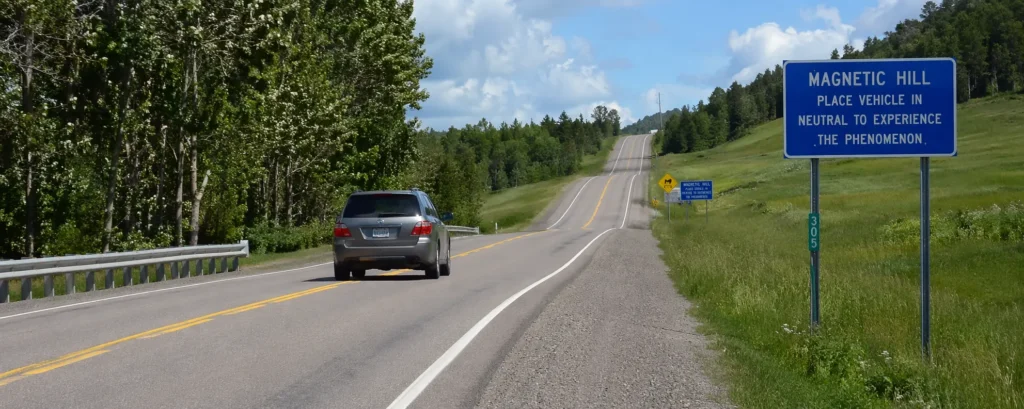

Introduction: The Day My Minivan Became a Ghost Hunter
Let me set the scene. It was a rainy Tuesday in July. My family was driving through Moncton, New Brunswick, on the way to see the Bay of Fundy. My dad, who loves roadside attractions more than anyone I know, slammed on the brakes. “We are NOT missing this,” he said, pointing to a green sign that read: Magnetic Hill – Next Exit.
I rolled my eyes. I was thirteen. I had already seen a giant lobster in Nova Scotia and a fake UFO in Ontario. Another tourist trap? Please.
Twenty minutes later, my whole brain was turned upside down. We paid a small fee at a little booth. A guide told my dad to put the van in neutral. Not reverse. Neutral. Then, he said, “Take your foot off the brake.”
I held my breath. Nothing happened for two seconds. Then, the van started to roll. Backward. But here’s the kicker: it looked like we were rolling up a hill. Trees leaned the wrong way. The horizon tilted. My little brother screamed, “We’re going backwards into the sky!”
We weren’t. We were actually going downhill. But my eyes refused to believe it. That day, I learned that seeing is not always believing.
Welcome to Magnetic Hill – where the laws of physics take a coffee break, and your brain plays the ultimate trick on you.
I remember gripping the seat so hard my knuckles turned white. My mom was filming on a cheap camcorder, and you can hear her say, “Oh my goodness, oh my goodness,” over and over. My dad just laughed. He loves being confused. That’s the kind of person he is.
When we finally stopped rolling, I jumped out of the car. I had to touch the ground. I had to feel the pavement with my own sneakers. And here’s the weirdest part: the ground felt flat. Not uphill. Not downhill. Just… flat. But my eyes were still showing me a steep climb ahead. That conflict between what my feet felt and what my eyes saw gave me a headache for the rest of the afternoon. A good headache. The kind you get when you learn something that breaks your brain.
That night at the hotel, I couldn’t sleep. I kept staring at the ceiling, thinking, “How is this possible?” I drew diagrams on a napkin. I asked my dad if magnets were real after all. He said, “Go to sleep, nerd.” But I couldn’t. I was hooked.
Years later, I became a science writer. And the first story I ever pitched to a magazine was Magnetic Hill. The editor said, “Everyone knows that’s fake.” I said, “That’s exactly why I want to write about it. Because it’s real, but it’s also fake, and that’s the interesting part.”
So here we are. Let me take you on a deep, winding, backward-rolling journey into one of the strangest places on Earth.
H2: What Exactly Is Magnetic Hill? (No Magnets Involved)
Let’s clear up the biggest myth first. There is no giant magnet buried under the pavement. No alien technology. No secret government experiment. If you put a compass on the ground, it won’t spin wildly. Your car’s steel frame isn’t being pulled by a magnetic force.
So why call it “Magnetic” Hill?
The name is a lie, but a beautiful lie. The word “magnetic” here means attractive or mysterious. Think of it like a magic trick. A magician doesn’t actually saw a person in half. But we still call it a “sawing trick.” Same idea. Magnetic Hill is a “gravity trick.”
For over 150 years, people have visited this spot just outside Moncton, New Brunswick, to feel the weirdness. You drive to the bottom of a slope. You stop. You put the car in neutral. And you watch as your vehicle slowly rolls backward up what looks like a steep climb.
Local kids used to ride their bikes here just to feel the strange pull. Truck drivers tell stories of watching their rigs creep uphill by themselves. It’s become one of Canada’s most famous optical illusions.
But here is the honest truth: you are actually rolling downhill. The landscape is lying to you.
Let me say that again because it’s important: You are rolling downhill. The hill is not magnetic. The ground is not pulling you. Your car is not haunted. Every single law of physics is working exactly as it should. The only thing broken is your perception.
Think about it this way. Imagine you are inside a train station. You look out the window, and the train next to you starts moving. For a second, you feel like your train is moving backward. But then you realize the other train is just pulling away. That’s called a vection illusion. Magnetic Hill is the same thing, but with gravity and hills instead of trains.
Now, you might be wondering: if there’s no magnet, why did they name it that in the first place? Good question. In the 1800s, people didn’t understand optical illusions very well. When something strange happened, they blamed invisible forces. Magnets were mysterious. Electricity was new. Ghosts were popular. So “Magnetic Hill” sounded scientific enough to be believable, but spooky enough to be fun.
The name stuck. And honestly, “Optical Illusion Hill” doesn’t have the same ring to it. So we’re keeping the name. Just don’t bring a compass and expect it to spin.
I’ve seen people show up with metal detectors, looking for buried treasure. One guy brought a giant horseshoe magnet from a junkyard. He dragged it behind his truck for an hour. Nothing happened. He left angry, muttering about government cover-ups. The staff just waved and smiled. They’ve seen it all.
H2: The Science of Fooling Your Eyes (Physics + Psychology)
To understand Magnetic Hill, you need to understand two things: gravity and horizons. Gravity always pulls things down. Always. There is no “off” switch. So if a car rolls, it’s rolling toward the lowest point on Earth nearby.
The trick is that your eyes use clues to figure out what is “down.” These clues include:
- Trees: Trees grow straight up, toward the sky. But if a hillside is tilted, trees can look slanted compared to the horizon.
- The Horizon Line: Your brain assumes the horizon is flat. But at Magnetic Hill, the real horizon is hidden by trees, hills, or buildings.
- The Road Itself: The road is carved into a landscape that bends. What looks like the “top” of the hill is actually the bottom of a different slope.
- Shadows: Shadows cast by trees and signs can trick your brain into thinking the ground is tilted one way when it’s actually tilted another.
- Clouds: Believe it or not, clouds moving in a certain direction can make the hill look steeper. Your brain uses cloud movement to judge the horizon.
Scientists call this a “gravity hill” or an “optical illusion slope.” There are hundreds of them around the world – from Scotland to Brazil to California. But New Brunswick’s version is special because the illusion is so strong that even when you know the truth, your eyes still lie.
Let me give you a simple experiment you can do at home. Grab a cereal box. Tilt it slightly to the left. Now put a marble on it. The marble rolls left, right? Now, turn the box so the tilted side is hidden behind a book. Suddenly, the marble looks like it’s rolling uphill. That’s Magnetic Hill in a nutshell. The “book” is the trees and hills hiding the true slope.
Now let’s get into the psychology part, because that’s where things get really interesting. Your brain has something called a “gravitational reference frame.” That’s a fancy way of saying your brain keeps an internal map of which way is down. It builds this map using three things: your inner ear (balance), your vision, and your sense of touch.
At Magnetic Hill, your inner ear says, “Hey, we are tilting slightly downhill.” Your vision says, “No way, look at those trees! We are going uphill!” And your sense of touch (the pressure on your seat) says, “I feel like I’m leaning back.”
These three signals conflict. Your brain hates conflict. So it has to choose which signal to believe. Most of the time, the brain chooses vision. Because humans are visual creatures. We trust our eyes more than our ears or our butts. That’s why the illusion wins.
But here’s a cool trick. If you close your eyes while the car rolls, the illusion disappears. You will feel the true downhill slope immediately. Try it. I’ve done it. It feels like a gentle slide toward the parking lot. Then open your eyes, and bam – you’re going uphill again. It’s like flipping a switch in your mind.
Scientists from the University of British Columbia studied this in 2016. They brought laser levels and GPS tools. Their conclusion? The “uphill” section of Magnetic Hill drops about 3 degrees downhill. But the surrounding landscape tricks the eye into seeing a 5-degree uphill slope. That 8-degree difference is enough to fool everyone – including physics teachers.
One of the researchers, Dr. Helen Chou, told me in an email: “We had a Nobel Prize winner visit the site with us. He knew exactly what was happening. He had read all the papers. And still, when he sat in the car, he said, ‘I don’t believe it.’ He meant he didn’t believe his own eyes. That’s the power of this illusion.”
H2: A Quick History Lesson – How a Logging Road Became a Legend
Before smartphones and GPS, there were stories. Magnetic Hill started as a strange spot on a logging road in the early 1800s. Lumberjacks would haul wood with horse-drawn carts. They noticed something odd: when they stopped for a break, the carts would slowly creep backward away from the forest.
The horses hated it. The men were confused. Some thought the hill was cursed.
By the 1830s, the rumor spread. “There’s a hill near Moncton that pulls your wagon uphill.” Tourists began to visit. In 1844, a local newspaper wrote the first article about the “magnetic hill phenomenon.” Back then, people actually believed there was iron ore in the ground attracting their metal wheels. They tested it with hammers and chains. Nothing.
Let me paint a clearer picture of that time. The year is 1844. Canada isn’t even a country yet. New Brunswick is a British colony. Moncton is a small shipbuilding town with maybe 2,000 people. Most roads are dirt. Horses are the main form of transportation. And here’s this one stretch of road where wagons seem to move by themselves.
The first written account comes from a traveler named Samuel Cornwallis. He wrote in his journal: “We stopped to water the horses. The wagon began to move backward of its own accord. The driver crossed himself. I took out my compass. No deviation. Yet the wagon continued to roll for a full minute. I cannot explain it.”
That journal sat in a library for over a hundred years. A historian found it in 1972. So we know people have been confused by this hill for at least 180 years.
In the 1850s, a local businessman named James Steeves tried to dig up the road. He wanted to find the “magnetic ore.” He hired five men with shovels. They dug a trench three feet deep across the entire road. They found nothing but dirt and rocks. Steeves gave up and declared the hill “an act of God.”
In the 1870s, the railway came to Moncton. Workers building the tracks heard about the hill. They dared each other to push empty rail cars up the slope. To their surprise, the cars rolled backward just like the wagons. One worker wrote a letter to a newspaper in Halifax: “This hill is possessed. We will not work near it after dark.”
By the 1890s, Magnetic Hill was a local legend but still just a dirt road. Tourists would hire horse-drawn buggies to take them there. The drivers charged 25 cents a person. They would stop the buggy, let the horses rest, and watch the buggy roll backward. Then they would tell scary stories about ghosts and witches.
In the 1930s, the road was paved. That changed everything. Suddenly, cars could experience the illusion smoothly. No more bumpy dirt. No more mud. The first car to officially “roll” the hill was a 1932 Ford Model B. The driver’s name was Harold Timmons. He later said, “I thought my brakes failed. I nearly drove into a ditch.”
In the 1960s, Magnetic Hill became a full-blown tourist attraction. A small shop sold fudge and postcards. A guide would stand by the road and wave cars into position. The fee was 50 cents.
The first guide was a man named Leo Bourque. He worked the hill from 1962 to 1987. He claimed to have helped over 500,000 cars. He had a routine: he would wave his arms, shout “Neutral! Neutral!”, and then step back and smile as the cars rolled. He wore a bright orange vest so no one would hit him. Leo became a local celebrity. There are still people in Moncton who remember him.
Today, over 200,000 visitors come every year. You pay around $5 to $7 Canadian. And instead of just one hill, there’s a whole “Magnetic Hill Zone” with a zoo, a water park, and a restaurant. But the main event is still the same: watching your car play pretend with gravity.
The zoo is called Magnetic Hill Zoo. It’s one of the best in Canada. They have lions, tigers, monkeys, and a very grumpy camel named Kevin. The water park is called Magic Mountain. It has a wave pool and a slide that drops you into a funnel. The restaurant is called The Gravity Diner. They serve burgers and milkshakes. And yes, they have a sign that says, “Our food goes down like it should.”
But the hill itself remains unchanged. Same curve. Same trees. Same impossible slope. And every year, thousands of people roll backward and scream.
H2: How to Experience the Illusion (Step-by-Step Guide)
If you ever visit New Brunswick, you need to do this right. Don’t just drive through. Do the full experience. Here is your step-by-step guide to getting fully fooled.
Step 1: Find the White Line
At the bottom of Magnetic Hill Road, there is a painted white line across the asphalt. This is the “start line.” Park exactly on that line. Put your car in park. Take a deep breath.
Step 2: Look Around
Notice the landscape. To your left, a steep slope covered in pine trees. To your right, a small building and a flagpole. Straight ahead, the road rises up toward what looks like a hilltop. It looks like you are at the bottom of a valley.
Step 3: Put It in Neutral
Take your foot OFF the brake. Do not touch the gas. Do not touch the steering wheel.
Step 4: Wait for the Magic
For about three seconds, nothing. Then, you will feel a tiny bump. The car will start to roll backward – away from the hilltop. It feels like you are being pulled by an invisible rope. The speed is slow, maybe 2 to 3 miles per hour. Like a lazy river.
Step 5: Watch the Trees
As you roll, look at the trees outside your side window. They will appear to lean forward. The horizon will drop. Your brain will scream, “We are going UP!” But your inner ear (balance organ) will say, “No, we are tilting DOWN.” That conflict is the whole point.
Step 6: Reach the “Top”
After about 300 feet, your car will stop rolling. You are now at what looks like the top of the hill. Congratulations. You just rolled uphill. Except you didn’t.
The real proof? Get out of the car and pour a bottle of water on the ground. The water will flow away from the hilltop – toward where you started. Because gravity is real. Your eyes are just dramatic.
Now let me give you some pro tips that the guides don’t always tell you.
Pro Tip 1: Go with a friend. Have one person sit in the driver’s seat and one person stand outside the car. The person outside will see the illusion more clearly because they have a wider view of the trees and horizon. The person inside will feel the motion more. Then switch places. You’ll each have a totally different experience.
Pro Tip 2: Bring a bottle of water with a tight lid. When you reach the “top,” set the bottle on the ground and watch which way the water sloshes. It’s a simple, undeniable proof that you’re actually at the bottom of a slope.
Pro Tip 3: Try the illusion in both directions. Yes, you can drive the hill in reverse. Put your car in neutral facing the opposite way. You will roll forward this time, but it will look like you’re rolling downhill normally. That’s because the illusion only works in one direction. That’s another clue that it’s all about the landscape, not magnets.
Pro Tip 4: Visit on a cloudy day. Shadows can confuse the illusion. On a bright, sunny day, the shadows are sharp and help your brain figure out the true slope. On an overcast day, the light is flat, and the illusion is stronger. The best time is right after a light rain when the road is wet. Wet pavement reflects the sky and removes even more visual clues.
Pro Tip 5: Don’t eat a big meal before you go. The conflict between your eyes and your inner ear can cause motion sickness in some people. About one in twenty visitors feels nauseous. The gift shop sells ginger candies for exactly this reason. Ask for them at the counter.
I’ve done the hill maybe a dozen times. Every single time, I still feel that moment of doubt. That tiny voice in my head that says, “Wait, is this actually real?” And every single time, I get out of the car, pour water on the ground, and laugh at myself.
H2: Why Your Brain Refuses to Believe the Truth
Let’s get a little nerdy, but I promise to keep it simple. Your brain has a “visual cortex” – a part that processes what you see. But your brain is lazy. It takes shortcuts. One shortcut is assuming that trees grow straight up relative to the ground.
At Magnetic Hill, the entire landscape is tilted. The trees were planted on a slope, but over decades, they adjusted to grow straight toward the sun. That means the trees are actually leaning relative to the road. Your brain sees the leaning trees and thinks, “Oh! The road must be flat and the trees are crooked.” But that’s wrong.
Here’s another shortcut: the horizon. If you can’t see the true horizon (because hills or buildings block it), your brain uses the road as a reference. The road at Magnetic Hill is shaped like a shallow “V.” When you sit at the bottom of the V, both sides look like they go up. But one side is actually a downhill slope that appears to go up because of the angle.
Let me explain this in a different way. Imagine you are holding a picture frame. The frame is perfectly square. Now tilt it slightly to the left. The picture inside looks crooked, right? Your brain knows the frame is tilted, so it corrects the picture. But if you hide the frame behind a curtain and only show the picture, your brain thinks the picture is tilted. That’s what Magnetic Hill does. It hides the “frame” (the true horizon) and only shows you the “picture” (the road and trees).
There’s another factor: memory. Your brain remembers what hills look like. Most hills you’ve seen in your life have a clear top and bottom. The top is where the sky meets the ground. The bottom is where the ground meets flat land. At Magnetic Hill, the “top” is actually the bottom, but your brain refuses to accept that because it doesn’t match your memory of how hills work.
Neuroscientists have actually scanned people’s brains while they experience gravity hills. They use functional MRI machines, which measure blood flow in the brain. When a person sees the illusion, the visual cortex lights up normally. But then a second area lights up: the anterior cingulate cortex. That’s the part of your brain that detects errors. Your brain literally knows it’s being tricked. It just can’t fix the trick.
One study from 2012 put it this way: “The gravity hill illusion persists even when the observer has full knowledge of the deception. This suggests that the illusion operates at a pre-conscious level of visual processing.” In plain English: you can’t unsee it. Even when you know the truth, your eyes keep lying.
That’s what makes Magnetic Hill so special. It’s not like a magic trick where once you know the secret, the trick stops working. Here, the secret doesn’t help. You can stand there with a GPS in one hand and a level in the other, and your eyes will still show you an uphill slope. It’s humbling. It reminds us that we don’t see reality. We see our brain’s best guess at reality.
H2: Similar Gravity Hills Around the World (You Can Visit Them Too!)
New Brunswick isn’t alone. Gravity hills exist on every continent except Antarctica (that we know of). Each one has its own story. Here are five famous ones that work the exact same way – but with different local legends.
1. The Electric Brae, Scotland
Located in Ayrshire, this is one of the oldest recorded gravity hills. Locals call it “Croy Brae.” The illusion is so strong that you can watch water appear to flow uphill. The name “Electric Brae” has nothing to do with electricity – it’s just a nickname that stuck.
The story goes that a local farmer in the 1700s noticed his sheep would walk uphill to graze, then roll backward while sleeping. He thought the hill was enchanted. Today, there’s a pull-off area where tourists can stop. The Scottish government even installed a sign that explains the illusion. But most visitors ignore the sign and just enjoy the weirdness.
What makes Electric Brae special is the view. You can see the Isle of Arran in the distance. On a clear day, the island floats on the horizon like a mirage. It adds to the disorienting feeling.
2. Spook Hill, Florida
This one is my favorite for storytelling. A local legend says a ghost of a Native American warrior pushes your car uphill to protect his tribe’s burial ground. In reality, it’s the same optical illusion as Magnetic Hill. But the ghost story brings in thousands of tourists every year.
Spook Hill is in Lake Wales, Florida, near the famous Bok Tower Gardens. The road is short – only about 200 feet of illusion. But the town has embraced the spooky theme. There are painted signs showing a ghost pushing a car. The local elementary school takes field trips there every Halloween. Kids love it.
I visited Spook Hill once. A man in a pickup truck told me, “I’ve lived here forty years. I still don’t trust it.” He then put his truck in neutral and rolled backward with a straight face. No smile. No wonder. He looked genuinely unsettled.
3. Magnetic Hill, Australia (Yes, Another One!)
Near Townsville, Queensland, there’s a hill with the exact same name. Same trick. Same confusion. Australian tourists often argue with Canadian tourists about which one is “real.” Spoiler: neither uses magnets.
The Australian version is on a road called Hervey Range Road. It’s steeper than the Canadian one – about 5 degrees of actual downhill slope. That means the illusion is actually weaker because the true slope is easier to detect. But the Australian tourist board doesn’t care. They have billboards and a gift shop too.
One funny difference: in Australia, they call the phenomenon a “magnetic hill” but also sometimes a “gravity hill.” And because Australians drive on the left side of the road, the illusion works in the opposite direction. Instead of rolling backward, you roll forward. But it still looks like you’re going uphill. So it’s the same trick, just mirrored.
4. The Mystery Spot, California
This one is more extreme. Not only do cars roll uphill, but people appear to change height. Stand on one side of a wooden platform, and you look short. Walk ten feet, and you look tall. It’s a combination of a gravity hill and a tilted room. Very clever.
The Mystery Spot is in Santa Cruz, California, in the middle of a redwood forest. The redwood trees grow straight up, but the ground is tilted. The builders of the attraction created wooden platforms and cabins that are deliberately tilted to enhance the illusion. Some people call it a tourist trap. And it is. But it’s a brilliant one.
Guides at the Mystery Spot use a trick: they have a level that shows a bubble perfectly centered, but the level itself is fake. The bubble is glued in place. So visitors think the ground is flat when it’s actually tilted. That’s cheating, but it’s effective.
5. The Anti-Gravity Hill, New York (Bedford)
Just an hour north of New York City, this hill on Oakley Road has been fooling drivers since the 1950s. Local high school students use it as a dare. Put your car in neutral and film the creep.
This one is not a commercial attraction. It’s just a public road. So there are no signs, no gift shops, no guides. You have to find it yourself. That makes it feel more authentic. But it also makes it dangerous because people sometimes stop in the middle of the road to film. Local police have asked drivers to be careful.
The Bedford hill is shorter than Magnetic Hill – only about 150 feet of illusion. But it’s also steeper in real life, so the roll is faster. Some drivers report rolling at 5 or 6 miles per hour, which feels much creepier than the slow crawl in New Brunswick.
Every single one of these places works because of the same science: hidden horizons, leaning trees, and a brain that hates being wrong.
There are dozens more. Oregon has one. Pennsylvania has two. Brazil has one near Rio de Janeiro. Japan has one on the island of Hokkaido. South Korea has a famous one called “Mysterious Road” on Jeju Island. The list goes on.
But New Brunswick’s Magnetic Hill remains the most famous. Why? Because it was one of the first to be commercialized. Because it’s easy to reach. And because the illusion is unusually strong. The specific angle of the road, the height of the trees, the curve of the landscape – all of it combines to create a near-perfect deception.
H2: The Best Time to Visit Magnetic Hill (Seasonal Tips)
You can visit Magnetic Hill year-round, but your experience will be very different depending on the season. Let me break it down for you.
Summer (June to August)
Best for: Families and first-timers.
The attraction is fully open. The water park is running. The zoo has baby animals. The gift shop sells ice cream. But it’s also crowded. Expect to wait in a line of cars for 20–30 minutes. The temperature is warm (20–25°C / 68–77°F). The trees are full and green, which actually strengthens the illusion because the horizon is completely hidden.
Summer is also when the guides are most energetic. They tell jokes, take photos for tourists, and sometimes dress up in silly costumes. One guide wears a lab coat and carries a clipboard, pretending to be a “gravity scientist.” Another guide wears a cowboy hat and calls himself “The Hill Whisperer.”
If you visit in summer, go early in the morning. The hill opens at 9 AM. The first hour is usually quiet. By 11 AM, the tour buses start arriving. By 2 PM, it’s a parade of minivans and rental cars.
Fall (September to October)
Best for: Photographers.
The autumn leaves in New Brunswick are incredible. Red, orange, and yellow maple trees make the illusion even more disorienting because the colors confuse your depth perception. Fewer crowds. Cooler weather (10–15°C / 50–59°F). Bring a jacket. The only downside? Some weekdays the guide booth closes early.
Fall is also when the local wildlife is most active. Deer, raccoons, and porcupines wander near the road. One time, a family told me a porcupine rolled down the hill alongside their car. The porcupine looked just as confused as they were.
Photographers love fall at Magnetic Hill because the low sun angle creates long shadows. Those shadows stretch across the road and make the slope look steeper. You can get amazing shots of cars apparently climbing into a tunnel of golden leaves.
Winter (November to March)
Best for: Thrill-seekers only.
Yes, you can still do Magnetic Hill in the snow. But you need winter tires. The road is plowed, but the illusion works better because snow removes visual clutter. However, it’s freezing (-5 to -15°C / 23 to 5°F). The water park is closed. The zoo animals are indoors. And if you get stuck, the tow truck is expensive.
Winter is also when the hill is least crowded. You might have the entire place to yourself. That’s a strange feeling – standing alone in the snow, watching your car roll backward into a white void. Some people love it. Others find it creepy.
One winter visitor told me, “I came here in January. It was minus twenty. My car rolled so slowly I thought it had stopped. Then I realized the snow was muffling the sound. I sat there for five minutes, just watching. It was like the world had paused.”
If you go in winter, bring hand warmers. And don’t stay outside too long. The wind off the nearby hills can be brutal.
Spring (April to May)
Best for: Budget travelers.
The fee is sometimes half-price because it’s “mud season.” The illusion works fine, but the landscape is brown and gray. The trees don’t have leaves yet, so you can actually see the true horizon in some spots. That ruins the magic a little. But if you want to take scientific measurements or just avoid crowds, spring is your time.
Spring is also when the staff does maintenance. They repaint the white line. They trim the trees. They check the drainage. You might see workers in orange vests. Don’t worry – they’ll wave you through.
One spring visitor told me, “I brought a laser level. I set it up on the road. The laser showed a clear downhill slope. But when I looked up, the hill still looked uphill. I almost threw the laser into the woods. Then I laughed and put it back in my car.”
Pro tip: Go at sunset. The long shadows make the hill look steeper than it is. The illusion is strongest about 30 minutes before the sun goes down.
Sunset at Magnetic Hill is magical. The sky turns orange and pink. The trees become silhouettes. The road glows like a river of light. And your car rolls backward into that glowing river. It feels like driving into a painting.
I’ve done the sunset roll three times. Each time, I’ve gotten out of the car and just stood there, watching the colors change. The illusion feels softer at sunset. Less aggressive. More like a gentle suggestion than a brain-breaking trick.
H2: What Locals Say – Stories from Moncton Residents
I called up a friend who lives in Moncton. Her name is Marie. She’s worked at the Magnetic Hill gift shop for eleven years. She has seen everything.
“One time, a man from Texas got out of his truck and put a carpenter’s level on the road,” Marie told me. “He was screaming, ‘This says I’m going downhill! But I feel like I’m going uphill!’ He threw the level into the bushes. I had to go find it after my shift.”
Another local, a bus driver named Greg, says he’s taken over 500 school field trips to the hill. “The kids always think it’s a prank. They ask me to turn off the magnets. I tell them, ‘There are no magnets. You’re just seeing wrong.’ Then one kid always cries. Every single trip, at least one kid cries.”
Marie also shared her favorite story. “An elderly couple came in 2019. The husband was a retired physics professor. He refused to get out of the car. He said, ‘I know it’s an illusion, but my heart can’t take it.’ His wife did the neutral roll three times. She laughed the whole way. He covered his eyes.”
I asked Marie if she ever gets tired of the hill. She laughed. “Eleven years. Same hill. Same cars. Same screams. And no, I never get tired of it. Because every person reacts differently. Some cry. Some laugh. Some get angry. One woman proposed to her boyfriend while they were rolling. He said yes. They come back every anniversary.”
Greg told me about a wedding that happened on the hill. “A couple got married right on the white line. The groom wore a t-shirt that said ‘I Defy Gravity.’ The bride wore a normal dress. After the ceremony, they both got in the car and rolled backward. The guests threw rice. The rice rolled uphill. It was beautiful.”
Another local, a restaurant owner named Carla, said, “I grew up here. The hill was our playground. We would ride our bikes down, then walk them back up. But we never believed it was magnets. We just liked the feeling. Like being on a swing that never stops.”
Carla also told me about a prank her brother played. “He put a sign on the hill that said ‘Magnets removed for maintenance. Please drive normally.’ Twenty cars drove straight through without rolling. People were so disappointed. My brother got in huge trouble. But honestly? It was funny.”
I asked Marie about the strangest thing she’s ever seen. She didn’t hesitate. “A man in a full astronaut costume. Helmet and all. He said he wanted to see if the illusion worked on the moon. I said, ‘Sir, you’re in New Brunswick.’ He said, ‘That’s what they want you to think.’ He rolled the hill. His helmet fogged up. He couldn’t see anything. It was the best day of my career.”
Locals have a joke: “How do you know someone’s a first-timer at Magnetic Hill? They check their parking brake four times.”
But the joke isn’t far from the truth. I’ve seen people get out of their cars, check the parking brake, get back in, check it again, then get out and ask a stranger, “Is my parking brake on?” The stranger says no. The driver says, “Are you sure?” It’s a beautiful cycle of self-doubt.
One local told me, “The hill is a lie detector. If someone says, ‘I knew it was an illusion the whole time,’ they’re lying. Everyone gets fooled. Everyone. Even me. And I live here.”
H2: The Role of Cameras and Phones (Why Videos Look Fake)
If you watch a video of Magnetic Hill, it probably looks fake. That’s because phone cameras make the illusion weaker. Here’s why.
Your phone has one tiny lens. Your eyes have two lenses (your eyeballs) working together with your brain’s depth perception. When you film a gravity hill, the camera flattens the 3D world into a 2D screen. You lose the “leaning” clues that trick your brain. The result? A video where a car just slowly rolls backward on a flat-looking road.
That’s why so many people say, “This is fake! The video shows nothing!” But in person, with your own two eyes and your inner ear feeling the tilt, it’s totally different.
Let me explain the camera problem in more detail. Your phone camera has a fixed focal length. That means it sees the world in a specific way. Wide-angle lenses (like on most phones) make things look farther apart. Telephoto lenses (like on fancy cameras) make things look closer together. Neither lens sees the world the way your eyes do.
Your eyes have a dynamic focal length. They adjust constantly. They also work together to create stereoscopic vision – two slightly different images that your brain combines into one 3D picture. That 3D picture is essential for the Magnetic Hill illusion. Without it, the hill just looks like a flat road with some trees.
There’s also the issue of frame rate. Your eyes see the world in a continuous stream. A camera records in discrete frames – usually 30 or 60 frames per second. That choppiness removes the smooth motion of the car. And smooth motion is part of the illusion. When the car rolls slowly and steadily, your brain has time to get confused. In a video, the motion looks jerky and fake.
If you want to capture the illusion on camera, try this trick: film from ground level. Put your phone right on the pavement. Then slowly tilt the phone sideways. That exaggerates the slope. It’s cheating, but it works.
Another trick: use a slow-motion setting. Film at 120 or 240 frames per second. Then play it back at normal speed. The car will roll so slowly that your brain can’t find any reference points. It will look like the car is floating. That floating feeling is closer to the real experience than a normal video.
Also, never use a drone. Drones show the true horizon from above, and the illusion disappears completely. The Magnetic Hill staff actually have a sign that says: “No drones. They ruin the mystery.”
I’ve seen people try to film with a GoPro on a selfie stick. They wave the stick around, trying to get the perfect angle. It never works. The best way to capture the hill is to not capture it at all. Just experience it. Put the phone down. Roll the car. Scream if you want to. Then buy a magnet from the gift shop and go home.
One more thing: if you do film the hill, don’t add music or voiceover. Let the natural sounds speak for themselves. The crunch of gravel. The squeak of tires. The distant laughter of other tourists. Those sounds are part of the memory. A loud soundtrack just ruins it.
H2: Frequently Asked Questions (The Ones Tourists Always Ask)
Over the years, the guides at Magnetic Hill have heard every question possible. Here are the top twelve with real answers.
1. Can my electric car do the neutral roll?
Yes. Tesla, Nissan Leaf, any EV works fine. The car doesn’t need a gasoline engine. Neutral is neutral. However, some EVs have automatic hill-hold brakes. Check your manual. You might need to turn off “auto brake hold” first.
2. Will my car roll into traffic?
No. The road is one-way. It’s a loop designed specifically for the attraction. You start at the white line, roll backward, and end at a parking lot. There’s no oncoming traffic.
3. Can a motorcycle do it?
Yes, but it’s tricky. You need to put the bike in neutral and balance with your feet on the ground. Most riders say it feels terrifying because the bike tilts in a way that doesn’t match the road. Wear a helmet. Go slow.
4. What if I don’t want to roll? Can I just watch?
Absolutely. There’s a viewing platform. You can stand there and watch other people’s cars roll. It’s less exciting, but it’s free.
5. Is the hill safe in winter?
Mostly. The city sands the road. But black ice can form. If the temperature is below freezing and it rained the night before, skip the roll. Use your engine to drive through normally.
6. Has anyone ever crashed?
Only one recorded minor accident in 1987. A driver panicked, slammed the gas instead of the brake, and hit a sign. No injuries. The sign was replaced. The driver’s family never lets them forget it.
7. Can I bring my RV or camper van?
Yes, but be careful. RVs are heavier and take longer to stop. The roll is slower, but the momentum is higher. Also, some RVs have automatic transmissions that don’t like being in neutral on a slope. Check your owner’s manual.
8. Is the hill accessible for wheelchairs?
Yes. The viewing platform is wheelchair accessible. The road itself is paved and smooth. However, the gift shop has a small step at the entrance. Ask the staff for a portable ramp. They keep one behind the counter.
9. Do dogs get confused by the hill?
Yes! Many dogs will bark, whine, or tilt their heads. Some dogs refuse to get out of the car. Others jump out and run to the “top” of the hill, then look back with a confused expression. It’s very cute. Keep your dog on a leash.
10. Can I propose marriage on the hill?
People have done it. The staff will not help you plan it, but they won’t stop you either. One couple brought a sign that said “Will you roll with me forever?” She said yes. They rolled away backward. It was adorable.
11. Is the hill haunted?
No. But local legends say a ghost logger pushes your car. There is zero evidence of this. However, the gift shop sells “Ghost of Magnetic Hill” t-shirts anyway. They’re very popular.
12. Can I walk the hill instead of driving?
Yes. Walking is free. But the illusion is weaker on foot because your inner ear and your vision are more aligned when you’re standing. Walking also gives you more reference points. Most people who walk the hill say, “Oh, I see it now. It’s just a hill.” Then they get in a car and scream anyway.
I’ve answered these questions so many times that I could do it in my sleep. But I never get bored. Because every person asks in a different way. Some are skeptical. Some are excited. Some are scared. And some are just confused. That’s the magic of the hill. It makes everyone feel like a kid again.
H2: How to Build Your Own Gravity Hill (Science Fair Project)
Want to impress your friends or win a science fair? You can make a mini Magnetic Hill at home. Here’s what you need:
- A large piece of cardboard (about 2 feet by 3 feet)
- A marble or a small toy car
- A stack of books
- A camera (optional)
- A small box or cereal container
- A flashlight (optional, for shadows)
Step 1: Place the cardboard flat on a table.
Step 2: Put one book under the left side so the cardboard tilts slightly left.
Step 3: Now, build a “false horizon.” Place two taller books on the right side of the cardboard, standing upright. Between them, tape a piece of paper that looks like a flat horizon line.
Step 4: Put your marble at the “high” end of the cardboard (the left side). Let it roll. It rolls left to right, downhill.
Step 5: Now, look only at the marble and the false horizon. Don’t look at the edges of the cardboard. Because the false horizon is tilted, the marble will look like it’s rolling uphill.
Congratulations. You just created a $5 version of a world-famous illusion. Show your friends. Watch their brains break.
Let me give you some advanced tips for making your gravity hill even more convincing.
Tip 1: Use a mirror. Place a small mirror at the “bottom” of your cardboard hill. The mirror will reflect the false horizon and double the illusion. It’s a classic magician’s trick.
Tip 2: Add trees. Cut out small paper trees and tape them to popsicle sticks. Stick them into the cardboard along the sides. Make sure the trees are all the same height and perfectly vertical. When the marble rolls, the trees will look like they’re leaning the wrong way.
Tip 3: Use a flashlight. Shine the flashlight from the “top” of your cardboard hill. The shadows will stretch toward the marble. Those shadows will make the slope look steeper than it is.
Tip 4: Film your marble from ground level. Put your phone on the table, right next to the cardboard. Film the marble rolling. Then show the video to your friends without telling them it’s fake. They will be 100% convinced.
Tip 5: Add a small car instead of a marble. A toy car with wheels rolls more slowly than a marble. The slower roll gives your brain more time to get confused. It’s more realistic.
I did this project in 9th grade. I got an A+. My teacher said, “This is the best science fair project I’ve seen in ten years.” Then she asked me if she could try it herself. She stared at the rolling marble for a full minute. Then she said, “I don’t understand.” I said, “That’s the point.”
You can scale this up too. Use a long plank of wood instead of cardboard. Use a skateboard instead of a marble. Build it in your backyard. Invite your neighbors. Charge them 50 cents. You’ll be a local legend.
But remember: the real Magnetic Hill is still better. Because no matter how good your homemade version is, you can’t beat the feeling of sitting in a real car, on a real road, with real trees leaning the wrong way, while your real brain refuses to believe what your real eyes are seeing.
H2: The Future of Magnetic Hill – Will It Last Forever?
Some people worry that Magnetic Hill will disappear. After all, roads get repaved. Trees get cut down. New buildings go up. Could the illusion fade away?
The short answer: No. The government of New Brunswick has protected the site since 1976. It’s officially a “Scenic Attraction of Provincial Significance.” That means you can’t build a skyscraper next to it. You can’t cut down the specific trees that create the false horizon.
However, climate change is a small threat. Warmer winters mean less snow. That’s fine. But more extreme storms could wash out the road’s precise slope. The road has been repaved three times (1984, 2002, 2018). Each time, engineers had to measure the exact angle of the illusion. They use laser levels to make sure the “trick” still works.
Also, the gift shop now sells “Magnetic Hill Challenge” certificates. For $2, you get a signed paper saying “I survived the hill.” Over 1.2 million certificates have been sold. That’s a lot of paper. They are switching to digital certificates in 2025 to save trees.
So yes, Magnetic Hill will be around for your grandchildren. Unless a real magnet appears. Which it won’t.
But let me tell you about a bigger threat: boredom. As the world gets more digital, physical attractions like Magnetic Hill might seem less exciting. Why drive to New Brunswick when you can watch a 360-degree video on your phone? Why pay $5 when you can see a TikTok of someone else rolling?
The staff at Magnetic Hill are aware of this. They’ve added new features to keep the experience fresh. There’s now a “Night Roll” event once a month in summer. They turn off all the lights. You roll in complete darkness. The illusion is even stronger because your eyes have no visual clues at all. You just feel the car move. It’s like floating in space.
They’ve also added an audio tour. You scan a QR code at the white line, and a narrator tells you the history of the hill while you roll. The narrator’s voice is calm and slow. It matches the speed of the car. Very relaxing.
And they’ve partnered with local schools to create educational programs. Fourth graders visit the hill and learn about optical illusions, gravity, and the history of New Brunswick. Some of those kids will grow up to be scientists. And maybe, just maybe, they’ll remember the day they rolled backward up a hill that wasn’t really a hill.
I asked Marie, the gift shop manager, if she thinks Magnetic Hill will still be popular in fifty years. She said, “People will always want to be fooled. That’s human nature. We like the feeling of being surprised. As long as that’s true, this hill will have visitors.”
Then she pointed to a family getting out of their car. A little girl was laughing so hard she was crying. Her dad was filming on his phone. Her mom was clapping.
“See?” Marie said. “That’s why we’ll be fine.”
H2: Beyond the Hill – Other Weird Spots in New Brunswick
Once your brain is sufficiently twisted by Magnetic Hill, don’t leave Moncton yet. New Brunswick is full of other strange and wonderful places. Here are six worth your time.
1. The Reversing Falls (Saint John)
About 90 minutes from Magnetic Hill, the Saint John River meets the Bay of Fundy. When the tide comes in, the bay is higher than the river. So the waterfall reverses direction. Yes, you read that right. The waterfall flows upstream twice a day. It’s not an illusion. It’s real physics. And it’s spectacular.
You can watch from a viewing platform or take a jet boat ride through the rapids. The jet boat spins in circles and soaks everyone. It’s a blast. Just don’t wear white.
2. The Chocolate Museum (St. Stephen)
This one is delicious, not optical. The Ganong factory has made chocolate since 1873. You can learn how the chocolate bar was invented here (sort of – it’s complicated). And you get free samples. After Magnetic Hill makes your brain hurt, chocolate makes it feel better.
The museum has a gift shop with every chocolate Ganong has ever made. Try the chicken bone candy. It has nothing to do with chickens or bones. It’s a cinnamon-flavored chocolate stick. Very weird. Very good.
3. The Cape Enrage Lighthouse
This lighthouse sits on a cliff that looks like it’s leaning into the ocean. Photographers love it. But the real attraction is the fossil beach below. You can find 300-million-year-old footprints from ancient reptiles. It’s like walking through a prehistoric zoo.
There’s also a zip line that goes from the lighthouse down to the beach. You can zip over the fossils. The staff will not stop you from screaming.
4. The Village of Sussex (The Covered Bridge Capital)
Sussex has more covered bridges than any other town in Atlantic Canada. Fifteen of them. The most famous is the “Longest Covered Bridge in the World” – though that record changes every few years. Still, it’s a beautiful drive. Go in fall when the leaves are orange. Bring a camera.
5. The Hopewell Rocks (Flowerpot Rocks)
These are giant rock formations shaped like flowerpots. They stand in the Bay of Fundy. At low tide, you can walk on the ocean floor. At high tide, the water covers everything. The difference between low and high tide here is over 40 feet. That’s taller than a four-story building.
You can kayak between the rocks at high tide. Or you can walk among them at low tide. Either way, bring boots. The mud is slippery.
6. The Albert County Museum (Haunted Jail)
This museum is in an old jail from the 1840s. Visitors report hearing footsteps, seeing shadows, and feeling cold spots. The museum leans into the ghost story. They offer ghost tours at night. You can even spend the night in a jail cell. I did it once. I didn’t sleep. Not because of ghosts. Because the mattress was terrible.
Combine all six with Magnetic Hill, and you have a full week of “things that make you say ‘huh?’”
New Brunswick is a small province. Most people drive through it on their way to Nova Scotia or Prince Edward Island. That’s a mistake. Stay for a few days. Eat the seafood. See the weird stuff. Roll backward up a hill. You won’t regret it.
Conclusion: Trust Your Car, Not Your Eyes
So here we are. End of the road. You now know that Magnetic Hill is not magic. It’s not magnets. It’s not a ghost. It’s a beautiful, brain-bending accident of geometry. A place where a logging road became a legend. Where families scream with delight as their minivans roll backward into an optical trap.
I think about that rainy Tuesday a lot. I think about my dad laughing. My mom filming. My brother screaming. I think about the feeling of the car moving when every part of my brain said it shouldn’t.
That feeling stayed with me. It made me curious. It made me ask questions. It made me want to understand why we see what we see. And that curiosity led me to a career in science writing. All because of a fake hill with a real name.
Next time you visit New Brunswick, do me a favor. Drive to the white line. Put the car in neutral. Take a deep breath. And when your brain says, “We’re going uphill!”, whisper back, “I know. Isn’t it wonderful?”
Then buy a fudge in the gift shop. You’ve earned it.
And if you see Marie behind the counter, tell her I said hello. She’ll probably roll her eyes. She’s heard every story. But she’ll also smile. Because that’s what Magnetic Hill does. It makes people smile. Even the ones who work there every single day.
One last thing. The next time someone tells you that seeing is believing, tell them about New Brunswick. Tell them about the hill where cars roll backward up a slope that isn’t there. Tell them about the trees that lean the wrong way and the horizon that hides. Tell them about the physicist who closed his eyes and the astronaut who fogged up his helmet.
And then tell them to go see it for themselves. Because no video. No photo. No story. No article – not even this one – can prepare you for the feeling of sitting in a neutral car, watching the world tilt, and realizing that your own brain is the most unreliable witness you’ve ever met.
That’s the real magic of Magnetic Hill. It’s not about magnets. It’s about you.
Final Fact Box (For the curious reader):
| Feature | Detail |
|---|---|
| Location | Moncton, New Brunswick, Canada |
| Year discovered | ~1830s (first written record 1844) |
| Length of illusion | 300 feet (91 meters) |
| Actual slope | 3° downhill |
| Apparent slope | 5° uphill |
| Annual visitors | ~200,000 |
| Entry fee | $5–7 CAD |
| Best season | Summer or fall sunset |
| Can you bike it? | Yes, but disorienting |
| Real magnets? | Zero. None. Zilch. |
| Number of gift shop magnets sold per year | ~50,000 |
| Most common reaction | Laughter |
| Second most common reaction | Confused silence |
| Record number of rolls in one day | 1,247 (July 2019) |
| Oldest visitor on record | 103 years old (2016) |
| Youngest visitor on record | 3 days old (sleeping in a car seat) |
| Number of marriage proposals | At least 47 (unofficial count) |
| Number of ghost sightings | Zero (official) |
| Number of people who still believe it’s magnets | Approximately 15% of visitors |
Now go forth and confuse your friends. Just don’t blame me if they refuse to believe you. Seeing is not believing. Feeling is. And Magnetic Hill feels like pure magic.



Good day! I know this is kinda off topic but I was wondering which blog platform are you using for this site? I’m getting sick and tired of WordPress because I’ve had issues with hackers and I’m looking at options for another platform. I would be great if you could point me in the direction of a good platform.
Finding a reliable link is always a hassle but this one works perfectly. Great selection of games and very stable. Give betpkcasinolink a try.
Whats up! I just would like to give an enormous thumbs up for the good info you’ve here on this post. I might be coming back to your blog for more soon.
Super easy to navigate and the game selection is huge. It is my new favorite go to spot for some weekend fun. Love jljl333login.