
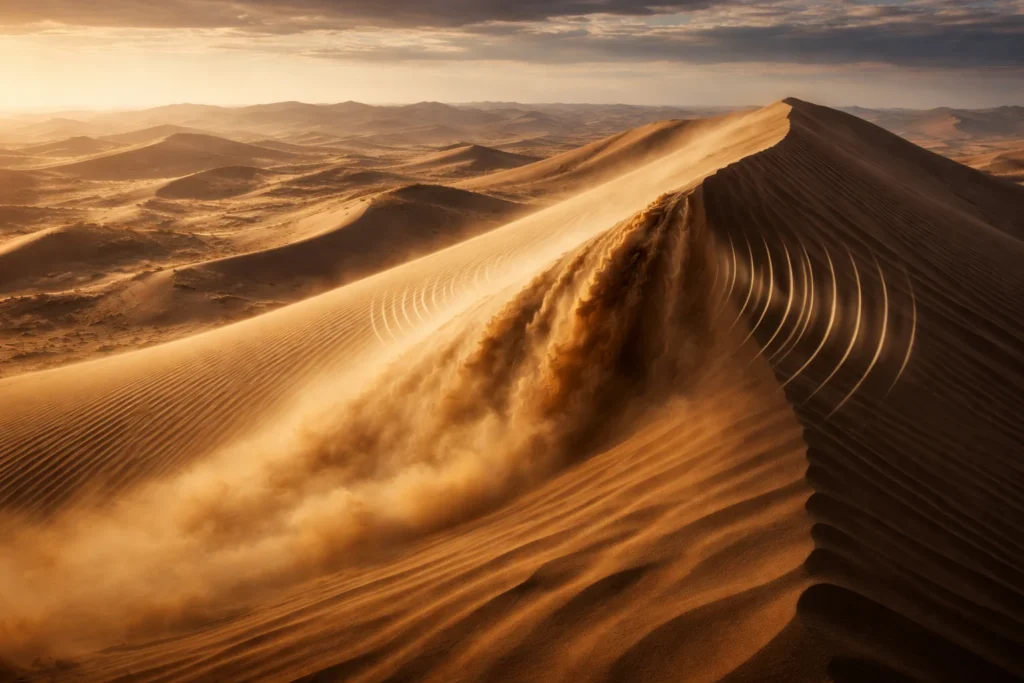

Part One: The Sound That Should Not Exist
Imagine you are hiking across a giant sand dune in the middle of nowhere. The sun is hot enough to fry an egg on a rock. Your legs are tired from climbing. Your mouth is dry. You have not seen another person for two days.
Suddenly, you hear something strange.
It starts as a low rumble. Like a hungry stomach, but deeper. Then it grows louder. It sounds like a cello played by a giant. Or a swarm of bumblebees the size of cars. Or a distant airplane engine that never gets closer.
You look around. There are no planes in the sky. No roads for miles. No buildings. No speakers hidden in the sand.
Then you kick a small pile of sand near your feet.
Boom.
The sound gets louder. You kick again.
Hummm.
You sit down on the slope and push off. Suddenly, the entire dune beneath you starts to vibrate. Your whole body shakes. The noise fills your ears and your chest. It is deep and musical and totally impossible.
You are not crazy. You are not dehydrated. You are not hearing things.
You have just discovered one of Earth’s strangest natural wonders: the singing dunes.
For thousands of years, travelers in the hottest, driest deserts on Earth have reported this weird music. Some called it the “Devil’s fiddle.” Others thought it was the sound of ghosts arguing. A few brave explorers tried to dig into the dunes to find the source. They found nothing but sand.
Only in the last fifty years have scientists finally figured out the secret. And trust me—the truth is stranger than any ghost story.
Part Two: A Quick Stop in Ancient History
Let us climb into a time machine. Set the dial for the year 1271.
A young Italian explorer named Marco Polo is crossing the Gobi Desert in what is now Mongolia and China. His camels are exhausted. His water supply is running low. His guide keeps looking over his shoulder like he is scared of something.
Then night falls.
Marco Polo later writes in his journal that the desert air filled with the sound of musical instruments. He heard drums. He heard trumpets. He heard the clash of swords and armor. The noise came from every direction at once. It lasted for hours.
He wrote: “Sometimes the air is filled with the sound of all kinds of musical instruments, and also of drums and the clash of arms.”
What was Marco Polo hearing? The Singing Sand Dunes of the Gobi.
But he had no science book to explain it. He had no geologist to ask. So he did what most people would do: he assumed it was evil spirits trying to confuse travelers. He urged his men to ride faster. They did not stop to record the music. They did not try to find the source. They ran.
And for the next seven hundred years, most people in the Western world thought Marco Polo was either lying or exaggerating.
But he was not.
Local Mongol herders had their own explanation. They told stories of an ancient buried city beneath the dunes. The hum, they said, was the sound of temple bells still ringing underground. Monks who died a thousand years ago were still praying. The sand was just the blanket covering their holy place.
That is a beautiful image, is it not? An entire city of bells singing beneath your feet.
Today, we know the truth is even cooler. It is not ghosts. It is not buried cities. It is not demons or magic. But honestly? A mountain of sand that plays music like a guitar is still pretty magical.
Part Three: What Exactly Is a Singing Dune? (The Simple Version)
Let us start with the basics. No complicated words. No fancy science.
A singing dune is a sand dune that produces a loud, musical tone when the sand slides down its face. That is it. That is the whole definition.
Think of it like a violin string. But instead of metal and wood, you have billions of tiny grains of sand rubbing together at the same time. They vibrate. Those vibrations turn into sound waves. Those sound waves travel through the air and into your ears.
The sound can be as low as a bass guitar. That is about 80 hertz, if you want the number. Or it can be as high as a tea kettle whistle. Some dunes produce a single clear note. Others produce a whole chord, like someone strumming a guitar.
The really amazing part? The sound can last for several minutes. Not just a quick boom. A long, steady, musical tone that goes on and on.
On a quiet night, with no wind, the sound can travel over six miles. That means you could be camping two hours away from the dune and still hear the desert humming you to sleep. Imagine lying in your tent, looking at the stars, and listening to a mountain of sand play a lullaby.
But here is the crazy part: not all sand dunes sing.
In fact, most of them do not. Out of the millions of sand dunes on planet Earth, only about thirty to forty have this ability. That is it. Less than fifty natural musical instruments scattered across the entire world. The rest are silent as a library during final exams.
So what makes these special dunes different? Why do they sing while their neighbors stay quiet? Let us dig deeper. Way deeper.
Part Four: The Science Behind the Song (No PhD Required)
Okay, put on your thinking cap. But do not tighten it too much. I promise this is easy to understand.
Scientists have argued about singing dunes for over a hundred years. Yes, a hundred years of smart people yelling at each other about sand.
Some said the sound came from wind blowing over the top of the dune like a giant flute. Others said it was friction between the sand grains, like rubbing your hands together. A few wild theories suggested the sound came from air pockets exploding deep inside the dune.
They were all partly right. But mostly wrong.
The real answer came in 2012. A team of physicists from a university in Paris, France, decided to settle the argument once and for all. They did a clever experiment.
They traveled to a singing dune in Morocco, North Africa. They scooped up buckets of sand. Then they traveled to a silent dune just a few miles away. They scooped up that sand too. Back in their lab, they built a special ramp. It looked like a playground slide for scientists.
They poured the singing sand down the ramp. Then they poured the silent sand down the same ramp. They used sensitive microphones to record every noise.
The result was clear:
The singing sand made a beautiful, pure, musical tone. It sounded like someone humming into a glass bottle.
The silent sand just made a scratchy, hissing noise. Like static on an old radio.
Why? What was the difference? The physicists looked at the sand under powerful microscopes. And that is when they found the secret.
Secret Number One: Grain Size.
In a singing dune, all the sand grains are almost exactly the same size. We are talking about 0.3 to 0.5 millimeters wide. That is thinner than a credit card. Thinner than a grain of table salt. The grains are uniform, like a bag of identical peas.
In a silent dune, the grains are mixed sizes. Big ones. Small ones. Medium ones. Some are round. Some are jagged. It is like a bag of mixed nuts and pretzels. No two pieces are the same.
Secret Number Two: The Silica Coating.
Here is where it gets really interesting. Each grain of sand in a singing dune is wrapped in a super-thin layer of silica gel. Yes, the same stuff in those little packets you find in shoe boxes that say “DO NOT EAT.” That stuff.
This coating is incredibly smooth. It is also slightly slippery. But here is the trick: it is also slightly sticky at the same time. Not sticky like glue. Sticky like two pieces of wet glass pressed together.
When the grains slide past each other, this coating makes them vibrate in perfect sync. One grain moves. It pushes the next grain. That grain pushes the next. Within a fraction of a second, billions of grains are vibrating together like a choir.
Think of a choir. If everyone sings a different note at a different time, you get noise. Random. Messy. Unpleasant.
But if everyone sings the same note at the exact same time, you get music. Beautiful. Powerful. Moving.
A singing dune is a sand choir. Every grain is a singer. And they all know the same song.
Part Five: The Three Strict Rules of a Singing Dune
Not every tall pile of sand can sing. After studying dunes in California, Oman, Chile, China, Saudi Arabia, and Namibia, geologists discovered three strict rules. Break one rule, and the dune stays quiet forever.
Rule Number One: The Sand Must Be Bone Dry.
This is the most important rule. Wet sand cannot sing. Why? Because water acts like glue. It sticks the grains together. They cannot slide freely. They cannot vibrate. They just clump and fall.
That is why singing dunes only exist in the driest deserts on Earth. Places where it might not rain for years at a time. If it rained yesterday, the dune will be silent. You have to wait for the sun to bake it completely dry. That can take hours or days depending on how hard it rained.
One time, a scientist in California waited three days for a dune to dry out after a surprise thunderstorm. On the fourth day, the dune sang again. Nature is patient.
Rule Number Two: The Slope Must Be Steep Enough.
The singing happens when sand slides down a slope. But not just any slope. The slope has to be tilted at least thirty degrees. That is steeper than most wheelchair ramps. Steeper than most hiking trails. Steeper than your driveway.
If the slope is too gentle, the grains just roll lazily down. They bump into each other, sure. But they do not build up enough speed to vibrate in sync. It is like trying to play a guitar by petting the strings. Nothing happens.
If the slope is too steep, the grains fall too fast. They tumble and crash. That creates a loud rumbling noise, but not a pure musical tone. It is more like a rockslide than a song.
The sweet spot is between thirty and forty-five degrees. That is the Goldilocks zone for singing sand. Not too flat. Not too steep. Just right.
Rule Number Three: The Grains Must Be Polished Smooth.
Over thousands of years, wind rolls sand grains across the desert. It tumbles them like tiny rocks in a river. This process polishes the grains, rounding off their sharp edges. A polished grain is smooth and shiny. A jagged grain is rough and dull.
Singing dunes have polished grains. Silent dunes have jagged grains.
Why does that matter? Polished grains slide past each other easily. They do not snag or catch. Jagged grains get stuck. They scrape and grind. That creates friction, not vibration. Friction makes heat and scratchy noise. Vibration makes music.
Think of running your finger around the rim of a fancy wine glass. If your finger is clean and slightly damp, the glass sings. If your finger is rough and dirty, the glass just squeaks. Same glass. Different result.
So a singing dune is basically a giant, dry, steep, polished sand guitar. And you are the guitarist. Every time you slide or kick, you are strumming the strings.
Part Six: How to Make a Dune Sing (Your Own Adventure Guide)
Here is the fun part. You do not need a PhD. You do not need a laboratory. You just need to be in the right place at the right time. And then do one of these things.
Method One: The Butt Slide.
This is the most common method. Walk to the top of a singing dune. Find the steepest slope facing away from the sun. Sit down on the sand. Push off with your hands and slide down on your backside.
As you slide, the sand beneath you will start to vibrate. It will feel like sitting on a washing machine during spin cycle. The noise will start low and deep. It will grow louder as you pick up speed. By the time you are halfway down, the whole dune will be humming.
The sound is not coming from the sand you are touching. It is coming from the sand ten feet below you, and twenty feet to your sides, and fifty feet ahead of you. The entire slope is singing.
When you reach the bottom, the sound will fade. But if you sit still and listen, you might hear the echo bouncing off nearby hills.
Method Two: The Kick.
Stand at the top of a singing dune. Use your heel to kick a wave of sand down the slope. Each kick produces a short “boop” or “thump.” If you kick in a steady rhythm, you can make a simple drumbeat.
People have actually recorded themselves making music this way. One musician in Oman used a singing dune as a drum kit. He kicked out a basic rock beat. Then he added hand claps. Then he whistled a melody over the top. The result was weird and wonderful.
Method Three: The Avalanche.
This is the most dramatic method. If the slope is unstable, the entire face of the dune might collapse in a mini-landslide. You do not cause this on purpose. It just happens sometimes when the sand is perfectly dry and the angle is just right.
When an avalanche starts, the sound begins low and deep. Like a cello playing its lowest note. Then, as the sand accelerates, the pitch rises. Higher and higher. By the time the sand is falling at thirty miles per hour, the sound is a high-pitched roar. Witnesses say it sounds like a jet engine taking off underground.
The avalanche lasts only a few seconds. Then the dune goes silent again. But for those few seconds, you are standing next to one of the loudest natural sounds on land.
Warning: Do not try to cause an avalanche on purpose. A sand avalanche can bury you up to your chest in seconds. People have died this way. Always go with a local guide in desert regions. Never slide or kick alone.
Method Four: The Sandboard.
In some deserts, people ride sandboards down singing dunes. A sandboard is like a snowboard but for sand. You strap your feet in, stand up, and ride down the slope.
When you sandboard on a singing dune, the sound is incredible. The board presses a wide path of sand into vibration. The noise comes up through the board, through your feet, through your legs, into your whole body. Riders say it feels like the dune is screaming beneath them.
One professional sandboarder in Peru described it as “riding a wave of thunder.” I believe him.
My Own Story:
I tried the butt slide method once in Death Valley, California. The dune was called Eureka Dunes. It was early October. The sun had just set. The sand was still warm from the day.
I climbed to the top. My heart was pounding. Not from the climb—from excitement. I had read about singing dunes for years. Now I was finally standing on one.
I sat down. Took a deep breath. Pushed off.
For the first two seconds, nothing happened. Just the sound of sand rustling. I thought, “Maybe it is not going to work.”
Then the vibration started. A deep, thrumming whoooom that shook my thighs. The sound grew louder as I slid faster. It was not loud like a scream. It was loud like a bass speaker at a concert. I felt it in my chest. In my teeth. In my bones.
I slid for about twenty seconds. Then I hit the bottom and stopped.
The desert went silent again.
I sat there in the dark, grinning like an idiot. I wanted to do it again. And again. But I knew that each slide wears down the dune a little bit. Too many slides, and the dune would stop singing forever.
So I just sat there. Listening to the silence. And smiling.
It was one of the top five coolest things I have ever done.
Part Seven: Where to Find the World’s Best Singing Dunes
You want to hear this for yourself? Pack your bags. Here is the complete list of known singing dunes around the world. I have included everything you need to know: location, sound, best time to visit, and a fun fact.
Location One: Eureka Dunes – Death Valley, California, USA
Sound: Deep bass hum. About eighty to one hundred hertz. Think of the lowest note on a cello.
Best time to visit: Late summer or early autumn, after a long dry spell. Avoid winter and spring, when rain is more common.
Fun fact: These dunes are the tallest in North America. They rise over six hundred eighty feet above the desert floor. That is taller than a sixty-story building. Native American tribes in the area called them the “talking mountains.” They believed the dunes were alive.
Getting there: You need a four-wheel-drive vehicle. The road is rough and unpaved. Bring plenty of water. There are no services for fifty miles.
Location Two: Singing Sand Dunes – Dunhuang, China
Sound: Medium-pitched roar. Like a distant waterfall or a strong wind through trees.
Best time to visit: Spring or autumn mornings. The sand is cool and dry from the night.
Fun fact: This is the same desert Marco Polo wrote about in 1271. Today, tourists can ride camels to the top of the dunes. Local guides will demonstrate the singing by sliding down on wooden boards. The sound echoes off nearby mountains.
Getting there: Fly to Dunhuang Airport. Take a taxi to the Singing Sand Dunes park. Entry fees are cheap. Camels cost extra.
Location Three: Barking Sand Dunes – Namibia, Africa
Sound: Low barking noise. Yes, like a dog. Not a musical tone. A short, punchy “woof” sound.
Best time to visit: Early morning after a cool night. The sand needs to be as dry as possible.
Fun fact: The sand here is red because of iron oxide. The same stuff that makes rust. When you kick the sand, the bark is so sharp and sudden that first-time visitors often jump. Locals say the dunes are warning you to stay away.
Getting there: Fly to Windhoek, Namibia. Hire a guide to take you into the Namib Desert. Do not go alone. The desert is extremely remote.
Location Four: Cerro Blanco – Nazca, Peru
Sound: High-pitched whistle. Like a tea kettle or a referee’s whistle.
Best time to visit: December through March. That is the dry season in Peru.
Fun fact: This is the tallest sand dune in the entire world. It stands three thousand eight hundred sixty feet high. That is taller than the Empire State Building. Adventurers sandboard down the face. The dune screams the whole way down.
Getting there: Fly to Lima, Peru. Take a bus to the town of Nazca. Hire a local guide to drive you to Cerro Blanco. The climb to the top takes about three hours.
Location Five: Al-‘Ula Dunes – Saudi Arabia
Sound: Multiple tones at once. A chord! Like someone strumming a guitar.
Best time to visit: Winter nights. The desert is cold but the sand stays dry.
Fun fact: Bedouin tribes have lived in this desert for thousands of years. They used to navigate by listening to the dunes. If the dune was humming, they knew the wind was safe. If the dune was silent, they knew a storm was coming. The dunes were their weather forecast.
Getting there: Saudi Arabia has recently opened to tourists. Fly to Al-‘Ula Airport. Book a desert tour through a licensed company.
Location Six: Badain Jaran Dunes – Inner Mongolia, China
Sound: Extremely loud bass. Up to one hundred five decibels. That is as loud as a chainsaw or a rock concert.
Best time to visit: Late summer after a long dry period.
Fun fact: These dunes hold the world record for loudest singing sand. In 2018, scientists measured the sound at one hundred five decibels from fifty feet away. They had to wear ear protection. The sound lasted for over seven minutes on one slide.
Getting there: Fly to Beijing, China. Take a train to the Inner Mongolia region. Hire a local guide. These dunes are very remote.
Location Seven: Kelso Dunes – Mojave Desert, California, USA
Sound: Medium hum. Like a didgeridoo, the Australian wind instrument.
Best time to visit: Spring or fall. Avoid summer because it is dangerously hot.
Fun fact: These are the most accessible singing dunes in the United States. A paved road leads to the parking lot. A short hike takes you to the dune field. On busy weekends, you can hear multiple people sliding at once, creating a weird chorus.
Getting there: Drive to the Kelso Dunes parking area off Kelbaker Road. No fee. No permit needed.
Location Eight: Great Sand Dunes National Park – Colorado, USA
Sound: Quiet hum. Easy to miss if you are not listening carefully.
Best time to visit: Late spring after the snow has melted and the sand has dried.
Fun fact: Most people do not know that these dunes sing. They are famous for being the tallest dunes in North America, but the singing is a hidden secret. Locals call it the “whispering sand.”
Getting there: Fly to Denver, Colorado. Drive three hours south to the national park. Entry fee per vehicle.
Location Nine: Rig-e Jenn Desert – Iran
Sound: Deep, slow rumble. Like thunder rolling across the sky.
Best time to visit: Autumn. Summer is too hot. Winter is too cold.
Fun fact: The name “Rig-e Jenn” means “Dunes of the Spirits.” Local legend says the dunes are haunted by demons. For centuries, no one would go near them. Now we know the “demons” were just singing sand.
Getting there: Iran requires special permits for foreign tourists. Book through an authorized travel agency.
Location Ten: Simpson Desert – Australia
Sound: High-pitched squeak. Like a mouse or a rubber toy.
Best time to visit: Winter (June to August). Summer is deadly hot.
Fun fact: These are the only singing dunes in the Southern Hemisphere. They are also the most remote. You cannot reach them without a four-wheel-drive vehicle and weeks of supplies.
Getting there: Fly to Alice Springs, Australia. Join an organized desert expedition. Do not go alone.
Part Eight: Why Do Different Dunes Sing Different Notes?
You might be wondering: If all singing dunes follow the same three rules, why does one sound like a bass guitar and another sound like a tea kettle?
Great question. The answer is size and speed.
When sand grains slide down a dune, they create vibrations in the air. Those vibrations are sound waves. The speed of the avalanche changes the frequency of the waves. Frequency is just a fancy word for pitch.
Here is the simple rule:
- Slow slide (about ten miles per hour): Low frequency. Deep bass hum.
- Fast slide (about thirty miles per hour): High frequency. Whistle or squeak.
But there is another factor: the thickness of the dry sand layer.
On some dunes, the top two feet of sand are dry and loose. That creates a deep, rich sound. On other dunes, only the top six inches are dry. The sand underneath is damp or packed hard. That creates a thin, high sound.
So a singing dune is like a musical instrument that retunes itself depending on the weather. One day it might be a cello. The next day, after a dry wind strips away the top layer, it might be a flute.
That is also why the same dune can sound different to two people standing fifty feet apart. The sand depth varies across the slope. One person might be sitting on a deep, dry patch. The other person might be sitting on a shallow, damp patch. They hear different notes.
Scientists have recorded dunes changing pitch by as much as twenty hertz in a single afternoon. That is like a singer jumping from a low note to a high note without stopping.
Nature is weird. And wonderful.
Part Nine: The Mystery of the Silent Dunes (Why Most Sand Is Shy)
Now let us talk about the ninety-nine point nine percent of dunes that do not sing. Why are they so quiet? Why are they shy?
For a long time, scientists thought that old dunes lost their voice because the sand got too dusty. Dust fills the gaps between grains. The grains cannot vibrate freely. It is like trying to ring a bell that is packed in foam. No sound escapes.
That is partly true. But the real reason is more interesting.
Most sand is too “sticky” in the wrong way.
Remember the silica coating I talked about earlier? On silent dunes, that coating gets worn off by wind and time. Without the coating, the grains rub together roughly. They create friction, not vibration. Friction makes heat and scratchy noise. Vibration makes music.
Think of it this way:
A singing dune is like a well-oiled machine. Everything moves smoothly. Nothing catches.
A silent dune is like a rusty machine. Everything grinds and squeaks. No music. Just noise.
Over millions of years, singing dunes slowly go silent. The wind breaks down the silica coating. Rain adds impurities. Dust storms dump fine particles into the gaps. Earthquakes shake the dune and mix the uniform grains with different sizes.
Eventually, the dune forgets how to sing.
That means every singing dune on Earth today is a temporary miracle. It is a snapshot in time. A brief moment in geological history when all the conditions are perfect.
Enjoy it while it lasts. In another fifty thousand years, most of the dunes on this list will be mute. The sand will still be there. The slopes will still be steep. But the song will be gone.
Scientists are now racing to record the sounds of every singing dune on Earth. They want to create an audio archive before the dunes fall silent forever. It is like recording the songs of extinct birds. Once the sound is gone, you cannot get it back.
There is a website called the Global Sand Sound Archive. It has recordings from twenty different singing dunes. You can listen to them for free. Some sound like cellos. Some sound like drums. One sounds like a crying baby. (That one is creepy.)
I have listened to all of them. The best recording comes from a dune in China. The sound is so clear and pure that you would swear it was a musical instrument. But it is just sand. Billions of grains of sand singing together.
Part Ten: Can You Make Your Own Singing Sand at Home?
Short answer: No.
Long answer: Sort of. But it is very, very hard.
People have tried to manufacture singing sand since the 1950s. Engineers in Japan, Germany, and the United States have all taken a crack at it. You need three things: perfectly round grains, a uniform size, and that special silica coating.
Factories can make the first two things easily. They can grind sand into uniform particles. They can polish those particles until they are round and smooth. That is not the hard part.
The hard part is the silica coating.
In nature, that coating forms over thousands of years. Wind and water deposit microscopic layers of silica onto each grain. It happens slowly. Very slowly. You cannot speed it up in a factory.
In 2019, a team of scientists in Japan tried a different approach. They used a chemical process to coat glass beads with synthetic silica gel. They put the beads in a rotating drum. When the drum spun at just the right speed, the beads produced a faint hum.
It worked. Sort of. But the sound was weak. It lasted only a few seconds. And the beads lost their ability to sing after about fifty rotations.
So can you do this in your kitchen? Almost certainly not.
You would need a ball mill to round the grains. That is a machine that costs thousands of dollars. You would need a furnace to apply the coating. That is another thousands of dollars. You would need a chemistry lab to mix the synthetic silica. That is a whole other level of expensive.
Also, your neighbors would wonder why you are making artificial sand at two in the morning.
However, you can buy “singing sand” as a novelty online. A quick search will find dozens of listings. Be warned: ninety-nine percent of it is fake. Real singing sand is rare and expensive. A small vial the size of your thumb might cost fifty dollars or more.
And even if you buy real singing sand, it only works under specific conditions. You have to pour it down a steep slope made of the same material. You have to make sure the sand is bone dry. You have to pour it at just the right speed.
Most people who buy singing sand end up disappointed. They pour it on their kitchen table. Nothing happens. They pour it on a piece of cardboard. Nothing happens. They think they got scammed.
But they did not get scammed. They just did not understand the physics. Singing sand needs a massive slope to work. A kitchen table is not massive. A piece of cardboard is not a dune.
My advice? Save your money. Travel to a real desert instead. The experience of standing on a five-hundred-foot dune while the Earth hums beneath you is worth every penny. No vial of sand can match that.
Part Eleven: How Climate Change Might Silence the Song Forever
Let me pause the fun for a serious moment. Singing dunes are in danger.
Climate change is making deserts wetter in some regions and hotter in others. Both are bad for singing sand.
Problem Number One: More rain.
When a singing dune gets wet, the silica coating absorbs moisture. The grains become sticky instead of slippery. They cannot vibrate. They cannot sing. And if it rains multiple times a year, the coating can permanently degrade.
Scientists have already seen this happen in Morocco. A singing dune that was famous in the 1990s has gone completely silent. Local people say the rainy seasons have gotten longer. The dune never dries out completely anymore. Its voice is gone.
Problem Number Two: Stronger wind storms.
Climate change is increasing the frequency of massive dust storms. These storms dump fine dust particles onto singing dunes. The dust fills the tiny gaps between sand grains. It acts like a muffler. The dune can no longer resonate.
Think of a guitar with a pillow stuffed inside. You can still strum the strings. But the sound is dull and quiet. That is what dust does to a singing dune.
Problem Number Three: Higher temperatures.
Extreme heat can actually melt the silica coating. Not melt like ice cream. Melt like soften. When the coating softens, it becomes gummy. The grains stick together. They cannot slide freely. No vibration. No music.
Deserts are getting hotter every year. In some parts of the Sahara, temperatures have risen by two degrees Fahrenheit in the last thirty years. That might not sound like much. But for a singing dune, it is a death sentence.
Problem Number Four: Human tourism.
This one is ironic. The more people visit singing dunes, the more they trample the sand. Footprints disrupt the uniform surface. They mix the top layer with the layer below. They introduce dust and dirt.
Over time, heavy foot traffic can “kill” a dune’s voice. Some dunes in Morocco have gone silent in just twenty years because of too many tourists sliding down them.
Does this mean you should not visit singing dunes? No. It means you should visit responsibly. Stay on marked paths. Do not slide in the same spot over and over. Follow the rules set by park rangers and local guides.
One person sliding once will not hurt a dune. One thousand people sliding every day for ten years will.
What is being done?
Scientists are now racing to record the sounds of every singing dune on Earth. They want to create an “audio archive” before the dunes fall silent forever. It is like recording the songs of extinct birds. Once the sound is gone, you cannot get it back.
Some countries have protected their singing dunes as national treasures. China has made it illegal to remove sand from the Dunhuang dunes. The United States has restricted vehicle access to the Eureka Dunes. Namibia has limited the number of tourists per day.
But protection is not enough. Climate change does not care about national borders. A storm in the Atlantic can dump rain on a desert in Africa. A heatwave in Asia can melt the silica coating on a dune in Mongolia.
The singing dunes need global action to survive. That means reducing carbon emissions. That means slowing the rise in temperatures. That means protecting the world’s driest places from getting wetter.
It is a big problem. But every big problem starts with small steps. You can start by learning about singing dunes. By sharing their story. By visiting them responsibly. By caring about their future.
Part Twelve: The Desert Instrument – A Deeper Reflection
So here we are. A pile of sand that hums. A natural guitar made by wind and time. A mystery that confused explorers, terrified traders, and now delights scientists.
The singing dunes teach us something important: Even the most ordinary things can be extraordinary if you pay attention.
Sand is everywhere. We walk on it at the beach. We brush it off our shoes after a hike. We call it boring. We call it dirt. We ignore it.
But under the right conditions, sand becomes a musician. It sings. It hums. It plays chords that echo for miles.
What else are we ignoring? What other ordinary things are hiding extraordinary secrets? The next time you see a pile of sand, remember the singing dunes. Remember that nature is full of surprises. Remember that the world is weirder and more wonderful than any video game or movie.
A Challenge for You:
Next time you are at a beach or a desert, try this experiment. Find a patch of dry sand. Grab a handful. Let it slowly pour through your fingers onto a hard surface like a rock or a piece of wood. Listen carefully.
Do you hear anything? Probably not. Most sand is silent.
But now you know what to listen for. Now you know that sand can sing. Now you are one of the few people on Earth who understands the secret.
And if you ever hear a low, rumbling hum coming from a distant dune? Do not run away like Marco Polo. Do not assume it is ghosts. Do not pull out your phone to check for a hidden speaker.
Walk toward it. Climb to the top. Sit down. Take a deep breath. Push off.
The desert has been waiting to play you a song for ten thousand years. All you have to do is listen.
Part Thirteen: Frequently Asked Questions (The Complete Collection)
I have collected the most common questions about singing dunes. Read through them. You might find the answer to something you have been wondering about.
Q: Can singing dunes hurt you?
A: The sound itself is harmless. Loud, yes. But not damaging to your ears unless you are standing right next to a very loud dune for a very long time. The real danger is the sand itself. Avalanches can bury you. Dehydration can kill you. Always bring water. Always go with a guide.
Q: Do singing dunes work at night?
A: Yes. In fact, they often sing better at night. Why? Because the sand cools down. Cool sand releases moisture into the air, making the top layer even drier. Dry sand sings better than warm sand. Just bring a flashlight.
Q: Can I record the sound on my phone?
A: You can try. But most phone microphones are not designed to capture deep bass tones. The recording will sound thin and quiet compared to the real thing. Use an external microphone if you want high quality.
Q: Are there singing dunes on other planets?
A: Maybe. Mars has giant sand dunes. Some scientists think Martian sand could sing under the right conditions. But Mars has a very thin atmosphere. Sound does not travel well in thin air. A singing dune on Mars would be very quiet. One day, a rover might hear it. That would be incredible.
Q: What is the loudest singing dune ever recorded?
A: The Badain Jaran Dunes in China. In 2018, scientists measured a tone at one hundred five decibels from fifty feet away. That is as loud as a chainsaw or a rock concert. The scientists had to wear ear protection.
Q: How long does the sound last?
A: It depends on the size of the avalanche. A small kick might produce a sound that lasts one second. A large slide might produce a sound that lasts twenty seconds. A full dune avalanche can produce a sound that lasts several minutes.
Q: Can singing dunes sing without human help?
A: Yes. Wind can trigger singing. When wind blows over the crest of a dune, it can knock loose small avalanches. Those avalanches sing just like human-triggered ones. In fact, most singing dunes are discovered by people who heard them singing in the wind.
Q: Do singing dunes sing the same note every time?
A: No. The pitch changes based on the speed of the avalanche and the thickness of the dry sand layer. One dune can produce many different notes. Some dunes can produce a whole scale.
Q: Can you see the vibrations?
A: Not with your naked eye. The vibrations are too small and too fast. But high-speed cameras can capture them. The footage looks like the surface of the dune is boiling.
Q: Do animals react to singing dunes?
A: Yes. Camels are known to get nervous around singing dunes. They will refuse to walk near a dune that is actively singing. Local guides have learned to avoid certain dunes during windy days because the camels will panic.
Q: How old are singing dunes?
A: The sand itself can be millions of years old. But the “singing” condition is much younger. A dune only sings for a few thousand years before the silica coating wears off. The singing dunes we hear today were born around the same time humans invented writing.
Q: Can you ski on a singing dune?
A: People have tried. Skiis do not work well on sand. Sandboards work better. But you can attach sandboard bindings to old skis. Some people call them “sand skis.” They work okay but not great.
Q: Do singing dunes exist in cold deserts like Antarctica?
A: Antarctica has sand dunes, but they are covered in ice and snow. Wet sand does not sing. So no. But if Antarctica ever warms up and dries out, the dunes there might start singing. That would be a strange sound echoing across the ice.
Q: Can you make a singing dune stop singing?
A: Yes. Pour water on it. The sound will stop immediately. It will not return until the sand is completely dry again. In some deserts, local people used to pour water on singing dunes to “silence the spirits” before crossing.
Q: Is there a singing dune near a big city?
A: The closest is Kelso Dunes in California. They are about three hours from Los Angeles. That is not exactly “near,” but closer than most. The Great Sand Dunes in Colorado are about four hours from Denver.
Part Fourteen: Glossary of Sand Words (For Easy Understanding)
I have put together a simple glossary. These are the words you need to know to talk about singing dunes like a pro.
Avalanche – A large mass of sand sliding down a slope. Can be small (a few buckets) or large (thousands of tons).
Decibel – A unit for measuring how loud a sound is. Normal conversation is about sixty decibels. A chainsaw is about one hundred ten decibels.
Dune – A hill or ridge of sand formed by wind. Dunes can be as small as a car or as tall as a skyscraper.
Frequency – How high or low a sound is. Low frequency = bass. High frequency = treble. Measured in hertz.
Geologist – A scientist who studies rocks, sand, and the Earth’s crust. The people who figured out why dunes sing.
Grain – A single piece of sand. Billions of grains make up a dune.
Hertz – The unit for measuring frequency. One hertz equals one vibration per second. A singing dune might vibrate at eighty hertz.
Polished – Smooth and shiny. Polished sand grains slide past each other easily.
Resonate – To vibrate in sync with something, making a louder sound. A choir resonates. A singing dune resonates.
Silica – A hard, glassy material found in sand and quartz. Also found in those “do not eat” packets in shoe boxes.
Slope – The angled face of a dune. Steep slopes are more likely to sing.
Uniform – All the same size or type. Uniform sand grains are the secret to singing.
Vibration – A rapid back-and-forth motion. Sound is just vibration traveling through the air.
Part Fifteen: A Letter to Future Travelers
Dear future singer,
You are reading this because you are curious about singing dunes. Maybe you have already heard one. Maybe you are planning a trip to find one. Maybe you just like weird nature facts.
Wherever you are, whatever your reason, thank you for caring about these strange, wonderful places.
The singing dunes are fragile. They are rare. They are disappearing. Every year, another dune goes silent. Another song is lost forever.
But you can help.
You can visit responsibly. Stay on marked paths. Do not slide in the same spot over and over. Do not remove sand. Do not drive vehicles on the dunes. Follow the rules.
You can spread the word. Tell your friends about singing dunes. Share articles like this one. The more people know, the more people will care.
You can support conservation. Donate to organizations that protect desert environments. Vote for leaders who take climate change seriously. Make small changes in your own life to reduce your carbon footprint.
And most importantly, you can listen.
The next time you are in a desert, stop. Be quiet. Close your eyes. Listen.
Maybe you will hear nothing but wind. That is fine. The silence is beautiful too.
But maybe—just maybe—you will hear a low, rumbling hum coming from a distant dune. A sound that has no business existing. A song made of sand and science and magic.
If you hear it, walk toward it. Climb to the top. Sit down. Take a breath. Push off.
And for those few seconds, as the dune sings beneath you, you will understand something that Marco Polo never understood. Something that ancient travelers never understood. Something that most people will never understand.
You will understand that the Earth is alive. Not alive like a plant or an animal. Alive in a different way. Alive with vibration. Alive with sound. Alive with song.
The desert has been waiting to play you this song for ten thousand years.
Go find it.
– The Author
Part Sixteen: Final Thoughts from the Desert
I have spent many hours sitting on sand dunes. Some sang. Most did not. But every single one taught me something.
The singing dunes taught me that nature is full of surprises. Just when you think you understand the world, it throws a curveball. A mountain of sand that plays music? Come on. That is ridiculous. And yet it is true.
The silent dunes taught me patience. Not every place reveals its secrets right away. Sometimes you have to wait. Sometimes you have to come back. Sometimes you have to accept that some mysteries are not for you to solve.
And the desert as a whole taught me humility. We are small. Our lives are short. The dunes have been here for millions of years. They will be here for millions more. We are just visitors. Guests in a vast, ancient, singing house.
So be a good guest. Leave no trace. Take only memories. Listen more than you speak.
And if you ever hear a dune singing in the distance? Do not turn away. Do not hurry past. Do not assume it is nothing.
Sit down. Stay a while. Let the desert play you its song.
You will never forget it.
The End.


Здесь портале можно обнаружить обилие ценной материалов.
https://ivecodom.ru/
Digital games serve as a widely enjoyed mode of amusement for numerous people around the world.
These games offer immersive experiences and interactive connection, often enabling players to team up with fellow players instantaneously.
Featuring an extensive range of categories, there exists an option for every taste, be it casual or competitive play.
https://histblog.meatmoda.ru/1uDmvDt0J89k/
I have not checked in here for a while because I thought it was getting boring, but the last several posts are good quality so I guess I will add you back to my everyday bloglist. You deserve it my friend 🙂
Перевозки грузов осуществляют ключевую функцию в хозяйстве любой страны.
Такие перевозки поддерживают непрерывное снабжение магазинов и заводов всеми необходимыми продукцией.
Эффективная доставка даёт возможность уменьшать сроки и затраты на перемещение продукции, что повышает прибыльность фирм.
В итоге, сектор перевозок являются важнейшим компонентом современной экономической системы.
https://perevozimgruz.by/
Interactive games offer gamers the wonderful method to link and explore with peers across the globe.
https://www.mixcloud.com/cohos82685/
Грузоперевозки выполняют основополагающую задачу в экономике любой государства.
Такие перевозки гарантируют бесперебойное обеспечение торговых точек и производств всеми нужными товарами.
Качественная логистика даёт возможность снижать сроки и издержки на доставку грузов, что повышает прибыльность компаний.
В итоге, грузоперевозки являются критическим звеном современной экономической системы.
https://perevozimgruz.by/
Great website. Plenty of helpful information here. I am sending it to a few buddies ans additionally sharing in delicious. And certainly, thanks for your effort!
Плановый технический осмотр представляет собой обязательной процедурой для обеспечения исправности транспортного средства.
В ходе проверки обнаруживаются потенциальные неисправности, что способны вызвать аварии на дороге.
Своевременное прохождение ТО позволяет сэкономить крупных затрат на дорогостоящий ремонт позже.
Также исправный транспорт гарантирует спокойствие вашу и окружающих в пути.
Пункт техосмотра
Internet play supply users the great means to unite and have fun with people everywhere.
https://lanexteriors.com/uncategorized/spisok-luchshikh-ofitsialnykh-klubov-s-obzorami-i-otzyvami/
Свое дело служит ключевым локомотивом роста общества.
Предпринимательство создаёт новые вакансии и обеспечивает людям постоянный доход.
олег белай
Помимо этого, бизнес стимулирует прогресс и разработку новых решений.
Таким образом, бизнес делает экономику намного более динамичной и создаёт путь для личностному росту.
La ludopatía responsable se define como un enfoque mediante el cual procura conservar la moderación sobre las apuestas así como minimizar los riesgos relacionados con esta actividad.
Supone definir límites de dinero previo a comenzar, y también identificar las señales que indican una conducta problemática.
https://www.apkfiles.com/apk-622658/descargar-mobcash-apk-oficial-gesti-n-de-caja-m-vi
También, impulsa elecciones informadas y pretende que la la diversión permanezca el propósito esencial de la actividad.
En definitiva, el juego responsable facilita a las personas a conservar el dominio sobre sus decisiones y a vivir el juego de manera segura.
На данном веб-сайте вы сможете найти множество увлекательных публикаций.
На страницах ресурса доступны разнообразные исследования на актуальные темы.
Каждый читатель сможет найти много нового и пополнить свой кругозор.
Материалы периодически пополняются, чтобы посетители неизменно имели доступ к самой свежей информации.
https://sakhaday.ru/news/zachem-v-pogrebe-zhgut-odnu-svechu-staryy-dedovskiy-tryuk-kotoryy-spasaet-urozhay-ot-syrosti
Love how easy it is to use GCash here. No more waiting for hours for my money to reflect. Best integration I have seen at playtimeappgcash.
Really impressed with the variety of games here. I had a few questions and the support team sorted me out in minutes. vn88xxplus is the way to go.