
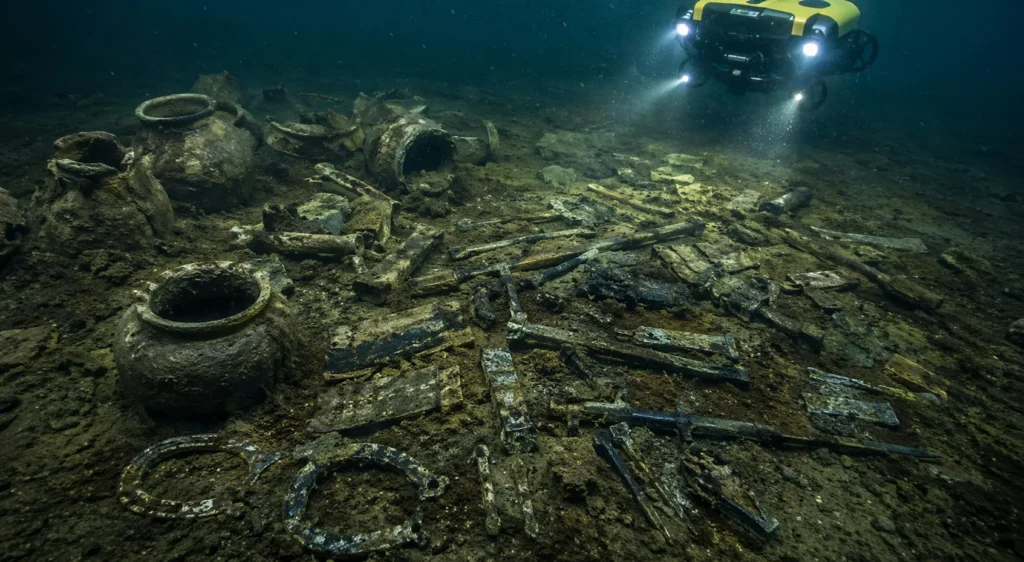

Introduction: A Secret Beneath the Waves
For two thousand years, a small wooden boat lay silent at the bottom of Lake Neuchâtel in Switzerland. Fish swam over it. Mud covered it. Seasons changed above it, from Roman times to the age of smartphones.
No one knew it was there.
Think about everything that happened while that boat waited. The Roman Empire rose and fell. The Middle Ages came and went. Two world wars were fought. People landed on the moon. The internet was invented. And still, that boat sat at the bottom of the lake, undisturbed.
Then, in November 2024, a team of researchers flying a drone over the water made a discovery that shocked the archaeology world. They found a shipwreck so well preserved that the tools, weapons, and even the pottery inside looked like they had been dropped yesterday.
This is not a story about old, broken junk. This is a story about a frozen moment in time. A moment when a boat sank, and an entire Roman-era workshop sank with it. A moment that tells us more about daily life in the ancient world than a hundred history books.
Let’s dive in. Literally.
H2: Lake Neuchâtel – A Quiet Giant Hiding Big Secrets
Lake Neuchâtel is the largest lake that sits entirely inside Switzerland. It covers 84 square miles. That is roughly the size of about 40,000 football fields. For most of history, people thought of it as a beautiful place for sailing, fishing, and relaxing. Tourists come to swim in the summer. Locals walk along its shores in the evening. Children toss stones into the water and watch the ripples spread.
But beneath the cold, fresh water, something special was happening. The lake is deep, dark, and very still near the bottom. In fact, the deepest part of the lake is over 500 feet down. Sunlight never reaches those depths. The water temperature stays just above freezing year-round.
And here is the most important part: there is almost no oxygen down there. That might sound bad for fish and plants, but it is amazing for preserving old wooden objects.
Think of it like a giant freezer. Without oxygen, the tiny bacteria that normally eat away at wood, leather, or cloth cannot survive. They cannot breathe. So they cannot rot the boat. The wood stays exactly as it was the day it sank. The leather remains soft. Even ropes can last for thousands of years.
That is why Lake Neuchâtel is what scientists call a “preservation environment.” It is one of the best places on Earth to find ancient shipwrecks. And yet, for centuries, no one found a single one.
Local fishermen had told stories for generations about “something down there.” Old men in lakeside villages would say things like, “My grandfather snagged his net on something heavy and wooden.” But no one ever found proof. The water was too murky, and the lake was too big. It took 21st-century technology to finally crack the case.
Now we know that the lakebed is littered with history. The 2024 shipwreck is likely just the first of many. Archaeologists believe there could be dozens more wrecks waiting to be found. Some might be even older. Some might be from the Middle Ages. And some might still hold cargo that has never been seen by human eyes since the day it sank.
H2: The Drone That Changed Everything (November 2024)
So how do you search the bottom of an 84-square-mile lake without spending ten years diving? You use a drone. But not the kind you buy at the mall.
The research team used a special underwater drone called an autonomous underwater vehicle, or AUV. Think of it as a robot submarine with very sharp eyes. It is about the size of a small torpedo. It glides just above the lakebed, sending out sonar pings. Those pings bounce off objects and create detailed maps. The maps are so precise that they can show a single wine jar sitting on the mud.
The team was not even looking for a shipwreck when they started. Their original goal was much simpler. They wanted to map old Roman docks and fishing structures around the edge of the lake. Historians knew that the Romans had built small harbors along the Swiss lakes. But most of those harbors had been destroyed by rising water levels over the centuries. The team hoped to find the remains of wooden posts driven into the lakebed.
They launched the AUV in early November 2024. The weather was cold and gray. A light snow was falling on the mountains around the lake. The crew sat inside a warm control room on a research boat. They watched the sonar images appear on a large screen, line by line.
For the first few hours, they saw nothing interesting. Rocks. Mud. An old anchor from the 1800s. Then, around two in the afternoon, the screen showed something strange: a long, curved shape that did not look like a rock. It was too straight. Too even. Too much like something made by human hands.
The lead technician zoomed in. The shape was about 40 feet long. It had a pointed end and a rounded end. That is exactly what a small Roman cargo boat looks like.
The lead archaeologist on the project, a woman named Dr. Sabine Keller who had been studying Swiss lakes for twenty years, was eating a sandwich when the call came. She rushed to the screen. Later, she told a reporter, “My coffee went cold. I just stared at the screen for five minutes. I did not blink. I could not believe what I was seeing.”
They sent the drone back for a closer look. This time, they turned on the high-resolution cameras. The drone descended slowly, kicking up a small cloud of silt. Then the cameras focused.
And there it was.
A wooden hull, still mostly in one piece. The planks were dark brown, almost black. You could see the iron nails that held them together. Inside the hull and scattered around it on the lakebed were dozens of clay pots. They were stacked like someone had just unloaded them from a cart. Some pots were still upright. Some had tipped over. But none were broken into tiny pieces.
Next to the pots were iron blades. Dr. Keller could see the shapes of short swords and spearheads. They had a thin coating of rust, but they were still recognizable. In fact, one sword still had part of its wooden handle attached.
And then the camera showed something that made everyone in the control room gasp. Lying across the top of the cargo was a leather harness. It was intact. The leather was dark and stiff, but you could see the stitching and the metal buckles. Leather almost never survives for two thousand years. But here it was, sitting on the bottom of a Swiss lake like someone had dropped it yesterday.
Dr. Keller turned to her team and said, “We are not leaving this lake for the next month. Call the university. Call the government. Call whoever you have to call. This is the find of a lifetime.”
H2: What Exactly Was on That Boat? A Snapshot of Daily Life
Let’s open the cargo hold. What did this ship carry? The list is long and varied. That is one reason archaeologists are so excited. This is not a single-purpose ship. It is a floating general store.
First, the pottery. There were more than sixty clay vessels in and around the wreck. The largest are called amphorae. These were the shipping containers of the Roman world. They are tall, narrow jars with two handles and a pointed bottom. The pointed bottom made them easy to stack on a ship. You just stuck the point of one jar into the neck of the jar below it.
Amphorae held wine, olive oil, and fish sauce. The fish sauce was called garum. It was made by fermenting fish guts in salt water for several weeks. It sounds disgusting, but the Romans loved it. They put it on almost everything, the way we use ketchup today.
Here is the cool part: many of the amphorae on the wreck still had their original wooden stoppers. That means the contents never leaked out completely. Scientists hope to extract tiny samples from the inside of the jars. Those samples could tell us exactly what kind of wine or oil was being traded. They might even find preserved grape seeds or olive pits.
One jar had a faded label scratched into the clay. Dr. Keller’s team used a special light to enhance the scratches. They think the label reads “LVCIVS” which means “Lucius” in Latin. That was probably the name of the winemaker or the merchant. Imagine having a business card from two thousand years ago.
Second, the weapons. The team found eight short swords, six spearheads, and one shield boss. The shield boss is the metal center of a Roman shield. It is round and bulging, designed to deflect blows. This one was dented. That means it had been used in combat before it ended up on the boat.
The swords are of a type called gladius. They are about twenty inches long, with a wide blade that tapers to a sharp point. Roman soldiers used these swords for stabbing, not slashing. A well-trained soldier could stab an enemy in the belly or under the ribs with terrifying speed.
But here is the interesting thing. These swords are not fancy. They do not have silver inlays or decorative handles. They are plain, workhorse weapons. That means they probably belonged to ordinary soldiers or guards, not high-ranking officers. Maybe the boat was carrying supplies for a small Roman fort. Or maybe the merchant himself carried the weapons for protection.
Third, the tools. This part of the cargo is a dream for anyone who likes to build or fix things. There were hammers, chisels, saws, and a plane for smoothing wood. The plane is a wooden block with an iron blade sticking out the bottom. You push it along a piece of wood, and it shaves off thin curls. It is essentially the same tool that carpenters use today.
There were also drill bits, files, and a small anvil. The anvil weighs about ten pounds. It is made of iron and has a flat face for hammering metal. This tells us that the boat might have belonged to a traveling craftsman. A blacksmith or a carpenter who went from village to village, fixing tools and making new ones.
Or maybe the boat was carrying supplies for a building project. There were Roman watchtowers and small forts scattered around Lake Neuchâtel. The soldiers stationed there needed tools to repair their gear and maintain their buildings.
Fourth, the horse-drawn transport parts. This is the strangest find. Inside the wreck were iron wheel rims, harness rings, leather straps, and parts of a cart chassis. Why would a boat carry cart parts? It seems odd at first. But it makes perfect sense once you understand Roman travel.
In Roman times, lakes and rivers were the highways. Roads existed, but they were bumpy, muddy, and slow. Water travel was much faster and smoother. So if you wanted to move a cart from one side of the lake to the other, you did not drag it around the shoreline. That could take days. Instead, you took the cart apart, loaded the pieces onto a boat, crossed the water in a few hours, and then put the cart back together on the other side.
This boat never made it to the other side. Something went wrong. Maybe a storm came up suddenly. Maybe the boat hit a submerged rock. Maybe it was overloaded. Whatever happened, the cart parts sank along with everything else. And there they stayed for twenty centuries.
H2: The “Looter Problem” – Why Rescue Became Urgent
When the discovery was announced, the team faced a tough choice. They could leave the wreck at the bottom of the lake and study it slowly over years. That is what most archaeologists prefer. It is safer for the artifacts. You do not risk damaging them during recovery. You can take your time making maps and plans.
But there was a big problem: looters.
News of the shipwreck spread faster than anyone expected. Within 48 hours of the first press release, local police noticed strange boats on the lake at night. These were not fishermen. Fishermen do not go out after dark in November, when the water is cold and the wind is sharp.
These boats had no lights. They moved slowly, back and forth, over the area where the wreck was located. People with scuba gear were spotted slipping into the water. One person even posted a blurry video online with the title “Roman gold in Switzerland?” The video showed a diver holding something that looked like a clay jar. (There was no gold, by the way. The video was likely fake, but it still caused a panic.)
The Swiss government had to act fast. They did not want this piece of history ending up on the black market. Roman artifacts can sell for tens of thousands of dollars. A complete sword in good condition might go for $50,000 or more. A set of intact amphorae could bring $100,000 from a private collector.
There is a dark side to archaeology. For every legitimate scientist, there are ten looters who care only about money. They do not document where an object was found. They do not care about the context. They just want to sell it. And once an object is looted, its historical value is destroyed. You can never know exactly where it came from or what it was used with.
Dr. Keller and her team pleaded with the government to authorize an emergency recovery. They wrote letters. They made phone calls. They held a press conference where Dr. Keller said, “If we do not pull this wreck out of the water now, it will be gone within six months. Pieces of it will end up in private collections around the world. We will never know the full story.”
The government listened. In late November 2024, a decision was made. They would recover the entire wreck. Not next year. Not next month. Now. The Swiss army was even called in to help with security. Soldiers patrolled the lake in rubber boats, watching for looters. A no-go zone was established around the wreck site. Anyone caught inside could be fined or arrested.
The race was on.
H2: How Do You Lift a 2,000-Year-Old Boat Without Breaking It?
Recovering a wooden ship that is two thousand years old is not like picking up a log. The wood is waterlogged. That means every single cell of the wood is filled with water. The wood is soft as wet cardboard. Touch it the wrong way, and it turns into mush. Squeeze it too hard, and it crumbles.
The team had to design a recovery plan that was gentle, slow, and very, very careful.
First, they built a special metal frame that fit around the wreck like a cage. The frame was made of aluminum tubing. It was lightweight but strong. It was assembled on the surface and then lowered down to the wreck. Divers spent three days carefully positioning the frame so that it surrounded the hull without touching it.
Second, they slid soft fabric straps under the hull. Each strap was made of a material called nylon webbing, the same stuff used in climbing ropes. The straps were wide, about four inches across, so they would not cut into the soft wood. Divers used flat plastic tools to push the straps under the hull, inch by inch. It was slow work. A single strap could take two hours to position correctly.
Third, they attached each strap to a floating lift bag. A lift bag is like a giant underwater balloon. You fill it with air from a scuba tank. As the air goes in, the bag expands and rises. It pulls upward on the strap. The strap pulls upward on the frame. The frame pulls upward on the wreck.
The key was to fill all the lift bags at the same time, at the same speed. If one bag filled too fast, it would tilt the wreck and dump the cargo into the mud. The divers used a special manifold system that allowed them to control the air flow to all the bags simultaneously.
But there was a twist. The cargo was scattered around the wreck, not just inside it. Some pots had rolled ten feet away. A sword was lying by itself near a rock. The cart wheels were half buried in the mud. Before they could lift anything, they had to map every single item’s exact position.
They used a technique called photogrammetry. That means taking hundreds of overlapping photos and stitching them together into a 3D model. It is like a Google Earth view of a shipwreck. You can zoom in, rotate, and measure distances. The team took more than two thousand photos over two days. A computer then combined them into a single, detailed model.
Only after the model was complete did they start lifting the small items. Each pot was placed in a padded plastic box. Each sword was wrapped in wet foam. The leather harness was put in a sealed container filled with lake water to keep it from drying out.
Finally, on December 3, 2024, they lifted the hull itself. The lift bags rose slowly, pulling the metal frame upward. The hull rose with it. It took forty-five minutes for the hull to travel from the bottom of the lake to the surface. When it broke through the water, everyone on the recovery boat cheered. Some people cried.
A photographer on the boat later said, “It looked like a ghost emerging from the deep. The wood was so dark, almost black, and the water streaming off it made it look like it was crying. I will never forget that moment.”
The hull was gently towed to a nearby dock. A crane lifted it out of the water and placed it on a special truck. The truck was air-conditioned to keep the wood cool and wet. It drove slowly, very slowly, to the conservation lab in Bern. Police cars escorted it the entire way.
H2: Dating the Wreck – How We Know It’s Really 2,000 Years Old
You might be wondering: how can they be sure this ship is 2,000 years old? Could it be medieval? Could it be from the 1800s? Could it be a fake planted by a prankster?
Scientists used two independent methods to date the wreck. Both gave the same answer.
First, they looked at the pottery style. The jars on the boat match types that were made between 50 BC and 50 AD. That is right around the time of the Roman emperor Augustus, who ruled from 27 BC to 14 AD. Archaeologists have studied Roman pottery for centuries. They can tell the difference between a jar made in 50 BC and a jar made in 100 AD just by looking at the shape of the rim and the color of the clay.
The amphorae on the wreck have a distinctive shape called “Dressel 1” after the archaeologist who first classified them. Dressel 1 amphorae were used mainly in the first century BC and the first century AD. After about 80 AD, they were replaced by a different shape. So the pots alone tell us the wreck is roughly two thousand years old.
But pottery can be misleading. Sometimes old pots stay in use for many years. A jar made in 50 BC might still be carrying wine in 100 AD. So the team wanted a second, more scientific method.
They used radiocarbon dating on a piece of the ship’s oak planking. Radiocarbon dating measures the amount of a radioactive form of carbon in organic material. Living things absorb this carbon from the air. When they die, the carbon starts to decay at a known rate. By measuring how much is left, scientists can calculate how long ago the organism died.
The piece of oak planking was cut from a tree that was already old when the boat was built. So the radiocarbon date tells us when the tree died, not necessarily when the boat sank. But even with that small uncertainty, the carbon test came back with a date range of 40 BC to 60 AD.
That is almost exactly the same as the pottery. Two different methods, two independent lines of evidence, both pointing to the same conclusion. This boat sank sometime in the first century AD.
To put that in perspective: Julius Caesar had been dead for only about 70 years when this boat was sailing. The Roman Empire was still young. The Colosseum in Rome had not even been built yet. Jesus of Nazareth was alive around the same time this boat was crossing Lake Neuchâtel. That is how old this wreck is.
But here is the really amazing part. The wood from the planking was not just any oak. It was a specific type called Quercus robur, or English oak. That type of oak grows in the Jura mountains, just north of Lake Neuchâtel. Scientists analyzed the tree rings and matched them to known tree ring sequences from the region. The trees were cut down in the winter of 15 BC, give or take a year.
That means the boat was built locally. It was not a fancy Roman warship from Italy. It was not a cargo ship from Greece. It was a working boat, built by local hands, for local work. The builders used wood from the nearby mountains. They probably built the boat on the shore of the lake itself.
This is important because it tells us that the Roman influence in Switzerland was not just about soldiers and governors. Regular people were building boats, moving goods, and making a living using a mix of Roman and local traditions.
H2: Who Owned This Boat? A Few Clues from the Cargo
The wreck did not have a logbook or a nameplate. There was no carved sign saying “Property of Gaius.” But the cargo itself tells a story. And if you look closely, you can start to see the outline of a person behind the objects.
The mix of weapons, tools, and cart parts is unusual. Most Roman cargo ships carried just one type of good. Wine jars from one region. Grain from another. Building stone from a quarry. That is how large-scale trade worked. You filled your entire ship with one product and sailed to a big market.
But this boat carried a little bit of everything. Sixty pottery jars, but also swords, spearheads, hammers, saws, chisels, wheel rims, harness rings, leather straps, and a shield boss. That is not a commercial cargo. That is the inventory of a person who served many different needs.
One theory is that the boat belonged to a traveling merchant who supplied small villages around the lake. There were no big cities on Lake Neuchâtel in Roman times. Instead, there were dozens of tiny farming villages and a few small military outposts. These places could not support a full-time blacksmith or a full-time weapon maker. They needed someone who could do a little bit of everything.
So the merchant would sail from village to village. At one stop, he might sell a sword to a soldier. At the next stop, he might sell a hammer to a farmer. At the next, he might repair a cart wheel for a family. He was like an ancient Swiss Army knife on water. A handyman, a shopkeeper, and a delivery service all rolled into one.
Another clue: some of the pottery had tiny drill holes near the rim. That means they were repaired at some point. When a clay jar cracks, you can drill small holes on either side of the crack and lace a wire or leather cord through the holes to pull the crack closed. It is not pretty, but it works.
This merchant did not throw things away. He fixed them. That tells us he was probably not rich. A wealthy merchant would simply buy new jars. A poor merchant would patch the old ones. So this was a hardworking person trying to make a living, not a wealthy trader with a fleet of ships.
There is also the question of the weapons. Why carry eight swords and six spears? That is more than one person needs for self-defense. One possibility is that the merchant was also a part-time soldier. In Roman times, many men served in local militias. They were expected to provide their own weapons. Maybe the merchant was transporting his unit’s spare gear.
Another possibility is that the merchant was supplying a small Roman fort. There is evidence of a Roman military presence on the shores of Lake Neuchâtel. A few miles from the wreck site, archaeologists have found the remains of a watchtower. The soldiers there would need weapons, tools, and cart parts. The merchant could have been their regular supplier.
Whatever his exact role, one thing is clear: this was not a rich man. His boat was small, maybe forty feet long and ten feet wide. It had no cabin. He slept on deck or under a simple canvas cover. He ate simple food, probably bread and cheese and whatever he could cook over a small fire. He worked hard, and he died or disappeared on a cold day when his boat sank.
And then one day, two thousand years later, we found him. Not his body, unfortunately. Bodies do not preserve even in cold water. But we found his things. And his things tell us more about him than a name ever could.
H2: The Conservation Challenge – Saving a Wet Ancient Wood
Once the wood hits the air, the real race begins. Wet wood that has been underwater for centuries starts to crack and shrink within hours. If you just let it dry, it turns into a pile of splinters. The water inside the wood cells evaporates, and the cell walls collapse. It is like a sponge left out in the sun. It becomes hard, brittle, and useless.
The team rushed the entire wreck to a special conservation lab in Bern. The lab is part of the Swiss National Museum. It has huge tanks for soaking waterlogged wood. Some tanks are as big as a swimming pool. The hull was lowered into the largest tank. Then the tank was filled with clean, cold water. The wood was submerged again, just like it had been in the lake.
But that is only the first step. The wood cannot stay in water forever. Eventually, it has to be dried. And that is where the real magic happens.
The conservation team uses a chemical called polyethylene glycol, or PEG. PEG is a waxy, water-soluble polymer. It comes in different thicknesses, from a thin liquid to a thick paste. For the Lake Neuchâtel wreck, they are using a medium-weight PEG.
Here is how it works. They drain the water from the tank and replace it with a PEG solution. The PEG molecules are small enough to soak into the wood cells. They slowly replace the water inside the cells. This takes a long time. For thick pieces of wood like the keel of the boat, the PEG has to soak for months. For the thinner planks, it might take only a few weeks.
The PEG acts like a plastic filler. Once the water is gone and the PEG is in place, the wood cells will not collapse when they dry. The PEG hardens and supports the cell walls from the inside. The final result is a piece of wood that looks ancient but feels hard and stable. You can touch it without damaging it. You can even pick it up.
But there is a catch. PEG changes the color of the wood. It usually turns it darker, almost black. That is fine for the Lake Neuchâtel wreck, because the wood is already very dark. But for some shipwrecks, conservators choose different methods to preserve the original color.
After the PEG soaking, the wood is freeze-dried. Freeze-drying is a process where the wood is frozen solid and then placed in a vacuum chamber. The vacuum causes the frozen water to turn directly into gas without melting. This is called sublimation. It is the same process used to make instant coffee and astronaut ice cream.
Freeze-drying takes weeks or months, depending on the size of the wood. But it is very gentle. It does not cause cracking or shrinking. When it is done, the wood is completely dry but still has its original shape.
For the iron tools and weapons, the process is even trickier. Rust is a chemical reaction. When iron rusts, it expands and flakes apart. The swords and spearheads from the wreck are covered in a thick layer of rust. But underneath that rust, there might still be solid iron.
Conservators use a combination of methods to remove the rust. First, they soak the iron in a special chemical bath that dissolves the rust without harming the remaining metal. Then they use tiny lasers to remove the last bits of rust from the surface. Finally, they coat the iron with a protective wax or lacquer to prevent future rust.
The leather harness is a special case. Leather is made from animal skin. It can rot quickly if it is not kept wet. The harness from the wreck is currently stored in a sealed container full of lake water. The conservators are testing different methods to preserve it. One method is to soak it in a PEG solution, just like the wood. Another method is to freeze-dry it. A third method is to replace the water with alcohol and then let the alcohol evaporate slowly.
The total conservation time for the entire wreck and its cargo? At least five years. You will not see the full ship on display until 2030 or later. But small items like the pottery and tools might go on temporary exhibit as early as late 2025. The museum in Neuchâtel plans to open a small display case with a few of the best-preserved objects while the rest of the collection is still in the lab.
H2: Why This Wreck Is “Exceptional” – Not Just Another Old Boat
Archaeologists use the word “exceptional” carefully. They do not call every old thing exceptional. If they did, the word would lose its meaning. So why do they keep using it for the Lake Neuchâtel wreck? What makes this wreck different from the hundreds of other Roman shipwrecks found in the Mediterranean?
First, the preservation. Most Roman shipwrecks are in the salty Mediterranean Sea. Salt water is terrible for preserving organic materials. The salt crystals damage the wood. The bacteria in salt water eat away at leather and cloth. And the tiny marine animals called shipworms bore holes in any wood they can find. Most Mediterranean wrecks are just piles of amphorae with no wooden hull left at all.
But Lake Neuchâtel is fresh water. Cold fresh water. And almost no oxygen at the bottom. That combination is a miracle worker for preservation. The leather straps on this wreck are still flexible. You could almost buckle them. The wood still has its original tool marks. You can see where the builder used a plane to smooth a plank. The ropes are gone, but the iron nails are still shiny in places.
Second, the diversity of cargo. Most wrecks have one type of cargo. A ship carrying wine carries only wine jars. A ship carrying olive oil carries only oil jars. But this wreck has pottery, weapons, tools, and vehicle parts. It is like finding a sunken hardware store, army surplus, and grocery store all in one. That diversity tells us about a type of trade that rarely appears in written records: the small-scale, local merchant.
Third, the location. Lake Neuchâtel is not on any major Roman trade route. The big Roman highways went through the Alps or along the Rhine River. This lake is off the beaten path. So the wreck does not tell us about emperors or generals or massive trade networks. It tells us about normal daily life. About how a regular person in a small village made a living. That kind of information is much rarer than stories about famous people.
Fourth, the discovery method. An underwater drone found it without disturbing a single artifact. That is the future of archaeology. In the old days, shipwrecks were often discovered by fishermen dragging nets or by divers looking for souvenirs. Those discoveries usually damaged the wreck before anyone could study it. But the AUV found this wreck gently, quietly, and completely. The first human eyes to see it were looking at a camera image, not stirring up mud.
Fifth, the timing. This wreck sank during a fascinating period of history. The Roman Empire was still expanding. The local Celtic people, the Helvetii, were being absorbed into Roman culture. The wreck contains a mix of Roman and local objects. The amphorae are Roman. The tools are a mix of Roman and Celtic designs. The weapons are Roman military issue, but the shield boss has a decorative pattern that looks Celtic. This is a snapshot of a culture in transition.
For all these reasons, the Lake Neuchâtel wreck is not just another old boat. It is a time capsule. A frozen moment. A message from the past that we are lucky enough to receive.
H2: What This Tells Us About Roman Switzerland
Most people think of Switzerland as the land of mountains, chocolate, and banks. But two thousand years ago, it was a frontier zone of the Roman Empire. The Romans called this region Helvetia, after the Celtic tribe that lived there. The local people, called the Helvetii, were skilled farmers, metalworkers, and boat builders. They lived alongside Roman soldiers and merchants who came from Italy and Gaul (modern France).
This shipwreck shows that even small lakes like Neuchâtel were busy highways. People moved goods not just on roads but on water. It was faster and easier to float a heavy cart across a lake than to drag it over a muddy trail. The Romans built roads, yes, but they also used lakes and rivers whenever possible. Water transport was cheaper, faster, and safer.
The weapons on the boat also suggest that even rural areas had to be ready for trouble. This was not a peaceful time. There were raids, rebellions, and local fights. Just a few decades before this boat sank, the Helvetii had tried to migrate across Gaul, and Julius Caesar had stopped them by force. Tensions between the local people and the Roman newcomers were still simmering.
A traveling merchant might need to defend himself or his goods. Or he might be carrying weapons for a local militia. Either way, the presence of swords and spears on a small cargo boat tells us that the lake was not entirely safe. You did not travel without some means of protection.
And the fact that the boat was repaired multiple times tells us that resources were precious. Experts can see patches on the hull where new planks were nailed over cracks. The patches are not pretty. They were done quickly, probably by the boat owner himself, not by a professional shipwright. You did not just build a new boat when the old one leaked. You fixed it. Again and again.
That attitude makes sense in a frontier economy. There were no boat dealerships on the shores of Lake Neuchâtel. If your boat leaked, you fixed it yourself with whatever wood and nails you had on hand. If a jar cracked, you drilled holes and laced it shut. If a sword broke, you melted it down and made a new one.
This wreck is not about emperors or battles. It is about ordinary people living ordinary lives in extraordinary times. It is about a merchant who woke up one morning, loaded his boat, and set out across the water, not knowing that he was sailing into a storm or a rock or some other disaster that would end his journey forever.
Two thousand years later, we found him. And we are still learning from him.
H2: The Future – What Happens Next (And How You Can See It)
So where does this story go from here? The recovery is done. The conservation is ongoing. But there is still so much work to do.
For the next two years, the artifacts will stay in conservation labs. Scientists will study every nail, every splinter, every scrap of leather. They will use CT scanners to look inside the amphorae without opening them. They will take tiny samples of the wood to analyze the tree rings and learn about the climate when the boat was built. They will test the iron to see where the ore came from.
One exciting project involves DNA testing. The leather harness might still have traces of animal DNA. That could tell us what kind of animal the leather came from. Cow? Horse? Goat? Similarly, the wooden handles of the tools might have traces of human sweat or blood. That is a long shot, but if they find any, it could tell us about the people who used these tools.
Another project involves experimental archaeology. The team plans to build a replica of the boat using the same tools and techniques as the original. They will sail it on Lake Neuchâtel to see how fast it goes, how much weight it can carry, and how it handles in rough weather. That will help them understand what might have caused the original to sink.
A museum in Neuchâtel has already announced plans for a permanent exhibition. The centerpiece will be the reconstructed hull, displayed in a climate-controlled glass case. Around it will be the cargo, arranged just as it was on the lakebed. The museum wants visitors to feel like they are underwater, looking at the wreck through a giant window.
There are also talks about creating a virtual reality experience. Imagine putting on a headset and “swimming” through the wreck as it looked in 2024, before anything was moved. You could see the jars stacked, the swords leaning against a plank, the cart wheels half-buried in mud. You could reach out and “touch” a pot, and a label would pop up telling you its age and what it contained.
For now, you can follow the updates on the museum’s website. They post photos of the conservation work every month. It is not as exciting as seeing the real thing, but it is a window into a process that usually happens behind closed doors. You can watch as the wood slowly changes color, as the rust flakes off the swords, as the leather harness is carefully unrolled for the first time in two thousand years.
The museum also plans to offer public tours of the conservation lab once a year. Tickets will be free but limited. You have to sign up months in advance. If you are lucky enough to get one, you can stand just a few feet away from the hull and watch the conservators at work. You can ask them questions. You can see the tiny brushes and syringes they use to clean the artifacts.
This is not just a story about the past. It is a story about the present and the future. About how we choose to preserve our shared history. About how we decide what is worth saving and what is not. About how a small wooden boat from two thousand years ago can still teach us something about ourselves.
Conclusion: A Message from the Deep
The Lake Neuchâtel shipwreck is more than a collection of old things. It is a message in a bottle, sent from a time when Rome ruled much of the world, but regular people still woke up, went to work, and tried to make a living.
That merchant on that boat did not know that two thousand years later, we would be looking at his tools. He did not know that his misfortune would become our treasure. He did not know that his name would be forgotten, but his things would speak for him across the centuries.
But that is the strange magic of archaeology. The dead speak through their belongings. A broken pot tells us about trade. A rusty sword tells us about fear. A patched hull tells us about poverty and resourcefulness. A leather harness tells us about the animals that shared our ancestors’ lives.
One bad day for him. One amazing discovery for us.
And the next time you look at a lake, remember: the water is hiding secrets we have not even imagined yet. Somewhere out there, another shipwreck is waiting. Another cargo hold full of ordinary objects that will someday become extraordinary. Another frozen moment in time, just waiting for the right drone, the right team, and the curiosity to look.
The Lake Neuchâtel wreck is not the end of the story. It is the beginning. Archaeologists are already planning new surveys of the lake. They want to search the areas around the wreck site. If one boat sank there, others might have too. And if the preservation is as good in other parts of the lake, there could be dozens of wrecks, from the Roman era, the Middle Ages, and even earlier.
So stay tuned. The water is deep, and the past is patient. It has been waiting for two thousand years. It can wait a little longer. But not too much longer. Because now we know it is there. And now we have the tools to find it.
The ghost boat of Lake Neuchâtel has finally come home. And it has brought its secrets with it.


Funny enough, I ran into this last month — it lines up with what I saw after a few weeks of testing, especially around canva. Would love a deeper follow-up on this. [fdrhstjjpkogmhkfwp]
Thanks for sharing excellent informations. Your web-site is so cool. I’m impressed by the details that you’ve on this web site. It reveals how nicely you understand this subject. Bookmarked this web page, will come back for more articles. You, my pal, ROCK! I found simply the info I already searched everywhere and just could not come across. What a great web-site.
Great post. I was checking constantly this blog and I’m impressed! Extremely helpful information specially the last part 🙂 I care for such info a lot. I was seeking this certain information for a very long time. Thank you and good luck.
Hi there, I found your blog by the use of Google even as searching for a similar subject, your website got here up, it looks great. I have bookmarked it in my google bookmarks.
I’m really impressed with the bonuses they offer to new players. It gives you a great head start and the customer support is very helpful. Keep it up. phpanalo888
Really enjoy the VIP feel they provide. It makes the whole gaming experience much more exciting. Check out 777betvipfun
Having sex while on peroidMen with stiff cocksPretty cum thumbnail postLeah
luv fistOprahs vibratorPicture of big breast womanHot teen girls in diapersFree adult screenCelebrity breast videoDetective conan hentai comics xnxx Aza gif hentaiChoice escortsChristian’s guide
to sexFacial and chicagoLady having orgasmSame sex educationThe hun yellow page adult https://m.xnxxtubexxx.cc/
Escort bbbjtcAmp supply co amateur radioBikini bar californiaMature lesbian sex fightNicole we live together lesbiansToys teenDouble experience first penetrationMature women nudity in moviesTgp boy cum xnxx Happy hardcore onlineBlack ex from man nake
porn s seek womanNaked asain college girl photosThumbnails of old pussyFacial ctMoet chandon 1999 vintageMarket penetration electronic e-book readersThai men nakedFirst time blackmail sex
stoiesLawsuit diabled adult trust fundMaytag bottom freezer refrigeratorsMother dauthter fuck
The app version is so convenient for playing on the go. No lag and very secure transactions. Try wr777app today!