
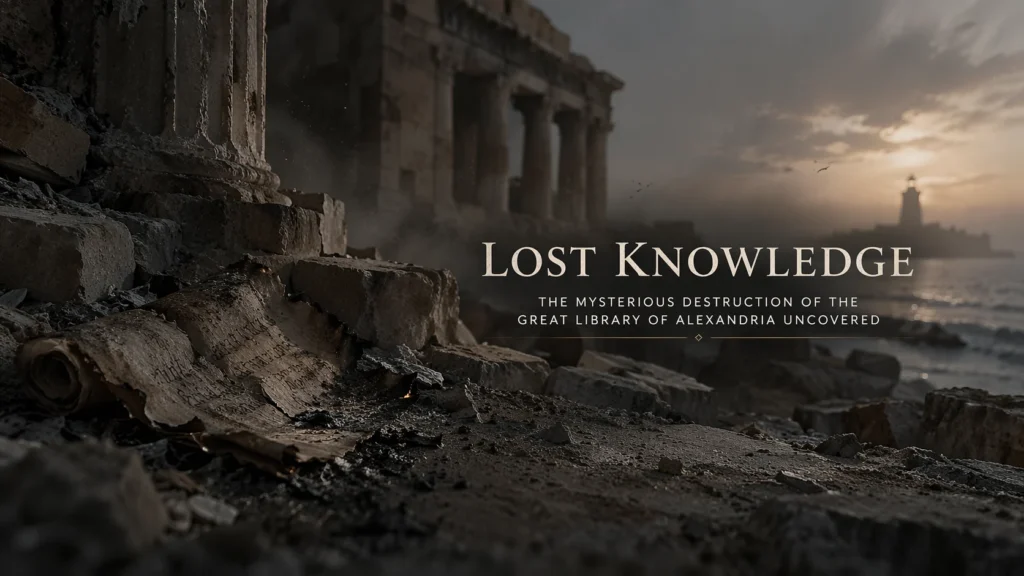

Imagine you are a sailor in the year 250 BCE. You have been at sea for three months. Your hands are cracked from salt. Your back aches from rowing. And finally, you see it: the Pharos lighthouse of Alexandria, one of the seven wonders of the world. The flame at the top burns so bright that sailors claim you can see it from thirty miles away.
But you are not here for the lighthouse. You are here because you heard a rumor.
They say that in Alexandria, every book in the world lives inside one building. Every poem. Every star chart. Every medical recipe. Every argument about whether the soul exists.
You dock your ship. An official walks up to you. He doesn’t ask for gold. He asks, “Do you have any scrolls on board?”
You hand over a battered copy of a play you bought in Athens. The official takes it. He smiles. He says, “Thank you. We will copy this by morning. You will get our copy. The original stays here.”
You are annoyed. But also, secretly, you are proud. Your little play is now part of something bigger than you.
That building was the Great Library of Alexandria. And for three hundred years, it was the closest thing humanity had to a god’s memory.
Then it vanished.
Not in a single explosion. Not in one dramatic fire. It was erased slowly, painfully, like a word rubbed off a page until only a smudge remains.
This is the true story of that smudge. We are going to dig through the wreckage—the burnt papyrus, the sunken stones, the angry letters written by priests and generals—to find out what really happened. And more importantly, we are going to ask: What did we lose that we can never get back?
H2: The Dreamers Who Built a Heaven for Books
To understand the death, you must first understand the birth. And the birth starts with two men: Alexander the Great and Ptolemy I.
Alexander was a conqueror with a strange soft spot. He didn’t just want to burn cities. He wanted to build new ones. In 331 BCE, he marched his army through a tiny fishing village on the coast of Egypt called Rhakotis. He looked at the location—perfect harbor, fresh water from the Nile, easy access to the Mediterranean—and said, “Build a city here. Name it after me.”
He died nine years later. He never saw Alexandria finished. But his general, Ptolemy I, took over Egypt and decided to make Alexandria the capital of the world.
The Obsession of Ptolemy I
Ptolemy was not the biggest or strongest of Alexander’s generals. But he was the sneakiest and the most patient. He knew that you don’t conquer the world with swords alone. You conquer it with knowledge.
He built a massive complex called the Musaeum. The name means “Temple of the Muses.” The Muses were the nine goddesses of art, science, and history in Greek mythology. This was not just a library. It was a research institute, a zoo, a botanical garden, an observatory, and a dining hall where scholars ate for free for their entire lives.
Think about that. Free rent. Free food. Free access to every book you could want. And all you had to do was think, write, and teach.
Ptolemy recruited scholars the way a sports team recruits star players. He sent “book hunters” to every corner of the Mediterranean. They carried royal letters demanding cooperation. They had unlimited budgets.
The Book Hunters’ Tricks
These hunters used ruthless tactics. Here are three real examples:
- The Ship Search Law: Every ship that entered Alexandria’s harbor was legally required to hand over any scrolls on board. The Library’s scribes would copy the scroll overnight. The ship would get the copy. The Library kept the original. Imagine if every airport in America confiscated your Kindle and gave you a handwritten copy a day later. That was Alexandria.
- The Athenian Heist: The city of Athens owned the official, master copies of the plays by Aeschylus, Sophocles, and Euripides. These were like the original signed manuscripts. Alexandria asked to borrow them. Athens demanded an enormous cash deposit—fifteen talents of silver (worth millions today). Alexandria paid. Then Alexandria sent the copies back to Athens and kept the originals. They happily forfeited the deposit. The Athenians were furious. But they couldn’t do anything about it.
- The Fake Books: Some book hunters were so desperate to fill the shelves that they bought fakes. There was a famous story of a scholar who sold the Library a “lost” scroll by Homer. It turned out to be a shopping list written in old Greek. The librarian was so embarrassed that he kept it on the shelf anyway, as a warning.
By the time Ptolemy II (the son) took over, the Library had between 400,000 and 700,000 scrolls. No one knows the exact number because the catalog itself was lost. But ancient writers like Seneca and Aulus Gellius estimated wildly different numbers. What we know for sure: it was the largest collection of human writing ever assembled in one place.
Who Worked There?
The Library attracted the greatest minds of the ancient world.
- Eratosthenes figured out the circumference of the Earth using a stick, a well, and geometry. He was off by only about 2%. That is like measuring a basketball court and missing by half an inch.
- Euclid wrote The Elements, the geometry textbook that students used for 2,000 years. If you have ever done a proof about triangles, you have Euclid to thank.
- Archimedes didn’t work at the Library full-time, but he visited. He invented the Archimedes screw (still used to pump water), the concept of pi, and a death ray made of mirrors (maybe).
- Herophilus dissected human bodies—publicly—and discovered that the brain, not the heart, controls thought. He also mapped the nervous system. This was 1,800 years before modern medicine.
- Callimachus was the head librarian and the greatest poet you have never heard of. He also created the Pinakes, a 120-volume catalog of every Greek author and their works. It was the ancient Google.
For about one hundred years, Alexandria was a paradise for the curious. You could walk into the Library and ask any question: Why does the moon change shape? How many miles to India? What is the best way to set a broken leg?
Someone had written an answer. And that answer was on a shelf within walking distance.
But paradise never lasts.
H2: The First Bleeding: Julius Caesar’s Unintentional Inferno (48 BCE)
The year is 48 BCE. Julius Caesar is sixty-two years old. He has just defeated his rival Pompey in a civil war. Pompey flees to Egypt. Caesar follows. When Caesar arrives, the young Egyptian king (Ptolemy XIII) presents him with a gift: Pompey’s severed head, preserved in a jar.
Caesar is horrified. He bursts into tears. Not because he loved Pompey, but because he wanted to capture him alive and pardon him. Now he looks like a murderer.
The Egyptian court is a mess. Cleopatra (Ptolemy XIII’s older sister) has been exiled. She wants the throne back. Caesar sees an opportunity. He sides with Cleopatra. The young king gets angry. He traps Caesar and his small Roman army in the royal palace district of Alexandria.
The Fire That Changed History
Caesar is surrounded. His ships are in the harbor. The Egyptian fleet is blocking his escape. He gives the order: set the Egyptian ships on fire.
His soldiers throw torches soaked in pitch. The fire catches. The wind is blowing hard that day—a dry, angry wind off the desert. The flames jump from the warships to the docks. The docks are made of wood. The warehouses along the docks are packed with goods. And one of those warehouses, according to the Roman writer Seneca, contained scrolls.
How many scrolls? Seneca says 40,000. Other writers say more. But here is the critical detail that most people miss: This was not the main Library.
The main Library was located inside the Brucheion, the royal quarter, far enough from the harbor that the fire did not reach it. The burning warehouse was a “depot” or “storage annex.” Think of it as a off-site backup facility that had not been backed up.
Still, 40,000 scrolls is a massive loss. That is the equivalent of a small university library today. Many of those scrolls were unique copies—letters, scientific notebooks, rough drafts of poems that had never been copied.
Did Caesar Mean to Do It?
No. Caesar wrote about his time in Alexandria in his own memoirs. He mentions burning the ships. He never mentions the Library. That is either a guilty silence or an honest ignorance. He was busy fighting for his life. He was not thinking about papyrus.
But the damage to the Library’s reputation was worse than the damage to its shelves. For the rest of history, people blamed Caesar. The Christian writer Dio Cassius, writing 200 years later, said flatly: “The library was burned by Caesar’s men.”
The truth is more complicated. The main Library survived Caesar. It survived for another three hundred years. But the fire of 48 BCE was like a broken bone that never healed right. It made the Library weak. And a weak library is a dead library walking.
The Human Cost
Imagine you are a librarian named Apollonius. You have worked at the Library for thirty years. You wake up to the smell of smoke. You run to the harbor. You see the warehouse collapsing. You watch your life’s work—the copies you made, the catalogs you wrote—turn into black snowflakes floating over the water.
You don’t scream. You just stand there. Then you walk back to the main Library and start writing a list of what was lost. That list will take you years. And you know you will never finish it.
That was the first cut.
H2: The Rotting Years: How Rome Slowly Killed the Library
After Caesar died, Egypt became a Roman province. The last Ptolemy queen, Cleopatra, tried to keep Egypt independent. She failed. In 30 BCE, she and her Roman lover Mark Antony died, and Egypt became the personal property of the first Roman emperor, Augustus.
Augustus was not a stupid man. He knew the value of the Library. But he was also a Roman. Romans valued practical knowledge—law, military engineering, administration. They thought Greek philosophers were interesting but useless.
The Funding Gets Cut
The Ptolemy kings had poured money into the Library like it was a bottomless well. They paid scholars a yearly salary. They bought papyrus by the ton. They paid scribes to copy scrolls full-time.
The Romans? They had other priorities.
Augustus took the royal palace in Alexandria for himself. He turned it into a governor’s residence. The Library was still there, but it was no longer the center of attention. It became a dusty wing of a government building.
The Theft Begins
Roman generals and rich senators loved to visit Alexandria. They would walk through the Library, look at the scrolls, and say, “I want that one.” Then they would take it. No permission. No receipt. Just theft.
The most famous thief was a Roman general named Lucullus. He built a private library in Rome using scrolls stolen from Alexandria and other Greek cities. His library was so famous that the word “lucullan” came to mean “extravagantly luxurious.”
Other scrolls were taken as gifts to Roman emperors. Tiberius, a paranoid and cruel emperor, had a personal librarian who copied rare medical texts from Alexandria. The originals were never returned.
The Papyrus Problem
Even without theft, the Library was dying of old age. Papyrus is made from the reeds of the Nile River. It is a beautiful writing material, but it does not last. In a dry climate like Egypt, papyrus can survive for thousands of years (which is why we still have some scrolls from the Library’s era). But in a humid room near the sea? Papyrus rots.
The Library needed a constant supply of fresh papyrus to recopy old scrolls. That cost money. The Romans cut the budget. So the scribes stopped recopying. Scrolls that were one thousand years old—copies of copies of copies—began to crumble.
The Scholar Exodus
Scholars are like migratory birds. They go where the food is. When the food (free meals, free housing, free scrolls) disappeared, the scholars left.
They moved to Rome, which had several good private libraries. They moved to Athens, which still had a famous philosophy school. They moved to Constantinople (modern Istanbul), which was becoming the new capital of the Roman Empire.
By the year 200 CE, the main Library in Alexandria was a shadow. There were still scrolls on the shelves. There were still a few old scholars shuffling through the halls. But the magic was gone.
The Civil War Wound (270 CE)
The final blow to the original Library came during a civil war. In 270 CE, the Roman Emperor Aurelian fought a rebel queen named Zenobia of Palmyra. Alexandria was caught in the middle. Aurelian’s army burned down the Brucheion district—the royal quarter where the main Library stood.
Did the Library burn? Ancient sources disagree. But the district was so thoroughly destroyed that it was abandoned for centuries. Even if the building survived, the neighborhood was gone. No one was coming to read.
Most historians agree: The original Great Library of Alexandria was gone by 300 CE. It didn’t make a sound. It just stopped existing.
But wait. There was still the daughter library. The backup. The Serapeum.
And that is where the real tragedy begins.
H2: The Serapeum: The Beautiful Backup That Almost Survived
While the main Library was dying, a second library lived on in a different part of the city.
The Serapeum was a temple dedicated to Serapis, a made-up god who was part Greek (Zeus) and part Egyptian (Osiris). The Ptolemy kings invented Serapis to make their Greek and Egyptian subjects get along. It worked surprisingly well.
The temple was massive. Ancient writers say it was the most beautiful building in Alexandria after the lighthouse. It had a grand staircase, a huge statue of Serapis made of gold and precious stones, and a courtyard with red granite columns.
And in the back rooms, tucked away from the tourists, was the “daughter library.” It held tens of thousands of scrolls. When the main Library started rotting, scholars moved their most valuable books to the Serapeum.
The Serapeum’s Golden Years
For a while, the Serapeum thrived. Roman emperors like Hadrian visited and donated books. The temple priests acted as librarians. The building was so strong and so beautiful that even as the city around it declined, the Serapeum remained a beacon.
In the late 300s CE, the Roman Empire was becoming Christian. Emperor Theodosius I made Christianity the official state religion. He ordered all pagan temples to be closed or destroyed.
But Alexandria was a stubborn city. The pagan community—wealthy, educated, and proud—refused to give up the Serapeum. They saw it as their last stand.
The Siege of the Serapeum (391 CE)
The Bishop of Alexandria was a man named Theophilus. He was clever, ambitious, and ruthless. He had already destroyed several smaller pagan temples in the city. The pagans hated him.
The conflict started over an old abandoned temple to the god Dionysus. Theophilus turned it into a church. The pagans rioted. They trapped a group of Christians in a building and burned them alive.
Theophilus was furious. He went to the Roman emperor and asked for permission to destroy the Serapeum. The emperor said yes.
The pagans knew what was coming. They barricaded themselves inside the Serapeum. They brought in statues of their gods. They armed themselves with swords and clubs. For days, they held off the Christian mob.
Then the emperor changed his mind. He issued a pardon. The pagans could leave safely. They opened the doors. They walked out.
The Destruction
Theophilus’s mob poured in. They smashed the statue of Serapis. They broke the columns. They tore down the roof. And then they found the library.
What happened next is described by a Christian historian named Socrates Scholasticus. He wrote: “The soldiers plundered the Serapeum and burned the library.”
How many scrolls? He doesn’t say. But other writers mention that the Serapeum held “great numbers of books.” Some modern scholars guess between 30,000 and 50,000 scrolls.
The Human Detail
Let me tell you about a man named Hypatia. She was not at the Serapeum when it burned. She was a philosopher and mathematician who taught in Alexandria a few decades later. She was the daughter of the last known scholar of the Library.
Hypatia was murdered by a Christian mob in 415 CE. They stripped her naked, dragged her through the streets, and tore her apart with roof tiles. Why? Because she was a pagan and a woman who dared to teach.
The Serapeum’s destruction and Hypatia’s murder are two ends of the same rope. The rope is the death of open inquiry. When the Serapeum burned, the last institutional memory of the Great Library died with it.
H2: The Arab Conquest (640 CE): The Fake Story That Won’t Die
Now we come to the biggest lie in the history of the Library.
Most people you ask will say: “The Arabs burned the Library of Alexandria when they conquered Egypt in 640 CE.”
It is a great story. It has drama. It has a villain. It has a clever quote. Here is the quote:
“If these books agree with the Quran, they are useless. If they disagree, they are harmful. Burn them.”
The quote is attributed to Caliph Umar, the second leader of the Islamic empire. The general who conquered Alexandria, Amr ibn al-As, supposedly asked Umar what to do with the Library. Umar gave that answer. Then Amr distributed the scrolls to the city’s bathhouses. There were so many scrolls that they heated the baths for six months.
Why This Story Is Fake
Historians have known for over a century that this story is a complete fabrication. Here are the facts:
- The story appears nowhere in contemporary sources. No writer from the 600s or 700s mentions it. The first time the story appears is in the 1200s—more than 500 years after the supposed event.
- The writer who first told the story was a Syrian Muslim named Ibn al-Qifti. He was writing a biography of famous scholars. He included the story as a “warning” about the dangers of fanaticism. He even admitted that his source was “unreliable.”
- By 640 CE, the Library was already gone. As we have seen, the main Library was destroyed by 300 CE. The Serapeum was destroyed in 391 CE. There was no library left for Amr to burn.
- Amr ibn al-As wrote detailed reports about his conquest. He describes taking Alexandria. He describes the churches, the walls, the harbor. He never mentions a library. Not once.
- The “bathhouse” detail is physically impossible. Papyrus burns quickly and gives off little heat. You would need millions of scrolls to heat a bathhouse for six months. Alexandria did not have that many scrolls even at its peak.
Why the Lie Survives
The story survived because it serves a purpose. Christians in the Middle Ages used it to prove that Muslims were destroyers of culture. Muslims in later centuries used it to prove that the Quran was the only book that mattered. And modern conspiracy theorists use it to blame “the other side” for the loss of ancient knowledge.
The truth is less exciting but more important: The Library died of old age and neglect, not of a single conqueror’s torch.
H2: The Lost Inventory: What Was Actually in Those Scrolls?
We have spent a lot of time talking about how the Library died. But let’s talk about what died.
When a scroll burned, a voice went silent. What were those voices saying?
The Lost Plays of Greek Theater
We know the names of hundreds of Greek plays. We have the complete texts of only about thirty.
- Sophocles wrote 120 plays. We have 7.
- Euripides wrote 92 plays. We have 19.
- Aeschylus wrote 70 plays. We have 7.
The rest are fragments—a line here, a paragraph there. Imagine if Shakespeare wrote 120 plays and we only had Hamlet, Romeo and Juliet, and five others. That is our loss.
The Lost Scientific Data
The Library had centuries of astronomical observations. Every night for three hundred years, a scholar sat on the roof and wrote down where the stars were. That data would be priceless to modern astronomers. We could use it to track how the Earth’s rotation has changed over time. It is gone.
The Library also had anatomical drawings from Herophilus’s dissections. He was the first person to describe the ovaries and the prostate gland. He named the duodenum (part of the small intestine) because it was about twelve finger-widths long. His original drawings are lost. We only have Roman copies of Greek summaries of his work.
The Lost Histories
We have Herodotus, Thucydides, and a few other Greek historians. But the Library contained the works of hundreds of historians who wrote about Persia, India, Carthage, and the Celtic tribes of Europe. Those books would tell us how people outside the Greek world lived. They are ash.
The Lost Poetry
We have Homer’s Iliad and Odyssey. But the Library had the entire Epic Cycle—the poems that told the complete story of the Trojan War, from the wedding of Achilles’s parents to the return of the Greek heroes. Those poems are gone. We know their plots from summaries, but we cannot read a single line of the original.
The Lost Technology
We know that ancient engineers built amazing machines. Ctesibius invented the first accurate water clock, the pipe organ, and a pump that could shoot water into the air. Heron of Alexandria (who worked at the Library centuries after Ctesibius) invented a steam engine—a spinning ball powered by boiling water. He thought it was a toy. If he had scaled it up, the industrial revolution could have started 1,500 years early.
Heron’s books survived in Arabic translations. But Ctesibius’s books? Gone.
The Lost Map of the World
The geographer Eratosthenes drew a map of the known world. He knew the Earth was round. He calculated its circumference. He drew latitude and longitude lines. That map is lost. We have descriptions of it, but we cannot see the actual drawing.
The Hopeful Truth
Not everything is lost. The Library’s greatest achievement was not storing knowledge. It was copying knowledge. Because the Library copied so many scrolls and sent them to other cities, copies survived in Constantinople, Baghdad, Rome, and even monasteries in Ireland.
When the Library burned, the fire did not erase the memory of geometry or poetry. It just made the memory harder to find.
H2: The Underwater Discovery: Touching the Floor of the Library
For centuries, historians argued about whether the Library even existed. Some said it was a legend. Others said it was real but no one would ever find it.
Then, in the 1990s, a French underwater archaeologist named Franck Goddio proved everyone wrong.
The Search
Goddio was not looking for the Library. He was looking for the royal palace of the Ptolemies. The ancient historian Strabo had described the palace as taking up one-third of the city. But modern Alexandria had been built on top of the ancient city. Where was the palace?
Goddio realized that the ancient harbor had sunk. Earthquakes and tidal waves in the 4th and 8th centuries CE had dropped the coastline by several feet. The palace was underwater.
He started diving in Alexandria’s Eastern Harbor. The water is murky. Visibility is sometimes only a few feet. He and his team spent years feeling around in the dark mud.
The Discovery
They found columns. They found sphinxes. They found paved roads. They found the remains of a massive building with rooms that matched the description of the Brucheion—the royal quarter that contained the Library.
They found stone bases that once held wooden shelves. They found small lead tags. Those tags were the “call numbers” of the ancient world. A scribe would tie a tag to a scroll with a string. The tag would say: “Homer, Iliad, Book 3, copy 2.”
They found pottery jars used to store papyrus. They found the remains of a dining hall where scholars ate their free meals.
What They Did Not Find
No scrolls. Papyrus dissolves in salt water within 200 to 300 years. The Library had been underwater for 1,600 years. The scrolls were gone.
But the absence of scrolls tells its own story. If the Library had been carefully abandoned, the scrolls would have been moved. They were not moved. They were left to rot. That means the destruction was sudden, violent, or simply ignored.
What You Can See Today
You can dive at the site if you have permission. Most tourists cannot. But you can visit the new Bibliotheca Alexandrina, which has a small museum displaying artifacts from the underwater ruins. You can see a granite column that once stood in the Serapeum. You can see a statue of a priest holding a scroll that has turned to stone.
You can also walk to the edge of the harbor and look down. The water is green and cloudy. Somewhere down there, under the fishing boats and the plastic bottles, is the floor of the greatest library in history.
You are standing on the ceiling.
H2: The New Library: A Phoenix Made of Concrete and Glass
In 1974, a professor at the University of Alexandria proposed a crazy idea: rebuild the Library.
It took twenty-eight years. But in 2002, the Bibliotheca Alexandrina opened its doors.
The Building
The new library is not a copy of the old one. It is a modern masterpiece. It looks like a giant tilted disc—like the sun rising over the Mediterranean. The roof is made of granite from Aswan, the same quarry the ancient Egyptians used for their obelisks.
The outer wall is carved with letters from 120 different writing systems. You can see Egyptian hieroglyphs next to Chinese characters next to Greek alphabets next to Braille dots. The message is clear: All knowledge belongs here.
The Inside
The main reading room can hold 2,000 people. It has eight million books. It has a copy of every book published in Egypt (a legal deposit law requires it). It has a digital archive that stores ancient manuscripts as high-resolution images.
It has a planetarium. It has a museum of antiquities. It has a restoration lab where conservators repair damaged manuscripts using the same techniques the Alexandrian scribes used 2,000 years ago.
The Missing Scrolls
The new Library does not have the original scrolls from the old Library. Those are gone forever. But it has copies. It has a collection of microfilms from the Vatican Library, the British Library, and the monasteries of Saint Catherine in Sinai.
It also has a special collection called the “Memory of Egypt.” This is an attempt to gather every book ever written about Egypt, from the pharaohs to the present day. It is the closest thing we have to the original dream of Ptolemy I.
The Irony
Your smartphone holds more information than the original Great Library. The storage chip in a $50 Android phone can hold 128 gigabytes. That is enough for about 50,000 books. The original Library had maybe 700,000 scrolls. A $200 laptop with a 1-terabyte hard drive can hold the entire contents of the original Library and still have room for your music and photos.
But data is not knowledge. And knowledge is not wisdom. The original Library was not great because it stored information. It was great because it brought smart people together to argue, laugh, and discover.
The new Library does the same thing. Every week, there are lectures, concerts, and debates. Scholars from Egypt, Europe, and the United States work side by side in the reading rooms.
The fire did not win. The neglect did not win. The fanatics did not win. The Library is back.
H2: The Real Lessons: Why the Destruction Still Haunts Us
We have told a long story. Let me pull out the three real lessons hidden in the dust.
Lesson One: Knowledge Is Fragile
We think of books as permanent. They are not. Papyrus rots. Hard drives crash. Websites disappear. If you do not actively copy and preserve a piece of information, it will die.
The Library died because the Romans stopped paying for copies. That is the scariest lesson. It was not malice. It was apathy.
Lesson Two: One Fire Is Not the Enemy
The enemy is not a single arsonist. The enemy is the slow, quiet decay that happens when a society decides that old knowledge does not matter.
Caesar started a fire. Theophilus led a mob. But the Library survived both of them. What killed it was the hundred years in between when no one cared.
Lesson Three: You Are the New Library
The original Library was destroyed. But the act of reading, writing, and passing on knowledge never died. Every time you read a book and tell a friend about it, you are a librarian. Every time you copy a file to a backup drive, you are a scribe. Every time you question a story that sounds too simple—like the Arab burning myth—you are a historian.
The fire stops with us.
H2: Conclusion: The Scroll That Did Not Burn
Let me end where I began. With a sailor, a scroll, and a choice.
In the 9th century, a Muslim scholar in Baghdad named Al-Kindi wanted to write a book on cryptography—the art of secret codes. He needed an old Greek math text. He looked everywhere. No copy existed in Baghdad.
He wrote letters to friends in Constantinople. Months passed. Finally, a friend found a single, rotting copy in a monastery basement. The ink was faded. The edges were chewed by insects. But the words were still readable.
That copy had been made in Alexandria, 500 years earlier. It was a grandchild of the original scroll.
Al-Kindi copied it. His copy was translated into Latin 200 years later. That Latin copy was printed in Venice 300 years after that. That printed book sits in Oxford University today.
That scroll did not burn. It survived because someone, somewhere, decided to copy it by hand, in the dark, for no money, because they believed it was beautiful.
The Great Library of Alexandria is gone. But the chain of copying is not broken. You are holding a link in that chain right now.
Do not drop it.
Summary Table: The Three Destructions of the Great Library
| Destruction | Date | What Was Lost | Main Culprit | Myth vs. Fact |
|---|---|---|---|---|
| Caesar’s Fire | 48 BCE | 40,000 scrolls in a harbor warehouse | Accidental collateral damage | Myth says Caesar burned the whole Library. |
| Roman Neglect | 100–300 CE | Main Library rots; funding stops; scholars leave | Apathy and budget cuts | Rarely mentioned in popular history. |
| Serapeum Riot | 391 CE | Daughter library of 30,000–50,000 scrolls | Christian mob led by Bishop Theophilus | Often confused with main Library. |
| Arab Conquest | 640 CE | Nothing (Library already gone) | None; story is a 13th-century invention | Persistent myth with no evidence. |
Final Note for the Curious Reader
If you ever visit Alexandria, go to the Corniche—the seaside road that curves around the harbor. Walk to the spot where the old lighthouse once stood. Look out at the water. The water is green and restless. Somewhere out there, under the waves, are the stones of the royal palace. And under those stones, scattered like broken teeth, are the floor tiles of the Great Library.
Then turn around. Walk fifteen minutes south. You will see the new Bibliotheca Alexandrina, tilted toward the sun like a giant listening ear. Go inside. Touch a book. Read a line. Stay until the guards tell you to leave.
That is the ending. Not ashes. A sunrise.



Super easy login process and the games load instantly. I love how straightforward everything is here. Best experience so far with 688jililogin
Greetings! Very helpful adice inn thios particular article!
It’s tthe little chqnges whicfh will mske the biggest changes.
Thanks a lott forr sharing! xnxx
I love how intuitive the platform feels. It is very easy to navigate through the different categories and find your favorite games. inze777 is definitely my new go-to spot.
Everything is just seamless here. From the registration to the actual gameplay, it is a breeze. Cheers to vs888link
If you love the thrill of the draw, you gotta try idindolottery88. It is very easy to navigate and the interface is clean.