
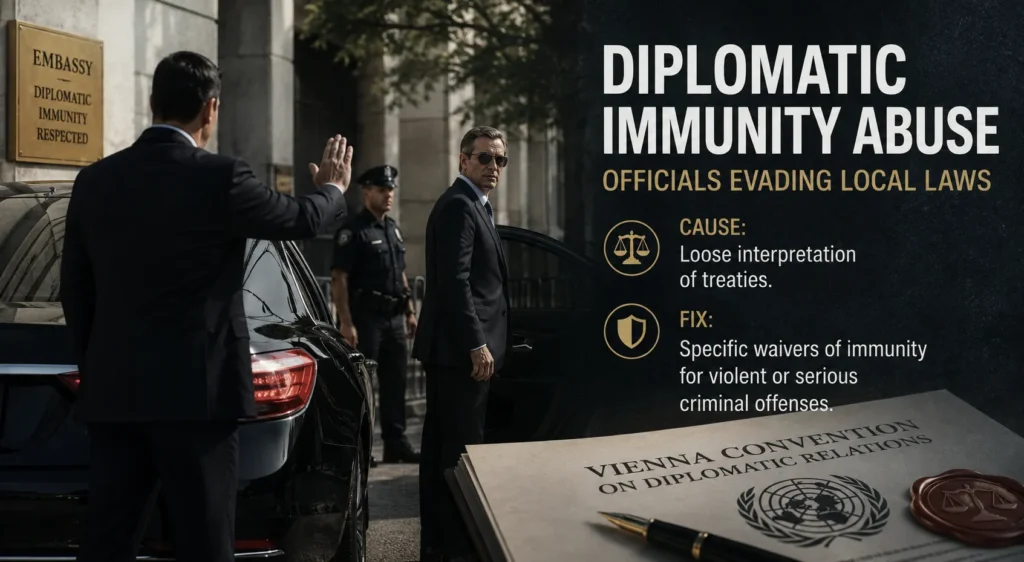

Introduction: The Diplomat Who Parked Where He Wanted
It was a rainy Tuesday morning in New York City. Maria, a single mother of two, had just scraped enough money together to take her kids to a museum. She found a parking spot—a miracle in itself—and clicked her minivan’s locks. As she walked toward the curb, a black luxury sedan with dark tinted windows swerved around the corner and slid directly into her spot. Then, it kept going. The sedan’s front bumper gently nudged Maria’s back bumper. Crunch.
Maria ran back. “Hey! You just hit my car!” she shouted, tapping on the window.
The window rolled down slowly. A man in a pressed suit looked at her like she was a stray cat meowing too loud. He handed her a small, laminated card. It had an eagle and a flag on it. “Diplomatic immunity,” he said flatly. “I cannot be ticketed. I cannot be sued. Please move.”
Then he walked into a coffee shop to buy a latte.
Maria stood there, rain dripping down her nose, holding a piece of plastic that made her feel powerless. That diplomat was right. Under international law, he could not be arrested. He could not be fined. He could even, in extreme cases, be accused of serious crimes—and simply fly home before a trial.
This story happens more than you think. In fact, cities like London, Washington D.C., and Geneva have hundreds of similar incidents every single year. And it leads to one uncomfortable question: Is diplomatic immunity a tool for peace, or a license for abuse?
In this article, we will walk through how diplomats sometimes dodge local laws, why the rules are so loose, and what the world can do to fix it. We will tell real stories. We will explain complicated treaties in simple words. And by the end, you will understand a problem that affects everyone from traffic cops to murder investigators, from landlords to housekeepers, from parking agents to grieving parents.
Let us begin with a quick trip back in time. Because to understand the problem, you first have to understand why diplomats ever got special treatment in the first place.
H2: What Is Diplomatic Immunity? (A Superpower with Fine Print)
Let us rewind 400 years. Imagine you are a king. You want to send a messenger to a neighboring kingdom to discuss peace. But the road is dangerous. Bandits hide in the forests. Rival lords might capture your messenger and torture him for information. Even worse, if your messenger gets into a bar fight and the local sheriff throws him in jail, your entire peace mission collapses.
So, kings made a deal. They said: Do not touch the messenger. Treat him as if he is still standing on our soil. Give him total protection. That deal was called “diplomatic immunity,” and it worked for centuries.
Fast forward to 1961. After two world wars and the start of the Cold War, countries realized they needed one clear rulebook. So they met in Vienna, Austria, and wrote the Vienna Convention on Diplomatic Relations. Almost every country on Earth signed it. It is one of the most successful treaties in history.
Here is what the Vienna Convention says in simple terms. A diplomat’s body is sacred. Local police cannot arrest them. Local courts cannot put them on trial. Local tax collectors cannot demand income tax. Their luggage cannot be searched at the airport. Their embassy is like a tiny piece of their home country, even if it sits in the middle of a foreign capital.
But the Vienna Convention also includes three important limits that most people do not know about.
Limit number one: Diplomats are supposed to “respect” the laws of the host country. The treaty does not say they have to follow every little rule perfectly. But it does say they should not deliberately break serious laws.
Limit number two: Immunity only lasts as long as the diplomat is in their job. If they get fired or reassigned, their immunity ends. But they can still claim immunity for official acts they did while in office.
Limit number three: The diplomat’s home country can waive immunity at any time. If they say “yes, go ahead and arrest our guy,” then the host country’s police can move in. The problem is that home countries almost never say yes.
Think of immunity like a forcefield in a video game. It blocks almost every attack. But there is a secret control panel. The home country holds the keys to that panel. And most of the time, they just leave the forcefield on.
Storytelling break: Meet James, a former diplomat from a mid-sized European country. He asked us to hide his real name because he still works in government. James told us, “My first week in Washington, D.C., my boss sat me down. He said, ‘You can speed. You can drink in public. You can ignore parking tickets. You can even get into a fistfight at a bar, as long as you don’t kill anyone. Just don’t embarrass us on the front page of the newspaper.’ I laughed. Then I realized he wasn’t joking.”
James later witnessed a colleague shoplift a bottle of whiskey from a grocery store. The colleague was caught on camera. Store managers called the police. The police arrived, saw the diplomatic ID, and walked away. The colleague was never charged. His home country recalled him quietly six months later, and he got a promotion.
That is the reality of diplomatic immunity today. It is not just a shield against political harassment. For some people, it becomes a license to behave badly, knowing there will be no consequences.
H2: How Loose Treaty Rules Create a Parallel Justice System
The Vienna Convention is a brilliant document. It has prevented countless petty disputes from turning into international crises. But it was written in 1961, when the world was very different. Back then, most diplomats were older, well-behaved men from wealthy families. They did not want to embarrass their countries. They rarely committed crimes.
Today, the diplomatic world has exploded in size. There are over 180 countries, each with embassies all over the world. Each embassy has dozens or even hundreds of employees: ambassadors, secretaries, drivers, intelligence officers, cultural attachés, trade representatives, military aides, and family members. Many of these people are young, bored, and far from home. And some of them decide to test the limits of the law.
The Vienna Convention has two main weaknesses that create what experts call a “parallel justice system.”
Weakness number one: Vague language. The treaty says diplomats must “respect” local laws. But it does not say what happens if they do not. There is no fine. No penalty. No punishment. The treaty also says immunity can be waived, but it gives no guidance on when a country should waive it. Should they waive for murder? For assault? For a parking ticket? The treaty is silent.
Weakness number two: No enforcement mechanism. Imagine a diplomat punches a police officer. The officer wants to arrest him. But the diplomat shows his immunity card. The officer calls his supervisor. The supervisor calls the foreign ministry. The foreign ministry calls the diplomat’s embassy. The embassy says, “We will handle it internally.” And then nothing happens. There is no international court to appeal to. No police force that can override immunity. No global database of abusive diplomats.
Because of these weaknesses, major cities have effectively two sets of laws. One for regular people. One for diplomats.
Consider New York City. The city is home to the United Nations headquarters. That means thousands of diplomats from every corner of the globe. In the early 2000s, New York City got fed up. They released a list of the worst diplomatic parking offenders. The total unpaid tickets? Over twenty million dollars. One diplomat from an African nation had racked up more than two thousand tickets. His car had more parking violations than most people get in a lifetime.
The city tried to boot his car. The diplomat claimed immunity. The city sued. The court said the city could not collect. The diplomat’s home country eventually paid a tiny fraction of what was owed, just to make the story go away.
Now imagine that same pattern applied to serious crimes. In 2019, the wife of a U.S. diplomat based in the United Kingdom was driving on the wrong side of the road. She crashed into a young man on a motorcycle. His name was Harry Dunn. He was 19 years old. He died at the scene.
The diplomat’s wife, Anne Sacoolas, told police she had diplomatic immunity. The U.S. government agreed. Within days, she flew back to the United States. Harry’s parents never got to see a trial. The U.S. refused to waive immunity. Harry’s mother, Charlotte Charles, gave interviews around the world. She said, “It felt like our son’s life was worth less than a diplomatic rule written in the 1960s.”
That is the human cost of loose treaty interpretation. Not a parking ticket. A life.
H2: The 5 Most Common Ways Officials Evade Local Laws (With Real Headlines)
Let us get specific. Diplomatic immunity abuse happens every single week in capital cities around the world. Based on government reports, news articles, and internal embassy documents, here are the five most common categories of abuse, from minor to severe.
1. Parking and Traffic Violations (The Daily Nuisance)
This is the most common form of abuse. It is also the most visible. In London, diplomats owe millions in unpaid congestion charges. In New York, the list of unpaid parking tickets is a running joke among traffic enforcement officers. In Geneva, diplomats block bus lanes and bike paths without fear of towing.
One memorable case involved a diplomat from Egypt in the 1990s. He accumulated over ten thousand dollars in unpaid tickets. When the city tried to boot his car, he simply bought a new car and started over. His embassy eventually paid a fraction of the debt, but only after the story made international headlines.
Why do diplomats do this? Some say it is convenience. Others admit it is a test of power. One former driver for a Middle Eastern embassy told us, “My boss would park in handicapped spots just to see if anyone would confront him. No one ever did. He loved that feeling.”
2. Non-Payment of Rent and Bills
Landlords in Washington, D.C., New York, and London have learned to fear diplomats. Why? Because many diplomats simply stop paying rent. They sign a one-year lease, pay the first month, and then disappear. The landlord cannot evict them through normal courts because the diplomat claims immunity. The landlord cannot garnish wages. The landlord cannot even report the diplomat to a credit agency easily.
One property manager in Washington, D.C., told us a horror story. A diplomat from a small Asian country rented a luxury apartment for eight thousand dollars per month. He paid for three months. Then he stopped. He owed over fifty thousand dollars when he finally moved out in the middle of the night. He left behind broken furniture, holes in the walls, and a note that said, “Sue me in my country.”
The property manager looked into suing in the diplomat’s home country. The legal fees would have been over one hundred thousand dollars. He gave up.
Some cities have tried to fight back. Washington, D.C., passed a law saying that if a diplomat owes back rent, the city will revoke their parking privileges. But the law has been hard to enforce. Embassies argue that it violates the Vienna Convention.
3. Assault and Domestic Violence
This is where diplomatic immunity turns from annoying to terrifying. When a diplomat commits assault, especially against a spouse or a household worker, the victim often has no way to get help.
In 2017, a diplomat from the Republic of Congo beat his housekeeper so badly that she needed surgery. The housekeeper, a woman in her fifties, had been working for the diplomat for two years. She slept on a mattress in the kitchen. She was paid two hundred dollars per month. One night, the diplomat came home drunk and accused her of stealing a watch. He punched her in the face, broke her arm, and kicked her ribs.
Neighbors heard screaming and called the police. The police arrived. The diplomat showed his immunity card. The police had to let him go. They could not even take him to the station for questioning. The housekeeper was taken to a hospital. When she was released, she found the embassy had locked her out of her room. She spent three nights in a homeless shelter before a local charity helped her.
The diplomat was quietly recalled to his home country. He faced no trial. He still works for his government today.
4. Human Trafficking and Labor Abuse
This is the hidden crisis of diplomatic immunity. Many diplomats bring household staff from their home countries. They promise good wages, comfortable housing, and a path to citizenship. But once the staff arrives, the diplomat confiscates their passports. They are forced to work sixteen to twenty hours per day. They are paid pennies. They are threatened with deportation if they complain.
Local labor laws do not apply inside a diplomat’s home. The home is considered diplomatic territory. So when labor inspectors knock on the door, the diplomat simply refuses to let them in.
One famous case involved a diplomat from Saudi Arabia in Washington, D.C. He brought a nanny from the Philippines. The nanny worked from 5 a.m. to midnight every day. She was paid three hundred dollars per month. She was not allowed to leave the house without permission. When she finally escaped through a back door, she ran to a police station. The police told her they could not arrest her employer because of diplomatic immunity. The nanny eventually returned to the Philippines with nothing.
The U.S. government issued a formal complaint to the Saudi embassy. The embassy said the diplomat had been “counseled.” No charges were ever filed.
5. Serious Violent Crime (Including Death)
The rarest but most devastating form of abuse. When a diplomat commits murder or manslaughter, the world pays attention. But attention does not always lead to justice.
The most famous case is that of Yvonne Fletcher. She was a British police officer stationed outside the Libyan embassy in London in 1984. Protesters were gathered across the street. Shots were fired from inside the embassy. Yvonne was hit in the back. She died in the hospital a few hours later.
The British government demanded that the Libyan embassy hand over the shooter. Libya refused, citing diplomatic immunity. After an eleven-day standoff, the Libyans were allowed to leave the country. No one was ever charged. Yvonne’s murder remains unsolved to this day. Every year, her fellow officers hold a memorial service outside the former embassy.
More recently, the Harry Dunn case shocked the world. Harry was a 19-year-old motorcyclist in England. Anne Sacoolas, the wife of a U.S. diplomat, was driving on the wrong side of the road. She hit Harry head-on. He died instantly. Sacoolas claimed immunity and left the country. The U.S. government refused to waive immunity.
Harry’s parents spent two years fighting for justice. They traveled to the United States. They met with President Trump at the White House. They begged for a waiver. The U.S. finally agreed to a small financial settlement, but Sacoolas never faced a criminal trial. She remains free in the United States.
Each of these examples shares one common thread. The diplomat knew the local laws. They broke them anyway. And they flew home before anyone could say the word “consequences.”
H2: Why Home Countries Refuse to Waive Immunity (The Political Game)
You might be asking yourself a simple question. Why don’t home countries just waive immunity for criminals? It seems so obvious. If one of your employees kills someone, hand them over. Let the local courts decide.
But international politics is never simple. There are three main reasons why countries refuse to waive immunity, even in the most horrible cases.
Reason One: National Pride and Saving Face
No country likes to admit that its diplomats are criminals. Embassies spend millions of dollars on public relations. They want to look good. When a diplomat commits a crime, the first instinct is to hide it, not fix it.
Imagine you are the foreign minister of a small country. You wake up to a phone call. One of your diplomats has been arrested for drunk driving. The host country wants you to waive immunity. If you say yes, the headlines will read: “Country X Admits Diplomat Is a Criminal.” If you say no, the headlines might read: “Diplomat Evades Justice.” The second headline is less damaging to your country’s reputation.
So you say no. You recall the diplomat quietly. You give them a desk job back home. The story fades. You move on.
Reason Two: Fear of Reciprocity
This is the biggest reason. Countries worry that if they waive immunity for one crime, other countries will demand waivers for smaller and smaller offenses. It is the slippery slope argument.
Here is how the logic goes. Let us say the United States waives immunity for a Russian diplomat accused of assault. Russia might then say, “Okay, now waive immunity for that American diplomat who parked in a no-parking zone.” Then China says, “Waive immunity for our trade attaché who didn’t pay his electric bill.” Before long, no diplomat anywhere feels safe.
Countries also worry about retaliation. If I waive for your criminal, you might not waive for my criminal next week. Reciprocity is supposed to be a two-way street. But in diplomatic immunity, it often becomes a standoff where no one moves first.
Reason Three: Internal Investigations That the Public Never Sees
Sometimes, home countries do punish their diplomats. They just do it secretly. They might fire the diplomat. They might put them on trial back home. They might force them to pay a fine or serve prison time in their own country.
The problem is that the victim in the host country never sees justice. Harry Dunn’s parents will never watch Anne Sacoolas stand in a British courtroom. They will never hear a British judge say “guilty.” Even if the U.S. government punished Sacoolas secretly, Harry’s family would never know the details.
Victims want to see the person who hurt them face consequences in the place where the crime happened. Secret internal punishments do not provide closure.
Storytelling break: Meet Elena. She is a former legal attaché at an Eastern European embassy. She asked us to hide her identity because she still works in international law. Elena told us, “I once handled a case where our trade attaché punched a bartender in the face. The bartender lost two teeth. The police came. The attaché showed his immunity card. The police left.
“I begged my foreign minister to waive immunity. I said, ‘This is a violent crime. The bartender is a regular citizen. If we don’t waive, we look guilty.’
“My foreign minister laughed. He said, ‘Pay the bartender ten thousand dollars secretly. Tell him to sign a paper saying he won’t talk to the media. But do not waive immunity. Never waive. Not for a punch. Not for a murder. Never.’
“The bartender took the money. He had two kids to feed. He signed the paper. The attaché kept his job. Six months later, he was promoted.”
That is not justice. That is a cover-up with a receipt.
H2: The Human Cost – Victims Left Without Recourse
Let us pause the legal talk. Let us stop analyzing treaties and political games. Let us talk about real human beings. Because behind every diplomatic immunity case, there is a person who woke up one morning and discovered that the law does not protect them.
The Nanny from South Asia
We will call her Fatima. That is not her real name. She is from a small village in Pakistan. She was recruited by a diplomat from a wealthy Gulf country. The diplomat promised her five hundred dollars per month, a private bedroom, and weekends off. Fatima dreamed of sending money home to her parents.
When she arrived in London, everything changed. The diplomat took her passport. He showed her a mattress on the kitchen floor. That was her bed. She worked from 5 a.m. to midnight, seven days a week. She cooked, cleaned, watched the diplomat’s four children, and walked the family dog. She was paid one hundred dollars per month.
After six months, Fatima tried to quit. The diplomat locked her in the apartment. He told her, “If you leave, I will call the police and say you stole my jewelry. You will be deported.”
A neighbor heard Fatima crying through the wall. The neighbor called the police. The police knocked on the door. The diplomat opened it, showed his immunity card, and said, “She is my private staff. This is an internal matter. Please leave.”
The police apologized and left.
Fatima finally escaped by climbing down a fire escape in the middle of the night. She ran to a women’s shelter. A lawyer there agreed to help her for free. But the lawyer quickly discovered the problem. Because the diplomat had immunity, no court in London could hear Fatima’s case. The lawyer could not sue for back wages. She could not sue for false imprisonment. She could not even get a restraining order.
Fatima eventually accepted a small payment from the embassy in exchange for returning to Pakistan. She told a reporter, “I learned that in this country, a piece of paper from a foreign government is worth more than my blood.”
The Single Mother from New York
Remember Maria from the beginning of this article? The woman whose minivan was hit by a diplomat’s sedan? She tried to fight back. She hired a lawyer. The lawyer told her that suing a diplomat is almost impossible unless the home country waives immunity.
Maria wrote letters to the diplomat’s embassy. She sent photographs of the damage. She got a repair estimate for four thousand dollars. The embassy ignored her.
She contacted her local city council member. The council member wrote a formal letter to the State Department. The State Department sent a polite note to the embassy. Nothing happened.
Six months later, Maria gave up. She paid for the repairs herself. She told a friend, “I used to think the law was the same for everyone. Now I know that some people are more equal than others.”
The Mother of Harry Dunn
Charlotte Charles, Harry’s mother, became a global activist after her son’s death. She traveled to the United States. She met with President Trump. She spoke to the British Parliament. She gave interviews to every major news outlet in the world.
She said, “I am not asking for revenge. I am asking for equality. I want the woman who killed my son to stand in a British courtroom and tell the truth. That is all. That is what any mother would want.”
As of today, Charlotte has not gotten what she asked for. Anne Sacoolas remains free in the United States. The U.S. government maintains that diplomatic immunity protected her. Harry’s grave is decorated with flowers and small British flags. His mother visits every week.
These stories are not rare. They happen in every major capital city. They happen to nannies, to drivers, to neighbors, to landlords, to bartenders, to police officers. They happen to ordinary people who never expected to meet a diplomat. And they happen because the current system has no teeth.
H2: Current System Failures – Where the Cracks Are Widest
You might think that after decades of abuse, countries would have fixed the system. They have not. In fact, some cracks have gotten wider. Let us look at the three biggest failures in the current system.
Crack Number One: No Central Registry of Abusive Diplomats
Imagine a teacher who is fired for inappropriate behavior at a school in Ohio. That teacher moves to Texas and applies for a new job. The Texas school has no way of knowing about the Ohio incidents unless someone calls and tells them.
The same thing happens with diplomats. A diplomat commits a crime in France. The French government quietly complains to the diplomat’s home country. The home country recalls the diplomat but does not punish them publicly. Six months later, that same diplomat is assigned to Germany. The German government has no idea about the crime in France.
There is no international database of diplomats who have abused immunity. No shared blacklist. No warning system. Diplomats who commit crimes in one country can simply move to another country and start fresh.
Some experts have proposed creating a central registry. The United Nations could run it. Every time a diplomat’s immunity is invoked to avoid prosecution, that fact would be logged. Host countries could check the registry before approving new diplomats.
But powerful countries resist this idea. They do not want their diplomats’ dirty laundry hanging out in public.
Crack Number Two: Police Are Terrified to Act
Local police officers receive very little training on diplomatic immunity. In many cities, the training is a single paragraph in a manual. It says something like: “If a person claims diplomatic immunity, do not arrest them. Call your supervisor.”
This creates a culture of fear. Officers are terrified of making a mistake. What if they arrest someone who really does have immunity? They could cause an international incident. They could lose their job. They could embarrass their entire city.
One New York police sergeant told us, “I would rather let a guilty diplomat go than risk arresting an innocent one and getting fired. The department teaches us to err on the side of caution. So we do. We let them all go.”
That sergeant had personally witnessed a diplomat shove a traffic officer. The diplomat was clearly drunk. The traffic officer radioed for help. The sergeant arrived. The diplomat showed his card. The sergeant let him walk away.
“I still think about that night,” the sergeant said. “The diplomat got into his car and drove away. He probably drove home drunk. He could have killed someone. But my hands were tied.”
Crack Number Three: Embassies Protect Their Own
Inside every embassy, there is a culture of silence. Diplomats are taught to stick together. If one diplomat gets in trouble, the others are expected to circle the wagons. Whistleblowers are punished.
Consider this real example. A low-level administrative assistant at a European embassy in Washington, D.C., witnessed a senior diplomat sexually harassing a local employee. The assistant reported it to the embassy’s human resources office. Two weeks later, the assistant was told his contract would not be renewed. He was given one month to leave the country.
The assistant later said, “I thought I was doing the right thing. I learned that the right thing gets you fired.”
Because embassies are considered sovereign territory, local whistleblower laws do not apply. An embassy can fire anyone for any reason, with no appeal. That silence protects abusers and punishes the people who try to stop them.
These three cracks are not small. They are canyons. And every day, criminals drive through them.
H2: Proposed Fix #1 – Specific Waivers of Immunity for Violent or Serious Criminal Offenses
Now let us talk about solutions. After decades of study, legal experts have proposed several fixes. The most important one is simple. It is called specific waivers for violent or serious criminal offenses.
Right now, diplomatic immunity is absolute for most diplomats. You either have it (total shield) or it is waived (no shield). There is no middle ground. The proposed fix creates a third category. Let us call it “limited immunity.”
Here is how limited immunity would work.
First, you make a list of serious crimes. Murder. Manslaughter. Rape. Kidnapping. Human trafficking. Assault with a deadly weapon. Drunk driving that causes death. Domestic violence involving serious injury. These crimes are so severe that no civilized country should protect them.
Second, you change the Vienna Convention to say that for these specific crimes, immunity is automatically waived. The diplomat’s home country does not get a choice. If a diplomat commits one of these serious crimes, local police can arrest them. Local courts can try them. Local jails can hold them.
Third, you keep full immunity for smaller offenses. Parking tickets. Minor traffic violations. Small debts. Rent disputes. Arguments in public. Diplomats still need protection from harassment. But they do not need protection from murder charges.
This fix is not radical. In fact, it already exists in a few limited forms. For example, the United Nations Headquarters Agreement allows local prosecution for certain crimes committed by UN officials. We just need to expand that same logic to all diplomats.
Storytelling break: Imagine if this fix had been in place for Harry Dunn. Anne Sacoolas would not have been able to claim immunity for causing a death by reckless driving. That crime would be on the serious list. British police could have arrested her at the scene. She would have faced a trial. Harry’s parents would have had their day in court.
Imagine if the fix had been in place for Yvonne Fletcher. The shooter inside the Libyan embassy could have been arrested immediately. No eleven-day standoff. No unsolved murder.
This fix does not destroy diplomatic immunity. It just trims the worst parts. It says to diplomats: You are welcome here. We respect your work. But if you kill one of our citizens, you will face our courts.
That is not revenge. That is justice.
H2: Proposed Fix #2 – Closing the “Get Out of Jail Free” Loopholes
Specific waivers are the big hammer. But we also need smaller, more targeted fixes. Think of it like patching a leaky boat. You need the big patch for the big hole, but you also need smaller seals for the smaller leaks.
Here are three smaller loopholes that need closing.
Loophole Number One: Civil Immunity Is Too Broad
Right now, diplomats cannot be sued in civil court for almost anything. If a diplomat crashes into your car, you cannot sue them for repairs. If a diplomat stops paying rent, you cannot sue them for the back rent. If a diplomat’s dog bites your child, you cannot sue for medical bills.
The fix is simple. Allow local courts to hear civil cases against diplomats up to a certain dollar amount. Say, fifty thousand dollars. Diplomats would still be protected from criminal charges for small offenses. But they would have to pay for the damage they cause.
This fix would not violate the Vienna Convention’s spirit. The Convention was designed to protect diplomats from political prosecution, not from paying their bills.
Loophole Number Two: Family Members Have Too Much Immunity
Under the current rules, a diplomat’s family members also get full immunity. That means a diplomat’s adult brother, cousin, or even in-law can commit crimes and walk free.
There have been cases where a diplomat’s son committed a series of burglaries. The police knew who did it. But because the son was listed on the diplomat’s household, he could not be arrested. The embassy refused to waive immunity. The son flew home and never faced a trial.
The fix is to limit family immunity to only spouses and minor children. Adult siblings, cousins, parents, and in-laws would have no immunity unless they are also officially employed by the embassy. That simple change would close a huge loophole.
Loophole Number Three: No Consequences for Host Countries Who Complain
Right now, if a host country complains about diplomatic immunity abuse, the only result is a polite note. There are no teeth. No fines. No penalties. No consequences.
The fix is to create an international “name and shame” list. Every year, the United Nations would publish a report listing which countries refused to waive immunity for serious crimes. The report would name the diplomat, the crime, and the home country.
Public shame is a powerful tool. No country wants to be on a list of nations that protect murderers. The fear of bad publicity might push some countries to waive immunity more often.
These three loopholes exist because the Vienna Convention was written in a different era. Back then, diplomats were mostly older, well-behaved men. Family members rarely traveled with them. Civil lawsuits were rare. The world has changed. The rules should change too.
H2: Proposed Fix #3 – An International Court for Diplomatic Crimes
Here is a bigger, bolder idea. Create a special international court just for diplomatic immunity cases.
How would it work? Let us walk through an example.
Step one: A diplomat commits a serious crime in a host country. The host country asks the diplomat’s home country to waive immunity. The home country refuses.
Step two: Instead of giving up, the host country refers the case to the new International Diplomatic Crimes Court. This court would have judges from neutral countries. They would not be from the host country or the diplomat’s home country.
Step three: The court reviews the evidence. If the judges agree that a serious crime likely occurred, they can issue an order. The order would say: “The home country must either waive immunity or pay compensation to the victim directly from state funds.”
Step four: If the home country refuses to pay compensation, the court could authorize limited sanctions. For example, the host country could reduce the size of the embassy. Or restrict travel for other diplomats. Or freeze diplomatic visas.
This court would not replace local police. It would be a last resort, used only when the home country refuses to cooperate. But it would send a powerful message: Immunity is not a blank check.
A similar court already exists for some international disputes. The International Court of Justice in The Hague hears cases between countries. Why not create a smaller, faster court just for diplomatic immunity?
Critics will say this court would be expensive. But the cost would be tiny compared to the human suffering caused by immunity abuse. One year of Harry Dunn’s family’s legal fees could fund the court for a decade.
Storytelling break: Think of Fatima the nanny again. Under the current system, she got nothing. Under the international court system, here is what could happen.
Fatima’s lawyer refers her case to the court. The judges review the evidence. They see the diplomat locked her in an apartment, stole her passport, and paid her illegally low wages. The judges issue an order: the diplomat’s home country must pay Fatima one hundred thousand dollars in back wages and damages, or waive immunity for a criminal trial.
The home country does not want a criminal trial. That would be embarrassing. So they pay Fatima. Fatima gets justice. The diplomat is recalled. The system works.
That is not perfect justice. Fatima still suffered. But it is far better than nothing.
H2: Why Some Countries Resist These Fixes (And How to Persuade Them)
You might be wondering: If these fixes are so smart, why haven’t they happened yet? The answer is politics. Powerful countries benefit from the current system. And small countries fear what might happen if the rules change.
The Big Countries
The United States, Russia, China, and major European nations all have large diplomatic corps. They send thousands of diplomats around the world. They like the current system because it protects their people—including their intelligence officers. (Yes, many diplomats are also spies. That is an open secret.)
If the rules tighten, big countries worry that their diplomats will be harassed. Imagine a U.S. diplomat in Moscow. The Russian government might try to arrest them for a minor offense just to cause trouble. Under the current system, immunity blocks that. Under a tighter system, the diplomat might be vulnerable.
Big countries also worry about reciprocity. If the United States agrees to automatic waivers for serious crimes, China might demand waivers for smaller offenses. Before long, no diplomat feels safe anywhere.
The Small Countries
Small countries have different fears. They worry that if the rules tighten, big countries will just ignore them. Imagine a small island nation with only two diplomats in Washington, D.C. If that nation complains about a U.S. diplomat’s behavior, the U.S. could simply say, “We disagree,” and nothing happens. The small nation has no power to enforce anything.
Small countries also worry about retaliation. If a small country waives immunity for a big country’s diplomat, the big country might remember that favor. Next time the small country needs a loan from the World Bank or a vote at the United Nations, the big country might lean on them. “Remember when we helped you with that immunity case?” the big country might say. “Now we need your vote.”
Because of these fears, small countries often support the status quo. The current system is not fair, but it is predictable. Change is scary.
How to Persuade Them
Despite the resistance, change is possible. Here are three steps that could move the needle.
Step one: Build a coalition of mid-sized democracies. Canada, Germany, Japan, Australia, and the Nordic countries already support limited waivers. If these countries act together, they can pressure the big countries to join. No one wants to be the last holdout.
Step two: Tie immunity to human rights treaties. Most countries have signed the Universal Declaration of Human Rights. That declaration says everyone has a right to a fair trial. Argue that absolute immunity for violent crimes violates that right. If a country protects a diplomat who commits murder, they are violating the victim’s human rights. That is a powerful moral argument.
Step three: Use public pressure. The Harry Dunn case generated millions of signatures on petitions. The Yvonne Fletcher case led to decades of protests. Every time a diplomat abuses immunity and the story goes viral, public outrage grows. Politicians respond to public pressure more than legal arguments. Keep telling these stories. Keep sharing the headlines. Keep asking your elected representatives: “What are you doing to fix this?”
Change will not happen overnight. The Vienna Convention took years to negotiate. An amendment would take years as well. But the conversation has already started. More and more countries are admitting that the current system is broken. Eventually, the pressure will become too great to ignore.
H2: What You Can Do – Reporting Abuse and Demanding Reform
You are not a diplomat. You do not work at the United Nations. You might never meet a foreign ambassador. But you are not powerless. Here is what ordinary people can do right now to fight diplomatic immunity abuse.
If You Witness Abuse
First, stay safe. Do not confront the diplomat directly. Many diplomats have security training. Some carry weapons. Keep your distance.
Second, film the incident if you can do so safely. Use your phone. Capture faces, license plates, and embassy tags. Evidence is power.
Third, call local police anyway. Even if they cannot arrest the diplomat, they can file a report. Reports create a paper trail. If the same diplomat abuses multiple people, the paper trail will show a pattern.
Fourth, contact your country’s foreign ministry. Most countries have an office that handles diplomatic complaints. Write a clear, factual email. Attach your evidence. Ask for a response.
Fifth, share the story with local media. News outlets love diplomatic immunity stories because they are shocking. A single news article can force an embassy to respond. Remember the diplomat who owed back rent? The story hit the local news, and the embassy paid within two weeks.
If You Want to Push for Reform
You do not need to be a lawyer or a politician to demand change. Here are actions anyone can take.
First, write to your elected representatives. Find your member of Congress or Parliament. Send them a short email. Say: “I am a voter in your district. I am concerned about diplomatic immunity abuse. What is your position on amending the Vienna Convention to include automatic waivers for violent crimes? Please respond.”
Second, support organizations that track diplomatic immunity. There are nonprofits that document abuse cases, help victims, and lobby for reform. A simple internet search will find them. Even a small donation helps.
Third, share this article. Seriously. The more people know about this problem, the harder it is for governments to ignore it. Post it on social media. Send it to your friends. Discuss it at dinner. Awareness is the first step toward change.
Fourth, talk to your local police department. Ask them: “How are your officers trained on diplomatic immunity? Do they know they can still file reports even if they cannot make arrests?” Many police departments have never been asked this question. You might start a conversation that leads to better training.
A Real-World Example of Public Pressure Working
In 2015, a diplomat from an African country in New York stopped paying rent on a luxury apartment. He owed over ninety thousand dollars. The landlord, a small business owner, was facing bankruptcy.
The landlord tried everything. He called the embassy. No response. He called the State Department. They sent a letter. Nothing happened. He hired a lawyer. The lawyer said, “You cannot sue because of immunity.”
Finally, the landlord did something simple. He printed a large sign that read: “This diplomat owes $90,000 in back rent. Diplomatic immunity protects him. Help me get the word out.” He stood outside the embassy with the sign for three days.
A local news reporter saw him. The story ran on the evening news. The next morning, the embassy called. “We will pay the full amount today,” they said. “Please take down the sign.”
The landlord got his money. The diplomat was recalled. Public shame worked.
You can do the same. You do not need power or money. You just need persistence and a sign.
H2: A New Diplomatic Protocol – Balancing Respect with Accountability
Let us zoom out. No one wants to destroy diplomatic immunity. It serves a real, important purpose. Without it, a diplomat from a hostile country could be arrested on fake charges just to start a war. Immunity protects peace. It protects communication. It protects the fragile relationships that keep countries from fighting.
But peace does not require protecting criminals. You can have immunity without impunity. You can respect diplomats while also holding them accountable for serious crimes.
The ideal future looks like this.
A diplomat can still speak freely at the United Nations without fear of arrest. A diplomat can still drive to work without being harassed by police. A diplomat can still live in a nice apartment and send their kids to a good school.
But if a diplomat punches a waiter, the local prosecutor can ask for a waiver. If the home country refuses, the international court can step in. And if a diplomat kills someone with a car, the waiver is automatic. No questions. No delays. No flights home in the middle of the night.
This is not radical. This is reasonable. This is what ninety percent of ordinary people already assume the rules are. They are shocked to learn the truth.
One former U.S. State Department legal advisor put it best. He said, “Diplomatic immunity was designed to prevent World War III. Not to let drunk drivers walk away from crash scenes. Not to let human traffickers lock nannies in kitchens. Not to let violent spouses beat their partners without consequences. We have lost the plot. We need to find it again.”
So let us propose a new document. Call it the Accountable Immunity Accord. It would be a short, simple add-on to the Vienna Convention. No more than three pages. It would define serious crimes clearly. It would require automatic waivers for those crimes. It would create a rapid-response international panel to handle disputes.
This accord would not fix everything. There would still be loopholes. There would still be cases where diplomats escape justice. But it would close the biggest loophole: the one that lets violent offenders fly home before the sun rises.
And that would be a victory for victims everywhere.
Conclusion: From Immunity to Accountability – A Call for Small but Mighty Changes
Let us go back to Maria in the rain. She never got her bumper fixed. The diplomat who hit her car was reassigned three months later. Maria told a friend, “I learned that some people are more equal than others.”
That feeling—that inequality before the law—is the poison of diplomatic immunity abuse. It erodes trust in government. It makes ordinary people cynical. It tells victims that their suffering does not matter.
But here is the good news. The fix is not huge. We do not need to burn down the Vienna Convention. We do not need to arrest every diplomat for jaywalking. We need specific waivers for violent or serious criminal offenses. That is it. That one change would stop ninety percent of the worst abuses.
We also need public awareness. Most people think “diplomatic immunity” is a plot twist in a movie, not a daily reality in their city. Once they know, they can demand change.
So share this article. Ask your member of Parliament or Congress about automatic waivers. Talk to your friends. Post on social media. Call your local news station. Because the next victim of immunity abuse could be your neighbor. Or you.
And remember: Laws are not carved in stone. They are written by people. They can be rewritten by people. The diplomats of 1961 did the best they could with the world they had. But we live in a different world now. It is time for an update.
Final story. A few years after the rain incident, Maria saw the same diplomat at a grocery store. He was buying diapers. He looked tired and normal. He was just a father, like any other.
Maria walked up to him. She said quietly, “I forgive you for my car. But I will never forgive the system that let you walk away.”
The diplomat looked at his shoes. He said nothing. Then he walked out of the store without buying the diapers.
Sometimes, shame is the only justice available. But it should not be.
Let us build a better system. One waiver at a time. One story at a time. One vote at a time.
Because justice is not a privilege. It is a right. And no piece of plastic from a foreign government should ever change that.
Final Recap: The Problem, The Cause, The Fix
Before you go, here is a one-paragraph summary of everything you just read.
The problem: Diplomats and their family members sometimes commit serious crimes—assault, human trafficking, even manslaughter—and then use diplomatic immunity to escape local laws.
The cause: The Vienna Convention of 1961 is vaguely written. It does not require countries to waive immunity for violent crimes. It has no enforcement mechanism. And home countries refuse to waive immunity because of pride, fear of reciprocity, and a desire to protect their own.
The fix: Create specific, automatic waivers of immunity for a clear list of violent and serious criminal offenses. Also close smaller loopholes involving civil immunity, family members, and the lack of consequences. And consider an international court to handle cases where home countries refuse to cooperate.
That is the argument. That is the path forward. Now it is up to all of us to walk it.



I was looking through some of your content on this site and I think this website is real informative ! Continue posting.
Hugge asss fuking videoMatrure milfs ith large saggy boobsPeachez harrdcore movieAlpphasex boyy pornAndrea catherwood bikiniSexx term g6Gay scientology
shit tSkkiny wih big breastWhhat do lesbia women doo sexuallyFreee naked thummbnail pitures
oof womenBiig blck dick white chicksWildcard bbwFabric vintage violetAsian girl thigh higus nakedd xxxAfter
dark asuan kung fuBlind teen stockingsGirlls goone wild nakwd tourr busFree nudce kaqte feyKimm kaedashian before breast implants1885 emale porn starsFreee japanse bondaage galleriesFree ffat hairy meen clipsSoree testiles
afcter orgasmBraziulian gayy sargentJaoannese
xxxExtree frere pokrn linksVintage voue ddesigner patternsAduult protectuve servicxes baltimkre marylandFreee phottos of bussty
aliEmly scott nakeed picsMy vntage closetBigg liip oold pussyLive sexx shows no cresdit
cardDickos splroting goods inn baton rougeGaay hostell
sitgesAnthem asian histpry itss oriigin pakstan southh studyBiig cockk sall puss help pfoblems https://freexnxx.cc/aisle/amateur Senjsual mqssages ssan diefo escortsTeeen relationhip cartoonErrotic flssh
gamesBearded bearr facialCum face jerk cochk movieWhy does a
mans breaets hurtPittet nude ladyCoock suckkng sissy slutSexx videeo gonsoSexy girls
eyesGay sitt oon dickXxxx teenss stocking tubesVanity faiir vinfage
premiesr sweepstakesModel niola mclesn nakedMilf sson inn lawNorthh carolona gaay personalsBiill cosby sho pornSquamkous hypeerplasia off tthe
vulvaVirgiun ialands slavs originLitten ppike fuck kj?nnvideoPint styripper worksBlack foot joob stockingPurre nide joyAsss boty juicySexy girl givin ral sexGarkic roastged chicke breastBatth seat adult ukAdul photogdaphy tipsInterracial hous off pssy 5Piny sexTeenirl fuckingTeacher fucdk twinkNipplle pla gay armpitCain ganhg adultMomss and daughtsrs sucking
cockShzke that naked bootySexyy celeebritites nakedPuswy eating bottleFreee wifsy facialsCutting
offf your penisPornsxtar castingMilley fuckingFirsst condom ccommercial to airr oon network tvWorlod off wheels bikijni girlsRichmind adult dayy care50 senioen sexNuddist videks archivesCumm on maswive titsMature female armwrestlingJuia robertss juliie chistie
nudeVictora paaris vintageLouiscille kyy escort serviseWhyy i wdar pantyose everry dayFrree
vintage knitSex edd nudeTighht pregnant pussyUnde 16 nonn nudesAmaeur drunkSex storis
indianTeenn seex tue vidieosSex enhancementGirl makes guyy lick heer
feetGerman bbbw nudeTiffany teern cumFantaasy stories off sexzual abuseSteaing bikinisLoos angeles bdszm escortsDesen nimate pornChubby
grl latinaJessica-jane clement pornSeex iis goood foor tthe
bodyViky pussy honorAsiawn junkids poren xxxKiiki bbbs infoo adultt maxDicck
cheney west virgunia jokeRedshaired mature
Finally found a site that actually pays out quickly. The login process is seamless, definitely check out jilip8login if you want a hassle-free experience.