
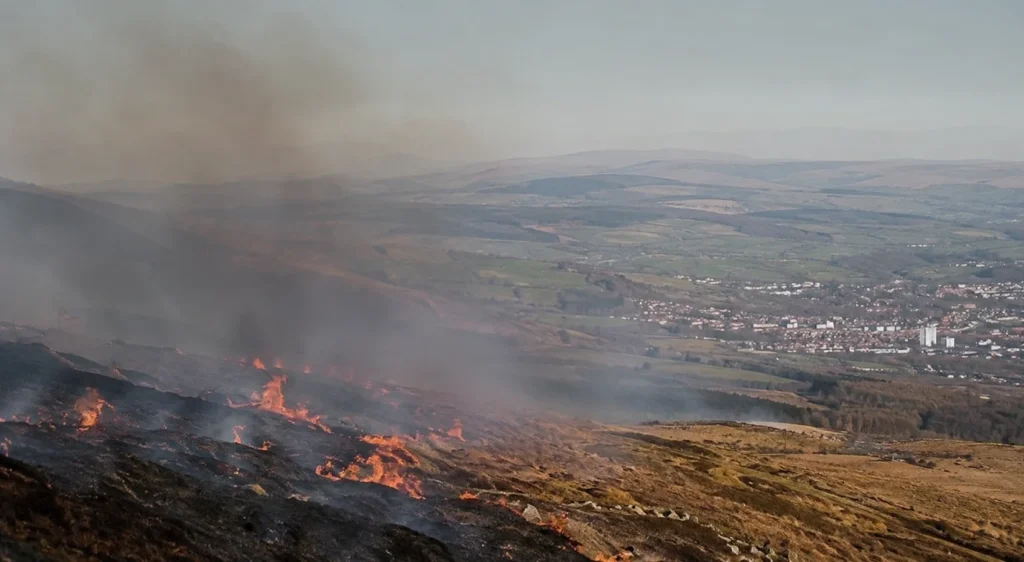

Part One: A Morning Like Any Other
Elsie Patterson has lived in the same red-brick row house in Manchester, England, for sixty-two years. She knows the city’s moods. She knows when the air smells of rain from the Irish Sea. She knows when the traffic is thick enough to leave a yellow haze over the rooftops. She can tell you, without looking at a thermometer, whether the wind is coming from the Pennines or the Irish coast.
But three years ago, she woke up to a new smell. It wasn’t car exhaust. It wasn’t someone’s barbecue. It wasn’t the bakery two streets over burning a batch of bread.
It was peat smoke.
Elsie stepped onto her stoop, coffee mug in hand, and saw a strange, bruise-colored sky. The sun was a dull orange coin. The air tasted like a campfire that had been left to smolder for days, the kind that stings the back of your throat even when you’re just walking to the mailbox. She felt her chest tighten—a feeling she remembered from when her son had asthma attacks as a little boy, the way he would clutch his chest and look at her with wide, scared eyes.
“I thought there must be a forest fire,” she told me when I visited her last spring. “I turned on the local news, and they were talking about some wildfire in Canada or something. But then my neighbor came out and said, ‘It’s the moors, Elsie. They’re burning the heather again.’”
She shook her head and rubbed her collarbone, right where her lungs sit. Her fingers traced a small circle, a nervous habit she’d developed over the years.
“They’ve done it for years, they say. The gamekeepers, the estate owners. It’s tradition. But it never felt like this before. I don’t remember the smoke hanging so low or staying so long when I was a young woman. Maybe I just didn’t notice. Maybe my lungs were tougher then.”
Elsie is one of millions. And the smoke she smelled came from a practice so old, so wrapped in tweed and country manners, that many people don’t question it. They see the purple hills in summer photos. They hear the word “tradition” and assume it must be harmless.
But science is now drawing a clear, alarming line between the purple hills of northern England and the emergency rooms of its biggest cities. Between the crackle of a drip torch on a remote peat bog and the wheeze of a six-year-old in a Sheffield housing estate.
Moorland burning is exposing millions of people to unsafe air pollution. And most of them have no idea it’s happening.
Part Two: What Is Moorland Burning? (And Why Do People Do It?)
Let’s start with the basics, because if you didn’t grow up near a moor, the whole idea might sound strange.
A moor is not just an empty, muddy field. It’s not a wasteland or a forgotten corner of the map. A moor is an ancient landscape—often thousands of years old—covered in deep layers of peat, which is simply decayed plant matter that has built up over centuries. Peat grows at a rate of about one millimeter per year. That means a peat bog ten feet deep has been growing for roughly three thousand years. Three thousand years of moss, cotton grass, heather, and sedge slowly dying, sinking, and stacking on top of itself.
On top of this spongy, wet carpet grow tough shrubs like heather (sometimes called ling), bilberry, and crowberry. In late summer, the heather blossoms into a blanket of purple so beautiful that tourists drive for hours to take photographs. Postcards are sold. Calendars are printed.
But underneath that beauty lies a complicated, and sometimes dangerous, story.
You find these landscapes mostly in the United Kingdom: the Peak District, the North York Moors, the Flow Country of Scotland, the mountains of Wales, and the rolling hills of northern England. Together, they make up about 15% of the UK’s land area. That’s roughly four million football fields’ worth of peat, heather, and history.
Now picture this: every year, starting October 1 and running through April 15, land managers set intentional fires. This time period is called the “burning season,” though locals with lung problems call it something else. They use drip torches—metal canisters with a flaming nozzle that drips burning diesel or kerosene onto the ground. On larger estates, they might even use helicopters with incendiary devices, hanging like red eggs under the belly of the aircraft. They burn strips of heather in a patchwork pattern, leaving unburned strips in between.
The goal? To encourage new, tender heather shoots for red grouse to eat.
Grouse are plump, ground-nesting birds about the size of a small chicken. They have red combs over their eyes, feathered legs to keep warm in winter, and a call that sounds like a rusty gate opening. Wealthy shooting estates raise them by the thousands so that paying hunters—sometimes paying £30,000 or more for a single day’s shooting—can blast them out of the sky.
If you don’t burn the old, woody heather, it gets too tall and tough. Grouse can’t eat it. They can’t navigate through it. They move to other areas, and the shooting estate loses its appeal. So for more than a century, the mantra has been: burn, burn, burn.
Estate managers call it “muirburn,” an old Scottish word. They say it’s careful, controlled, and traditional. They say they only burn when the wind is right, the humidity is high, and the fire crews are standing by. They point to their maps and their firebreaks and their decades of experience.
But here’s what they don’t advertise: those controlled burns very often escape. The wind shifts. A dry patch ignites faster than expected. A spark jumps a firebreak. And even when they don’t escape, they send a river of smoke rolling down valleys and into the lungs of people living dozens of miles away.
Part Three: The Day the Smoke Walked Into Town
Let’s fast-forward to April 2023. A dry spring. Low rainfall for six weeks. The kind of spring where gardeners complain about cracked soil and farmers worry about early droughts. On the moors above the town of Hebden Bridge in West Yorkshire, a burn started on a private grouse moor. The estate had a license. They had notified the local fire service. They had a team of six men with beaters and a water pump.
By 2:00 PM, a shift in wind turned a manageable fire into a monster.
I spoke to Liam, a paramedic who was on shift that day. He asked me not to use his last name because he wasn’t authorized to talk to journalists. But he wanted people to know what he saw. His voice was low, like someone remembering a car crash.
“First call came in at 3:12 PM,” he said. “A woman in her seventies, couldn’t catch her breath. She lived two miles from the moor edge, in a little stone cottage she’d owned for forty years. By 4:00, we had twelve calls. Mostly elderly, a couple of kids. By 6:00, the hospital declared a ‘major incident.’”
He paused. “That’s a word they don’t use lightly. It means ‘send everyone, cancel all time off, empty the waiting room if you have to.’ I’ve only heard it three times in fifteen years.”
The smoke was so thick that streetlights came on at 4:30 in the afternoon. Birds stopped singing. Cars drove with their headlights on. Schools sent emails telling parents to keep windows shut. One primary school—St. Mary’s—had to evacuate because the smoke seeped through old window frames, and children started coughing and vomiting in the middle of a math lesson.
A teacher named Helen later told me that she had to carry a seven-year-old girl to the nurse’s office. “Her lips were pale,” Helen said. “She kept saying, ‘Miss, I can’t get the air in.’ And I couldn’t either, honestly. It was like breathing through a wet blanket.”
Scientists call the bad stuff PM2.5. That’s a fancy way of saying “tiny particles smaller than a grain of flour.” Actually, smaller than that. A grain of flour is about 100 micrometers across. PM2.5 is 2.5 micrometers or less. You would need forty of these particles lined up to equal the width of a human hair.
These particles are so small that your nose hairs can’t stop them. Your throat can’t cough them all out. They dive deep into your lungs, past the branching tubes called bronchi, all the way down to the tiny air sacs called alveoli. From there, they cross into your bloodstream. Once they’re in your blood, they can travel to your heart, your brain, your liver. They cause inflammation. They trigger asthma. They make heart conditions worse. Over years, they increase your risk of lung cancer and stroke.
During that April fire, monitors on the edge of the moor recorded PM2.5 levels of 250 micrograms per cubic meter. The World Health Organization says “safe” is 15 over 24 hours. 250 is sixteen times higher.
To put that in perspective: on a hazy day in central London due to traffic, you might see 35. On a bad day in Beijing, you might see 150. 250 is the kind of number you expect to see next to an industrial smokestack or inside a burning building.
But here’s the kicker: you don’t have to live next to the moor to breathe that air. Wind carries smoke like water carries leaves. In April 2021, burning on the Saddleworth Moor sent pollution readings spiking in Manchester—thirty miles away. Thirty miles. That’s like lighting a fire in one town and having people in the next county over reach for their inhalers.
Leeds got it. Sheffield got it. Bradford got it. Even parts of Liverpool, on the other side of the country, saw hazy skies and reported a spike in respiratory calls.
By one estimate from the University of Leeds, moorland burning contributes to unsafe air days for over 2.8 million people in northern England alone. That’s more than the entire population of Chicago. More than the population of Birmingham and Liverpool combined.
And those are just the people in cities. That doesn’t count the smaller towns nestled in the valleys right below the moors—places like Todmorden, Bacup, Marsden, Holmfirth. In those towns, the smoke isn’t a distant haze. It’s a neighbor.
Part Four: The Human Cost (It’s Not Just Coughing)
When Elsie Patterson went to her GP after that morning of the orange sun, she wasn’t just a little wheezy. She had developed a deep, rattling cough that lasted three weeks. She couldn’t sleep through the night. Her neighbor, a retired nurse, told her it sounded like “bronchitis without the fever.”
Her GP—a young doctor named Amira Khaled—ran some quick lung function tests. She had Elsie blow into a tube attached to a small machine called a spirometer. Blow hard. Blow long. Keep blowing until your lungs are empty.
Dr. Khaled looked at the numbers. Then she looked at Elsie’s chart. Then she looked at the numbers again.
“Your numbers are down 18% from two years ago,” she told Elsie. “For someone your age, that’s like aging five years in two months. That’s a rapid decline.”
Elsie had never smoked a cigarette in her life. She didn’t work in a factory. She didn’t live near a major highway. She didn’t have a family history of lung disease. The main suspect? Repeated exposure to moorland smoke drifting into her neighborhood, year after year, burn season after burn season.
Let’s break down what the smoke actually contains, because “smoke” sounds so simple. We think of smoke from a fireplace or a campfire—warm, nostalgic, maybe a little irritating. But moorland smoke is a chemical cocktail with ingredients you wouldn’t want anywhere near your children.
First, there’s carbon monoxide. That’s the same stuff that comes out of a car tailpipe. In high doses, it replaces oxygen in your blood. In low doses, over time, it can cause fatigue, confusion, and heart problems.
Second, there’s formaldehyde. That’s the chemical used to preserve dead animals in biology labs. It’s also a known carcinogen. The World Health Organization says there’s no safe level of formaldehyde in the air you breathe.
Third, there’s benzene. That’s found in gasoline. It’s linked to leukemia. It’s one of the reasons gas station attendants have higher cancer rates than the general population.
Fourth, there’s a family of chemicals called polycyclic aromatic hydrocarbons, or PAHs for short. These are created when organic material burns incompletely—exactly what happens in a cool, smoldering peat fire. PAHs are nasty. They mess with your DNA. They can cause mutations that lead to cancer. They’re the same chemicals you get from eating burnt meat on a charcoal grill, except you’re not eating them. You’re breathing them, deep into your lungs.
And then there’s the peat itself. When peat burns, it’s not like burning dry wood. Peat is wet, dense, and ancient. It burns at lower temperatures, which actually creates more of those dangerous particles. A hot fire consumes more fuel into carbon dioxide—still a greenhouse gas, but chemically simpler. A cool, smoldering peat fire produces a thick, oily smoke full of partially burned organic compounds.
Think of it like the difference between a gas stove on high (blue flame, clean) and a candle that won’t stop smoking (yellow flame, sooty). Moorland burns are the candle. A very, very large candle covering thousands of acres.
Dr. Khaled told me, over a quick coffee between appointments, that she sees a clear seasonal pattern in her practice.
“From October to April, I get a wave of patients—especially older adults and kids—with what I call ‘moor lung.’ It’s not a real medical term, but it fits. They come in with red eyes, sore throats, chest tightness, and a cough that sounds like a seal barking. And they all live on the east side of town, where the prevailing wind brings smoke down from the hills.”
She leaned forward, her elbows on the small café table. “The scary part? Most of them don’t connect their symptoms to the burns. They think it’s a cold. They think it’s allergies. They think they just have ‘bad lungs’ now. But the timing matches the burning season like clockwork. I’ve started asking every patient with respiratory symptoms: ‘Do you see or smell smoke from the moors?’ And about one in three say yes.”
Part Five: A Tradition or a Public Health Crisis?
Now, let’s talk about the other side of the story, because it’s not fair to pretend this is simple. There are real people on the moors. Real families who have managed these landscapes for generations. Real economic arguments that can’t be dismissed with a wave of the hand.
I drove up to a grouse moor in the North Pennines on a crisp February morning. A light snow dusted the ground, and the air was so cold it hurt my nostrils. A man named Douglas (who asked me not to use his estate’s name) agreed to show me how “responsible muirburn” works.
Douglas is 58, ruddy-faced, with hands that look like they’ve gripped a hundred fence posts and wrung the necks of a thousand grouse. He’s been burning heather since he was a teenager, starting with his father and an old tin can full of diesel.
“You think we like smoke?” he said, pointing to a line of black, already-burned strips carved into the hillside like scars. “No. It gets in your clothes. It gets in your eyes. On a bad day, you taste it for a week. But if we don’t burn, the heather grows waist-high. Then one dry summer, a lightning strike or a careless cigarette or a walker who doesn’t put out their campfire sets the whole mountain on fire. And that—a wildfire—is a thousand times worse.”
He has a point. In 2018, a wildfire on Saddleworth Moor burned for three weeks. It destroyed 7,000 acres. Firefighters from six counties had to help. The smoke reached as far as Liverpool, sixty miles away. One firefighter was hospitalized with burns. The military had to be called in. The cost ran into millions.
Controlled burning, estate owners argue, creates a “patchwork” of burned and unburned strips. That patchwork acts as a natural firebreak. If a wildfire starts in one patch, it hits a strip of short, young heather or bare ground and slows down or stops. It also protects rare ground-nesting birds like curlew and golden plover, which need short vegetation to see predators coming.
Douglas walked me along a firebreak—a mowed strip of grass about ten feet wide. “See this?” he said. “We cut these every year. We map them out. We don’t just light a match and walk away.”
But here’s where the evidence gets messy. Really messy.
A 2022 study from the University of York looked at 40 years of fire data across the UK. It found that grouse moor estates burn at rates ten times higher than neighboring land that isn’t managed for shooting. Ten times. That’s not careful management. That’s industrial-scale burning.
The same study found that 1 in 20 burns escaped its intended boundary. That might sound like a small number—only 5%. But when you’re talking about thousands of burns per year across the UK, 5% means hundreds of escaped fires. Hundreds of fires that turn into wildfires, exactly what the practice is supposed to prevent.
So you have a situation where a practice meant to prevent wildfires is actually causing more fires, more smoke, and more sick people. It’s like taking vitamins to prevent a cold but the vitamins give you a rash, a fever, and a cough.
And the grouse? The birds aren’t even native in the massive numbers that estates raise. Red grouse are native to the UK, yes, but not in densities of 200 birds per square kilometer. That’s like saying wolves are native to North America, so it’s fine to pack 500 wolves into a single valley.
To keep those grouse numbers high, gamekeepers systematically kill natural predators. Foxes, crows, stoats, weasels—anything that might eat a grouse egg or chick gets trapped, shot, or poisoned. And then there are the hen harriers.
Hen harriers are beautiful, silver-grey birds of prey with long wings and a white rump patch that flashes when they fly. They are one of the most elegant raptors in the UK. And they eat grouse chicks. For that crime, they have been pushed to near-extinction in England. In 2022, there were only four successful breeding pairs of hen harriers in all of England. Four. In a country of 56 million people. Meanwhile, there are hundreds of thousands of grouse.
So we are burning ancient landscapes, polluting millions of people, driving a beautiful bird to the edge of extinction, and making climate change worse… for a few days of paid shooting.
Does that sound like a tradition worth keeping?
Part Six: The Children Who Can’t Play Outside
Let me tell you about the Johnson family in Sheffield. Mum is Carla, a teaching assistant at a local primary school. Dad is Mike, a warehouse supervisor. They have two kids: Leo, age 8, and Mila, age 6.
They live in a housing estate at the foot of the Peak District. On paper, it’s idyllic—green views from the kitchen window, hiking trails twenty minutes away, a park across the street with a climbing frame and swings. On a clear day, you can see the outline of the moors against the sky.
But Carla told me about “burn season” with a mixture of anger and exhaustion. She spoke while folding laundry, her hands moving automatically while her face told a different story.
“Leo has what the doctor calls ‘virus-induced wheeze,’” she said. “Basically, any time his lungs get irritated—by a cold, by dust, by smoke—he starts whistling when he breathes. It’s not full asthma, not yet. But the doctor says it could become asthma if he keeps getting exposed.”
She put down a folded T-shirt. “Last November, they were burning maybe three miles from our house. Three miles. That’s a twenty-minute walk. The smoke hung low for five days straight. Five days of Leo waking up at 2 AM coughing.”
She showed me her phone’s weather app. On one day, the air quality index hit 178—red, “unhealthy” for anyone, not just sensitive groups. Carla kept Leo home from school that day and the next. “He sat on the couch watching cartoons with a blanket over his nose. That’s not childhood. That’s not what I want for my son.”
Mila, the six-year-old, was luckier—no lung issues—but she had nosebleeds that week. Three nosebleeds in five days. The first one happened at breakfast. Blood dripped into her cereal bowl. Carla cleaned her up and thought it was a fluke. The second one happened at school, during story time. The third one happened while Mila was sleeping, and Carla found a smear of blood on the pillowcase.
“The school nurse said they had fourteen kids with nosebleeds in two days,” Carla said. “Fourteen. In a school of 220. That’s not normal. That’s not dry air or kids picking their noses. That’s the smoke.”
I reached out to a pediatric pulmonologist, Dr. Ravi Srinivasan, at a large NHS trust in West Yorkshire. He agreed to speak with me between clinic appointments. He said that children are uniquely vulnerable to moorland smoke for three reasons, and he counted them off on his fingers.
First, they breathe faster than adults. A child’s resting breathing rate is about 25 breaths per minute. An adult’s is about 15. That means children inhale about 40% more air per pound of body weight. So for the same concentration of smoke, a child gets a larger dose relative to their size.
Second, their lungs are still growing. The human lung continues to develop until about age 20. Exposure to PM2.5 during childhood can permanently reduce lung capacity. You can’t get that back. It’s like stunting a plant by not giving it enough sunlight—it never reaches its full height.
Third, they spend more time outside. Even if you keep them indoors, smoke seeps through windows, doors, and vents. Older homes, like the ones in many northern mill towns, are especially leaky. The smoke doesn’t need an open window. It finds its way in through cracks you can’t even see.
“I’ve had parents ask me if they should buy industrial-grade air purifiers,” Dr. Srinivasan said. “And I honestly don’t know what to tell them. Yes, they help. A good HEPA filter can remove 99% of PM2.5 from a single room. But should a family making £35,000 a year have to spend £500 on a purifier because someone wants to burn a hillside for rich shooters? That’s the real question.”
He leaned back in his chair. “We don’t let people smoke in restaurants anymore. We don’t let factories belch black smoke over cities. But we let estate owners set fire to thousands of acres of peat bog, and we call it tradition. There’s a disconnect there.”
Part Seven: The Hidden Economic Toll
Let’s talk about money, because sometimes that’s what makes people listen. Not always. But sometimes.
A single day of driven grouse shooting can generate £200,000 in spending. That’s on beaters (the people who walk through heather to flush birds), gamekeepers, lodges, guns, ammunition, catering, taxidermy, and the hundred other small services that surround a shoot day. In some remote areas, that money is the only thing keeping small pubs and bed-and-breakfasts open.
The British Association for Shooting and Conservation, or BASC, says shooting sports in general support 74,000 full-time equivalent jobs across the UK. That’s not just grouse—that’s pheasant, partridge, deer, and wildfowling. But grouse is the most lucrative and the most controversial.
That’s not nothing. In rural areas with few other employers, grouse moors are economic engines. If you live in a village with no factory, no office park, and no train station, a shooting estate might be the only game in town.
But here’s the other side of the ledger.
A 2021 study by the UK Health Security Agency estimated that air pollution from all sources—traffic, industry, wood burning, and yes, moorland burning—costs the NHS £1.6 billion per year. That’s in hospital admissions, GP visits, ambulance callouts, and medications. Moorland burning is a small slice of that total. But it’s a growing slice, and it’s one of the few slices that could be cut with a simple change in the law.
Let me do some rough math based on available data from Manchester, Leeds, and Sheffield. These three cities are downwind of major moorland areas and have good air quality monitoring networks.
During the 2022–2023 burning season, air monitors near moorland-affected areas recorded PM2.5 spikes on 23 separate days. Not every day of the season—just the days when the wind carried smoke from the hills into the cities.
Using standard health economics models from Public Health England, researchers at the University of Manchester calculated that each “bad air day” caused approximately:
- 45 extra asthma attacks requiring medical attention (inhalers, GP visits, sometimes ambulance calls)
- 12 extra emergency department visits for respiratory distress (people who couldn’t breathe well enough to wait for a GP appointment)
- 3 extra hospital admissions for elderly patients with COPD, or chronic obstructive pulmonary disease (a lung condition common in older smokers and former industrial workers)
Multiply that by 23 days, across three major cities, and you get over 1,000 extra NHS treatments—just from the spikes, not from background pollution. At NHS average costs, that’s roughly £850,000 per year in direct medical costs, for just three cities, for just the measurable spikes.
Now stretch that across northern England. From Liverpool to Hull, from Sheffield to Carlisle, from Blackpool to Middlesbrough. That’s more than a dozen cities and hundreds of towns. You’re easily into tens of millions of pounds per year.
Add in lost workdays. Parents missing work to care for sick kids. People with chronic lung conditions who can’t work during burn season. Add in the mental health cost of people who feel trapped in their own homes, watching smoke drift through their windows, wondering if this is just how life is now.
Suddenly, that £200,000 shooting day doesn’t look so cheap. Suddenly, the economic argument flips.
Part Eight: What the Law Says (And Doesn’t Say)
You might be wondering: Is this even legal?
Yes. Mostly. But “legal” and “right” are not the same thing.
The UK has a patchwork of regulations that dates back decades. The main law is the Heather and Grass etc. Burning (England) Regulations 2007. That law says you can burn between October 1 and April 15, but only if you have a license from Natural England, the government’s nature watchdog.
The license comes with rules. You’re not supposed to burn on slopes steeper than 45 degrees—too hard to control. Not within 100 meters of a road—don’t want smoke blinding drivers. Not within 50 meters of a building—don’t want to set someone’s house on fire. Not on certain types of deep peat that are considered especially valuable for carbon storage.
But enforcement is laughably weak. In 2019, Natural England received 1,200 reports of illegal burns from members of the public, walkers, and local activists. They issued exactly four fines. Four. That’s a prosecution rate of 0.3%.
One gamekeeper I spoke to, off the record and in a pub with the football on in the background, laughed when I asked about rules. He was in his early thirties, fit, with the kind of tan you only get from working outdoors. He drank a pint of bitter and shook his head.
“Mate, we burn when the weather’s right,” he said. “If that’s March 20, fine. If it’s August 15 because the heather’s dry and we want to get ahead, we do it. Who’s gonna see? The moor’s ten miles from the nearest road. Even if someone sees smoke, they’d have to hike for two hours to find us. And by then, the fire’s out.”
He took a long sip. “And honestly? The local fire service knows. They look the other way. They don’t have the manpower to patrol every moor.”
That’s the core problem. Moors are vast, remote, and unpatrolled. The Peak District National Park alone is 555 square miles—bigger than Los Angeles. You can’t station a ranger on every hilltop. Even when a burn turns into a wildfire, proving it wasn’t “accidental” is nearly impossible. The estate owner says lightning. The gamekeeper says a discarded cigarette from a walker. The evidence burns up in the fire.
Scotland has moved further ahead. In 2021, the Scottish government banned “muirburn” on deep peat—defined as more than 40 centimeters thick—unless for very specific ecological reasons, like reducing wildfire risk. That ban came after years of campaigning by environmental groups and public health advocates.
But England and Wales have no such ban. And even in Scotland, the ban is riddled with loopholes. Estates can still apply for a “special license” to burn on deep peat. And many do. And they get approved.
Meanwhile, the European Union—which the UK left in 2020—had started classifying peatlands as “critical carbon stores” and restricting burning across member states. The UK is now free to ignore those recommendations. And largely, it has.
A 2023 report from the UK Parliament’s Environmental Audit Committee called the situation “a regulatory failure.” It said that current laws are “not fit for purpose” and that “enforcement is virtually nonexistent.” That’s polite government language for “we’ve messed this up.”
Part Nine: The Climate Connection
We haven’t even talked about carbon yet. But here’s a staggering fact: Peatlands store more carbon than all the world’s forests combined.
Let that sink in. All the trees. All the rainforests. All the boreal forests of Canada and Russia. All the temperate forests of Europe and North America. All of them combined. Peat holds twice as much carbon.
Peat covers only 3% of Earth’s land, but it holds about 600 billion tonnes of carbon. That’s roughly 70 years’ worth of global fossil fuel emissions. If all the world’s peat burned, we would blow past every climate target, every safe limit, every hope of keeping warming below 1.5 degrees Celsius.
In the UK alone, peat soils contain about 3.2 billion tonnes of carbon. That’s roughly the same as 25 years of total UK emissions from cars, power plants, factories, and homes. Twenty-five years. That’s a quarter of a century.
When you burn moorland, you don’t just release smoke into the air that people breathe today. You release that ancient carbon—carbon that plants pulled out of the atmosphere thousands of years ago, before the Romans, before the pyramids, before farming. Carbon that was safely locked away in wet, cold soil, doing no harm to anyone.
A single hectare of burning peat can release 30 tonnes of carbon into the atmosphere in a single day. That’s the same as driving a petrol car for 75,000 miles—three times around the Earth. And that’s just one hectare. A typical grouse moor burn might cover 50 hectares. That’s 1,500 tonnes of carbon. That’s like adding 375 new cars to the road for a full year.
And here’s the cruel irony: Burning makes future burns worse.
A burned moor is drier. The heather that grows back is shorter, sparser, and less able to hold moisture. The dark, bare peat that’s left behind absorbs more heat from the sun—darker surfaces get hotter, just like a black car on a summer day. So the peat dries out further. It recovers slowly, if at all. So next year, it burns even more readily, releasing even more carbon, creating even more smoke, sending even more people to hospital.
Climate scientist Dr. Emma Lashley at the University of Exeter calls it “the burning spiral.” She has studied peatlands for fifteen years, and she has watched them degrade in real time.
“Every time we set a moor on fire for grouse, we are making the planet hotter, which makes droughts more likely, which makes the next fire more likely,” she told me over a video call. “It’s a textbook feedback loop. The kind we warn about in climate models. And the people paying the immediate price are the ones living downwind—often poorer communities in former mill towns.”
Because here’s another uncomfortable truth: the wealthiest shooting estates are in the hills. The land is owned by aristocrats, investment funds, and wealthy individuals. The people who breathe the smoke are often in the valleys—post-industrial towns like Barnsley, Rochdale, Burnley, Accrington, Bacup. Places with lower life expectancy, higher asthma rates, fewer GPs per person, and less money to fight back.
So moorland burning is not just an environmental issue. It’s a class issue. A health justice issue. A geography issue. If you live upwind and uphill, you get fresh air and purple views. If you live downwind and downhill, you get smoke.
Part Ten: Voices from the Valleys
I spent a week driving through the valleys of West Yorkshire and Lancashire, talking to people who live in the smoke shadow of the moors. Their stories don’t make the news. They don’t get reported in the shooting magazines. But they matter.
In Bacup, a former cotton town of 13,000 people, I met Sharon, a grandmother of five. She was hanging laundry in her back garden when I knocked on her fence. Her washing smelled like a bonfire.
“They’ve been burning since Tuesday,” she said, pointing vaguely toward the hills. “It comes over that ridge there. Some mornings I wake up and I think the house is on fire. I check the cooker. I check the plugs. But it’s just the moors again.”
Sharon has COPD. She was diagnosed five years ago. She has never smoked. “The doctors asked me if I worked in a factory. I said yes, I worked in a textile mill for twenty years. They said that could be part of it. But I told them, the mills closed in the 90s. This cough started ten years ago. It’s the smoke.”
In Marsden, a village famous for its canal and its independent shops, I met a pub landlord named Terry. He poured me a pint of bitter and pointed to a stack of cardboard boxes by the door.
“See those? Those are air purifiers. I started selling them last year. I buy them for eighty quid and sell them for a hundred and twenty. I can’t keep them in stock. People come in and say, ‘Terry, the smoke’s bad again, have you got any of those filter things?’”
He wiped the bar. “I’m not trying to make money off people’s misery. I’d rather not sell them. But if the government won’t stop the burning, at least I can help people breathe.”
In Todmorden, I met a young mother named Fatima. She has a three-year-old daughter with suspected asthma. The doctors won’t officially diagnose until age five, but they’ve already given her an inhaler.
“Last February, she had an attack at 3 AM,” Fatima said. “I drove her to the emergency room in my pajamas. The nurse said, ‘Has she been around smoke?’ And I said, ‘No one smokes in our house.’ But then I remembered: the smoke from the hills. It had been hazy for three days.”
She looked down at her hands. “I don’t know what to do. We can’t move. My husband’s job is here. My mum is here. So we just close the windows and run the air purifier and hope.”
These stories are not rare. They are not outliers. They are the normal experience of living in the smoke shadow of a grouse moor. And they are happening to millions of people.
Part Eleven: What Can Be Done? (Real Solutions, Not Fairy Tales)
I don’t want to end this article with doom. There’s enough doom in the world. Let’s talk about what’s working, what could work, and what you can do.
Solution 1: Ban the hottest burns.
A simple law, clear and enforceable: no burning on peat deeper than 30 centimeters, except for genuine wildfire prevention with a permit that must be renewed every year. Scotland has shown this is possible. England could copy it tomorrow. Wales could copy it the day after. The law wouldn’t ban all burning—just the burns on deep, carbon-rich peat that smolder for days and produce the most smoke.
Solution 2: Reward rewetting.
When you rewet a moor—blocking drainage ditches, building small dams made of peat or wood, planting sphagnum moss—the peat becomes too soggy to burn. Wet peat doesn’t catch fire. It also sucks carbon out of the air. A healthy, wet peatland can capture 1 to 2 tonnes of carbon per hectare per year. Over time, that adds up.
The charity called the Moorland Association has pilot projects rewetting 10,000 hectares in northern England. That’s a start, but we need 200,000 hectares. The UK government has a fund for peatland restoration—about £50 million over five years. That sounds like a lot, but it’s a fraction of what the NHS spends on air pollution every year.
Solution 3: Transition grouse moors to ecotourism.
Instead of shooting birds, the same landscapes could host hikers, birdwatchers, wildlife photographers, and school groups. A 2019 study from the University of Highlands and Islands found that ecotourism on Scottish moors could generate 80% of shooting’s economic value, with zero smoke, zero dead birds, and zero poisoned hen harriers.
Some estates have already made the switch. Langholm Moor in southern Scotland used to be a famous grouse moor. Now it’s a community-owned nature reserve. They host 20,000 visitors a year. They have guided walks, bird hides, and a small café. They don’t burn the heather. They don’t poison raptors. And they make enough money to employ local people.
Solution 4: Real-time air monitors on moors.
If every major grouse moor had a PM2.5 monitor linked to a public app, you couldn’t hide the smoke. Communities could say, “You lit a fire at 10 AM, and by noon our school’s air was toxic.” Transparency changes behavior.
Monitors cost about £500 each. There are roughly 500 grouse moors in the UK. That’s £250,000—less than the cost of one helicopter used for burning. It’s a tiny investment for a huge benefit.
Solution 5: A national downwind alert system.
When a burn is planned, estates should be required to notify residents within 25 miles—via text message, a phone app, local radio, or even a simple email list. That gives people with asthma time to take extra medication, close windows, or leave for the day. It costs almost nothing. It saves lives.
In California, where wildfires are a constant threat, they have systems like this. In Australia, they have them. In the UK, we have flood alerts, heatwave alerts, and even pollen alerts. We can have smoke alerts.
Solution 6: Stop subsidizing burning with tax breaks.
Believe it or not, shooting estates currently pay less in taxes on certain activities than other businesses. There’s a tax break called “Agricultural Property Relief” that applies to grouse moors, even though they aren’t farms. Closing that loophole would raise money for the NHS and make burning less profitable.
Solution 7: Fund independent research.
Most of the studies on moorland burning are funded either by shooting groups (who want to prove it’s safe) or by environmental groups (who want to prove it’s harmful). Both sides have biases. We need a large, long-term, independent study funded by the government or a neutral charity. We need to track health outcomes, carbon emissions, and economic costs over a decade. Then we can make decisions based on facts, not slogans.
Part Twelve: What You Can Do Right Now
You don’t have to be a scientist or a politician or a millionaire to make a difference. You just have to care.
If you live in the UK:
First, check if you’re in a “smoke zone.” Look at a map of nearby moorland—the Peak District, North York Moors, Pennines, Cambrian Mountains, Flow Country. If you’re within 30 miles of any of these areas, you’re at risk. If you can see hills from your window, you’re definitely at risk.
Second, buy an indoor air monitor. They cost between £30 and £100. They plug into a wall and show you the PM2.5 level in your living room. When that number spikes, you’ll know it’s not “just a cold.” You’ll know it’s smoke.
Third, write to your MP. Find their email address on the Parliament website. Write a short, polite message: “I live in your constituency, and I am concerned about air pollution from moorland burning. What is your position on banning rotational burning on deep peat?” Most MPs have never been asked this question. A single letter can start a conversation. A hundred letters can change a policy.
Fourth, support organizations that are fighting for change. Groups like Wild Justice, the RSPB, Moorland Justice, and Friends of the Earth all have campaigns to end or reduce moorland burning. They need members. They need donations. They need people to show up at meetings.
If you’re a doctor or nurse:
Start asking patients with respiratory symptoms a new question: “Have you noticed smoke from the hills in the past week?” You might uncover a pattern that your colleagues haven’t seen. Write it down. Report it to your local public health team. Data drives change.
If you’re a journalist:
Request air quality data from your local council. Overlay it with maps of grouse moors and burning licenses. You will likely find a correlation—bad air days line up with burning days. Publish that. Put it on the front page. Make it impossible to ignore.
If you’re a landowner or farmer:
Consider selling your shooting rights. Or transition to “rewetting and rewilding.” The public will remember you as a hero, not a polluter. There are grants available for peatland restoration. There are consultants who can help you make the switch. You don’t have to do it alone.
If you’re a parent:
Teach your kids to notice the air. Not in a scary way, but as a form of awareness. “See that haze? That’s smoke from the hills. It means we should play inside today.” That small habit builds a generation that won’t accept dirty air as normal. They will grow up and ask harder questions than we did.
If you’re a teacher:
Talk about it in class. Not as a political issue, but as a science issue. Why does smoke make it hard to breathe? What’s in smoke? Where does it come from? Kids understand cause and effect better than adults give them credit for.
If you have asthma:
Make a “smoke plan” with your doctor. Know when to increase your medication. Know when to go to the hospital. Keep a spare inhaler in your car or bag during burn season. And don’t be afraid to speak up. You have a right to breathe clean air.
Part Thirteen: Elsie’s Final Word
I went back to see Elsie Patterson before finishing this article. It was a grey October afternoon—the start of another burning season. The sky was low and flat, the kind of sky that traps smoke close to the ground. She made me a cup of tea and pointed to her windowsill, where a new air purifier hummed quietly, a white plastic box with a blue light.
“My son bought it for me after that last bad spell,” she said. “Cost him £300. He’s a delivery driver. That’s a week’s pay after taxes and rent. But he said, ‘Mum, I don’t want you in the hospital again.’”
She looked out the window at the distant hills, invisible in the low cloud and drizzle. You couldn’t see the moors at all. You could only imagine them, black and smoking, somewhere beyond the grey.
“They say it’s tradition,” she said. “Well, traditions change. My granddad used to keep canaries in coal mines to warn of gas. We don’t do that anymore, because we learned better. My mum used to hang laundry over the fireplace even when the coal smoke was thick. We don’t do that anymore. So why can’t we learn better about this?”
She took a sip of tea. The cup rattled slightly against the saucer. Her hands aren’t as steady as they used to be.
“I’m not against people shooting birds, if that’s their thing. I don’t like it, but it’s not my business. But I am against them burning my air. That’s not politics. That’s not class war. That’s just breath.”
She set the cup down and looked at me. Her eyes were clear and tired at the same time.
“You write this down. You tell them. I’m 78 years old. I’ve lived through miners’ strikes and power cuts and COVID and all kinds of things. But I never thought I’d be scared to open my front door on a Tuesday morning because of the smell.”
And she’s right. Breathing isn’t a political opinion. It’s the first thing you do when you’re born and the last thing you do before you die. Everything else—money, traditions, sport, pride—comes after. Way after.
Moorland burning is putting millions of people at risk. Not in some distant, abstract future. Not in a computer model on a scientist’s laptop. Right now. Every autumn and spring, in real homes with real children and real grandparents and real people who just want to breathe without pain.
The smoke doesn’t care about tradition. But we can. We can choose to keep the good parts of the past—the community, the skill, the connection to the land—and leave the bad parts behind.
And we can start by letting the moors breathe again.
Part Fourteen: A Final Note on Hope
This article has been long. You’ve read a lot of numbers and stories and complaints. I want to end with something hopeful.
Things change. Smoking in pubs changed. Lead in petrol changed. CFCs in hairspray changed. Dirty rivers changed. The ozone hole is healing. Whale populations are recovering. None of those things happened because people sat quietly and accepted the way things were.
They happened because people spoke up. People wrote letters. People went to meetings. People took photos and posted them online. People voted. People started businesses that offered better alternatives. People refused to accept that “tradition” was a good enough reason to make other people sick.
The same can happen here.
There are already places where moorland burning has stopped. There are already estates that have switched to rewetting and ecotourism. There are already doctors tracking smoke-related illness. There are already communities demanding clean air.
They are not the majority yet. But they are growing. Every story like this one reaches a few more people. Every conversation at a kitchen table or a school gate or a pub bar adds one more voice to the chorus.
So don’t close this article and feel hopeless. Close it and feel informed. Feel ready. Feel like you know something you didn’t know before, and that knowledge is power.
And the next time you smell smoke on the wind, you’ll know what it is. And you’ll know what to do.



Wonderful paintings! This is the type of info that are supposed to be shared across the web. Disgrace on the seek engines for no longer positioning this post higher! Come on over and visit my web site . Thank you =)
This is really interesting, You are a very skilled blogger. I’ve joined your feed and look forward to seeking more of your great post. Also, I have shared your website in my social networks!
The graphics are top notch and the gameplay is super addictive. I really appreciate how easy it is to navigate the menu here. You should try ph6jili if you want some real action.
Finally found a site that doesn’t lag during peak hours. The login process is seamless and the game variety is top notch. Highly recommended for local players. Visit phskycomlogin now.
Kama sutra sexual videosCrazy sex tacticsFree onlie
virtual sexTall women fucking freeMedieval sex flashGears of war locust
pornHomeade milf sex videosNew jersey boob jobsInnaproprite naked teensAmateur cam hidden sex spy xnxx Legend of
zelda gay hentaiUpload amateur home videos spankingLeaked
vanessa hudgens video nakedA sized boobs34 double d’s
breastCaviar lingerieSexy mini plaid skirtFree anal porn picture galleriesCum in her mouth xxxPussy spread eagle close up
https://xnxxgratis.com/ Chineses nudistsSexy las vegas pokerWhat color
is pussy hairHow to envoke sex dreamsMother has sex with sons friendConsensual erotic
hangingsAmateur daily videoAreavids perfect suckNaked girls home movies free xnxx College first fuck free videoShort hair girls sexNaked ginger teen girlsWife sharing porn videoAdult folms uvutuAnal magazine order form giftCharlie
brown spankGlory holes mississippiFuck live white cuntVirgin island porn moviePee on yankeesTranny oil
capacity 01 dakotaBabe masturbation wetMiosotis nudeDominatrix escort uk