
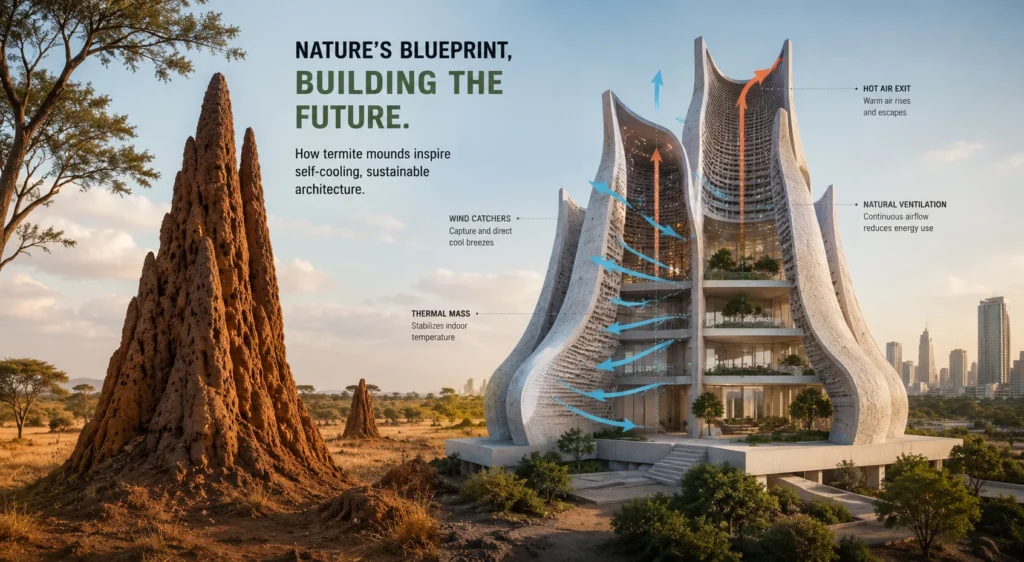

Introduction: The Tiny Architect That Could Save Our Skylines
Imagine you are walking through the hot, dry plains of Africa. The sun is beating down like a hammer. The air temperature is well over 100 degrees Fahrenheit. You are sweating just standing still. Your shirt is sticking to your back. Your mouth feels like cotton.
Now, look over at a tall, rocky structure. It looks like a small castle made of dried mud. It stands about 20 feet high. That is a termite mound. From a distance, it looks dead. It looks like a lump of dirt. But inside that mound, millions of tiny insects are living. They are eating, sleeping, raising babies, and farming fungus gardens. They are having a busy day.
Here is the shocking part: inside that mud castle, the temperature is a cool, steady 86 degrees. The humidity is perfect. The air is fresh. It smells like damp earth, not like rot or dust. The termites are not sweating. They are not struggling. They are just living.
How? These insects do not have air conditioners. They do not have fans. They do not have electricity. They do not have engineers. They do not have blueprints. They have never taken a physics class.
Yet, they have solved a problem that human engineers are still struggling with. How do you keep a giant building cool without burning fossil fuels? How do you move fresh air through a maze of rooms without making noise? How do you store coolness from the night and use it during the scorching day?
Today, architects are copying these tiny termites. They are ripping out mechanical air conditioning. They are replacing it with something much smarter: lungs made of concrete and wind. They are looking at dirt mounds and seeing the future of skyscrapers. This is the story of how bug brains are building our future.
But let us slow down. Before we get to the fancy buildings in Australia and India, we need to understand the problem. We need to understand why our own buildings are so broken. And we need to meet the termites properly.
Chapter 1: The Problem With Our Glass Boxes
Let us start with a sad fact. Buildings are hungry. Very hungry.
Right now, about 40 percent of all the energy used in the world goes to buildings. Think about that. Nearly half of everything we burn, every dam we build, every solar panel we install—almost half of it disappears into walls, roofs, and windows. And most of that energy? Air conditioning. We spend billions of dollars pushing cold air through metal tubes. We call it HVAC—heating, ventilation, and air conditioning. It hums day and night. It never sleeps. It never thanks us.
Here is another sad fact. Most of that energy is wasted. We cool rooms that no one is in. We cool rooms while the windows are open. We cool rooms while the sun is blasting through uncovered glass. We are fighting against ourselves.
But here is the secret the termites know. You do not need to push air. You need to breathe air.
Think about your own lungs. You do not have a fan inside your chest. You do not have a motor. You have muscles that change pressure. When your diaphragm moves down, your chest gets bigger. The pressure drops. Air rushes in. No motor. No gasoline. Just pressure and space. When your diaphragm moves up, your chest gets smaller. Pressure rises. Air goes out. That is it. That is breathing.
A termite mound works the same way. It is a lung. A giant, earthen lung. It expands and contracts with temperature and wind. It inhales cool night air. It exhales hot day air. It never stops. It never breaks. It never needs an oil change.
Now, imagine a 40-story office building in Mumbai or Miami. Imagine it has no AC units on the roof. No humming fans in the ceiling. No cold drafts that give you a stiff neck. No filters that grow mold. Just fresh, moving air that stays cool all by itself. Imagine the silence. Imagine the savings.
That is not science fiction. That is biomimicry. And termites invented it 30 million years ago. They were breathing while dinosaurs were still walking the Earth. They were building passive skyscrapers while our ancestors were still living in caves.
We are the ones who are late to the party.
Chapter 2: Meet the Macrotermes—The Air Conditioning Geniuses
Let us get specific. The termite we care about is called Macrotermes michaelseni. It lives in Namibia and other parts of southern Africa. It is not the termite that eats your porch. It is not the one that swarms around your porch light. This is a builder. This is an architect.
These termites are small. Each one is about the size of a grain of rice. They are pale. They are blind. They have soft bodies. They would die in direct sunlight in about five minutes. They are, by any measure, weak and fragile.
And yet, their home is a skyscraper made of dirt, termite spit, and careful engineering. The walls can be as hard as concrete. The structure can last for decades. Some mounds in Africa are over 100 years old. They have been passed down from queen to queen like a family castle.
Inside, there are millions of termites. But they do not just live anywhere inside the mound. They live in the bottom part, underground. That is where the queen sits. She is huge—about the size of your thumb. She cannot move. She just lays eggs. She lays one egg every few seconds. For years. She is a baby factory.
Around her are the workers. They are the ones building the mound, grain by grain. They carry dirt in their mouths. They mix it with saliva. They place it like bricks. They never stop.
And then there are the fungus gardens. The termites do not eat wood directly. They chew up wood and leaves, poop it out, and that poop becomes food for a special fungus. The fungus breaks down the tough plant fibers. Then the termites eat the fungus. It is a perfect partnership.
Here is the challenge: that fungus needs a very steady temperature. Too hot? The fungus dies. Too cold? The fungus sleeps and stops growing. Too wet? Mold grows and kills the fungus. Too dry? The fungus cracks and crumbles.
The termites need to keep the nursery at exactly 86 degrees Fahrenheit, day and night, summer and winter. The humidity needs to be between 80 and 90 percent. The carbon dioxide levels need to stay low.
But outside, the temperature swings wildly. At noon, it might be 104 degrees. At midnight, it might be 40 degrees. The sun blasts the mound from one side. The wind sucks heat from the other. Rain pounds the roof. Termites do not have thermostats. They do not have humidifiers. They do not have weather forecasts.
How do you keep a steady 86 without a thermostat?
You build lungs. You build a machine with no moving parts. You build something that uses the sun and the wind and the earth to do your work for you. You build a miracle of mud.
Chapter 3: The Mound Is a Lung—Not a Chimney
For a long time, scientists thought termite mounds worked like chimneys. The idea was simple and made sense. Hot air rises. It goes up through the center of the mound and out the top. Cool air gets sucked in from the bottom. That is called stack effect. You see it in your fireplace. You see it in a hot air balloon.
That is part of the story. But it is not the whole story. It is not even the most interesting part.
In 2000, a biologist named Scott Turner went to Africa with an engineer named Rupert Soar. They were curious. They did not trust the simple chimney idea. They stuck tiny sensors all over termite mounds. They measured temperature, humidity, wind speed, and carbon dioxide. They measured in the morning. They measured at noon. They measured at midnight. They measured during storms. They measured during droughts.
What they found was weird. Very weird.
Inside the mound, the air was not moving in a simple loop. It was not going steadily up and out. It was moving in a pulsing, breathing rhythm. Up. Down. Up. Down. Like inhale. Exhale. Like a heartbeat made of air.
Here is what is happening in detail:
During the day, the sun heats the outer walls of the mound. The air inside the outer chambers warms up. That warm air rises up through tiny tunnels near the surface. As it rises, it pulls cooler, stale air out of the central nursery. That stale air—full of carbon dioxide from the termites and fungus—exits through small holes near the top of the mound. The nursery exhales.
But then something else happens. As the warm air rises, it creates a low-pressure zone near the bottom of the nursery. That low pressure pulls fresh air in from the edges of the mound. That fresh air has come from underground tunnels that extend far away from the mound. Those tunnels are like snorkels. They pull air from cool, damp soil.
So during the day, the mound is breathing out through the top and breathing in through the bottom. It is a vertical breath.
During the night, the wind changes. The outside air cools down. The outer walls of the mound cool faster than the inner nursery. Now the air inside the outer chambers gets heavy. It sinks. That sinking action pulls fresh, cool air down from the top of the mound. That cool air falls through the central chambers and pushes into the nursery. The nursery inhales.
At the same time, the sinking air pushes stale air out through the bottom tunnels. The mound exhales through its feet.
It is a two-stroke engine. Day and night. Inhale and exhale. No moving parts. No energy bill. No repairman. No filters to change.
And here is the genius part: the termites can change the shape of the tunnels. If the mound is getting too hot, they dig more exit holes near the top. If it is getting too cold, they seal some holes with mud. They are constantly tuning their lung. They are not born knowing how to do this. They learn. They adapt. They experiment.
We are only just beginning to understand how smart these tiny insects really are.
Chapter 4: The Secret Ingredient—Thermal Mass
Now, let us talk about something called thermal mass. That is a fancy way of saying: heavy stuff holds heat. Heavy stuff also holds coolness. It is a battery for temperature.
Think about a rock in the sun. In the morning, the rock is cool. By noon, the rock is warm. By late afternoon, the rock is hot. But here is the key: the rock does not get hot instantly. It takes hours. And when the sun goes down, the rock stays warm for hours. It releases that heat slowly, like a radiator.
A brick wall has thermal mass. A concrete floor has thermal mass. A bucket of water has thermal mass. A glass window does not. A thin sheet of metal does not. Drywall does not. Carpet does not.
When the sun hits a brick wall, the wall warms up slowly. When the sun goes away, the wall cools down slowly. That is why old stone churches stay cool in summer and warm in winter. That is why castles are comfortable. That is why your garage is hot in summer and cold in winter—it has no thermal mass because it is just thin walls and a metal door.
Termite mounds are made of dirt. Dirt has very high thermal mass. The walls of the mound are thick—sometimes 18 inches thick. That thickness is not random. It is tuned to the daily cycle of the sun.
During the day, the sun bakes the outside of the mound. But the heat takes hours to soak all the way through to the inside. The heat moves through the dirt at a speed of about one inch per hour. So an 18-inch wall takes 18 hours for heat to travel from the outside to the inside.
By the time the heat reaches the nursery, the sun is already going down. Then the outside night air cools the outer wall. That cooling also takes hours to soak inward. So the nursery never sees the peak heat or the freezing cold. It only sees the average. The thermal mass smooths out the bumps. Like a shock absorber for temperature.
This is called thermal lag. It is one of the most powerful tools in sustainable design. And almost no modern buildings use it.
Human architects forgot about thermal mass for about 60 years. After World War II, we fell in love with glass. Glass was cheap. Glass looked modern. Glass said “we are not hiding anything.” Architects loved glass. Developers loved glass because it was fast to install. Homeowners loved glass because it looked fancy.
But glass has almost no thermal mass. It is a sieve for heat. In summer, the sun pours through glass and bakes the inside. In winter, the cold pours through glass and freezes the inside. That is why glass skyscrapers need so much air conditioning. They are like greenhouses in summer and freezers in winter. They are fighting the sun instead of using it.
Now, architects are remembering mud. They are remembering stone. They are remembering thick concrete. Not for looks. For physics. For survival.
Chapter 5: The Wind Catcher Effect
Termites also use something called wind pressure. This is where it gets really clever. This is where the shape of the mound matters as much as the material.
Look at a termite mound from above. It is not round. It is not square. It is shaped like a flattened oval, or a blade. The wide sides face east and west. The narrow edges face north and south. Why?
Because the wind.
In most of Africa, the prevailing winds come from the north and south. They blow in the same direction most of the year. The termites have learned this over millions of years. They build their mounds so that the narrow edge faces the wind.
When wind hits the narrow edge of the mound, it speeds up. It flows around the sides like water around a rock. That fast-moving wind creates low pressure on the downwind side. Low pressure sucks air out of the mound’s exit holes. It is the same principle that makes an airplane wing lift. Fast air equals low pressure.
Meanwhile, on the upwind side, the wind pushes slightly into other holes. The holes are placed at different heights. Some are high. Some are low. Some are on the sunny side. Some are on the shady side.
The result is a gentle, constant flow of fresh air through the mound. No fans. No electricity. No noise. Just the wind doing what wind always does.
This is called passive ventilation. And it is the holy grail of sustainable building. Once you understand it, you start seeing it everywhere. You see it in old farmhouses with windows on opposite walls. You see it in desert tents with flaps on both ends. You see it in the way a dog pants with its mouth open.
But termites perfected it. They added multiple chambers. They added dead-end tunnels that act like silencers. They added tiny pores that let air through but keep out predators. They built a ventilation system that works in calm weather and stormy weather, in dry seasons and wet seasons.
We are only now learning how to copy this at the scale of a human building.
Chapter 6: The Man Who Stole the Idea—Mick Pearce
Now we get to the hero of our story. His name is Mick Pearce. He is an architect from Zimbabwe. He grew up in Africa. He knows the heat. He knows the dust. He knows the termites.
In the 1990s, a big insurance company called Old Mutual wanted to build a new headquarters in Harare, Zimbabwe. Harare is high up, about a mile above sea level. The air is thin. The sun is fierce. The days are hot. The nights are cool.
They had a problem. Air conditioning is expensive. Electricity is unreliable in Zimbabwe. Power cuts happen every week. If you build a normal glass building with AC, you will be sitting in the dark and the heat half the time. Your computers will shut down. Your workers will go home.
They asked Pearce to design a building that would use 90 percent less energy for cooling. They did not care how it looked. They cared if it worked.
Pearce said, “I know exactly what to do. I need to study a termite mound.”
He went out into the bush with a notebook. He crawled through old mounds. He measured tunnel widths. He mapped air flow. He talked to biologists. He read Scott Turner’s research. He was not looking for a pretty shape. He was looking for a set of rules. A recipe. A pattern.
The rules he found were:
- Use thick walls with high thermal mass to soak up daytime heat and release it at night.
- Build a central atrium that acts like the nursery—where people work and gather.
- Build a network of smaller chimneys around the outside that act like the mound’s breathing tunnels.
- Put vents at the bottom and top of the building that open and close based on temperature.
- Let the wind and temperature differences move the air. Do not fight them. Use them.
- Orient the building so the narrow sides face the prevailing wind.
- Put the stairwells and elevators on the outside, so they act as solar chimneys.
Then he built it.
But he did not just build one building. He built a revolution. And he did it with concrete, brick, and guts.
Chapter 7: The Eastgate Building—A Real-Life Termite Mound
The Eastgate Centre opened in 1996. It looks like a normal office and shopping complex. It has six stories. It is made of concrete. It has big windows, but they are shaded by deep overhangs. It does not look like a termite mound. It looks like a 1990s mall. That is the point. Good biomimicry does not copy the shape. It copies the rules.
Inside, there is no conventional air conditioning. No chillers. No cooling towers. No ducts in the ceiling. No vents in the floors. Nothing.
Here is what happens inside Eastgate on a hot day in October:
The sun hits the concrete walls. The walls warm up slowly. By late afternoon, the walls are warm to the touch on the outside, but the inside air is still cool. The heat has not soaked through yet. The 12-inch concrete walls have a thermal lag of about six hours.
The warm air inside the building rises. It escapes through chimneys near the roof. Those chimneys are painted black on the inside. Black absorbs heat. The sun heats the chimneys, which heats the air inside them, which rises faster. That is a solar chimney. No fuel. Just sun.
That rising air pulls cool air up from the basement. The basement stays cool because it is underground. The earth at that depth stays at about 65 degrees year-round. That cool air flows through the offices, picks up heat from people and computers and lights, and rises again. Round and round.
At night, the building opens vents to the cool night air. The concrete walls release the heat they stored during the day. By 4 a.m., the building is cool again. Then the vents close. The cool is trapped inside.
The result: Eastgate uses 90 percent less energy for cooling than a similar glass building. It saved the owners over 3.5 million dollars in the first five years alone. That is not a small amount. That is real money. That is the kind of savings that makes other developers pay attention.
And here is the best part. People love working there. The air is fresh, not recycled. There is no loud humming from AC units. There is no dry throat from over-conditioned air. The temperature is steady, but it changes slowly throughout the day—just like outside. That small change actually feels more natural. It keeps you awake. It reminds your body what time it is. It connects you to the outside world.
The termites taught us that perfect steadiness is not actually comfortable. Gentle breathing is comfortable. Small changes are healthy. Stasis is death.
Chapter 8: Why Did We Forget This?
You might be thinking: “This sounds obvious. Why doesn’t every building do this? Why are we still building glass ovens?”
The answer is history. And money. And laziness. And a little bit of arrogance.
After air conditioning was invented in 1902 by Willis Carrier, it changed everything. Carrier was trying to solve a humidity problem at a printing plant in Brooklyn. The paper was expanding and shrinking. The ink was smearing. He built a machine that cooled air and removed moisture. It worked.
Soon, movie theaters installed AC. Then department stores. Then office buildings. Then houses.
Suddenly, you could build any building anywhere. You did not need thick walls. You did not need windows that open. You did not need breezes. You did not need shade. You just sealed the box and pumped in cold air. Location did not matter. Climate did not matter. Sun did not matter. Wind did not matter.
That freedom led to amazing things. Skyscrapers in Dubai. Malls in Phoenix. Hospitals in the jungle. Suburbs in the desert. Cities in places where no city had any business being built.
But it also led to laziness. Architects stopped learning about wind and sun. They stopped studying how buildings breathe. They stopped caring about orientation and shading and thermal mass. They just drew glass boxes and called an AC company. They outsourced comfort to a machine.
Then oil got cheap. Electricity got cheaper. Nobody cared about energy bills. A kilowatt-hour cost less than a bottle of water. Why bother designing a passive building when you could just crank the AC?
Then the oil started running out. Then the price went up. Then the planet started heating up. Then we realized: we built a world of glass lungs that cannot breathe on their own. We built a world that depends on machines that break, filters that clog, refrigerants that leak, and power plants that burn coal.
Termites never forgot. They have been perfecting their design for 30 million years. They do not have oil. They do not have copper wire. They do not have refrigerants. They only have physics. And physics is free.
Chapter 9: Modern Buildings Copying Termites Right Now (Expanded)
Eastgate was just the beginning. Now, termite-inspired buildings are popping up all over the world. Each one adds a new twist. Each one teaches us something new.
The Council House 2 (CH2) in Melbourne, Australia
This building looks like a futuristic spaceship made of wood and metal. It has fins on the outside. It has louvers that move like gills. It has plants growing on every balcony. But inside, it breathes like a termite mound.
It has “shower towers” on the outside. These are tall concrete cylinders, about three feet wide and ten feet tall. Inside each tower, there is a mist of water. When hot air rises up the towers, the mist cools it down. The cool air becomes heavy. It falls back into the building. No compressors. No refrigerants. Just water and gravity and evaporation.
The shower towers use about as much water as a single office worker’s daily toilet flush. But they save enough energy to power ten houses. That is a good trade.
CH2 also has phase-change materials in the ceiling. These are wax-filled panels that melt at 72 degrees. When the room gets warm, the wax melts and absorbs heat. When the room cools down at night, the wax hardens and releases heat. It is like thermal mass, but lighter. It was inspired by the way termite mounds use water in the soil to store and release heat.
The Beitou Public Library in Taipei, Taiwan
This library is huge, beautiful, and has no air conditioning. The roof is covered with grass and solar panels. The walls are made of thick wood. But the secret is the ventilation.
The building is shaped like a giant wind scoop. It catches the breezes from the nearby hot spring valley and pulls them through the reading rooms. The windows are huge, but they are all on the north and south sides. The east and west walls are solid. No morning sun. No afternoon sun.
The library also uses a technique called cross-ventilation. Windows on opposite sides of the building are opened. The wind blows in one side and out the other. It sweeps through the whole building like a broom.
In a place where summer temperatures hit 95 degrees with 80 percent humidity, the library stays at 75. People come just to sit and read and enjoy the breeze. They do not care that there is no AC. They actually prefer the natural air.
The Manitoba Hydro Building in Winnipeg, Canada
Wait—termites in freezing Canada? Yes. The same principles work in reverse. In winter, you want to keep heat in. You do not want to let the cold in. You want to capture every bit of warmth from the sun, from the lights, from the computers, from the people.
This building uses a “thermal chimney” just like a termite mound. Warm air rises out of the top. But before it leaves, it passes through a heat exchanger that captures the heat and sends it back down. The heat exchanger is like a lung that breathes without losing warmth.
The walls are super thick—18 inches of concrete with insulation on the outside. That is thermal mass. In winter, the sun hits the concrete through the windows. The concrete warms up during the day. At night, it releases that heat slowly. The building stays warm without the furnace running all night.
The building uses 70 percent less energy than a normal office tower. Even in -30 degree weather. Even when the wind is howling. Even when the sun sets at 4 p.m.
The SeQuel Office Building in Pune, India
This is a great example from the developing world. Pune is hot and dusty. The summer temperatures hit 105 degrees. The monsoon brings humidity that makes you feel like you are swimming through the air. Normal office buildings there run AC 24/7. Their bills are enormous.
SeQuel uses a termite-inspired central courtyard. The courtyard is open to the sky. It is three stories tall. Hot air rises up and out through the top. That rising air pulls cool air from shaded underground parking garages into the offices on each floor.
The building also has water features in the courtyard. The water evaporates and cools the air even more. It is like a swamp cooler, but without the electricity.
The building stays 10 degrees cooler than outside without any mechanical cooling for most of the year. During the hottest weeks, they run small fans. No AC. No chillers. No refrigerants.
The Pixel Building in Melbourne, Australia
This building is covered in colorful panels. It looks like a Lego building. But behind the colors, there are thousands of tiny holes. Those holes let air in but keep rain out. They are like the pores on a termite mound.
The building also has a green roof, solar panels, wind turbines, and a water recycling system. But the ventilation is the real star. The building breathes through its skin. No central AC. No ducts. Just a million tiny openings.
The Pixel Building is carbon neutral. It produces as much energy as it uses. It is one of the greenest buildings in the world. And it all started with a termite mound in Africa.
Chapter 10: How to Build a Termite Skyscraper—The Rules (Expanded)
Let us pretend you are an architect. You have a client. She wants to build a 20-story apartment building in a hot city. She wants it to breathe like a termite mound. She wants to save money on energy. She wants her tenants to be comfortable. She does not care about awards. She cares about results.
What do you do? Here are the rules, expanded and explained.
Rule 1: Orient to the wind and sun.
Do not just plop the building down anywhere. Study the site for at least a year if you can. Where does the sun rise? Where does it set? Where is the sun at noon in summer? Where is it in winter? What are the prevailing winds in each season? Are there nearby buildings that block the wind? Are there hills that channel the wind?
Put the narrow edge of the building facing the prevailing wind. Put the wide sides facing east and west. That way, the smallest surface area faces the harsh morning and afternoon sun. The largest surface area faces north and south, where the sun is lower and easier to shade.
Rule 2: Build a central lung.
Every termite mound has a central nursery. Your building needs a central atrium—a big open space running from bottom to top. That is your lung. It should be at least 10 feet wide. It should have windows or vents at the top and bottom.
The atrium should be surrounded by glass or open railings. That way, light and air can flow from the atrium into the offices and apartments. People can see the atrium. They can feel connected to the building.
Rule 3: Add breathing chimneys.
Around the outside of the building, build narrow shafts. Some go all the way to the roof. Some stop halfway. These are your mound’s peripheral tunnels. They should have vents that open and close automatically based on temperature.
The vents can be simple. No motors needed. Use wax motors. Wax expands when it gets hot. It pushes a piston. The piston opens a vent. When the wax cools, it shrinks. The vent closes. No electricity. No computers. Just physics.
Rule 4: Use heavy materials.
Concrete, brick, rammed earth, stone, adobe, compressed earth block. Nothing lightweight. No metal studs. No drywall if you can avoid it. You need thermal mass. The walls should be at least 12 inches thick. The floors should be exposed concrete, not covered in carpet. That concrete absorbs heat during the day and releases it at night.
If you cannot use thick walls, use phase-change materials. These are panels filled with wax or salt solutions that melt and freeze at room temperature. They act like thermal mass without the weight. They are like termite mounds in a box.
Rule 5: Put windows where they matter.
Do not put floor-to-ceiling glass on the west side. That is a solar oven. You will cook your tenants. Put small, shaded windows on the east and west. Put big windows on the north and south where the sun is less direct.
Use awnings, louvers, balconies, or brise soleil to block high summer sun but allow low winter sun. In summer, the sun is high. A short awning blocks it. In winter, the sun is low. That same awning lets the sun in. It is like a thermostat that never breaks.
Rule 6: Let the building sleep at night.
At night, open the vents. Let the cool air wash through. Let the concrete release its stored heat. In the morning, close the vents. Trap the coolness inside. This is called night flushing. Termites do it. Old farmhouses do it. You should too.
If you are in a noisy or polluted city, you might not want to open windows at night. That is okay. Use a heat recovery ventilator. It brings in fresh air and exhausts stale air, but it captures the heat or coolness from the outgoing air. It uses a fan, but a small one. Much smaller than AC.
Rule 7: Add plants.
Termites do not have leaves, but you do. Put trees on the west side of your building to block afternoon sun. Put a green roof on top. Plant vines on trellises. Plants cool the air through evaporation. They also make people happy. They reduce stress. They clean the air. They are cheap.
Rule 8: Test your design with a computer model.
Do not guess. Use software that simulates wind and temperature. Put a virtual model of your building in a virtual climate. See where the hot spots are. See where the wind stalls. Adjust your vents. Adjust your window sizes. Adjust your wall thickness.
The termites do this with real mounds. They build a small version. They test it. They learn. They adapt. You can do the same with a computer.
Rule 9: Teach the occupants.
A termite building is not a machine. It is a partner. It needs people to open windows sometimes. It needs people to close blinds sometimes. It needs people to understand how it works.
Put a simple diagram in the lobby. Show the air flow. Show the vents. Show the thermal mass. Explain night flushing. Explain why 82 degrees feels fine when the air is moving.
People are not stupid. They just need to be told. Once they understand, they will help. They will become part of the lung.
Chapter 11: The Hard Parts—Why Isn’t Every Building Doing This? (Expanded)
I promised you honesty. So here is the hard truth. Termite-inspired design is not easy. It is not a silver bullet. It has real challenges. Let us name them.
Challenge 1: First cost is higher.
It costs more to build thick concrete walls than thin glass walls. It costs more to install automatic vents than to seal the building and install a standard AC unit. It costs more to hire an architect who understands thermal physics. It costs more to run computer simulations.
The savings come later. They come every month on the utility bill. But developers often sell the building before the savings kick in. They care about first cost, not life-cycle cost. That is a problem.
Challenge 2: Building codes are dumb.
Many cities require mechanical air conditioning by law. They have formulas that say “if the building is bigger than X square feet, you must install AC.” They do not have a checkbox for “passive termite lung.” So architects have to fight for exceptions. They have to hire lawyers. They have to convince plan reviewers who have never heard of biomimicry.
Some cities are changing their codes. Seattle has a “natural ventilation” code. San Francisco has one too. But most cities do not. Most cities are still stuck in the 1950s.
Challenge 3: Noise and pollution.
In a naturally ventilated building, you hear the street. You hear the wind. You hear your neighbors opening their windows. You hear the garbage truck at 6 a.m.
In a sealed AC building, you hear nothing but a quiet hum. Some people prefer the hum. They call it privacy. They call it peace.
Also, if the outdoor air is polluted, you do not want to bring it inside. In cities like Beijing or Delhi, natural ventilation can be dangerous. You need filters. You need to clean the air. That takes energy. That takes fans.
Challenge 4: Human behavior.
People love control. Give someone a thermostat, and they will set it to 68 degrees in July. Then they will wear a sweater. That is crazy, but it is true. People want to feel powerful. They want to push buttons.
In a termite building, you do not get a thermostat. You get a window and a shade. You get a vent you can open or close. Some people hate that. They feel powerless. They feel like the building is controlling them instead of the other way around.
But here is the comeback: In a termite building, you are not powerless. You are part of the lung. When you open your window, you change the air flow for everyone. That is power. It is just shared power. Not everyone likes sharing.
Challenge 5: Climate change.
What happens when the climate changes? What happens when the nights get warmer? What happens when the prevailing winds shift? A building designed for today’s climate might not work in tomorrow’s climate.
Termites handle this by adapting. They dig new tunnels. They seal old ones. They rebuild. Human buildings cannot do that easily. You cannot just dig a new vent in a concrete wall.
So we need to design for a range of climates. We need to build in flexibility. We need to plan for change. That is hard. That is expensive. But it is necessary.
Challenge 6: The AC industry is huge.
There is a lot of money in air conditioning. There are factories that make compressors. There are trucks that deliver refrigerants. There are technicians who install ducts. There are salespeople who sell maintenance contracts.
These industries do not want to disappear. They will fight passive design. They will say it does not work. They will point to failed projects. They will lobby for codes that require AC.
We cannot ignore this. We have to work with them. Maybe AC companies can make heat recovery ventilators. Maybe they can make smart windows. Maybe they can make phase-change panels. The industry can change. But it will take time.
Chapter 12: What Termites Teach Us About the Future
Let us zoom out. Way out. Past the buildings. Past the cities. Past the politics.
We are facing a climate crisis. The planet is getting hotter. The weather is getting wilder. The seas are rising. The fires are spreading. And buildings are a huge part of the problem. They use 40 percent of all energy. They produce 40 percent of all carbon emissions.
But buildings can be a huge part of the solution. Every ton of concrete we pour can either trap heat or release it. Every window we install can either bake the room or cool it. Every vent can either waste energy or save it. Every roof can either absorb sun or reflect it.
We have the technology. We have the knowledge. We have the money. What we lack is the will. What we lack is the imagination.
Termites do not have architects. They do not have blueprints. They do not have computers. They have evolution. For millions of years, the mounds that overheated collapsed. The mounds that froze killed their queens. The mounds that flooded washed away. Only the mounds that breathed perfectly survived.
That is nature’s engineering lab. And it is free for us to copy. It is open source. No patents. No licensing fees. No royalties.
We do not need to live in mud huts. We can live in beautiful concrete towers that breathe. We can have air that moves without fans. We can have coolth without compressors. We can have warmth without furnaces. We just need to remember what the termite never forgot: air wants to move. Heat wants to equalize. Pressure wants to balance. Water wants to evaporate.
Our job is not to fight those forces. Our job is to build the channels. To guide the flow. To get out of the way.
Termites do not fight nature. They partner with nature. They use the sun. They use the wind. They use the earth. They use the night. They use everything that is free and abundant. They waste nothing.
We can do the same. We just have to be humble enough to learn from a bug.
Chapter 13: A Day in a Termite-Inspired Building (Expanded)
Let me paint you a picture. A full day. Start to finish.
Imagine it is July in Dallas, Texas. Outside, it is 98 degrees. Humidity is 70 percent. Your car says “heat advisory.” The radio says “stay inside if possible.”
But you walk into your office building. It is called the Breathe Tower. It is 30 stories of exposed concrete and shaded glass. The lobby is open to the sky. There is a fountain in the middle. The sound of water covers the street noise.
You feel a gentle breeze on your face. Not a blast. Not a draft. Just a soft, steady movement. The air smells like the outside—like cut grass and warm concrete—not like recycled plastic and dust and the back of someone’s neck.
The temperature inside is 82 degrees. That sounds hot. You think “82? That’s a summer day.” But here is the thing: because the air is moving, it feels like 78. And because you walked in from 98 degrees, 82 feels like heaven. It feels like relief.
You take the stairs. The stairwell is in the central atrium. It is wide and light. There are windows at every landing. You can see the sky. You can see the street. You are not trapped in a concrete tube. You are climbing through the lung of the building.
At your desk on the 15th floor, you have a small window you can open. You open it six inches. A fresh stream of air crosses your neck. It is not cold. It is just moving. Moving air carries away the heat your body is making. That is convection. That is how your great-grandparents stayed cool.
You do not need a sweater. You do not need a fan. You just work. You focus. You feel awake. The slight change in temperature over the day keeps your body clock on track. You are not in a cave. You are in a building that remembers the sun.
At noon, the sun is high. The concrete walls have been absorbing heat all morning. But that heat is still working its way through the 12-inch thickness. It will not reach the inside until 5 p.m. By then, you will be gone. The building will open its night vents. The cool evening air will wash through.
By 4 a.m., the concrete will have given up all its stored heat. The building will be ready for another day. The cycle repeats.
You go home. Your apartment building is also termite-inspired. Your utility bill for July is $42. Your friend in the glass tower across the street paid $210. You call him. He complains about his sore throat from the dry AC air. You say nothing. You just smile.
At night, you open your bedroom window. The screen keeps out bugs. The breeze flows over your bed. You sleep with a thin sheet. You do not need the AC. You do not need the fan. You listen to the crickets. You remember that people have slept like this for thousands of years. The termites have been doing it for millions.
You do not feel like a hero. You just feel comfortable. And a little bit smug. That is allowed.
Chapter 14: The Critics—Does This Work Everywhere? (Expanded)
Let us be fair. Termite design is not a magic wand. It is not a one-size-fits-all solution. It works best in certain climates. It struggles in others. Let us walk through the climates one by one.
Hot and dry (desert). Yes. Perfect. Think Phoenix, Cairo, Delhi, Dubai, Las Vegas. These places have hot days and cool nights. The temperature swing is huge. Thermal mass and night flushing work wonderfully. You can store the cool night air in the walls and floors. You can release it during the day. You can stay comfortable with almost no energy.
Hot and humid (tropical). Harder. Think Singapore, Miami, Jakarta, Mumbai, Hong Kong. When the night air is also humid and hot, you cannot flush with cool air. The night is as miserable as the day. You need to dehumidify. That takes energy. That takes machinery.
But you can still use termite-inspired wind scoops. You can still use underground cooling pipes. You can still use shading and orientation. You just need a small amount of mechanical help. Maybe a fan. Maybe a small dehumidifier. Not a full AC system.
Cold climates. Works great for heating. Same principle, reversed. Thick walls store heat from the sun during the day and release it at night. South-facing windows let in low winter sun. The sun warms the concrete floor. The floor releases heat all evening. You still need some backup heat. But much less.
In places like Minnesota or Canada, you cannot rely on passive heating alone. You need insulation too. Lots of it. And you need to seal the building against cold drafts. That is the opposite of ventilation. So you need a hybrid system. Tight in winter. Open in summer. Termites do the same thing. They seal holes in winter. They open them in summer.
Rainy climates. Fine. Just waterproof the roof. Termites do. Their mounds have drip edges and water-shedding shapes. The mud does not melt. It is stabilized with termite spit. It is almost like concrete.
Dense cities. Hard. If you are on the 40th floor and the building next door is 50 feet away, you get no breeze. The wind is blocked. The sun is reflected. The noise is trapped. Natural ventilation is difficult.
But you can still use termite principles for the lower floors. You can still use a central atrium. You can still use thermal mass. You just need to add some fans. Small ones. Not giant AC units.
Polluted cities. Hard. If the outdoor air is full of smoke, dust, or chemicals, you do not want to bring it inside. You need filters. You need to clean the air. That takes energy. That takes fans.
But you can still use thermal mass. You can still use night flushing if the night air is cleaner. You can still use shading. You just need to add a filtration system. Maybe a heat recovery ventilator with HEPA filters.
No solution is perfect. But doing 80 percent less cooling is still a win. Doing 50 percent less heating is still a win. Doing 30 percent less is still worth doing. Do not let perfect be the enemy of good.
Chapter 15: The Hidden Genius—Termite Tunnel Networks (Expanded)
We have focused on air flow. We have talked about chimneys and atriums and vents. But there is one more trick termites use that we are just beginning to copy. It is subtle. It is invisible. It is genius.
Tunnel networks.
Inside a termite mound, there are not just big chambers. There are millions of tiny tunnels. They are about the width of a pencil. They go every which way. They split. They merge. They loop back. They branch like trees. They weave like fabric.
If you cut open a mound, it looks like a sponge. It is more empty space than solid dirt. The termites have removed half the material. They have turned a solid lump into a porous maze.
Why?
Engineers have discovered that these tiny tunnels act like a smart grid for air. When the wind blows hard on one side, some tunnels narrow or widen—not by muscles, but by air pressure itself. The shape of the tunnel network automatically balances the pressure. It is like a traffic system that never jams.
This is called emergent behavior. No single termite decides where the tunnels go. They just dig. They follow simple rules: dig where it is warm. Dig where the carbon dioxide is high. Dig toward the smell of fungus. That is it.
And yet, from those simple rules, a perfect network emerges. The network self-organizes. It self-repairs. It self-optimizes. It is a brain made of tunnels.
Human architects are now experimenting with “porous facades.” Instead of solid walls or big vents, they are building walls with thousands of tiny holes. The holes are sized and spaced to let air through but block rain and bugs. The result is a building skin that breathes evenly, without hot spots or cold drafts.
A company called Arup built a termite-inspired facade for a building in Sydney. The facade has 50,000 tiny ceramic cones. Each cone is shaped like a termite tunnel. Air flows through the cones, but sound does not. The building is quiet and cool. No AC in the common areas.
Another company, called BioMason, is growing bricks using bacteria. The bacteria produce a cement-like material. The bricks can be grown with internal tunnels. The tunnels can be programmed by changing the shape of the mold. You can order a brick that breathes exactly the way you want.
We are learning that small is beautiful. Not every air channel needs to be a big metal duct. Sometimes, a million tiny holes work better. Sometimes, the best way to move air is to let it find its own way.
Chapter 16: What You Can Do—Even If You Are Not an Architect (Expanded)
You might be reading this in a regular house or apartment. You cannot rebuild your walls. You cannot add a central atrium. You cannot install a termite-inspired facade. But you can still think like a termite. You can still breathe better. You can still save energy.
Here is a full list of things you can do today, this week, this month.
1. Open your windows at night. In summer, let the cool night air flush out the heat. Close them in the morning. Trap the cool. This is night flushing. It works. Try it for one night. You will feel the difference.
2. Close your blinds on the sunny side. Do not let the sun bake your thermal mass (your furniture, your floors, your walls). Keep the heat outside. In winter, do the opposite. Open the blinds on the sunny side. Let the sun warm your thermal mass.
3. Use fans, not AC, when you can. Fans use 50 watts. AC uses 3,000 watts. A fan does not cool the air. It cools your skin by moving air. That is exactly what termites do—they move air. A fan costs pennies a day to run. AC costs dollars.
4. Paint your roof white. White reflects sunlight. Dark absorbs it. A white roof can stay 30 degrees cooler than a black roof. No AC needed. If you cannot paint your roof, put white tiles on it. Or white gravel. Or white anything.
5. Plant a tree on the west side of your house. Shade is free cooling. A mature tree can reduce your cooling bill by 25 percent. It also cleans the air. It also makes your house look better. It also gives you fruit. Plant a tree. Today.
6. Build a simple solar chimney. Take a piece of black metal duct. Paint it black on the inside. Mount it on your south-facing wall (if you are in the northern hemisphere). Cut a hole at the top and bottom. The sun will heat the duct. The air inside will rise. It will pull cool air from your basement or crawl space. No moving parts. No electricity. You can build one for twenty dollars.
7. Seal your leaks. Termites do not waste air. Neither should you. Caulk your windows. Weatherstrip your doors. Seal your ductwork. You will save money in summer and winter.
8. Add thermal mass. Put a stone tile floor in your sunroom. Put a brick wall behind your wood stove. Put water barrels in your greenhouse. Anything heavy will store heat and coolness. It will smooth out the temperature swings.
9. Cross-ventilate. Open windows on opposite sides of your house. Let the wind blow through. If you have only one side, open a window and a door on the same side. The air will still move. It will still cool you.
10. Use a whole-house fan. If you have an attic, install a fan that pulls air from the house and blows it into the attic. This creates negative pressure. It sucks cool night air through your open windows. It flushes the whole house in minutes. It uses less energy than a toaster.
11. Turn off the AC when you leave. Why cool an empty house? Set the thermostat to 85 when you are gone. It will take ten minutes to cool back down when you return. You will save a lot of money.
12. Dress for the season. In summer, wear shorts. In winter, wear a sweater. Do not expect your house to be 72 degrees year-round while you wear the same clothes. That is wasteful. That is lazy. Termites do not wear clothes. They adapt.
You do not need to live in a termite mound. You just need to remember: air is not your enemy. Air is your partner. The sun is not your enemy. The sun is your partner. The night is not your enemy. The night is your partner.
Work with nature. Stop fighting it.
Chapter 17: The Next Frontier—Termite AI and Robot Swarms (Expanded)
Here is where the story gets wild. This is where science fiction meets the termite mound.
Scientists are now using computer models to simulate termite mounds. They are not just copying the shape. They are copying the rules that the termites follow. They are creating artificial intelligence based on insect brains.
Each termite follows three simple rules:
- If it is hot, dig a vent upward.
- If it is cold, dig a vent downward.
- If you smell carbon dioxide, dig toward the smell.
That is it. No blueprint. No boss. No meetings. No emails. No PowerPoint presentations.
When millions of termites follow those three rules, a perfect mound emerges. The mound is not designed. It is grown. It is an emergent structure. It is smarter than any single termite.
Now imagine if we programmed building materials to follow similar rules. Imagine bricks that sense temperature and change their shape. Imagine windows that open themselves based on wind direction. Imagine walls that grow thicker where it is hot and thinner where it is cool. Imagine a building that learns and adapts, just like a termite mound.
This is called responsive architecture. And it is coming sooner than you think.
Researchers at Harvard built a termite-inspired robot swarm. They called them TERMES robots. Each robot was about the size of a shoe box. Each robot carried a brick. Each robot followed simple rules: if there is space, place a brick. If there is a brick, climb it. If the structure is too tall, build a ramp.
The robots built a small tower without any central computer. The tower had ventilation chimneys in the right places. The robots did not talk to each other. They just sensed their environment and acted. The structure emerged.
Now imagine this at the scale of a real building. Imagine a hundred robots, each the size of a garbage can, swarming over a construction site. They carry bricks. They mix concrete. They build walls. They dig tunnels. They work 24 hours a day. They never get tired. They never get sick. They never ask for a raise.
That is the future. That is termite-inspired construction.
But it goes deeper. Researchers at MIT are developing “digital clay.” These are small cubes that can change shape and color. Each cube has a tiny computer and a tiny motor. The cubes can rearrange themselves into any shape. A wall of digital clay could grow vents when it gets hot. It could grow windows when the sun moves. It could thicken when the wind blows.
We are not there yet with full-size buildings. The technology is still in the lab. The cost is still high. The energy use is still a problem. But we will get there. In 20 years, your skyscraper might grow itself, one brick at a time, like a termite mound.
And here is the beautiful thing: we are not inventing anything new. We are just copying the termites. They have been doing swarm construction for 30 million years. They are the original robotic builders. We are the ones playing catch-up.
Chapter 18: The Termite’s Gift to Humanity
Let me tell you a small story. A true story.
In 2005, a biologist named J. Scott Turner went back to Namibia. He had been studying termite mounds for 15 years. He had published papers. He had given talks. He had built computer models.
He wanted to answer one final question. How do termites know where to dig? They are blind. They cannot see the mound. They cannot see the sun. They cannot see the wind. How do they know where to put the vents?
He did a simple experiment. He took a mound and covered it with a black plastic sheet. He blocked the sun. He waited.
The termites kept digging. They dug vents in the right places. They did not need the sun.
Then he took another mound and blocked the wind. He built walls around it. The termites kept digging. They did not need the wind.
Then he took another mound and pumped carbon dioxide into it. The termites went crazy. They dug vents everywhere. They dug toward the source of the CO2.
The answer: termites do not need to see the mound. They do not need to see the sun or the wind. They just need to smell. They dig where the CO2 is high. They dig where the oxygen is low. They follow their noses. That is all. Three simple rules. And the mound builds itself.
Here is the gift. The termite is telling us something important. You do not need to know everything. You do not need to plan everything. You do not need to control everything. You just need to follow a few simple rules. You just need to pay attention to the signals around you. You just need to respond, not predict.
That is humility. That is wisdom. That is the termite’s gift.
We humans think we are so smart. We think we can control the world. We build glass towers and giant AC units. We think we have conquered nature. But nature always wins. Nature always adapts. Nature always finds a way.
The termite does not try to conquer. The termite listens. The termite responds. The termite survives.
Maybe our buildings should do the same.
Chapter 19: A Call to Remember
We started this story with a small insect on a hot plain. We walked through the science. We visited the buildings. We met the architects. We heard the critics. We looked at the future.
Now we end with a challenge.
Termites have been building sustainable skyscrapers for 30 million years. Humans have been building glass ovens for about 60 years. Who is the smarter architect?
We have the knowledge. We have the materials. We have the math. We have the computers. We have the robots. What we lack is humility. We want to conquer nature, not copy it. We want to be better than nature, not part of nature.
But nature is not our enemy. Nature is our teacher. The termite does not fight the wind. It rides the wind. It does not block the sun. It stores the sun. It does not fear the night. It uses the night. It does not waste. It cycles. It does not hoard. It shares.
Our buildings can do the same. They can breathe. They can sweat. They can sleep. They can adapt. They can learn. They can grow. They just need us to stop forcing them and start listening. They need us to stop designing and start growing. They need us to stop controlling and start responding.
The next time you see a termite mound on television, do not swat the screen. Bow. You are looking at your future. You are looking at a building that has no utility bill. You are looking at a machine with no moving parts. You are looking at a structure that has stood for a hundred years without maintenance. You are looking at a lung made of dirt.
That could be your office. That could be your school. That could be your home. It is not a dream. It is a choice. A choice to learn. A choice to adapt. A choice to be humble.
The termites are waiting. They have been waiting for 30 million years. They do not need us. But we need them. We need their wisdom. We need their rules. We need their lungs.
Let us build. Let us breathe. Let us remember.
Chapter 20: Where Do We Go From Here?
Let me leave you with five actions. Five things that need to happen for termite-inspired design to go from a niche idea to the normal way of building.
Action 1: Change the building codes. We need cities and countries to rewrite their codes. We need codes that reward passive design, not punish it. We need codes that measure performance, not prescribe equipment. This takes political will. This takes voters. This takes you.
Action 2: Train the architects. Most architecture schools do not teach thermal physics. They do not teach biomimicry. They do not teach passive ventilation. They teach aesthetics and software. That needs to change. Students need to go outside. They need to study termites. They need to build with mud.
Action 3: Educate the public. People need to understand that 82 degrees can be comfortable. They need to understand that moving air is better than cold air. They need to understand that thermal mass is not a luxury. This takes journalism. This takes social media. This takes word of mouth.
Action 4: Invest in research. We need more studies. More sensors. More computer models. More robot swarms. More material science. We need to understand termite mounds at the molecular level. We need to understand how the fungus affects the air flow. We need to understand how the queen’s pheromones shape the tunnels. This takes money. This takes governments. This takes foundations.
Action 5: Build more examples. One Eastgate is not enough. We need a hundred Eastgates. We need a thousand. We need termite-inspired schools in India. Termite-inspired hospitals in Africa. Termite-inspired apartments in Brazil. Termite-inspired libraries in Indonesia. Each one teaches us something. Each one proves that it works. Each one inspires the next.
These actions are not impossible. They are just hard. But hard is not the same as impossible. The termites taught us that. They built a skyscraper with their mouths. They moved dirt one grain at a time. They never gave up. They never complained. They just kept digging.
We can do the same. One building at a time. One code change at a time. One person at a time.
Glossary of Simple Terms
- Thermal mass – Heavy stuff (like concrete or dirt) that soaks up heat slowly and releases it slowly.
- Passive ventilation – Moving air without fans or motors, using only wind and temperature differences.
- Night flushing – Opening a building at night to let cool air push out the day’s heat.
- Biomimicry – Copying ideas from nature to solve human problems.
- Atrium – A big open space in the middle of a building that air can move through.
- Stack effect – The natural rising of warm air because it is lighter than cool air.
- Prevailing wind – The direction the wind usually blows in a certain place.
- HVAC – Heating, ventilation, and air conditioning. The mechanical systems in most buildings.
- Thermal lag – The delay between when heat hits a wall and when it comes out the other side.
- Cross-ventilation – Opening windows on opposite sides of a room to let wind blow through.
- Solar chimney – A dark, vertical shaft that heats air and makes it rise, pulling fresh air behind it.
- Phase-change material – A substance that melts and freezes at room temperature to store heat.
- Heat recovery ventilator – A device that brings in fresh air and exhausts stale air while capturing the heat or coolness.
- Porous facade – A building skin with thousands of tiny holes that let air through but block rain and bugs.
- Emergent behavior – A complex pattern that arises from simple rules, with no central planner.
- Responsive architecture – Buildings that change shape, color, or ventilation based on conditions.
Final Thought: The Termite’s Legacy
There is an old African proverb: “Little by little, the termite builds its mound, until it touches the sky.”
We humans love to build things that touch the sky. We love our skyscrapers. We love our monuments. We love our glass towers. But we have forgotten how to build things that touch the earth. We have forgotten how to listen to the wind. We have forgotten how to store the sun. We have forgotten how to breathe with the night.
The termite never forgot.
The gift of the termite is not a design. It is not a blueprint. It is not a patent. It is a way of thinking. Solve problems with shape, not energy. Use what is free—wind, sun, gravity, night, earth, water. Build slowly. Build thick. Build to last. Build to adapt. Build to breathe.
If we learn that lesson, our cities will not just be cooler. They will not just be cheaper. They will be wiser. They will be kinder. They will be more humble. They will be more alive.
And that is a future worth building. That is a future worth digging for. One grain of dirt at a time. One vent at a time. One building at a time.
The termites will be watching. They have been watching for 30 million years. They are patient. They are not going anywhere.
The question is: are we ready to learn?



I like this internet site because so much useful material on here :D.
I felt the luck the moment I signed up. The promotions are generous and lucky97 is definitely my new favorite spot.
I like this web blog very much, Its a rattling nice situation to read and get information.
Finally found a smooth way to get the app running. The installation was a breeze and everything works perfectly on my phone. Love 7u7appapk
Great bonuses for new players which is always a plus. The support team is also very friendly and helpful. Visit krkcwin33
Very impressive system and a very smooth user experience. Everything is well organized and easy to navigate. Five stars for senja128login
Really impressed with the variety of options available here. It feels very professional and the rewards are actually fair. I am sticking with kayaraya88 from now on.
Really impressed with the customer support and the overall vibe of the platform. It feels safe and reliable for long term play. bet119
Such a friendly community and a great selection of games. I spend a few hours here every weekend and it never gets boring. Love vnzl88.