
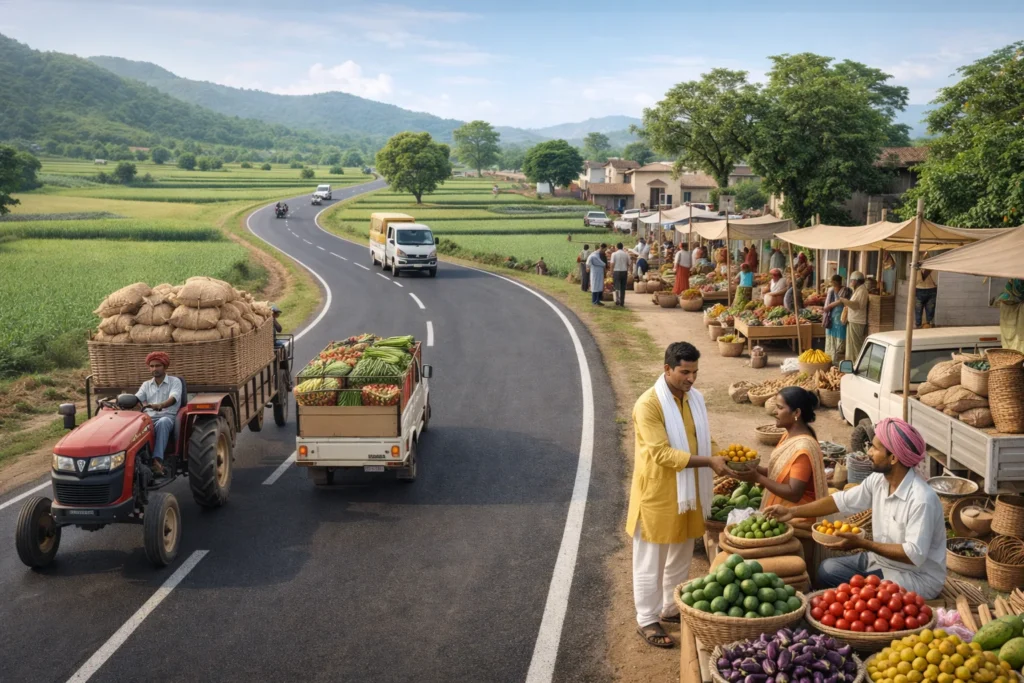

Imagine a basket of ripe, red tomatoes. In a bustling city supermarket, they are a routine sight, a symbol of freshness and nutrition. But for a farmer named Meera, living in a remote settlement in the heart of rural India, those tomatoes represented a desperate race against time. For decades, Meera’s life was dictated by the whims of the clouds. When the monsoon arrived, the only path connecting her village to the district market—a primitive dirt track—would dissolve into a treacherous river of waist-deep slurry.
Trucks couldn’t pass. Even the sturdiest bullock carts would sink axle-deep in the mire. Meera would sit in her porch, watching helplessly as her harvest, the fruit of months of back-breaking labor and expensive seeds, slowly turned to rot in their crates. The outside world, with its hungry consumers and fair prices, was only 50 kilometers away, but during the rains, it might as well have been on another planet. This was the “silent tax” of isolation—a tax paid in wasted effort, lost income, and broken spirits.
Meera’s story was not an outlier; it was the shared reality for nearly 300 million people. However, over the last two decades, a monumental engineering and social feat has been unfolding across the landscape. The transformation of these mud tracks into all-weather “market highways” is perhaps the most significant economic intervention in modern Indian history. This is the story of how bitumen and gravel are doing more than just moving vehicles—they are moving an entire nation toward equity.
The Great Rural Disconnect: Life Before the Roads
For generations in rural India, geography was destiny. If you were born in a “disconnected” village, your economic ceiling was set by how far you could carry a load on your head or a bicycle frame. This isolation created a stagnant economic ecosystem that experts often call the “poverty trap of distance.”
The Farmer’s Invisible Handcuffs
In the absence of roads, farmers were never truly “free” to sell. They were “price takers,” held hostage by the arrival of a single traveling middleman. Because the farmer couldn’t take their goods to the city, the middleman dictated the price—often 40% to 60% below the actual market value. For perishable items like milk, green chilies, or seasonal fruits, the pressure was even higher. If the farmer didn’t accept the pittance offered, the product would be worthless by sunset.
This cycle of vulnerability forced farmers into conservative, low-risk choices. Why invest in high-value but delicate horticulture if it would only spoil? Why produce a surplus when the market was a gamble? Agricultural innovation was stifled not by a lack of knowledge, but by the absolute certainty of logistical failure. The village economy operated not on principles of growth, but on the brutal arithmetic of survival, where minimizing loss was the only rational strategy.
The Artisan’s Fragile World
It wasn’t just agriculture that suffered. Imagine a master potter in Rajasthan or a weaver in West Bengal. Their crafts are world-class, but delicate. Transporting fragile terracotta or intricate handloom fabrics over bone-jarring, potholed tracks resulted in high breakage rates. The cost of “wastage” had to be factored into the price, making their beautiful work too expensive for urban markets and keeping the artisans in a state of perpetual debt.
This fragility extended beyond physical breakage. Without reliable access to urban centers, artisans were cut off from evolving design trends, new materials, and direct customer feedback. Their craft, often passed down through generations, risked becoming a museum piece—admired locally but economically non-viable. The artist’s creativity was shackled by the fear that their masterpiece would be shattered before it could ever be seen, their cultural contribution lost in transit.
The Human Cost of the “Kucha” Road
Beyond the economy, the lack of “pucca” (paved) roads had a devastating impact on human capital. The isolation was a multi-headed monster, affecting every pillar of development.
- Healthcare in Peril: In many regions, the “charpoy” (jute cot) served as the only ambulance. Villagers would carry pregnant women or the elderly for miles to reach a point where a motorized vehicle could finally pick them up. Preventative care was non-existent; vaccinations, prenatal check-ups, and chronic disease management were luxuries for those who could undertake the journey. The statistics of maternal and infant mortality in these cut-off regions painted a grim picture of this medical isolation.
- Education Interrupted: Teachers from nearby towns were often unwilling to commute to villages where the path was a dust bowl in summer and a swamp in winter. Consequently, rural schools faced chronic absenteeism. For students, higher education was a geographical impossibility. A child might pass her secondary exams with distinction, but the higher secondary school or college in the block headquarters remained unreachable for months each year. Dreams were routinely truncated by mud.
- Banking and Financial Deserts: Without roads, cash remained the only medium of exchange. Formal banking couldn’t reach these areas, leaving villagers at the mercy of local moneylenders who charged usurious interest rates. Savings were hidden in homes, vulnerable to theft or disaster. Credit for productive investment was unavailable, and government subsidies or pensions often required a day-long expedition to collect, if they were accessible at all.
- The Psychological Ghetto: Perhaps the most insidious cost was psychological. The constant struggle for basic access bred a mindset of limitation and dependency. The outside world was a place of rumor and mystery. News was old, information was scarce, and a sense of being forgotten, of existing on the periphery of the nation’s consciousness, took deep root. Ambition itself was tempered by the sheer physical barrier of the landscape.
This was the “Great Rural Disconnect.” It was a world of profound asymmetry where villages sustained the nation but remained imprisoned by their own geography. The economy wasn’t just informal; it was incarcerated, operating in a cage of its own making, with bars of mud and locks of distance.
Building Bridges of Opportunity: The Infrastructure Revolution
The shift began with a fundamental reimagining: you cannot have a “Digital India” or a “Startup India” if the “Physical India” is broken. The push for all-weather connectivity—headlined by the visionary Pradhan Mantri Gram Sadak Yojana (PMGSY)—became the largest rural infrastructure program in the world, a conscious effort to rewire the nation’s nervous system.
The Engineering of Inclusion: More Than Just Gravel
Building a rural road is vastly different from building a national highway. These roads are designed to be the “capillaries” of the country, reaching the smallest cells of society. Their construction is a nuanced science of contextual engineering.
- Scientific Elevation and Alignment: The roadbed is meticulously raised above the surrounding fields, not just to prevent flooding but to ensure it doesn’t become a barrier to natural water flow or farmland access. The alignment is often decided in consultation with villagers to serve the school, the health center, and the water source.
- Advanced Drainage Ecosystems: This is the engineering answer to the monsoon. A network of culverts, cross-drains, and side drains is integrated not as an afterthought, but as the road’s foundational principle. These structures ensure rainwater is channeled away swiftly, protecting the road’s foundation from being washed out and preventing the waterlogging of adjacent fields.
- Sustainable and Durable Materials: Using local materials reduces cost and carbon footprint. Innovations like cold-mix bitumen (which can be laid in remote areas without massive heating plants) and the incorporation of waste plastic have made roads more durable and environmentally conscious. This is engineering with an eye on both tomorrow’s traffic and tomorrow’s climate.
The Social Architecture: Building Ownership, Not Just Infrastructure
From the outset, the program wove community participation into its fabric. This was not a government gifting a road; it was a partnership in building a future.
- The Gram Sabha’s Voice: Village councils were empowered to have a say in the precise alignment. Should the road pass by the cluster of artisan homes? Could it connect to the grazing common? This participatory planning ensured the road served real, on-ground needs.
- Employment and Empowerment: A mandated portion of unskilled labor was hired locally, with priority given to women. This injected immediate wage income into the village economy during construction and, more importantly, fostered an unshakable sense of ownership. The women who broke stones and carried gravel for “their” road became its most fierce protectors.
- Transparency as a Tool: Detailed project plans, costs, and contractor information were displayed on boards at the site. This simple act of transparency built trust and allowed the community to be a watchdog, ensuring quality wasn’t compromised.
The process of building became a micro-lesson in grassroots democracy and collective agency. The road was being built by the people, for the people.
The Economic Multiplier Effect: How a Road Unlocks Value
Once the tarmac is laid and the first vehicle rolls smoothly in the rain, a powerful economic alchemy begins. The change operates through a cascade of interconnected mechanisms.
- The Collapse of Logistics Cost: This is the most direct impact. On a dirt track, a vehicle consumes excessive fuel, suffers constant breakdowns, and moves at a snail’s pace. On a paved road, transport costs can plummet by 30-40%. This saving is a direct income transfer to the producer. The “hidden tax” of bad roads is abolished.
- Market Integration and Price Sovereignty: Farmers are suddenly liberated from the middleman’s monopoly. With a vehicle and a road, they can travel to different mandis (wholesale markets), compare prices in real-time on their phones, and choose the best buyer. They transform from passive “price takers” to active “price makers.”
- The Cold Chain Miracle: Reliable roads are the critical first link in the cold chain—the network of refrigeration that preserves perishables. Before, refrigerated trucks were a fantasy. Now, they become viable. Mobile milk chillers can collect from village clusters; small refrigerated trucks can transport strawberries from hill slopes to metropolitan airports. This technological leap is the final conquest over post-harvest loss, turning high-value, perishable agriculture from a gamble into a sustainable business.
- The Reverse Flow and Local Renaissance: The road is not a one-way street. As it carries village products out, it brings goods, services, and ideas in. The local shopkeeper expands his inventory to include smartphones and branded goods. A motorcycle repair shed, a welding unit, a photocopy center—these new enterprises sprout along the road. The new liquidity fuels a construction boom. A single infrastructure investment triggers a virtuous cycle of local demand, supply, and employment generation, diversifying the rural economy beyond mere farming.
Voices from the Ground: Detailed Chronicles of Change
To understand the scale of this change, one must look at the individual lives that have been recalibrated by the presence of a simple paved road. These are the new authors of rural India’s story.
The Resurrection of Meera’s Farm: From Subsistence to Entrepreneurship
Meera no longer fears the clouds. With the completion of an all-weather road to her village, a logistics company now sends a mini-truck directly to her farm gate. She has transitioned from “subsistence farming” to “commercial horticulture.” But her journey didn’t stop at getting a better price for tomatoes.
The road brought an agricultural extension officer to her doorstep every month. She learned about greenhouse cultivation. With a small loan from a bank whose representative now visited the village weekly, she set up a low-cost polyhouse. Today, she grows high-value yellow bell peppers, cherry tomatoes, and exotic herbs like rosemary and thyme, supplying directly to high-end restaurants and organic stores in the state capital. Her son, who once wanted to leave for the city, now manages her digital presence, taking orders via WhatsApp and coordinating deliveries. Meera’s identity has evolved from a vulnerable farmer to the managing director of a small, specialized agricultural enterprise. The road carried not just her produce, but her confidence and ambition.
Ramesh and the Global Workshop: Craftsmanship in the Digital Age
Ramesh, the village carpenter, once only repaired broken plows and made sturdy, utilitarian furniture. Today, the road has brought the world to his doorstep. He discovered, through a relative with internet access, a thriving global market for handcrafted, traditional wooden toys and home decor.
Because the road allowed courier and logistics companies to offer reliable service, he took a leap. He refined his designs, focused on intricate wooden jali work and polished, contemporary pieces, and started a small online store. Orders began to flow in from apartments in Mumbai and Delhi. He now employs 12 local youths, teaching them not just carpentry, but quality control, packaging, and customer service. For these young men, the road provided a powerful alternative to migrating to a crowded city slum. Ramesh’s workshop is no longer a shed; it is a node in a national network of conscious consumers who value heritage and craftsmanship. The road didn’t just transport his furniture; it transported his village’s skill into the digital economy.
The Women’s Spice Collective: Redefining Gender Roles
In the hills of Uttarakhand, a group of 50 women, led by a dynamic woman named Jaya, foraged for wild ginger and turmeric. Before the road, they had to trek six hours uphill, carrying sacks of roots, to reach a collection point where a buyer would offer a pittance. The new road changed everything.
A collection van now arrives at their village square. Inspired by this access, they formed a registered cooperative. They attended training workshops (which trainers could now easily conduct) on food safety, packaging, and branding. They moved from selling raw roots to selling beautifully packaged, branded spice powders and pastes called “Himalayan Gold.”
The road didn’t just bring them money; it brought them “agency.” These women are now the primary bank account holders and decision-makers in their households. They meet in their new processing unit, discussing business plans and profit reinvestment. Their economic power has shifted social dynamics, leading to greater investment in their children’s education, particularly their daughters’. The spice collective became more than a business; it became a platform for social transformation, with the road as its foundational pillar.
The Return of Sanjay: Reverse Migration and the New Rural Economy
Sanjay’s story embodies a seismic shift. He left his village in Jharkhand a decade ago, tired of the isolation, to work as a security guard in a Gurgaon tech park. On a visit home, he found a transformed landscape: the road was paved, electricity was steady, and a mobile tower provided 4G connectivity.
He saw an opportunity everyone else missed. Using his savings and a government startup loan for returnees, he set up a “Digital Seva Kendra.” It’s a bustling one-stop shop: a Common Service Centre for government services, a mini-courier hub for e-commerce deliveries and returns, a photocopy and printing center, and even a charging station for the village’s new electric rickshaws.
Sanjay employs two local youths. He is the human embodiment of the road’s promise—it brought the world to the village, and it brought the villager back home, armed with urban experience and a vision for a modern rural hub. His return symbolizes the early stages of a “reverse brain drain,” where talent and capital flow back to revitalize the countryside.
The Ripple Effect: A Multi-Dimensional Transformation
Economists have noted that the benefits of rural roads spill over into every aspect of human life, creating a “virtuous cycle” of development that extends far beyond the marketplace.
1. The Educational Leap: Paving the Path to School
Reliable roads have a direct and dramatic correlation with educational outcomes, especially for girls. When a safe, paved road exists, parental anxiety about long, hazardous commutes diminishes. The arrival of a reliable school bus service is often the direct result of road connectivity. In many connected districts, the enrollment of girls in higher secondary schools and colleges has jumped by nearly 25% within five years of road completion. Furthermore, teachers are more willing to take up and retain postings, improving the quality and consistency of instruction. The road ensures that the journey of learning is never interrupted by the weather.
2. Healthcare at the Doorstep: Shrinking the Distance to Dignity
The concept of the “Golden Hour” in medical emergencies is now a reality for rural India. Ambulances can reach villages and transport patients to hospitals within a critical timeframe. Beyond emergencies, mobile health clinics, which were once hindered by impossible terrain, can now conduct regular weekly camps for vaccinations, antenatal check-ups, and chronic disease management. The success of nationwide vaccination drives hinges on this “last-mile” connectivity. The road becomes a literal lifeline, translating into lower maternal mortality, higher child immunization rates, and overall better health outcomes.
3. Financial Inclusion: From Mattress to Bank
The “last mile” in banking is often a literal mile of bad road. With reliable access, Banking Correspondents (BCs)—individuals with handheld devices—can visit villages regularly. Villagers can open accounts, deposit savings, withdraw cash, access insurance, and receive pension payments or subsidies directly. This formalizes the rural economy, builds credit histories for small entrepreneurs, and provides a critical safety net. The money that was hidden under mattresses moves into the formal financial system, where it can be leveraged for growth and protected from risk.
4. Real Estate and the Creation of Tangible Wealth
The mere announcement of a new road project often causes land values in a village to double or triple. For a small landholder, this represents a massive, previously unimaginable increase in their “net worth.” This newfound equity can be used as collateral for loans to start businesses, renovate homes, or fund advanced education. The road doesn’t just improve income; it creates and unlocks capital, building a foundation of intergenerational wealth that was previously impossible.
5. Social Cohesion and Cultural Revival
Connectivity reduces the “otherness” of the village. Families can visit each other more easily during festivals. Cultural troupes can travel for performances. Younger generations gain exposure to a wider world while elders find it easier to access pilgrimage sites. This flow strengthens social bonds and revitalizes cultural exchanges that were fading due to isolation. The road fosters a renewed sense of community and shared identity, both within the village and with the nation at large.
Navigating the Bumps: The Challenges of the Future
Despite the soaring success, the path forward requires constant vigilance and innovation. Building a road is only half the battle; the mission’s long-term success depends on navigating complex, ongoing challenges.
- The Perpetual Challenge of Maintenance: India’s extreme weather—from scorching 48°C summers that soften asphalt to torrential monsoons that test drainage—places immense stress on road surfaces. Without a dedicated, ring-fenced “Maintenance Fund” and robust institutional models (whether community-led monitoring, long-term contractor partnerships, or panchayat-led initiatives), these vital arteries can deteriorate rapidly, eroding gains and public trust. The ethos of “our road” cultivated during construction must be channeled into a culture of “our responsibility” for upkeep.
- Ecological Sensitivity and Green Engineering: In the fragile ecosystems of the Himalayan regions, the Western Ghats, or forested tribal belts, road building must be balanced with rigorous environmental conservation. Blind cutting of hillsides leads to landslides; disrupting natural drainage causes erosion and floods. The future lies in “green engineering”—using advanced techniques like balanced cut-and-fill, adequate bio-engineering for slope stabilization, and careful alignment to minimize ecological damage. The road must be a part of the landscape, not a scar upon it.
- The Last Mile of Equity: Reaching the Hardest Habitations: While villages with larger populations are largely connected, the final frontier is the most difficult. Reaching small habitations of 100-250 people in deep forests, on remote hilltops, or on river islands requires extraordinary political will, innovation, and resources. The cost per kilometer is exorbitant, and the engineering is complex. Reaching these last remaining communities is essential to truly leave no one behind, but it will be the program’s most demanding chapter.
- Ensuring Inclusive Growth: Preventing a New Divide: There is a risk that the major benefits of connectivity are captured by those with existing assets—larger farmers, established traders. The landless laborer, the marginal farmer, and artisans from the most marginalized communities may be left on the economic periphery. Purposeful policy interventions are needed: strengthening Farmer Producer Organizations (FPOs) to give smallholders collective bargaining power, integrating road corridors with warehousing and cold storage built by cooperatives, and ensuring wage employment schemes are linked to maintenance work. Growth must be broad-based.
- Managing New Pressures: The Double-Edged Sword: Connectivity also brings new challenges—increased consumerism, exposure to exploitative market forces, and potential loss of traditional practices. It can also accelerate out-migration if local non-farm job creation doesn’t keep pace. The road, therefore, cannot be a standalone intervention. It must be the spine of a holistic rural development strategy that includes digital connectivity, skill development, and promotion of sustainable local enterprises to ensure the village thrives on its own terms.
The Road Ahead: A Highway of Aspirations
The rural roads project is not merely an entry in a government ledger or a triumph of civil engineering. It is a story of national healing and reconnection. It is about erasing the invisible borders that have separated “Bharat” (the rural heartland) from “India” (the urban centers) and weaving them into a single, cohesive narrative of progress.
A well-paved road is a silent, powerful promise. It tells the farmer that their sweat and toil will be honored with fair value. It tells the student that their curiosity can lead them anywhere. It tells the artisan that their heritage has a place in the modern world. It tells the sick and the elderly that they are not forgotten, that help and care can reach them. It tells every villager that they are citizens, not subjects of their geography.
We stand at a pivotal moment. The foundation has been laid—literally and metaphorically. The next phase is about building upon this network with intelligence, empathy, and sustainability.
The Future Roadmap: From Connectivity to Prosperity
- From Roads to Integrated Value Chains: The focus must evolve from building roads to building complete economic ecosystems around them. This means integrating FPOs, food processing clusters, and digital marketplaces along these corridors.
- Green and Smart Roads: Future infrastructure should incorporate eco-friendly materials, solar lighting, and even simple sensor technology to monitor road health. These arteries could also become pathways for drone deliveries of medicines and essentials to the remotest hamlets.
- Cultural and Economic Corridors: By connecting heritage sites, craft villages, and ecological wonders, these roads can foster sustainable rural tourism, creating new livelihoods while celebrating cultural wealth.
As the tarmac stretches further into the horizon, it carries more than just trucks and bikes; it carries the weight of a new, confident, and connected rural identity. The mud tracks are fading into history, and in their place, the highways of hope are paving the way for a future where no village is left behind, and no dream is too far to reach. The journey of a billion people is no longer stuck in the mud; it is accelerating on a firm, fair, and finally free path toward a destiny of their own choosing.


Your writing is like a breath of fresh air in the often stale world of online content. Your unique perspective and engaging style set you apart from the crowd. Thank you for sharing your talents with us.
Your writing has a way of resonating with me on a deep level. I appreciate the honesty and authenticity you bring to every post. Thank you for sharing your journey with us.
Your blog is a constant source of inspiration for me. Your passion for your subject matter is palpable, and it’s clear that you pour your heart and soul into every post. Keep up the incredible work!