

Part I: The Place of Silence
The Long Road to Nowhere
There is a road in California that seems to lead to the edge of the world. It begins as a normal paved highway, cutting through the dusty foothills of the Mojave Desert. Then, without warning, the pavement ends. The road becomes a ribbon of crushed rock and dirt, winding through canyons so narrow that the sky disappears. The washboard surface rattles your bones. The dust rises in thick clouds, coating everything in a fine, pale film.
You drive for miles. Then more miles. The landscape grows more barren. The mountains that rise on either side are ancient, their slopes strewn with boulders the size of cars. There are no signs of civilization. No houses. No power lines. No cell service. Just the road, the rocks, and the vast, empty sky.
After nearly three hours of this slow, punishing drive, the canyon opens up. The mountains pull back, and suddenly, you are looking at something that does not look like it belongs on Earth.
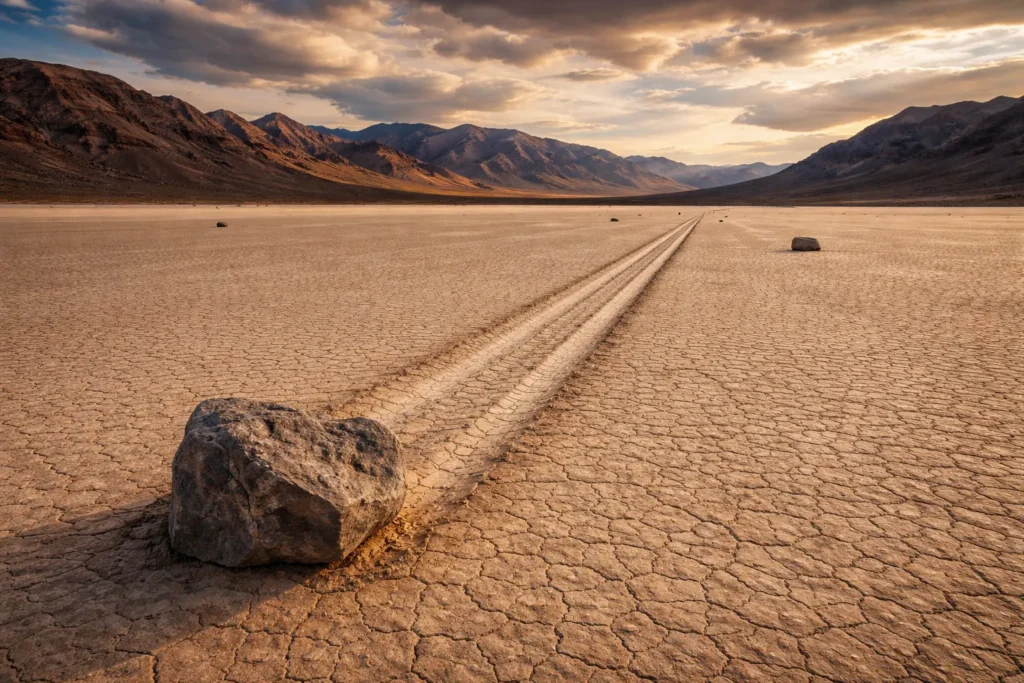
A white, flat expanse stretches before you, perfectly level, reaching toward distant peaks that shimmer in the heat. It is three miles long and two miles wide, a giant oval of cracked clay that looks like a dried-up seabed. This is the Racetrack Playa.
At first glance, it appears empty. Just a dead, white plain under a relentless sun. But as you step onto its hard surface, you begin to see them. Scattered across the playa, like toys left behind by a giant child, are rocks. Dozens of them. Hundreds. They range in size from small stones that fit in your palm to massive boulders that would take several people to lift.
And behind each rock, trailing away across the white surface, is a groove. A furrow carved into the hard mud. Some are short, just a few feet long. Others stretch for a quarter of a mile, straight as an arrow. Some curve gently. Others take sharp, sudden turns, as if the rock changed its mind mid-journey.
You look around. There is no one else here. There are no tire tracks, no footprints, no signs that anything has disturbed this place in years. The rocks simply sit at the end of their trails, silent and still, as if they have been waiting for you to arrive.
How did they get there? How did they carve those trails? And why do the trails look like the rocks were pushed, pulled, or sailed across the playa by some invisible hand?
For nearly a century, this was one of the greatest unsolved mysteries in the natural world. The sailing stones—sometimes called sliding rocks or moving rocks—defied explanation. They attracted the attention of geologists, physicists, and amateur sleuths. They inspired wild theories involving aliens, magnets, and secret government experiments. They became a legend, whispered about by desert explorers and featured in documentaries and books.
And then, finally, after decades of waiting, science caught up with the mystery. The answer was not magic. It was something far more fascinating: a rare, delicate recipe of water, ice, wind, and sunshine that comes together in a precise sequence, transforming a flat, dry lakebed into a temporary skating rink where rocks glide like ships.
This is the story of those rocks. It is a story about the patience of scientists, the hidden power of water in the driest place on the continent, and the slow, silent movement of nature when no one is watching.
The Geography of Extremes
To understand the sailing stones, you must first understand the world they inhabit. Death Valley is not a place that welcomes visitors. It is a place that tolerates them, if they come prepared.
Death Valley is a graben—a massive block of the Earth’s crust that dropped down between two mountain ranges millions of years ago. The valley floor is a long, narrow trough that sits below sea level for much of its length. The lowest point, Badwater Basin, is 282 feet below sea level, the lowest elevation in North America. The mountains that surround it rise to over 11,000 feet, creating a dramatic, almost theatrical landscape of contrasts.
This geological setting creates extreme weather. The valley is a rain shadow desert. Moist air from the Pacific Ocean rises over the Sierra Nevada mountains to the west, cools, and drops its moisture as rain or snow. By the time the air reaches Death Valley, it is bone dry. It then descends into the valley, compressing and heating up as it goes. This is why Death Valley holds the record for the highest air temperature ever recorded: 134 degrees Fahrenheit on July 10, 1913. In the summer, temperatures regularly exceed 120 degrees.
But Death Valley is not always hot. In the winter, temperatures can drop below freezing. The combination of high daytime temperatures and low nighttime temperatures is a hallmark of desert climates, and it plays a crucial role in the movement of the sailing stones.
The valley is also one of the driest places on Earth. The average annual rainfall is less than two inches. Some years, no rain falls at all. When rain does come, it often comes in the form of sudden, violent thunderstorms that can cause flash floods, scouring the canyons and sending torrents of water across the valley floor.
It is in this land of extremes that the Racetrack Playa sits. The playa is a dry lakebed, formed when water from winter storms collects in a low basin and then slowly evaporates, leaving behind a flat, hard surface of silt and clay. The Racetrack is not the only playa in Death Valley, but it is the most famous. Its remote location, its perfect flatness, and its population of moving rocks have made it a destination for scientists and adventurers from around the world.
The Naming of the Place
The name “Racetrack” is fitting. The playa looks like a giant track, a flat oval where something races. But the name did not come from the rocks. It came from the prospectors and miners who worked in the area in the late 1800s and early 1900s. They used the playa as a shortcut, a smooth, flat surface that allowed them to travel quickly across the valley. They called it the Racetrack because it was a place where you could let your horses run.
The name “sailing stones” came later. It was coined by journalists and writers who were captivated by the idea of rocks that moved across the desert like ships across the sea. The term evokes a sense of grace and mystery, which is fitting for a phenomenon that seemed to defy explanation.
The rocks themselves do not have official names, though some visitors have given them nicknames. There is “Karen,” a massive boulder that weighs over 700 pounds and has one of the longest trails on the playa. There is “The Wanderer,” a rock that has moved in a complex zigzag pattern over the years. There is “The Twins,” two rocks that moved side by side for a distance before diverging.
These informal names reflect the human tendency to anthropomorphize the natural world. We see the rocks as characters, as travelers on a journey. And in a way, they are. Their trails are a record of their movements, a diary written in the mud.
Part II: The First Witnesses
The Prospectors and the Pioneers
The first people to see the sailing stones were not scientists. They were prospectors, miners, and settlers who ventured into Death Valley in search of fortune or a new life. The valley was a notoriously difficult place to survive. The heat was brutal, the water was scarce, and the terrain was unforgiving. But there was wealth to be found—gold, silver, copper, and borax.
Borax was particularly important. In the 1880s, a miner named Aaron Winters discovered a large deposit of borax near Furnace Creek. Borax was used in soap, ceramics, and as a preservative. The discovery sparked a mining boom that brought hundreds of people into the valley. The famous “Twenty Mule Teams” were used to haul borax out of the valley, and their wagons left deep ruts that can still be seen today.
It was during this period that the first written accounts of the moving rocks appeared. In 1915, a prospector named Joseph Crook wrote an article for a mining journal describing his travels in the valley. He mentioned a strange lakebed where rocks seemed to move on their own. “The tracks were as plain as if the rocks had been dragged by the devil himself,” he wrote. “But there were no footprints, no marks of any kind, except the tracks of the rocks.”
Crook’s account was largely ignored. At the time, Death Valley was still a remote, little-known place. The idea of moving rocks seemed like the rambling of a prospector who had spent too long in the sun.
But other accounts followed. In the 1920s, a park ranger named George Palmer reported seeing the trails and speculated that the rocks might be moved by wind. He noted that the trails always seemed to point in the direction of the prevailing wind, which suggested that wind was involved. But he could not explain how the wind could move rocks that weighed hundreds of pounds.
In the 1930s, a geologist named James H. C. Martens visited the Racetrack and made detailed observations. He measured the trails, sketched their patterns, and noted the positions of the rocks. He was the first to suggest that the rocks might be moved by ice, but he lacked the evidence to prove it. His notes, stored in the archives of the U.S. Geological Survey, would later prove valuable to researchers.
The McCurdy Years
The first person to seriously study the sailing stones was a park naturalist named F. E. “Doc” McCurdy. McCurdy was a colorful character, a former cowboy and trapper who had worked in Death Valley for decades. He knew the valley better than almost anyone, and he had a deep curiosity about its natural features.
In the 1940s, McCurdy began documenting the rocks on the Racetrack. He took photographs, made measurements, and kept detailed records of their positions. He noticed that the rocks moved between his visits. A rock that was in one location in the spring might be in a different location in the fall. The trails were fresh, indicating recent movement.
McCurdy was convinced that wind was the primary force. He pointed to the fact that the Racetrack is located at the mouth of a canyon that funnels wind into the playa. He had seen winds in the valley strong enough to knock a man off his feet. If those winds could push a man, why could they not push a rock?
But McCurdy also noticed something puzzling. The trails were not all aligned with the prevailing wind direction. Some trails went in directions that seemed to defy the wind patterns. This suggested that something else was at play.
McCurdy’s work brought the sailing stones to the attention of the scientific community. In 1952, he published an article in a park newsletter describing the phenomenon. The article was picked up by newspapers and magazines, and soon, the sailing stones were being talked about across the country.
The USGS Investigation
The first systematic scientific study of the Racetrack was conducted in 1952 by a team from the U.S. Geological Survey. The team was led by geologist Jim McAllister, and they spent several months mapping the playa, measuring the rocks, and analyzing the trails.
McAllister’s team made several important discoveries. First, they confirmed that the rocks were indeed moving. By comparing old photographs with current conditions, they showed that rocks had shifted positions over time. Second, they noted that the rocks moved only during the winter months, suggesting that cold temperatures were a factor. Third, they observed that the playa was sometimes covered with a thin layer of water in the winter, which could freeze into ice.
McAllister’s team proposed a theory: during winter rains, the playa became wet and slippery. Strong winds, funneled through the canyons, pushed the rocks across the slick surface. It was a logical theory, and it gained widespread acceptance.
But there was a problem. When the team calculated the force required to move the largest rocks, they found that it would take wind speeds of over 500 miles per hour to overcome the friction of the mud. Such winds do not exist on Earth. Even the strongest winds in Death Valley, which can gust up to 70 miles per hour, would not be enough to move a 700-pound boulder across wet clay.
McAllister acknowledged the problem in his report. He suggested that perhaps the rocks were moved by a combination of wind and water, but he could not explain the physics. The mystery remained unsolved.
Part III: A Century of Theories
The Wind-Only Theory
The wind-only theory was the earliest and most persistent explanation for the moving rocks. It had a certain intuitive appeal. Anyone who has stood in a desert wind knows how powerful it can be. The wind can sandblast rocks, carve canyons, and move dunes. Why could it not move a few boulders?
Supporters of the wind-only theory pointed to the fact that the Racetrack sits at the mouth of a canyon that acts as a natural wind tunnel. The mountains on either side funnel the wind, increasing its speed and focusing it on the playa. Winds in the valley have been measured at over 70 miles per hour, and gusts can be even higher.
The theory also had the advantage of simplicity. It did not require any exotic mechanisms—just wind and a wet, slippery surface. For decades, it was the default explanation taught in schools and mentioned in guidebooks.
But the wind-only theory could not explain the movement of the largest rocks. Even on a wet surface, friction is a formidable force. A 700-pound rock has a lot of inertia. To get it moving, you need a sustained force that is greater than the friction holding it in place. A gust of wind might provide a brief push, but it would not be enough to overcome the rock’s inertia. The rock would need to be pushed continuously for several minutes to get it moving, and even then, it would stop as soon as the wind died down.
Geologists who calculated the forces involved concluded that wind alone could not account for the movement of the heaviest rocks. Some rocks would require wind speeds of over 500 miles per hour to move them—a speed that is physically impossible on Earth.
The wind-only theory also could not explain the sharp turns in some trails. If the wind was pushing the rocks, the trails would all point in the same direction. But the trails on the Racetrack point in many different directions, sometimes even crossing each other. This suggested that the rocks were not simply being blown by the wind.
The Dust Devil Theory
In the 1970s, a new theory emerged: dust devils. Dust devils are small, spinning columns of air that form on hot days when the ground heats up and the air above it becomes unstable. They are common in deserts and can range in size from a few feet to several hundred feet across. Most dust devils are harmless, but some can be strong enough to lift small rocks and even overturn vehicles.
Proponents of the dust devil theory suggested that these spinning columns of air could lift the rocks and carry them across the playa, leaving trails behind. The theory was appealing because it explained how heavy rocks could move without requiring hurricane-force winds. A dust devil could concentrate its force on a small area, creating enough lift to move a rock.
But there were problems with the dust devil theory. First, dust devils are usually short-lived. They form, spin for a few minutes, and then dissipate. The trails on the Racetrack are often hundreds of feet long, suggesting sustained movement over a period of hours. A dust devil could not push a rock that far.
Second, dust devils spin. If a dust devil was moving a rock, you would expect the trail to be curved or circular. But many of the trails on the Racetrack are perfectly straight. A spinning column of air would not produce a straight line.
Third, dust devils are most common in the summer, when the ground is hottest. But the rocks on the Racetrack move in the winter, when the ground is cold. The timing did not match.
The dust devil theory was largely abandoned by the 1980s, though it still appears occasionally in popular articles about the sailing stones.
The Algae Slick Theory
In the 1970s, a pair of geologists named Robert Sharp and Dwight Carey proposed a new theory: algae. Sharp and Carey were professors at the California Institute of Technology, and they conducted a long-term study of the Racetrack in the 1970s and 1980s.
Sharp and Carey observed that the playa sometimes developed a thin film of algae after rain. The algae, they theorized, could make the surface incredibly slippery, reducing friction and allowing the wind to push the rocks. They conducted experiments where they placed rocks on the playa and tried to push them. They found that when the surface was dry, the rocks were difficult to move. But when the surface was wet and coated with algae, the rocks slid more easily.
The algae slick theory was an improvement over the wind-only theory because it explained how friction could be reduced. But it still did not explain how the heaviest rocks moved. Sharp and Carey’s own experiments showed that wind alone was not enough to move the largest rocks, even on a slick surface.
Sharp and Carey also observed ice on the playa. They noted that during the winter, water on the playa could freeze into thin sheets of ice. They speculated that the ice might play a role in moving the rocks, but they did not develop the idea fully.
Their study, which lasted from 1968 to 1975, was the most comprehensive investigation of the Racetrack to that point. They mapped the positions of over 100 rocks, measured their movements, and documented the conditions under which movement occurred. Their data would prove invaluable to later researchers.
The Ice Raft Theory
The ice raft theory was first proposed in the 1950s by a geologist named George Stanley. Stanley noticed that the trails on the Racetrack often had raised edges, like the tracks left by a boat being dragged across a muddy bottom. He suggested that the rocks might be moved by floating sheets of ice.
The idea was simple. During the winter, the playa floods with a shallow layer of water. When the temperature drops, the water freezes into a thin sheet of ice. When the ice melts, it cracks into large, floating panels. The wind pushes these panels across the water, and the panels push the rocks, which are partially submerged in the mud below. The ice acts as a sail, and the rock acts as a hull.
The ice raft theory was elegant because it explained several key features of the phenomenon. It explained how heavy rocks could move with relatively light winds—the ice reduced friction, and the water buoyed the rocks slightly. It explained why the trails were often straight—the ice panels were stable and moved in a consistent direction. It explained why the rocks moved in the winter—the only time ice could form. And it explained the raised edges on the trails—the rock was being dragged through mud, leaving a berm on either side.
But for decades, the ice raft theory was just a theory. No one had ever seen it happen. Without direct observation, it remained a hypothesis, one among many.
The Prankster Theory
As with any good mystery, there were those who believed it was all a hoax. The prankster theory suggested that human beings were moving the rocks, either for fun or for attention. Perhaps a group of pranksters was dragging the rocks with ropes or chains, creating the trails to fool visitors. Perhaps the park rangers were in on it, using the mystery to attract tourists.
The prankster theory had some surface plausibility. The trails on the Racetrack are indeed remarkable, and it is not hard to imagine someone wanting to create them as a joke. But there were several problems with the theory.
First, the Racetrack is incredibly remote. Getting there requires a long, rough drive, and the playa is often inaccessible in the winter when the rocks move. It would take a dedicated group of pranksters to haul heavy rocks across the playa, and they would have to do it repeatedly over many years to account for all the trails.
Second, the rocks are heavy. The largest rocks weigh hundreds of pounds. Moving them would require machinery, and the tracks of that machinery would be visible on the playa. But there are no tire tracks or footprints near the rocks. The surface around the rocks is undisturbed.
Third, the rocks have been moving for decades. The first written accounts of the trails date back to 1915. If it was a prank, it would have to be a prank that has been ongoing for over a century, involving multiple generations of pranksters. That strains credulity.
Fourth, the rocks themselves show evidence of natural movement. Many of them have a flat side on the bottom, worn smooth by years of sliding across the mud. This is exactly what you would expect from natural movement, not from being dragged by a rope.
The prankster theory was largely dismissed by scientists, but it continued to circulate in popular culture. Some visitors to the Racetrack still joke that the rocks are moved by aliens or the government.
The Magnetic Field Theory
One of the more exotic theories suggested that the rocks were moved by magnetic fields. The idea was that the rocks contain iron, and that the Earth’s magnetic field, perhaps combined with magnetic anomalies in the surrounding mountains, could pull the rocks across the playa.
The magnetic field theory was popular among a small group of amateur scientists in the 1970s and 1980s. They pointed to the fact that some of the trails seemed to align with magnetic north, suggesting that the rocks were being pulled in that direction.
But the theory had serious problems. First, the Earth’s magnetic field is incredibly weak. It is strong enough to move a compass needle, but it is not strong enough to move a 700-pound rock. You would need a magnetic field thousands of times stronger to have any effect.
Second, the rocks on the Racetrack are mostly dolomite, which is not strongly magnetic. Dolomite contains very little iron, and what iron it does contain is not in a form that would respond to a magnetic field.
Third, the trails on the Racetrack do not consistently align with magnetic north. Some do, but many do not. If the magnetic field was pulling the rocks, you would expect all the trails to point in the same direction. They do not.
The magnetic field theory was quickly dismissed by geologists, but it continues to appear in fringe publications and websites.
Part IV: The Geology Beneath Your Feet
What Is a Playa?
To understand the sailing stones, you need to understand the ground they move on. The Racetrack is a playa, a term that comes from the Spanish word for “beach.” A playa is a dry lakebed, a flat expanse of clay and silt that forms when water collects in a low basin and then evaporates.
Playas are common in deserts around the world. They form in closed basins—areas where water cannot drain to the ocean. When rain falls, it flows downhill and collects in these basins. If the basin has no outlet, the water stays there until it evaporates. Over time, the repeated cycles of flooding and evaporation deposit layers of fine sediment, creating a flat, hard surface.
The Racetrack playa is about three miles long and two miles wide. Its surface is remarkably flat, with a slope of only about 0.1 degrees. This means that over the entire length of the playa, the elevation changes by only a few feet. For comparison, a typical parking lot has a slope of about 1 degree. The Racetrack is flatter than a parking lot.
This flatness is crucial to the movement of the rocks. If the playa had a significant slope, the rocks would roll downhill. But they do not. They move horizontally, pushed by external forces.
The surface of the playa is composed of a fine, clay-rich sediment that expands when wet and contracts when dry. This expansion and contraction create the polygonal cracks that cover the playa. These cracks can be several inches wide and several feet deep. They are a distinctive feature of playas and are often used to identify them from a distance.
The Mud Cracks
The polygonal cracks on the Racetrack are a natural work of art. They form a honeycomb pattern that covers the entire playa, creating a surface that looks like a giant jigsaw puzzle. The cracks form when the playa dries out. As the water evaporates, the clay shrinks, pulling apart into separate polygons. The cracks are the boundaries between these polygons.
The cracks are important for the movement of the rocks for several reasons. First, they create a textured surface that can affect how rocks slide. A rock moving across the playa will encounter the cracks, which can act as small bumps or channels. This can influence the direction of movement.
Second, the cracks fill with water when the playa floods. This creates a network of tiny channels that can affect the flow of water and ice. The cracks can also trap ice panels, preventing them from moving freely.
Third, the cracks can preserve evidence of past movement. When a rock slides over a crack, it can leave a distinctive mark, showing that the movement occurred after the crack formed. By studying these relationships, geologists can determine the relative timing of movement events.
The Grandstand
At the north end of the Racetrack playa is a massive outcrop of rock known as the Grandstand. The Grandstand is composed of dolomite, a hard, durable rock that is resistant to erosion. It rises about 50 feet above the playa, a dark, jagged island in a sea of white mud.
The Grandstand is the source of almost all the rocks on the playa. Over millennia, erosion has caused chunks of dolomite to break off from the Grandstand and fall onto the playa. These chunks range in size from small pebbles to massive boulders. Some of the boulders weigh over 700 pounds.
The Grandstand is a popular destination for visitors to the Racetrack. It is one of the few places on the playa where you can find solid rock and shade. From the top of the Grandstand, you can see the entire playa spread out below you—a vast, white canvas dotted with rocks and their trails. It is a breathtaking view that gives you a sense of the scale of the phenomenon.
The Grandstand also has its own history. It was once a small island in a ancient lake that covered the valley. The lake, called Lake Manly, existed during the last ice age, when the climate was cooler and wetter. As the lake evaporated, it left behind the flat, sediment-covered playa that we see today. The Grandstand is a remnant of the ancient landscape, a window into the past.
The Rocks Themselves
The rocks on the Racetrack are not all the same. They vary in size, shape, and composition. Most are dolomite, a carbonate rock similar to limestone. Dolomite is hard and resistant to weathering, which is why the rocks have survived for so long on the playa.
The rocks also vary in shape. Some are roughly spherical. Others are flat on one side. Some are jagged, with sharp edges. The shape of a rock can affect how it moves. Flat-bottomed rocks tend to move more easily because they have a larger surface area in contact with the mud, which distributes the force of the ice panel more evenly. Round rocks tend to roll rather than slide, which can create different types of trails.
The size of the rock is also important. Small rocks move more easily than large rocks, but they also leave shorter trails. The largest rocks move less frequently, but when they do move, they leave the most impressive trails. The famous “Karen” boulder, which weighs over 700 pounds, has a trail that is over 1,000 feet long.
The rocks also change over time. As they slide across the playa, they grind against the mud, which is made of fine clay particles. This acts like sandpaper, wearing down the bottom of the rock. Over many movements, the bottom of the rock becomes smooth and flat. This is one of the pieces of evidence that the rocks are moving naturally, not being dragged by humans.
Part V: The Norris Expedition
The Cousins
In the early 2000s, the mystery of the sailing stones was still unsolved. The ice raft theory was the leading hypothesis, but it had never been observed. Scientists knew that the rocks moved in the winter, but no one had ever been there at the exact moment to see it happen.
Enter Richard Norris and James Norris. Richard was a paleobiologist at the Scripps Institution of Oceanography, a man who had spent his career studying slow, invisible processes in the natural world. James was an engineer, a man who understood how to design and build instruments that could withstand harsh conditions. They were cousins who shared a passion for the desert and a determination to solve the puzzle.
The Norris cousins were not the first to try to catch the rocks in the act. Previous researchers had attempted to set up cameras and sensors, but they had been thwarted by the harsh conditions. The Racetrack is remote, with no electricity, no cell service, and no easy access. The winter storms that create the conditions for movement also make it nearly impossible to be on the playa.
But the Norris cousins had a new tool: GPS technology. In the early 2000s, GPS units had become small, affordable, and accurate enough to track the movement of rocks. The plan was simple: attach GPS units to a selection of rocks, set up a weather station to record conditions, and wait. When a rock moved, the GPS unit would record the exact time and location of the movement. The weather station would record the temperature, wind speed, and other conditions at that time.
It was a bold plan. The GPS units had to be waterproof, shockproof, and able to operate in freezing temperatures. They had to be powered by batteries that could last for months. And they had to be attached to the rocks in a way that would not interfere with the movement.
The Setup
In 2011, the Norris cousins began their experiment. They selected 15 rocks on the Racetrack that looked like typical sailing stones. They attached custom-built GPS units to each rock, housing them in waterproof cases and anchoring them with brackets that were bolted into the rock. They also set up a weather station on the playa with sensors to measure temperature, wind speed, and solar radiation.
Finally, they installed a high-definition camera on a nearby mountain slope, overlooking the playa. The camera was programmed to take a photograph every hour, capturing any movement that might occur.
The setup was not easy. The Racetrack is a long, rough drive from the nearest paved road, and the Norris cousins had to haul all their equipment in by truck. They had to drill holes in the rocks to attach the brackets, a process that took hours. They had to calibrate the GPS units and ensure that they were recording correctly. And they had to do it all in the harsh desert environment, with temperatures that could swing from freezing to over 100 degrees.
When they were finished, they left. There was nothing more to do but wait.
The Waiting
For over a year, nothing happened. The GPS units recorded no movement. The weather station recorded rain and wind, but never the precise combination needed for movement. The camera captured thousands of images of an empty, still playa.
The Norris cousins returned to the Racetrack periodically to check on their equipment. They replaced batteries, downloaded data, and made sure everything was still working. Each time, they saw the same thing: rocks that had not moved.
It was a test of patience. The Norris cousins had invested years of work in the experiment, and so far, it had yielded nothing. But they believed that the right conditions would eventually come. They just had to wait.
The Breakthrough
The breakthrough came in December 2013. The Norris cousins had been monitoring weather forecasts obsessively. They saw that a winter storm was moving into the Death Valley area, bringing a rare combination of rain and freezing temperatures. They made the long drive to the Racetrack to check their equipment.
The playa was wet. A thin layer of water covered the surface, reflecting the gray sky. The temperature was hovering around freezing. The rocks were still, but the conditions were right for movement.
The Norris cousins did not stay. The playa was too wet to walk on without leaving footprints, and they did not want to disturb the experiment. They checked their equipment, made sure the camera was working, and left.
A few weeks later, back at his office at Scripps, Richard Norris sat down to review the data. He pulled up the photographs from the time-lapse camera, scrolling through thousands of images. He expected to see nothing. He had seen nothing for over a year.
But then, he stopped scrolling.
There, on his screen, was an image of the Racetrack covered in a thin layer of water. The water had frozen overnight into a sheet of clear, glassy ice. As the sun rose, the ice had begun to crack and break apart into large, floating panels. And there, in the middle of the frame, were the rocks. They were moving.
It was not a fast movement. It was a slow, almost imperceptible drift. But it was unmistakable. The ice panels, driven by a gentle wind of only 10 to 15 miles per hour, were pushing the rocks across the shallow water. The rocks were sailing.
Norris stared at the image for a long time. He had spent years waiting for this moment. He called his cousin James, and together, they reviewed the rest of the data. The GPS units confirmed what the photographs showed: the rocks had moved up to 200 feet during a single event, and they had moved exactly when the ice panels were present.
The mystery of the sailing stones was solved. The answer was ice.
The Reaction
The news of the discovery spread quickly. The Norris cousins published their findings in the journal PLOS ONE in 2014, and the story was picked up by major news outlets around the world. Headlines announced that the mystery of the sailing stones had finally been solved.
The reaction from the scientific community was one of excitement and validation. The ice raft theory, which had been proposed decades earlier, was finally proven correct. The Norris cousins had done what generations of researchers had failed to do: they had caught the rocks in the act.
For the public, the discovery was a mix of satisfaction and disappointment. It was satisfying to finally have an answer to a long-standing mystery. But there was also a tinge of disappointment that the answer was so mundane. No aliens. No magnets. No secret government experiments. Just ice and wind.
But as Richard Norris pointed out in interviews, the mundane answer was actually more remarkable than any of the wild theories. The fact that a gentle breeze and a thin sheet of ice could move a 700-pound boulder was a testament to the subtle power of nature. It was a reminder that the most extraordinary phenomena often have the simplest explanations.
Part VI: The Physics of a Moving Rock
The Recipe
The movement of a sailing stone is not a simple event. It is a cascade of conditions that must occur in a specific order. It is a rare alignment of water, temperature, wind, and sunlight. Here is the recipe, step by step.
Step 1: Rain
The process begins with rain. In the winter, storms from the Pacific Ocean sweep across California and drop rain and snow on the mountains surrounding Death Valley. This water flows down the canyons and collects on the Racetrack Playa. Because the playa is so flat, the water does not drain away. It pools, creating a shallow lake that is usually only a few inches deep. This lake can cover the entire playa, turning the cracked, dry surface into a mirror-like expanse.
Step 2: Freezing
At night, the temperature in the desert drops dramatically. In the winter, it can fall well below freezing. The thin layer of water on the playa begins to freeze. But it does not freeze into a solid block. Because the water is shallow, it freezes into a thin sheet of ice, sometimes called “windowpane ice” because it is clear and fragile. This ice sheet covers the playa like a giant, delicate lid.
Step 3: The Break-Up
This is the most critical step. When the sun rises, the ice begins to melt. But because the ice is floating on water, it melts unevenly. The top surface melts faster than the bottom, and the edges melt faster than the center. This causes the ice sheet to crack into large, floating panels. These panels can be dozens of feet across, but they are only a fraction of an inch thick. They are essentially natural rafts of ice, floating freely on the water below.
Step 4: The Wind
Now, the wind enters the picture. Even a light breeze—10 to 15 miles per hour—is enough to push these large ice panels across the water. As the panels drift, they encounter rocks that are partially submerged in the mud at the bottom of the shallow lake. The ice panel pushes against the rock. Because the rock is surrounded by water and mud, the friction is dramatically reduced. The rock is no longer a heavy boulder stuck in dry clay; it is a heavy boulder floating in a lubricated environment.
Step 5: The Sail
The ice panel acts like a sail, and the rock acts like a hull. The wind pushes the ice, which pushes the rock, which slides across the muddy bottom, carving a trail as it goes. The rock moves slowly—about 10 to 15 feet per minute—but it can move for hours, covering hundreds of feet.
Step 6: The Stop
The movement continues until one of three things happens. First, the ice panel might melt completely, losing its ability to push the rock. Second, the water might evaporate, leaving the rock stranded on dry land. Third, the rock might encounter an obstacle—a bump in the playa, a larger rock, or the edge of the water—that stops its progress. When the rock stops, the trail dries and hardens, preserving the evidence of the journey.
The Role of Friction
Friction is the force that resists movement between two surfaces. In the case of the sailing stones, friction is the main obstacle that must be overcome. A rock sitting on dry clay has a high coefficient of friction. It takes a lot of force to get it moving.
But when the playa is wet, the friction is reduced. Water acts as a lubricant, allowing the rock to slide more easily. When the water is deep enough to float the rock partially, the friction is reduced even further. The rock becomes buoyant, meaning that the force of gravity pressing it into the mud is reduced.
The ice panel further reduces friction by providing a large, flat surface that distributes the force of the wind evenly across the rock. Instead of the wind pushing directly on the rock—which would only affect a small area—the ice panel pushes on the entire side of the rock, creating a more efficient transfer of force.
This combination of water lubrication and ice panel force is what allows a gentle breeze to move a massive boulder. It is a perfect example of how nature uses simple physics to achieve remarkable results.
The Role of Buoyancy
Buoyancy is the force that makes things float. When an object is placed in water, the water pushes up on it with a force equal to the weight of the water it displaces. If the object is less dense than water, it floats. If it is more dense, it sinks.
Rocks are much denser than water, so they do not float. But when they are partially submerged, the water pushes up on them, reducing their effective weight. A 700-pound rock submerged in a few inches of water might only weigh 600 pounds. That is still a lot of weight, but it is less than before. The reduction in weight means less friction, which means less force is needed to move the rock.
The ice panels, by contrast, do float. Ice is less dense than water, so it floats on the surface. This is why the ice panels can be pushed by the wind—they are not stuck to the bottom. They are free to drift.
The interaction between the floating ice panel and the partially submerged rock is the key to the movement. The ice panel pushes against the rock above the waterline, while the rock is held in place by friction and gravity below the waterline. When the force of the ice panel exceeds the friction, the rock slides.
The Role of Wind
The wind on the Racetrack is not just any wind. It is shaped by the surrounding mountains, which funnel it into the playa and increase its speed. The prevailing wind direction is from the north, but the wind can come from any direction depending on the weather patterns.
The wind speed required to move the rocks is surprisingly low. The Norris cousins recorded movement during winds of only 10 to 15 miles per hour. That is a gentle breeze, not a gale. The reason the wind does not need to be stronger is that the ice panels are so large and the friction is so low. The ice panels act like sails, catching the wind and converting it into a pushing force.
The wind does not push the rocks directly. It pushes the ice panels, and the ice panels push the rocks. This is a crucial distinction. If the wind were pushing the rocks directly, it would need to be much stronger to overcome the friction. But because the ice panels are large and flat, they are much more efficient at catching the wind.
The Role of Temperature
Temperature is the trigger for the entire process. The rocks only move when the temperature is cold enough to freeze the water on the playa, but not so cold that the ice remains solid. The ideal temperature range is around freezing—32 degrees Fahrenheit—with fluctuations that cause the ice to freeze and then melt.
If the temperature stays below freezing for too long, the ice becomes thick and solid. Thick ice does not break into floating panels. Instead, it forms a solid sheet that is anchored to the playa. The wind cannot push this solid sheet, and the rocks do not move.
If the temperature stays above freezing, the water does not freeze at all. There is no ice, and the rocks do not move.
The movement occurs during the narrow window when the temperature fluctuates around freezing—cold enough at night to freeze the water, but warm enough during the day to melt the ice and create the floating panels. This is why the rocks move in the winter, and why they move only during specific weather events.
Part VII: The Trails
The Language of the Trails
The trails left by the sailing stones are a form of natural writing. They tell the story of each rock’s journey—the direction it moved, the speed, the obstacles it encountered, and the forces that pushed it. A trained eye can read these trails like a book.
The length of the trail tells you how far the rock moved. Some trails are only a few feet long, suggesting that the rock moved for only a short time before stopping. Others are hundreds of feet long, suggesting a long, sustained movement event.
The width of the trail tells you about the size of the rock. A wide trail was made by a large rock. A narrow trail was made by a small rock.
The depth of the trail tells you about the condition of the playa when the rock moved. A deep trail was carved when the mud was soft and wet. A shallow trail was carved when the mud was harder.
The shape of the trail tells you about the forces that pushed the rock. A straight trail was made when the ice panel was stable and the wind was steady. A curved trail was made when the ice panel rotated or the wind changed direction. A trail with a sharp turn was made when the rock was caught by a new ice panel moving in a different direction.
The edges of the trail tell you about the rock itself. A trail with raised edges, like a berm, was made by a rock that was being dragged through the mud. A trail with smooth edges was made by a rock that was sliding more easily.
Straight Trails
The straight trails on the Racetrack are among the most striking. They look like they were drawn with a ruler, perfectly aligned for hundreds of feet. These trails are evidence of stable ice panels and steady winds.
When the ice panel is large and flat, and the wind is blowing from a consistent direction, the rock will move in a straight line. The ice panel acts like a steady paddle, pushing the rock forward without deviation. The rock follows the path of least resistance, which is straight ahead.
Straight trails are also evidence that the playa surface was relatively smooth when the rock moved. If the playa had large cracks or bumps, the rock would have been deflected. A straight trail tells you that the rock encountered no significant obstacles.
Curved Trails
Curved trails are more common than straight trails on the Racetrack. They range from gentle arcs to tight spirals. Curved trails are evidence of rotating ice panels.
As the ice melts, the panel can change shape. It can shrink, rotate, or break apart. If the panel begins to rotate, it will push the rock in a curve. The tighter the curve, the faster the panel was rotating.
Curved trails can also be caused by changes in wind direction. If the wind shifts, the ice panel will change direction, dragging the rock with it. This can create a smooth arc, with the rock gradually turning in response to the changing wind.
Sharp Turns
Some of the most dramatic trails on the Racetrack have sharp, sudden turns. A rock will move in one direction for a hundred feet, then make a 90-degree turn and continue in a new direction. These sharp turns are evidence of the rock being caught by a new ice panel.
When the ice panel that is pushing a rock melts or breaks apart, the rock may stop moving. If a new ice panel drifts into the rock, it can start pushing it in a new direction. This can create a sharp turn, with the rock changing course abruptly.
Sharp turns can also be caused by the rock encountering an obstacle. If a rock hits a crack or a bump, it may be deflected. But the most common cause is a change in the ice panel.
Crossed Trails
On some parts of the Racetrack, trails cross each other. One trail will go in one direction, and another trail will cut across it at an angle. Crossed trails tell you that the rocks moved at different times.
When a trail crosses another trail, the newer trail will be fresh and sharp, while the older trail will be weathered and faded. By looking at the crosscut relationships, geologists can determine the relative order of movement events.
Crossed trails also tell you that the rocks moved in different directions. This is evidence that the wind direction can vary from one movement event to the next. A rock that moved during one storm might have been pushed by wind from the north, while a rock that moved during a later storm might have been pushed by wind from the east.
The Longest Trail
The longest trail on the Racetrack belongs to a rock that has been nicknamed “The Traveler.” This trail is over 1,500 feet long, stretching from near the Grandstand to the southern end of the playa. The trail is straight for most of its length, with a slight curve near the end.
The Traveler is a medium-sized rock, weighing about 100 pounds. It has moved multiple times over the years, each time adding to its trail. The trail is a record of decades of movement, a slow, steady journey across the playa.
No one knows how old the Traveler’s trail is. It could be 50 years old, or it could be 100 years old. The trail has been preserved by the dry conditions on the playa, which slow erosion. It is a testament to the patience of nature.
Part VIII: The Human Element
The Scientists
The story of the sailing stones is also the story of the scientists who dedicated their careers to solving the mystery. Men and women who spent years in the desert, measuring rocks, analyzing data, and waiting for the conditions to be right.
Jim McAllister, who led the first systematic study in the 1950s, was a geologist with the U.S. Geological Survey. He was a quiet, patient man who believed in letting the data speak for itself. His work laid the foundation for all future research on the Racetrack.
Robert Sharp and Dwight Carey, who conducted the long-term study in the 1970s and 1980s, were professors at the California Institute of Technology. Sharp was a legendary geologist who had studied glaciers, deserts, and planetary surfaces. Carey was a meticulous field researcher who spent countless hours on the Racetrack, measuring rocks and mapping trails. Their study, which lasted seven years, was the most comprehensive investigation of the Racetrack until the Norris cousins’ experiment.
Richard and James Norris, who finally caught the rocks in the act, were not professional geologists. Richard was a paleobiologist, a scientist who studies ancient life. James was an engineer. They were cousins who shared a passion for the desert and a determination to solve the puzzle. Their success was a testament to the power of persistence and the value of interdisciplinary collaboration.
The Visitors
Every year, thousands of visitors make the long, rough drive to the Racetrack. They come from all over the world to see the sailing stones, to walk on the white playa, and to marvel at the trails. For many, it is a pilgrimage—a journey to one of the most remote and mysterious places on Earth.
Visitors to the Racetrack often describe a sense of awe and wonder. The silence is profound. The landscape is alien. The rocks and their trails seem to tell a story that is both ancient and immediate. It is a place that stays with you long after you leave.
Some visitors leave their own mark on the Racetrack. Unfortunately, some have moved rocks, taken them as souvenirs, or driven on the playa, leaving tire tracks that take years to fade. The National Park Service works hard to educate visitors about the importance of protecting the area, and most visitors respect the rules.
But the Racetrack is a fragile place. The trails are easily destroyed by footprints and tire tracks. The rocks are easily disturbed. The park service asks visitors to stay on designated roads, to walk carefully on the playa, and to leave the rocks where they are.
The Artists and Writers
The sailing stones have inspired artists and writers for decades. The image of a rock with a long trail behind it is a powerful metaphor—for journey, for mystery, for the unseen forces that shape our lives.
The poet Gary Snyder wrote about the Racetrack in his collection “Mountains and Rivers Without End.” He described the rocks as “sailing stones” that “leave their tracks in the mud.” His poem captures the sense of wonder and mystery that surrounds the phenomenon.
The photographer Ansel Adams never photographed the Racetrack, but other photographers have. The stark, monochromatic landscape of the playa is a natural subject for black-and-white photography. The contrast between the white surface and the dark rocks creates dramatic images.
The writer John McPhee visited the Racetrack for his book “Assembling California,” a geological history of the state. He described the rocks as “a mystery that seems to have been designed for the sole purpose of being a mystery.” His writing brought the sailing stones to a wider audience.
Part IX: The Philosophy of Rocks
What Is a Rock?
We think of rocks as inert, unchanging objects. They are the solid foundation of the world, the things that do not move. But the sailing stones challenge this assumption. They show us that rocks can move, that they can have journeys, that they can leave trails behind them.
In a way, the sailing stones are not just rocks. They are travelers. They have been on a journey that began millions of years ago, when the dolomite of the Grandstand was formed. They have been shaped by erosion, by falling, by sliding. They have moved across the playa, leaving a record of their movements.
The sailing stones remind us that nothing is truly static. Even the most solid objects are in motion, if only we have the patience to observe them.
The Slow Movement
The sailing stones move very slowly. A rock might move only once every few years, and when it moves, it might only travel a few hundred feet. Over the course of a century, a rock might move a mile. This is a pace that is almost imperceptible to human beings, who live on a timescale of seconds and minutes.
But if you zoom out, if you look at the Racetrack over millennia, you see a different picture. The rocks are constantly moving, slowly but steadily, across the playa. They are part of a geological process that is still unfolding.
The sailing stones are a lesson in perspective. What seems static from a human perspective is dynamic from a geological perspective. The rocks are moving, just very, very slowly.
The Mystery and the Answer
For decades, the sailing stones were a mystery. People speculated about aliens, magnets, and secret experiments. When the answer finally came—ice and wind—some people were disappointed. The answer seemed too simple, too mundane.
But the simplicity of the answer is actually what makes it beautiful. The sailing stones are moved by the most basic forces of nature: water, ice, wind, and sunlight. These are the same forces that shape mountains, carve canyons, and create deserts. The sailing stones are just one small example of the immense power of these forces.
The mystery of the sailing stones was solved, but the wonder remains. Knowing how the rocks move does not make them any less remarkable. If anything, it makes them more remarkable. The fact that a gentle breeze and a thin sheet of ice can move a 700-pound boulder is a testament to the subtle power of nature.
Part X: The Future of the Racetrack
Climate Change
The sailing stones require a very specific set of conditions: winter rain, freezing temperatures, and wind. If the climate changes, these conditions may change as well. Death Valley is already getting warmer. Winters are shorter, and freezing temperatures are less common. If this trend continues, the rocks may stop moving altogether.
Scientists are studying the long-term trends. They are looking at historical weather data for the Racetrack, as well as the movement records of the rocks themselves. Some rocks have trails that date back decades, providing a natural archive of past movement events. By studying these trails, scientists can infer how often the rocks moved in the past and whether that frequency is changing.
Preliminary data suggests that the frequency of movement events may be decreasing. The 20th century saw several decades of active movement, but the last 20 years have been relatively quiet. Whether this is a natural fluctuation or a sign of longer-term change is still unknown.
Preservation
The Racetrack is a protected area within Death Valley National Park. The National Park Service manages the area to preserve its natural features and to provide opportunities for visitors to experience them. This is a delicate balance.
The park service has implemented strict rules to protect the Racetrack. Visitors are not allowed to drive on the playa. They are not allowed to move the rocks or take them as souvenirs. They are asked to stay on designated roads and to walk carefully on the playa to avoid damaging the trails.
The park service also monitors the Racetrack for signs of damage. If trails are destroyed by footprints or tire tracks, they may take years to recover. In some cases, they may never recover. The park service works to educate visitors about the importance of protecting the area, and most visitors respect the rules.
The Next Mystery
The sailing stones are no longer a mystery, but the Racetrack still holds secrets. Scientists are still studying the playa, the rocks, and the conditions that lead to movement. There are still questions to answer.
How often do the rocks move? What is the role of the wind? How does the ice form? What is the history of the Racetrack? How will climate change affect the rocks?
These questions will keep scientists busy for years to come. The Racetrack is a natural laboratory, a place where the forces of nature are on display. It is a place of discovery, where new insights are waiting to be found.
Part XI: Visiting the Racetrack
The Journey
Visiting the Racetrack is not easy. It requires planning, preparation, and a willingness to endure a rough, remote road. But for those who make the journey, the reward is unforgettable.
The drive to the Racetrack begins at the paved highway near the town of Furnace Creek. From there, you drive north on a dirt road for 27 miles. The road is rough, washboarded, and often rutted. A high-clearance vehicle is strongly recommended, and a four-wheel-drive vehicle is advisable, especially after rain.
The drive takes about three to four hours, depending on road conditions. There are no services along the way, so you must bring plenty of water, food, and fuel. Cell service is nonexistent, so a paper map and a GPS device are essential.
When you arrive, you will see the white expanse of the playa stretching out before you. The Grandstand rises in the distance, a dark island in a sea of white. You will park at the designated parking area near the Grandstand and walk onto the playa.
What to Bring
The desert is unforgiving. Even in the winter, temperatures can swing from freezing at night to warm during the day. You should bring:
- At least one gallon of water per person per day
- Food and snacks
- Sun protection (hat, sunscreen, sunglasses)
- Warm clothing for cold nights
- A first-aid kit
- A spare tire and tools for changing it
- A paper map of the area
- A GPS device or satellite communicator
If you are camping, you will also need a tent, sleeping bag, and cooking equipment. Campfires are not allowed on the playa.
What to Do
When you arrive at the Racetrack, park at the designated parking area near the Grandstand. Do not drive onto the playa. Driving on the playa can damage the delicate surface and leave tracks that take years to fade. It is also illegal.
Walk onto the playa and explore. You will see the rocks and their trails scattered across the white surface. Take your time. Look at the different shapes of the trails. Notice how some rocks have moved recently, while others have not moved in decades. If you are lucky, you might see a rock that is in the middle of a trail, its journey interrupted.
Take photographs, but do not touch the rocks. Do not move them. Do not take them home. The rocks are protected by federal law, and removing them is a crime.
If you have time, hike to the top of the Grandstand. The view from the top is breathtaking. You can see the entire playa spread out below you, with the rocks and their trails visible in the distance.
When to Go
The best time to visit the Racetrack is in the spring (March to May) or fall (October to November). During these months, temperatures are mild and the weather is relatively stable. Winter can be cold, and the road may be closed due to snow or ice. Summer is brutally hot, with temperatures that can exceed 110 degrees Fahrenheit. If you visit in summer, carry extra water and avoid hiking in the middle of the day.
The rocks move in the winter, so if you want to see fresh trails, visit in the spring, after the winter storms have passed. But remember that the road may be closed or impassable in the winter, so plan accordingly.
Leave No Trace
The Racetrack is a fragile place. The trails left by the rocks are part of the natural history of the area. To preserve them for future generations, follow the principles of Leave No Trace:
- Stay on designated roads and trails
- Do not disturb the rocks or the playa surface
- Pack out all trash
- Respect wildlife (there is not much, but what is there is adapted to the harsh conditions)
- Be considerate of other visitors
By following these principles, you can help ensure that the Racetrack remains a place of wonder for generations to come.
Part XII: Frequently Asked Questions
How fast do the sailing stones move?
The sailing stones move very slowly. During a movement event, they typically travel at a speed of about 10 to 15 feet per minute. This is a slow walking pace. Over the course of a few hours, a rock can travel several hundred feet.
Do the rocks move at night?
Yes, the rocks can move at night. The ice panels form when temperatures drop below freezing, which often happens after sunset. If the wind picks up, the rocks can move in the darkness. However, the movement is most often observed in the early morning, when the sun begins to melt the ice and create the floating panels.
Can I touch the rocks?
You can touch the rocks, but you should not move them or disturb them. The rocks are part of a protected natural feature, and moving them can disrupt the scientific record. It is also illegal to remove rocks from the Racetrack.
Are there any dangers at the Racetrack?
The Racetrack is a remote and harsh environment. The main dangers are dehydration, heat stroke, and vehicle breakdown. Visitors should bring plenty of water, food, and emergency supplies. The road to the Racetrack is rough and can damage vehicles. Always let someone know your plans before heading into the backcountry.
Has anyone ever seen a rock move?
Yes. The Norris cousins captured the first images of rocks moving in 2013. Since then, other visitors have reported seeing rocks in motion during rare winter storms. However, these sightings are extremely rare because the conditions for movement are so specific.
Why do the trails sometimes have sharp turns?
Sharp turns are caused by changes in the direction of the ice panel. As the ice melts, it can rotate or break apart, pushing the rock in a new direction. The wind can also change direction suddenly, causing the ice panel to shift.
Do the rocks ever collide?
Yes. There are examples of rocks that have collided on the Racetrack. When two rocks collide, their trails often merge, and one or both rocks may change direction. These collision events are rare but provide valuable data for scientists studying the mechanics of movement.
How long do the trails last?
Trails can last for years or even decades, depending on the conditions. When the playa is dry and hard, the trails are preserved. When it rains, the mud softens and new trails can be created, sometimes erasing the old ones. Some trails on the Racetrack have been observed for over 50 years.
Are there any animals that live on the Racetrack?
The Racetrack is a harsh environment with little life. However, there are small insects, spiders, and lizards that can survive in the surrounding mountains. Occasionally, birds and coyotes pass through. The playa itself is too dry and salty to support most forms of life.
What is the best time of year to visit?
The best time to visit the Racetrack is in the spring (March to May) or fall (October to November). During these months, temperatures are mild and the weather is relatively stable. Winter can be cold, and the road may be closed due to snow or ice. Summer is extremely hot and dangerous.
Can I camp at the Racetrack?
Yes, camping is allowed on the Racetrack, but there are no facilities. You must bring your own water, food, and camping gear. Campfires are not allowed. Leave No Trace principles apply. Many visitors choose to camp at the nearby Homestake Dry Camp, which is a designated camping area with no services.
Is the Racetrack accessible to people with disabilities?
The Racetrack is a remote backcountry area with no paved roads or accessible facilities. The road to the Racetrack is rough and requires a high-clearance vehicle. The playa surface is uneven and cracked, making it difficult for wheelchairs or people with mobility issues. Visitors with disabilities should contact the National Park Service for more information.
How did the Racetrack get its name?
The Racetrack got its name from the prospectors and miners who used the playa as a shortcut in the late 1800s and early 1900s. They called it the Racetrack because it was a place where you could let your horses run.
What is the Grandstand?
The Grandstand is a massive outcrop of dolomite at the north end of the Racetrack playa. It is the source of almost all the rocks on the playa. Over millennia, erosion has caused chunks of dolomite to break off from the Grandstand and fall onto the playa.
Are there moving rocks anywhere else?
Yes. While the Racetrack is the most famous location, moving rocks have been found on dry lakebeds in other parts of the world, including Australia and Spain. However, the conditions are slightly different in each location. The Racetrack remains the classic example because of the clear, long trails left behind.
Why are the rocks different colors?
The rocks on the Racetrack are mostly dolomite, which is a grayish rock. However, some rocks have a reddish or brownish color due to the presence of iron oxides. The color of a rock depends on its mineral composition and how long it has been exposed to the elements.
How do scientists know the rocks moved?
Scientists know the rocks moved because they have compared old photographs with current conditions. They have also placed GPS units on rocks and tracked their movement. The trails themselves are evidence of movement—a rock cannot carve a trail without moving.
What would happen if I took a rock from the Racetrack?
Taking a rock from the Racetrack is illegal. It is a violation of federal law, and you could be fined or even jailed. More importantly, taking a rock disrupts the natural feature and diminishes the experience for future visitors. The rocks are part of the Racetrack, and they need to stay there.
Can I see the rocks move if I visit in winter?
It is highly unlikely. The window of movement is very short, often just a few hours in a single day. The park is also often closed to vehicles when the playa is wet, to protect the surface. Your best chance to “see” the movement is to look at the trails and imagine the process.
What is the biggest rock that has moved?
One of the largest sailing stones is nicknamed “Karen.” It weighs over 700 pounds. Its trail shows that it has moved several times, leaving a long, straight path across the playa. It is a testament to the power of the ice-panel mechanism.
Part XIII: Conclusion
The Dance Continues
The sailing stones of Death Valley are no longer a mystery. We know how they move. We know when they move. We know the precise combination of water, ice, wind, and sunlight that sets them in motion.
But knowing the answer does not make them any less remarkable. If anything, it makes them more remarkable. The fact that a 700-pound boulder can be moved by a thin sheet of ice and a gentle breeze is a testament to the power of nature working in subtle, patient ways.
The rocks are still out there, sitting on the white floor of the Racetrack Playa, waiting for the next winter storm. When the rain comes, and the temperature drops, and the wind blows just right, they will move again. They will slide across the shallow water, pushed by floating panels of ice, carving new trails into the mud.
And when the water evaporates and the ice melts, the trails will remain, a record of a journey that no one saw. They will wait for the next visitor, the next scientist, the next curious soul who looks at the ground and asks: How did that rock get there?
Now, you know the answer. But the wonder remains.
A Final Thought
The sailing stones teach us something important about the world and our place in it. They remind us that nature is full of wonders that are hidden in plain sight. They remind us that patience is a virtue, and that the best discoveries often come to those who wait. They remind us that the simplest explanations are often the most beautiful.
The next time you find yourself in a place that seems empty, look closer. Look at the ground. Look at the rocks. Look at the trails. There is a story there, waiting to be read. It might be a story of ice and wind, of water and sunlight, of forces that have been shaping the Earth for millions of years.
The sailing stones are just one chapter in that story. But it is a chapter that captures the imagination, that inspires wonder, that reminds us of the mystery and beauty of the natural world.
So, if you ever have the chance, make the long drive to the Racetrack. Walk out onto the white, cracked playa. Find a rock at the end of a long, straight trail. Stand there for a moment. Feel the heat of the sun on your skin. Listen to the silence. And think about the journey that rock took—the rain, the ice, the wind, the slow, steady push that carried it across the desert floor.
You are looking at one of the greatest mysteries ever solved. And you are looking at a wonder that will never cease to amaze.


Prostadine concerns can disrupt everyday rhythm with steady discomfort, fueling frustration and a constant hunt for dependable relief.
NativeGut is a precision-crafted nutritional blend designed to nurture your dog’s digestive tract.
GL Pro is a natural dietary supplement formulated to help maintain steady, healthy blood sugar levels while easing persistent sugar cravings.
Backbiome is a naturally crafted, research-backed daily supplement formulated to gently relieve back tension and soothe sciatic discomfort.
Visium Pro is an advanced vision support formula created to help maintain eye health, sharpen visual performance, and provide daily support against modern challenges such as screen exposure and visual fatigue.
ViriFlow is a dietary supplement formulated to help maintain prostate, bladder, and male reproductive health. Its blend of plant-based ingredients is designed to support urinary comfort and overall wellness as men age.
Backbiome is a naturally crafted, research-backed daily supplement formulated to gently relieve back tension and soothe sciatic discomfort.
Very good i like it
Dive into a charming world with princess mermaid accident er! This delightful game offers a relaxing experience with its cute graphics and simple, engaging gameplay. Perfect for unwinding after a long day, it’s a sweet escape into a whimsical underwater adventure that’s sure to bring a smile to your face.
wish you all the best
Mass comment blasting: $10 for 100k comments. All from unique blog domains, zero duplicates. I will provide a full report and guarantee Ahrefs picks them up. Email mailto:helloboy1979@gmail.com for payment info.If you received this, you know Ive got the skills.
wish you best and best
色即是空,空即是色