

The memory remains vivid for Dr. Anika Sharma, a materials scientist visiting her family in coastal India. She watched, helpless, as a young turtle, no larger than her palm, struggled against a translucent shroud—a plastic bag tangled around its flipper. The turtle’s frantic movements mirrored her own growing desperation about the plastic crisis she studied daily. That evening, as the sun bled orange across the Arabian Sea, she noticed local children gathering glistening strands of seaweed from the rocks, their laughter carrying on the salt-tinged air. In that poignant juxtaposition of tragedy and natural abundance, a question ignited within her: What if the very material choking marine life could be replaced by the ocean’s own boundless bounty?
This epiphany on an Indian beach was not an isolated event. Across the globe, from the pristine laboratories of Switzerland to the innovative startups of California, a parallel consciousness was awakening. We stand at the precipice of a materials revolution, one that seeks not merely to tweak our existing system, but to rewrite our fundamental relationship with packaging. This is not a story of finding a slightly better plastic; it is the story of learning to speak the ocean’s language, of transforming its most ancient and abundant resource into a material that serves our needs without betraying our planet. It is the story of the great kelp shift.
The Anatomy of a Crisis: A World Drowning in Convenience
To fully grasp the transformative potential of seaweed packaging, we must first confront the monumental scale of the problem it aims to solve. Our modern existence is encased in plastic, a reality so normalized we scarcely notice it. From the moment we wake to the foil-lined pouch of our coffee, to the late-night snack in its crinkly wrapper, we are willing participants in a system of profound convenience and even more profound waste.
The Pervasiveness of Plastic
The numbers are so large they border on abstraction. Since the dawn of the plastic age in the 1950s, humanity has produced over 9 billion tons of plastic. Today, we generate over 400 million tons annually, a figure that continues to climb. Nearly half of this is dedicated to single-use products—items used for moments, but engineered to persist for centuries. The packaging sector alone consumes over a third of all plastic production, creating a disposable reality for everything from a single cucumber to a sophisticated smartphone.
This reliance is a relatively recent historical blip. The post-World War II explosion in petrochemicals promised a future of cheap, sterile, and durable materials. Plastic democratized consumption, making goods safer and more accessible. But this golden age had a shadow, one we are only now beginning to fully comprehend. The very properties that made plastic so revolutionary—its indestructibility—have become its ecological curse.
The Recycling Myth
One of the most persistent and damaging myths of our time is the belief in a circular life for plastic. The symbol of three chasing arrows, stamped on countless products, implies a virtuous journey that rarely, if ever, happens. The stark reality is that of all the plastic ever created, less than 10% has been recycled. The system is plagued by economic and logistical failures.
For flexible plastics—the bags, wrappers, and films that constitute the largest and most problematic fraction of packaging—the recycling rate is virtually zero. These materials are the nightmare of material recovery facilities. Their lightweight nature allows them to fly off conveyor belts, and their flexibility causes them to wrap around spinning shafts and gears, leading to costly shutdowns. Most municipal programs explicitly advise residents to keep them out of the blue bin, condemning them to the landfill or a worse fate.
The Leakage into Life
When a plastic wrapper is discarded, its journey is often just beginning. Wind and rain carry it from overflowing bins, down storm drains, and into river systems. These rivers become superhighways of waste, carrying our discarded packaging to the sea. It’s estimated that 11 million metric tons of plastic enter the ocean each year, a figure that could triple by 2040 without drastic intervention.
The visual toll is heart-wrenching—whales with stomachs full of plastic bags, seals entangled in fishing line, and the haunting imagery of seabird carcasses filled with colorful plastic fragments. But the crisis extends far beyond what the human eye can easily see.
The Unseen Invasion: The Age of Microplastics
As plastic debris is battered by sun, wind, and wave, it does not biodegrade. Instead, it undergoes photodegradation, splintering into smaller and smaller pieces, eventually becoming microplastics—particles smaller than five millimeters. This is the plastic crisis’ second, more insidious act.
These microscopic particles have become a ubiquitous environmental contaminant. They are in the air we breathe, the food we eat, and the water we drink. They have been found in the placentas of unborn babies, in human bloodstreams, and in the most remote regions of the planet, from the Mariana Trench to the Antarctic ice sheets. Scientists are racing to understand the long-term health implications of this constant, low-level exposure, with early research pointing to potential impacts on human cells, including inflammation and oxidative stress.
The fundamental dilemma is that plastic was designed for permanence, yet it is used for transience. It was this glaring design flaw that pioneers like Dr. Sharma, and a growing global community of innovators, sought to overcome by looking beyond the land, to the sea.
The Unsung Hero: Seaweed’s Ancient Wisdom for a Modern Problem
For a solution to a problem of this scale, we needed not an incremental improvement, but a paradigm shift. We needed to look to an organism that has thrived for millions of years without human intervention, an organism that represents one of the most fundamental and efficient forms of life on Earth: seaweed.
What is Seaweed, Really?
Seaweed, or macroalgae, is often mistaken for a plant, but it belongs to a different kingdom of life altogether. Lacking true roots, stems, and leaves, it anchors itself to rocks or simply floats, absorbing nutrients directly from the water column through its entire surface. This simple, elegant structure is the key to its remarkable efficiency.
Seaweeds are broadly categorized by their pigment, which dictates their niche in the underwater world:
- Brown Algae (Phaeophyceae): This group includes the giants of the seaweed world—kelps that form vast underwater forests. They are rich in a gelling compound called alginate.
- Red Algae (Rhodophyta): More delicate and complex, red algae are the source of carrageenan and agar, powerful gelling agents used for centuries.
- Green Algae (Chlorophyta): Often found in shallower waters, these are closer relatives to land plants.
The Silent Climate Warrior
While the world rightly focuses on preserving the Amazon and other terrestrial forests, an equally crucial ecosystem has been largely overlooked: the underwater kelp forests. These submerged jungles are powerhouses of photosynthesis, drawing down massive amounts of carbon dioxide from the water.
Dr. Carlos Duarte, a renowned marine ecologist, has called seaweed “the forgotten ocean asset.” He explains, “A kelp forest can be as productive as a tropical rainforest. It grows incredibly fast, sequesters carbon, and creates a rich habitat for hundreds of species. When we cultivate it, we are essentially gardening the ocean to provide ecosystem services.”
This carbon sequestration happens on two levels. First, the seaweed itself incorporates carbon into its biomass as it grows. Second, as pieces of kelp break off and sink to the deep ocean floor, they can sequester that carbon for centuries, a process known as “blue carbon.” Furthermore, by absorbing CO2, seaweed directly combats ocean acidification, helping to neutralize the corrosive waters that threaten shellfish, corals, and the entire marine food web.
The Regenerative Crop: Farming Without Footprints
The cultivation of seaweed stands in stark contrast to conventional land-based agriculture. It requires no deforestation, no freshwater irrigation, and no application of fertilizer or pesticides. It grows using only sunlight and the nutrients already dissolved in the seawater.
This has given rise to a new generation of ocean farmers. On longlines suspended just below the surface, they cultivate seaweed in vertical columns, creating a three-dimensional farm that produces immense biomass in a small footprint. “We’re not just growing seaweed; we’re growing water quality,” says Bren Smith, a former commercial fisherman turned pioneer of regenerative ocean farming. “Our farms become habitat for fish and shellfish, filtering the water and creating a buffer against coastal acidification.”
The Molecular Magic: Nature’s Perfect Polymers
The true genius of seaweed, from a packaging perspective, lies in its molecular architecture. To survive in the turbulent intertidal zone—being pounded by waves, exposed to sun, and submerged by tides—seaweed cells produce complex polysaccharides. These long-chain sugars form gels and matrices that provide structural support and prevent desiccation.
The most important for packaging are:
- Alginate: Predominantly from brown seaweed, it forms strong, flexible gels in the presence of calcium ions. It is the secret to creating a film that can hold water yet dissolve on command.
- Carrageenan: Extracted from red seaweed, it is renowned for its ability to form viscous solutions and stable gels, making it ideal for creating consistent, uniform materials.
- Agar: Famous for its use in microbiology labs, agar forms a rigid gel that melts at high temperatures but solidifies at much lower ones, a property with unique manufacturing potential.
For decades, the food industry has used tiny amounts of these extracts as thickeners and stabilizers. The breakthrough is now using them as the primary structural component of materials, not just as additives.
| Characteristic | Seaweed-Based Packaging | Conventional Plastic | Land Crop Bioplastics | Ecological Significance |
|---|---|---|---|---|
| Resource Base | Ocean-farmed Macroalgae | Petroleum/Natural Gas | Corn, Sugarcane | Restorative Growth |
| Water Footprint | Zero Freshwater | High | Massive irrigation demands | Preserves Freshwater |
| Land Use | Ocean-based, 3D | Minimal (but extractive) | Competes with food production | No Deforestation |
| Chemical Inputs | None required | Intensive | Pesticides & Fertilizers | Clean Supply Chain |
| End-of-Life | Biodegrades in weeks | Persists for centuries | Often requires industrial composting | Nutrient Cycling |
| Carbon Impact | Net Negative | High emissions | Variable, often high | Climate Positive |
The Alchemists: The Global Movement Turning Kelp into Packaging
The vision of a seaweed-based packaging future is being brought to life by a diverse and passionate global community of scientists, entrepreneurs, and farmers. They are the modern alchemists, transforming sunlight and seawater into the materials of tomorrow.
Notpla: The Philosophy of Disappearance
The London-based startup Notpla (a name meaning “not plastic”) made an immediate splash with their most iconic product: the Ooho. This edible, biodegradable bubble designed to hold water, juice, or even cocktails looks like a delicate, gelatinous orb. The technology behind it is elegantly simple, borrowing from the culinary world of spherification.
Using a technique that encapsulates liquid in a membrane made from brown seaweed extract, the Notpla team created a package that could be eaten or simply discarded to decompose in weeks. “What we are really designing is disappearance,” says Pierre Paslier, Notpla’s co-founder. “We’re creating packaging that is fit for purpose, but then gets out of the way, leaving no trace. It’s about redefining our relationship with single-use, from something permanent to something ephemeral.”
Notpla has since expanded its vision, creating a seaweed-based coating for cardboard takeaway containers that makes them fully biodegradable, effectively removing the contaminating plastic liner that makes most paper packaging unrecyclable.
Sway: Weaving Seaweed into the Fabric of Commerce
While Notpla focused on replacing bottles, the American company Sway set its sights on the thin plastic film that constitutes nearly half of all plastic production. Their vision was pragmatic: create a material that could seamlessly integrate into existing supply chains.
After years of R&D, they launched TPSea™, a thermoplastic derived from seaweed that can be processed on standard plastic manufacturing equipment. This was a critical insight. For adoption to be widespread, a business producing compostable bags shouldn’t need to invest in a whole new manufacturing line; they should be able to simply switch their raw material feedstock.
Julia Marsh, Sway’s CEO, speaks of “democratizing sustainability.” She states, “Our goal isn’t to ask brands to completely overhaul their operations. It’s to provide a drop-in solution that is beautiful, functional, and actually healing for the planet. We see seaweed as a bridge to a future where our materials work in harmony with natural cycles.” Sway’s ambitious goal is to replace 1.4 billion plastic bags by 2030.
Ecoplasticity and Zerocircle: Turning Waste into Worth
Other innovators are tackling local environmental crises by turning problematic seaweed into valuable packaging. The startup Ecoplasticity focuses on the environmental damage caused by excessive Sargassum seaweed washing up on Caribbean and Gulf coastlines. When this seaweed decomposes on shore, it releases toxic hydrogen sulfide gas.
By utilizing this abundant, nuisance biomass, they are creating a valuable input for bio-based coatings. “We are tackling two major ecological problems with one regenerative material solution,” says co-founder Mayela Fernandez. Their research is focused on using a Sargassum-based coating to replace the plastic lining in disposable food containers.
Similarly, India-based Zerocircle uses locally sourced seaweed to create flexible packaging films that are home-compostable and marine-safe, ensuring their solution is tailored to the local environment and economy.
The Engine of Regeneration: Cultivating the Ocean Forest
While laboratory innovation provides the processing technology, the true revolution begins in the ocean. The key to the seaweed shift is regenerative ocean farming, a practice that views cultivation not as extraction, but as an act of ecological restoration.
The Farm Structure and Cultivation Cycle
Regenerative ocean farming is defined by its simplicity and low-tech approach. The typical structure involves a system of submerged anchors and buoys securing horizontal lines suspended just beneath the surface. The process is a dance with the seasons:
- Seeding: It begins in a land-based nursery, where microscopic seaweed spores are settled onto long strings of biodegradable twine.
- Deployment: This “seed string” is transported to the ocean farm and wrapped around the main lines in early winter.
- Explosive Growth: The seaweed, particularly kelp, undergoes a period of explosive growth, often up to a foot per day, fueled by winter and spring nutrients. It requires zero inputs—no fresh water, no fertilizer.
- Sustainable Harvest: In late spring, the mature seaweed is harvested manually or with small mechanical haulers. The harvest is calculated to be sustainable, and the farm’s structure remains to host the next crop.
The Ecological Superpowers of a Seaweed Farm
A seaweed farm is more than a cultivation site; it is an active ecological restoration project.
- Carbon Vacuums: The fast-growing seaweed pulls dissolved carbon dioxide from the water, locally combating ocean acidification and sequestering carbon in its biomass.
- Natural Water Filters: Seaweed acts as a natural biofilter, absorbing excess nitrogen and phosphorus from agricultural and urban runoff, thereby helping to prevent the harmful algal blooms that often result from this pollution.
- Biodiversity Havens: The dense, vertical lines of kelp create a complex three-dimensional habitat that serves as a nursery for juvenile fish, crustaceans, and invertebrates, boosting local marine biodiversity.
This model of Integrated Multi-Trophic Aquaculture (IMTA), where seaweed is grown alongside shellfish, creates a balanced, self-cleaning ecosystem that produces food and material while healing the environment.
From Ocean to Aisle: The Intricate Journey of Seaweed Packaging
Creating packaging from seaweed is a fascinating, multi-stage process that blends traditional knowledge with cutting-edge technology. It is a journey that begins with the rhythm of the tides and ends with a product on a shelf.
Step 1: The Regenerative Harvest – Partnering with the Ocean
The process begins not in a factory, but on a boat. Companies committed to a positive environmental impact partner with a global network of regenerative ocean farms. The harvest is a careful, often manual process. For many species, only the upper fronds are cut, allowing the base of the seaweed to regenerate. This ensures the continuous health of the underwater crop.
Step 2: The Gentle Extraction – Unlocking Nature’s Polymers
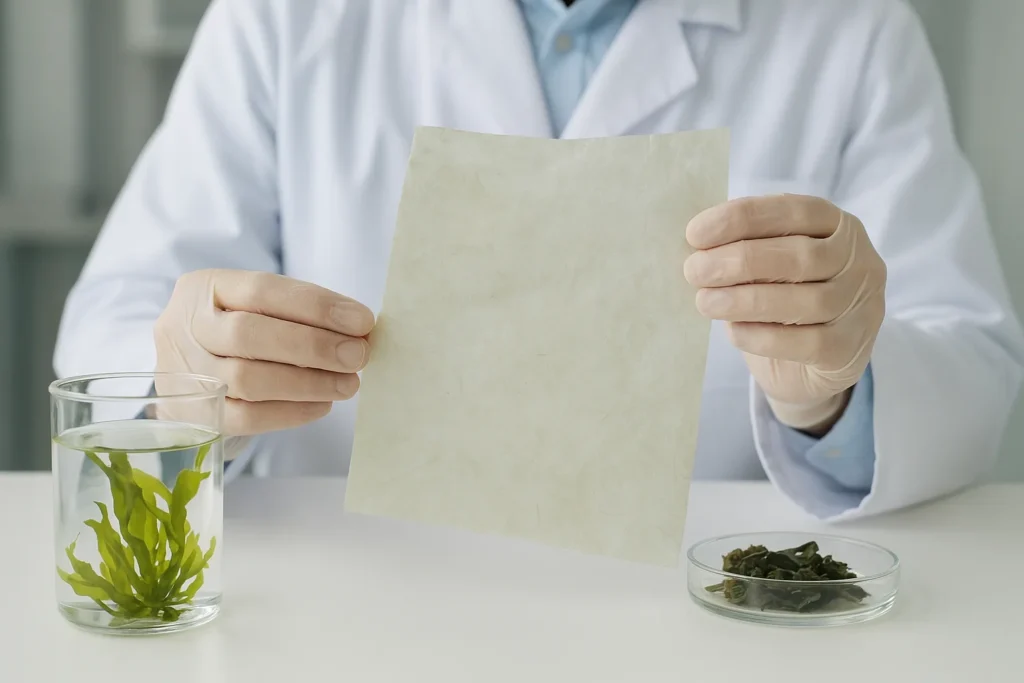
Once ashore, the freshly harvested seaweed is thoroughly washed. The next step is a hot water extraction process. The seaweed is heated in large vats, causing the cells to rupture and release the alginate or carrageenan into the solution. This creates a thick, viscous broth which is then filtered to separate the pure gelling compounds from the leftover plant fibers. These fibers are not wasted; they are often repurposed as a nutrient-rich fertilizer or animal feed, closing another loop in the process.
Step 3: Material Formation – From Gel to Functional Form
The resulting seaweed extract is a high-purity gel. To transform this gel into a functional material, it must be formed and dried. The method depends on the desired final product:
- Solution Casting: For thin, uniform films, the gel is spread onto a smooth, heated surface. As it passes through a drying tunnel, the water evaporates, leaving behind a continuous, flexible sheet of seaweed polymer.
- Extrusion: For high-volume production, the dried seaweed powder is fed into an extruder—a standard piece of plastic manufacturing equipment. Inside, the powder is melted and forced through a die, emerging as a continuous film or molded shape. This compatibility with existing machinery is a key advantage for rapid scaling.
Step 4: The Beautiful Disappearance – A Return to Nature
The final, and most critical, stage is the end of life. This is where seaweed packaging fundamentally diverges from its plastic counterparts. When discarded in a natural environment, it is recognized as food. Microorganisms secrete specific enzymes that break the long polysaccharide chains into simpler sugars, which they then consume. This process, true biodegradation, returns the material to the earth as carbon dioxide, water, and benign biomass that enriches the soil. It is a nutrient cycle, mirroring the decomposition of a fallen leaf. There is no persistence, no accumulation, and no creation of microplastic pollution.
A Universe of Applications: Where Seaweed is Making Waves
The potential uses for seaweed-based materials are vast and growing, extending into nearly every industry plagued by single-use plastics. This is not a niche solution; it is a platform technology.
The Food Service Revolution
This is the most immediate and impactful application, targeting the largest source of plastic packaging waste.
- Fresh Produce Bags: Replacing the thin, static-cling plastic bags in grocery stores.
- Thermoformed Trays: For berries, mushrooms, and baked goods.
- Takeaway Container Linings: A seaweed-based coating makes paper boxes fully compostable.
- Edible Packaging: For instant soups, seasonings, and sauces, where the packet itself dissolves in water.
The E-commerce and Fashion Frontier
The world of online retail generates a staggering amount of plastic waste from polybags.
- Compostable Poly Mailers: Seaweed-based mailers offer the same durability and protection as plastic, but can be composted by the customer at home.
- Garment Bags: Replacing the plastic used to protect clothing during shipping and in stores.
Agriculture: Tilling Packaging Back into the Soil
One of the most promising applications lies in modern agriculture.
- Biodegradable Mulch Films: Farmers can till these films directly into the soil after the growing season, where they decompose and add organic matter, eliminating the need to collect and landfill plastic mulch.
Surprising and Specialized Uses
The innovation continues into more niche areas:
- Dissolvable Laundry Pods: Pods made of seaweed film that dissolve completely in the wash.
- Medical Applications: Seaweed-based capsules for timed-release drugs and biodegradable packaging for sterile devices.
- Beauty and Personal Care: Dissolvable sachets for shampoos and lotions.
Navigating the Choppy Waters: The Real-World Challenges
For all its promise, the seaweed packaging industry is still in its adolescence. The path to mainstream adoption is fraught with significant hurdles.
The Cost Conundrum
The most immediate barrier is price. Petroleum-based plastic is artificially cheap, its price not reflecting the enormous environmental and social costs. Seaweed packaging, as a nascent technology, is currently more expensive. The cost equation is expected to shift as production scales up and the true cost of plastic pollution is increasingly factored into policy.
The Performance Gap
Matching the exact performance characteristics of a material refined over 70 years is a monumental task. Challenges remain in achieving the perfect barrier properties for certain foods and ensuring mechanical strength for demanding applications. This is an area of intense research and development.
The Infrastructure Hurdle
A compostable package is only as good as the system that handles its end-of-life. The lack of robust composting infrastructure in many parts of the world is a major obstacle. This is why the focus on “home-compostable” materials is so important—it decentralizes the solution.
Scaling the Supply Chain Responsibly
Growing enough seaweed requires a massive, and responsible, scaling of the supply chain. This involves navigating maritime spatial planning, ensuring genetic diversity to avoid monoculture risks, and engaging with coastal communities to ensure equitable development.
A Vision for a Restorative Future: What Lies on the Horizon
Despite the challenges, the momentum behind seaweed packaging is undeniable. It represents more than a material swap; it signifies a fundamental shift from a linear, extractive economy to a circular, regenerative one.
The Rise of the Blue Economy
Seaweed packaging is a flagship of the emerging “Blue Economy,” which focuses on sustainable economic development rooted in the ocean’s resources. It creates new, climate-resilient jobs in coastal communities—from farming and harvesting to processing and manufacturing.
The Power of Collaboration
The future is being built on unprecedented collaboration. Material startups are partnering with multinational corporations who are piloting these materials in their supply chains. Chemical engineers are working with marine biologists. Ocean farmers are advising policy makers. This cross-pollination is essential for creating real-world impact.
The movement is accelerating, driven by both regulatory pressure and significant corporate validation. Successes in international innovation awards signal that the technology is robust and commercially viable. As Extended Producer Responsibility regulations mandate that companies take responsibility for their packaging waste, seaweed-based compostable options offer a legal and ethical path forward.
The Turning Tide: An Invitation to Change
The story of the great kelp shift is unfolding now—in the bubbling bioreactors of innovative startups, on the submerged lines of ocean farms, and in the hands of major corporations seeking a sustainable edge. It is a powerful testament to the ingenuity that emerges when humanity commits to working with, rather than against, the natural world.
As Michelle Cullen of Ecoplasticity wisely observes, “Seaweed and algae-based materials are these incredibly versatile and exciting new materials, and we’re thrilled to be part of a solution that leverages the ocean’s abundance to solve multiple problems simultaneously.”
The next time you stand at the shoreline, gazing out at the vast, undulating ocean, consider the immense potential of the algae that washes onto the sand. The solution to one of humanity’s most persistent environmental crises is gently rocking in those waves, waiting for us to fully embrace its regenerative power. The future of materials may not be found in a deeper oil well, but in the sun-dappled, nutrient-rich waters of our own planet’s oceans. The tide is turning, and it is green.



Can you be more specific about the content of your article? After reading it, I still have some doubts. Hope you can help me.
Your article helped me a lot, is there any more related content? Thanks! https://www.binance.bh/futures/ref?code=IXBIAFVY