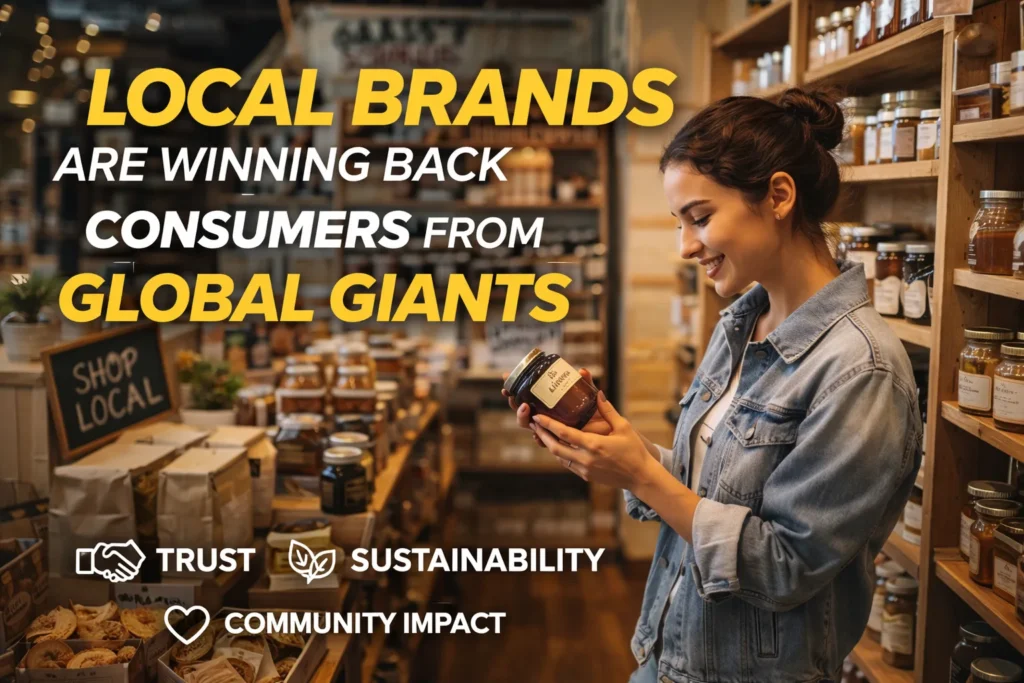

Part I: The Great Unraveling—When Global Promises Began to Fray at the Edges
We are living through one of the most significant recalibrations in the history of modern commerce. This is not a temporary market correction or a consumer trend that will fade with the next season’s fashion. This is a fundamental, structural, and philosophical shift in the relationship between people, the products they buy, and the communities they inhabit. For decades, the narrative was singular and seemingly inexorable: globalization would deliver boundless benefits through economies of scale, unprecedented choice, and the frictionless flow of goods across borders. The local merchant, the regional producer, the family farm—these were cast as charming but ultimately inefficient relics, destined to be consigned to the history books by the sleek, unstoppable force of the global supply chain.
Yet here we are, in the third decade of the 21st century, witnessing a profound and growing counter-movement. From the bustling food halls of Singapore showcasing native Kelantanese produce to the revitalized main streets of midwestern American towns; from the digital marketplaces connecting Italian hill-town artisans with global patrons who value their story to the community-supported fisheries of coastal Japan, a quiet revolution is gaining formidable momentum. Local brands—those embedded in specific geography, culture, and community—are not just surviving; they are thriving, reclaiming market share, consumer loyalty, and cultural relevance from the very global giants that were once presumed to have won the war for the marketplace.
This phenomenon transcends mere economics. It represents a collective re-evaluation of what we value, what we trust, and what we believe constitutes true progress. It is a story woven from threads of disillusionment with distant corporate power, a hunger for authenticity in a digitally mediated world, a deepening concern for planetary sustainability, and a resilient, innate human desire for connection and belonging. This is the story of how “local” ceased to be a description of scale and became a powerful ethos, a banner under which consumers are collectively reimagining the future of consumption itself. To understand its depth and permanence, we must embark on a detailed exploration, beginning with the historical pendulum swing that brought us to this pivotal moment.
Part II: The Pendulum of Commerce—A Historical Journey from Hearth to Horizon and Back Again
The Age of the Hearth and the Market Square (Pre-Industrial to 19th Century)
For millennia, commerce was synonymous with community. The economic universe was bounded by the distance one could walk, the range of a horse-drawn cart, or the reach of a local river. The butcher, the baker, and the candlestick maker were not abstract service providers; they were neighbors. Transactions were personal, credit was based on character and community standing, and the quality of goods was assessed not by a brand logo but by the reputation of a known craftsman. The marketplace was a physical and social hub—a space for exchange, news, and the reaffirmation of communal bonds. The concept of a “supply chain” was short and visible: from field to mill, from mill to baker, from baker to home. This system was not without its flaws—it could be insular, limited in choice, and vulnerable to local disasters—but it possessed an inherent accountability and a direct feedback loop between producer and consumer.
The Iron Horse and the Rise of National Brands (Late 19th to Mid-20th Century)
The Industrial Revolution, powered by steam and later electricity, began to stretch these geographical bonds. Railways and steamships collapsed distance. Mass production in factories promised standardization and lower costs. For the first time, products could be made in one place and consumed thousands of miles away. This gave birth to the “national brand”—a product like Ivory Soap or Coca-Cola that offered a consistent, reliable experience regardless of location. Advertising in national magazines and later radio created a new form of relationship: one between a consumer and a distant corporation mediated by imagery and promise. This era delivered undeniable benefits: access to affordable goods, technological innovation, and a sense of participating in a modern, connected nation. Yet, it began the slow process of divorcing the consumer from the origin and maker of their goods. Value began to shift from craft and locality to consistency and convenience.
The Zenith of Globalization: The World in a Shopping Cart (Late 20th to Early 21st Century)
The post-World War II era, particularly after the fall of the Berlin Wall and the acceleration of free-trade agreements, ushered in the hyper-globalized model. Container shipping, digital communication, and financial deregulation created a world where it became cheaper to produce a component in Malaysia, assemble it in Mexico, and sell it in Madrid than to make it entirely in one country. The goal was relentless efficiency and endless growth. Big-box retailers became cathedrals of consumption, offering staggering variety at rock-bottom prices. Global mega-brands achieved cultural ubiquity, their logos becoming more recognizable than local landmarks. The promise was one of democratic access—that anyone, anywhere, could have the same quality of life, symbolized by the same products.
This system achieved breathtaking scale and material abundance. However, its hidden costs accumulated like interest on a moral debt. The externalities became impossible to ignore: the erosion of local manufacturing hubs and the “rust belts” they left behind; the environmental toll of thousands of miles of freight transport; the homogenization of urban landscapes, where every high street began to look identical; the exploitation of labor in unseen factories; and the chilling effect on cultural and product diversity. The personal connection was utterly severed. When a product broke, there was no one to complain to. When you had a question about its making, there was no one to ask. The transaction became purely economic, stripped of its social and relational dimensions. The market square had been replaced by the anonymous checkout line.
The First Cracks: Seeds of Discontent (Early 2000s to 2010s)
The backlash did not arrive overnight. It simmered in various subcultures and movements. The Slow Food movement, originating in Italy in the 1980s as a protest against a McDonald’s opening near the Spanish Steps, championed regional cuisines, traditional techniques, and the pleasure of the table over fast food. The anti-sweatshop movement of the 1990s, led by student activists, forced a first wave of uncomfortable questions about the human cost of cheap apparel. The 2008 Global Financial Crisis was a profound psychological rupture. It revealed the fragility and profound inequity of the interconnected global financial system. As multinational banks were bailed out while Main Street businesses shuttered, public trust in large, distant institutions cratered. People began to look inward, to their communities, for resilience and security.
Simultaneously, the digital revolution, which had powered globalization, began to furnish the tools for its critique and alternative. The early internet allowed for the dissemination of documentary evidence of supply chain abuses. Social media platforms, initially tools for personal connection, became megaphones for activists and storytellers. Crucially, they also became storefronts. A potter in North Carolina could now sell directly to a customer in New York without a distributor. The tools for “small-batch” branding, storytelling, and direct sales were democratized. The stage was set. All that was needed was a catalyst to turn simmering discontent into a mass behavioral shift. That catalyst arrived in 2020.
Part III: The Great Accelerant—How Global Crises Forced a Local Reckoning
The COVID-19 pandemic was not the cause of the local shift, but it acted as a universal and unforgiving stress test on every system humans had built, especially global supply chains. Overnight, the sleek, just-in-time delivery model—designed for efficiency with no slack—snapped. Shelves emptied of everything from toilet paper to medical supplies. Consumers, confronted with empty spaces where goods should be, were faced with a stark question: “Where does my stuff actually come from, and how does it get to me?”
The answer revealed a terrifying fragility. Complex international logistics were crippled by port closures, sick workers, and geopolitical tensions. The dependency on single-source suppliers in distant countries became a critical vulnerability. In this vacuum of uncertainty, local and regional systems demonstrated remarkable resilience. Farmers who sold directly through Community Supported Agriculture (CSA) boxes found their demand exploding. Neighborhood bakeries, butchers, and greengrocers, with their shorter, more transparent supply lines, often remained stocked when supermarkets were bare. The restaurant down the street, pivoting to meal kits with local ingredients, became a lifeline.
This experience did more than provide a temporary alternative; it rewired consumer psychology. It proved that proximity was a form of security. The “local” option was no longer just a nice-to-have ethical choice; it was a reliable, robust, and safe choice. It rebuilt, in real-time, the severed connection between consumer and producer. People knew the name of their farmer again. They developed personal relationships with the shop owners who were holding items for them. The transaction regained its social component.
The pandemic was followed by other systemic shocks that reinforced this lesson. The war in Ukraine disrupted global grain and energy markets, causing price spikes that highlighted the geopolitical risks of concentrated production. Increasingly frequent and severe climate events—wildfires, floods, droughts—disrupted shipping lanes and agricultural production in far-off regions, making hyper-long supply chains look not just inefficient but dangerously naive. Resilience replaced efficiency as the most prized attribute in the public mind. And resilience, it turned out, was often best found close to home.
Part IV: The Modern Local Consumer—A Mosaic of Motivations and Identities
Today’s “localist” consumer is not a monolith. They are driven by a complex, interconnected web of motivations that blend pragmatism, ethics, emotion, and identity. Understanding this mosaic is key to understanding the movement’s power.
1. The Pragmatist: Seeking Quality, Transparency, and Security
This consumer is motivated by tangible, personal benefits. They have become a sophisticated assessor of value, looking beyond the price tag.
- The Quality Argument: They subscribe to the belief that local often means better. A vegetable harvested yesterday and sold at a farm stand is objectively fresher, more nutritious, and often more flavorful than one picked weeks ago, shipped across continents, and engineered for durability. An item made by a craftsperson who signs their work carries an inherent guarantee of care and attention that anonymous factory production cannot match.
- The Transparency Demand: In an age of greenwashing and corporate obfuscation, “local” offers a simple heuristic for trust. They can literally see where their food is grown or visit the workshop where their furniture is made. This direct line of sight demystifies production and builds confidence.
- The Security Priority: After recent crises, this consumer values systems that can withstand shocks. Supporting the local economy is seen as investing in community resilience. If another global crisis hits, they want to know their basic needs can be met by neighbors, not by a fragile network spanning oceans.
2. The Ethicist: Voting with Their Wallet for a Better World
For this consumer, every purchase is a moral statement. They see the market as a powerful lever for social and environmental change.
- The Environmental Calculus: They understand the carbon footprint of globalization. A 2022 study by the Center for Sustainable Systems at the University of Michigan found that food transportation alone accounts for about 11% of total food-system emissions. Choosing local drastically reduces “food miles.” Beyond transport, they associate local producers with more sustainable, often regenerative, practices—small-scale organic farming, responsible forestry, and lower waste from small batch production.
- The Social Justice Lens: They are concerned with the human cost of cheap goods. They prefer to buy from businesses where they know workers are paid fair wages and operate in safe conditions—standards that are verifiable in their own community but opaque in a global factory. They consciously choose to keep wealth circulating locally, understanding the multiplier effect that supports local jobs, funds public services, and reduces wealth inequality.
- The Biodiversity Advocate: They seek out heirloom varieties, heritage breeds, and traditional crafts that are pushed to extinction by industrial monoculture and mass production. In preserving a local apple variety or a native weaving technique, they see themselves as stewards of cultural and biological diversity.
3. The Communitarian: The Search for Belonging and Story
This consumer is driven by the intangible, psychological, and social benefits of local commerce. They are buying a product and a piece of identity.
- The Connection Craving: In an increasingly digital and atomized society, the act of shopping locally is a ritual of reconnection. It’s a conversation with the cheesemonger, a wave to the neighbor at the brewery, the feeling of being a recognized regular rather than a data point. This fulfills a deep human need for belonging and place.
- The Narrative Hunger: We are storytelling creatures. A global brand’s story is often a generic myth of aspiration or performance. A local brand’s story is specific, true, and rich: the family farm passed down through four generations, the immigrant chef blending her heritage with local ingredients, the retired engineer who started roasting coffee as a passion project. Consumers don’t just buy the product; they buy into the story and become a character in its next chapter.
- The Place-Maker: This consumer actively curates the character of their community. They choose the quirky, independent bookstore over the algorithmic Amazon recommendation because they want their downtown to be vibrant and unique. They understand that a landscape of chain stores creates a “geography of nowhere,” while a landscape of local businesses creates a “geography of somewhere”—a place with its own distinct flavor and memory.
4. The Aesthetic: The Cult of the Artisanal and Unique
This consumer is driven by taste, curation, and the desire to express individuality through consumption.
- The Rejection of Homogeneity: They are bored with the same globally available products. They seek the unique, the limited-edition, the seasonal offering that reflects a specific time and place. A locally distilled gin using foraged botanicals from a nearby forest offers an experience a mass-produced brand cannot replicate.
- The Appreciation of Craft: They value the evidence of the human hand—the slight imperfection in a hand-thrown mug, the unique grain of a locally milled wood table. This “maker’s mark” is a feature, not a bug, representing authenticity and care.
- The Curated Experience: They view local shops as curated galleries. The owner’s taste acts as a filter, selecting goods that reflect a particular aesthetic or quality standard. This provides a service no algorithm can: trusted, human curation.
Table 1: The Typology of the Modern Localist Consumer
| Archetype | Primary Motivation | Key Question | Sacrifice They’ll Make | Their Preferred Local Business |
|---|---|---|---|---|
| The Pragmatist | Quality, Security, Transparency | “Is this the best, most reliable option for my needs?” | Convenience of one-stop shopping | The hyper-efficient farm-to-table grocer; the meticulous craftsperson. |
| The Ethicist | Social & Environmental Impact | “What world does this purchase help build?” | Lowest price point | The worker-owned cooperative; the carbon-negative brewery. |
| The Communitarian | Connection, Story, Belonging | “Does this strengthen my community?” | Maximum variety/choice | The neighborhood pub; the family-run hardware store that knows your name. |
| The Aesthetic | Uniqueness, Craft, Curation | “Does this reflect my taste and offer a distinctive experience?” | Consistency of global brands | The avant-garde ceramic studio; the chef-driven restaurant with a daily menu. |
Part V: The Engine Room—How Technology Enables the Local Renaissance
Paradoxically, the tools that enabled globalization’s peak are now the very engines powering the local renaissance. Technology is no longer solely a force for centralization and scale; it has been democratized to empower specificity and community.
1. The Digital Storefront and Direct-to-Consumer (DTC) Revolution
Platforms like Shopify, Squarespace, and WooCommerce have obliterated the barrier to entry for creating a professional, transactional online presence. A local brand is no longer confined to the foot traffic on its street. Its “digital main street” can be accessed globally. This allows for a hybrid model: a physical space that serves as a community hub, production center, and experiential venue, complemented by an online store that captures revenue from a wider audience, including former residents and tourists who want a “taste of home.” The DTC model also allows the business to capture all the margin and, more importantly, all the customer data and relationship, breaking free from the slotting fees and power dynamics of large retail distributors.
2. Social Media as a Storytelling and Community-Building Tool
Instagram is not just for selfies; it is the modern-day window display and town square. For a local brand, social media provides a free or low-cost channel to:
- Tell the Origin Story: Daily videos of the harvest, the brewing process, the design sketches.
- Build Intimacy: Introduce team members, share failures and successes, show the dog sleeping in the workshop.
- Create Urgency and Exclusivity: Announce “today’s special batch” or “members-only pre-sale.”
- Foster User-Generated Content: Encouraging customers to share their own photos with the product, which is social proof that is infinitely more credible than corporate advertising.
- Provide Real-Time Customer Service: A direct, public line of communication that builds trust.
3. Logistics and Fulfillment Innovations
The “last-mile” delivery problem is being solved by a new wave of hyper-local logistics. Apps like DoorDash and Uber Eats now deliver from local retailers, not just restaurants. Micro-fulfillment centers in urban areas allow for rapid local delivery. Some communities have developed cooperative delivery services for their local businesses, keeping the logistics local and affordable. This means the convenience of “get it now” is no longer the exclusive domain of Amazon; the local bookstore can now compete on speed within its community.
4. The Power of Data and Niche Marketing
Local businesses can now use simple, affordable CRM and email marketing tools to know their customers intimately. They can track birthdays, purchase histories, and preferences. This allows for hyper-personalized service—the wine shop that emails you when a new Burgundy from your favorite producer arrives, the bakery that remembers your child’s name and favorite cookie. This level of personalization is something global brands, with their mass-market focus, cannot achieve at scale. Local businesses are leveraging their small size to be radically customer-centric, using technology as a memory aid and a relationship-deepening tool.
5. Platforms for Local Discovery
While Google Maps and Yelp help consumers find businesses, new platforms are specifically designed to champion local. Apps like “Nextdoor Neighbors” or regional “Buy Local” directories curated by chambers of commerce actively steer consumers toward community-based options. These platforms re-create, in digital form, the word-of-mouth recommendations that have always been the lifeblood of local commerce.
Part VI: The Response of the Giants—Glocalization, Stealth, and Ecosystem Building
Global corporations are not standing still. With vast resources, they are deploying a multi-pronged strategy to recapture the authenticity and trust they have lost. Their playbook can be categorized into several key approaches.
1. Glocalization: The Art of Local Veneer on Global Scale
This is the most common strategy: adapting global brands to feel locally relevant.
- Product Localization: Creating limited-edition products with local flavors, ingredients, or cultural references. Think McDonald’s offering a Teriyaki Burger in Japan or a McAloo Tikki in India.
- Marketing Localization: Featuring local landmarks, dialects, or cultural nuances in advertising campaigns. Using local social media influencers rather than global celebrities.
- Sourcing Localization: Making commitments, however symbolic, to source a percentage of ingredients or materials locally. This is often a headline-grabbing PR move, though its actual impact can be limited.
The risk of glocalization is perception as inauthentic—a corporate calculation rather than a genuine embrace of place. Consumers, especially younger ones, are adept at spotting “local-washing.”
2. The “Stealth” Acquisition and Venture Portfolio Model
Recognizing they cannot build authentic local brands from within, many conglomerates are buying them. Procter & Gamble, Unilever, Nestlé, and AB InBev have dedicated venture arms that scout for and acquire successful, authentic local brands in food, beverage, personal care, and apparel. The playbook is often the same: acquire the brand, provide capital for scaling, but keep the founding team, the brand name, and its marketing distinct. The corporate parent remains invisible to the consumer. This allows the giant to buy growth in a segment that distrusts it, while the local brand gets the resources to expand. The long-term tension lies in whether the original values and quality can survive the pressure for quarterly profit growth demanded by a public parent company.
3. Building Partnership Ecosystems
Instead of (or in addition to) acquisition, some giants are building partnership platforms. A large retailer like Target or Whole Foods might create an accelerator program for local brands, helping them with packaging, compliance, and shelf space in exchange for exclusive early access. A global tech platform like Etsy or Amazon Handmade provides the marketplace infrastructure for artisans to reach a global audience. This creates a symbiotic relationship: the giant gets to claim it supports small business and gains access to innovative products, while the local brand gets scale and reach previously unimaginable. The power dynamic in these partnerships, however, remains a critical concern.
4. Internal Innovation and “Intrapreneurship”
Some forward-thinking global companies are trying to foster a startup culture internally, creating skunkworks teams or separate sub-brands with their own P&L and autonomy. The goal is to replicate the agility and innovative spirit of a local startup. Examples include Google’s “Area 120” or L’Oréal’s internal incubators. Success here is mixed, as corporate culture and risk-aversion often stifle the very entrepreneurship they seek to emulate.
5. The Ultimate Test: Can a Giant Truly “Go Local”?
A few corporations are attempting the most radical shift: restructuring their core operations around local principles. This might involve:
- Regional Micro-Factories: Using technologies like 3D printing or automated small-batch production to manufacture goods closer to the point of consumption.
- Decentralized Decision-Making: Empowering regional managers to make product, marketing, and sourcing decisions based on local knowledge, not corporate mandates.
- Transparency Initiatives: Using blockchain or other tech to provide true, immutable traceability from source to store.
This is the hardest path, as it fights against the centralizing, efficiency-obsessed DNA of most global corporations. But for those who can achieve it, the reward is a genuine, structural authenticity.
Part VII: The Structural Hurdles—Why Local Still Faces an Uphill Battle
For all its momentum, the local movement faces formidable, deeply entrenched structural challenges. Ignoring these would be naive; overcoming them is the movement’s next great frontier.
1. The Economics of Scale and the Price Premium
This is the most persistent barrier. A local manufacturer cannot buy bulk ingredients at the same price as a multinational. They often pay employees living wages and benefits, a cost absent in many offshore factories. They absorb their environmental costs rather than externalizing them. All this makes their product more expensive. While a growing segment is willing to pay this “ethics premium,” for many households under financial pressure, the lowest price remains the decisive factor. The local movement must grapple with this issue of equitable access. Solutions like sliding-scale CSAs, “pay-what-you-can” models at community cafes, and advocacy for policy that internalizes the true cost of global goods (carbon taxes, living wage requirements) are critical.
2. The Distribution and “Shelf Space” Monopoly
Even if a local brand makes a superior product at a competitive price, getting it in front of consumers is a monumental challenge. The shelf space in major supermarkets is controlled by a handful of distributors and is paid for via “slotting fees” that are prohibitive for small producers. The dominance of Walmart, Amazon, and other mega-retailers creates a bottleneck. While farmer’s markets and specialty stores provide an outlet, they don’t offer the volume needed for a business to scale sustainably. Breaking this distribution logjam requires innovative collective action, such as local food hubs, cooperative grocery stores owned by the community, or regional online marketplaces that aggregate local producers for delivery.
3. The Regulatory Asymmetry
Global corporations have the resources to navigate complex international trade laws, regulatory standards, and tax codes—often influencing them to their advantage through lobbying. A small local business is often overwhelmed by local health codes, licensing, and zoning regulations that were not designed with small-scale, innovative models in mind. The burden of compliance is disproportionately heavy on the small player. Streamlining and creating “small business-friendly” regulatory pathways is a necessary policy intervention.
4. The Succession and Scaling Dilemma
Many beloved local brands are “lifestyle businesses” or family-run operations. What happens when the founder retires? Selling to a global conglomerate often means the soul of the brand is lost. Passing it to the next generation is not always possible or desired. Scaling while maintaining quality and values is an art form in itself. Too rapid growth can dilute what made the brand special, lead to outsourcing, and break the direct connection with customers. The movement needs to develop new models for ownership transition, such as employee stock ownership plans (ESOPs) or conversion to consumer cooperatives, that keep the business rooted in its community.
5. The “Local” Greenwashing and Dilution of Meaning
As “local” becomes a powerful marketing term, it risks being co-opted and diluted. How local is “local”? Is it made within 100 miles? Within the state? What percentage of ingredients must be local? Without clear standards and certifications (which themselves can be costly for small producers to obtain), consumers can be misled. A global brand sourcing one local ingredient can claim to be “supporting local,” muddying the waters for truly embedded businesses.
Part VIII: Visions of a “Glocal” Future—Possible Scenarios for 2035 and Beyond
The trajectory of this shift is not predetermined. Several plausible futures could emerge from the current tensions between global scale and local embeddedness.
Scenario 1: The Symbiotic Ecosystem (The Most Likely Path)
In this future, a healthy, interdependent ecosystem develops. Global corporations focus on what they do best: providing globally-sourced commodities, cutting-edge technology platforms, and large-scale infrastructure. Local businesses focus on what they do best: providing fresh, high-quality, experiential, and community-specific goods and services. The two systems connect through ethical platforms. Imagine an Amazon-style marketplace that is a certified B-Corp, prioritizing local producers and transparent supply chains, with logistics powered by electric, community-owned delivery fleets. Global brands act as venture partners for local innovation, providing capital without demanding control. Consumers fluidly move between the two worlds: buying their socks and smartphones from global providers, and their food, furniture, and unique gifts from local artisans. Policy supports this by taxing carbon-heavy transport and providing grants for local business incubators.
Scenario 2: The Resilience Fracture
If global shocks (pandemics, climate disasters, geopolitical conflict) continue to intensify, economies could fracture into more self-reliant, regional blocs. In this future, “local” becomes less of a choice and more of a necessity. Long-distance supply chains for essential goods (food, medicine, basic manufactures) become too unreliable and expensive. Communities are forced to develop strong regional production systems. This scenario boosts local sovereignty and resilience but could come at the cost of global cooperation, increased costs for certain goods, and reduced access to global innovation. It is a future born less from desire and more from collective adaptation to crisis.
Scenario 3: The Hyper-Curated and Phygital Blend
Technology further dissolves the boundary between physical and digital, creating a “phygital” (physical+digital) local experience. Augmented Reality (AR) glasses allow you to point at a restaurant and see its sourcing map and farmer profiles. Your refrigerator, connected to a local food hub, automatically orders milk from the dairy farm when you’re running low, scheduling a drone delivery. Local businesses become “experience studios”—part workshop, part retail, part classroom. You go to the local brewery not just to buy beer, but to take a brewing class using AR instructions, and your custom batch is then delivered to your home. In this world, the value of the local physical space is higher than ever, but it is deeply augmented by seamless, invisible technology that strengthens, rather than replaces, the human connection.
Scenario 4: The Values-Led Consolidation
The current trend of global conglomerates acquiring local brands accelerates and evolves. However, under pressure from consumers and regulators, these conglomerates transform themselves into “Holding Companies for Good.” They operate as federations of purpose-driven brands, each with operational autonomy. The parent company provides back-office support, ethical sourcing networks, and impact investment, but mandates strict standards for environmental stewardship, worker ownership, and community profit-sharing. In this scenario, scale and values are not in opposition; scale is used to amplify positive impact. The risk, of course, is that this becomes merely sophisticated PR, but with sufficient transparency and legal structure (like benefit corporation status), it could be a powerful model.
Conclusion: The Deeper Meaning—Local as an Act of Participatory World-Building
The triumph of local brands is not, in its essence, a story about business competition. It is a story about the reclamation of agency, narrative, and place in human life.
For too long, the dominant economic narrative told us we were merely consumers—passive recipients in a system designed by others. The local movement asserts that we are citizens, neighbors, and stewards. Every purchase is a tiny but real act of participation in shaping the world immediately around us. It is a vote for the kind of streets we walk down, the kind of air we breathe, the kind of relationships we have with those who provide our daily bread.
This shift represents a maturation of the capitalist ideal. It moves beyond a singular focus on financial efficiency to a more holistic accounting of well-being efficiency. What system is most efficient at creating healthy communities, a sustainable environment, trustworthy relationships, and a sense of meaning? The answer, for a growing multitude, is pointing away from the anonymous global and toward the rooted local.
The path forward is not about rejecting globalization outright—the genie of interconnection cannot be put back in the bottle. Nor is it about a nostalgic return to a pre-industrial past. It is about building a smarter, more humane, and more resilient balance. It is about using global networks of information and solidarity to strengthen local nodes of production and community. It is about a world where you can video-call a friend across the ocean in the morning, and in the afternoon, shake the hand of the person who grew your lunch.
The future belongs not to the purely local nor the purely global, but to the “glocal”—to systems, businesses, and mindsets that can think globally in terms of ethics, solidarity, and knowledge, while acting locally in terms of economy, ecology, and community. The local brand winning back the consumer is the first, tangible sign that this future is not only possible but is already being built, one conscious choice, one relationship, one community at a time. In the end, this isn’t a retail trend. It is a quiet, profound revolution in how we choose to be human together on this planet.