
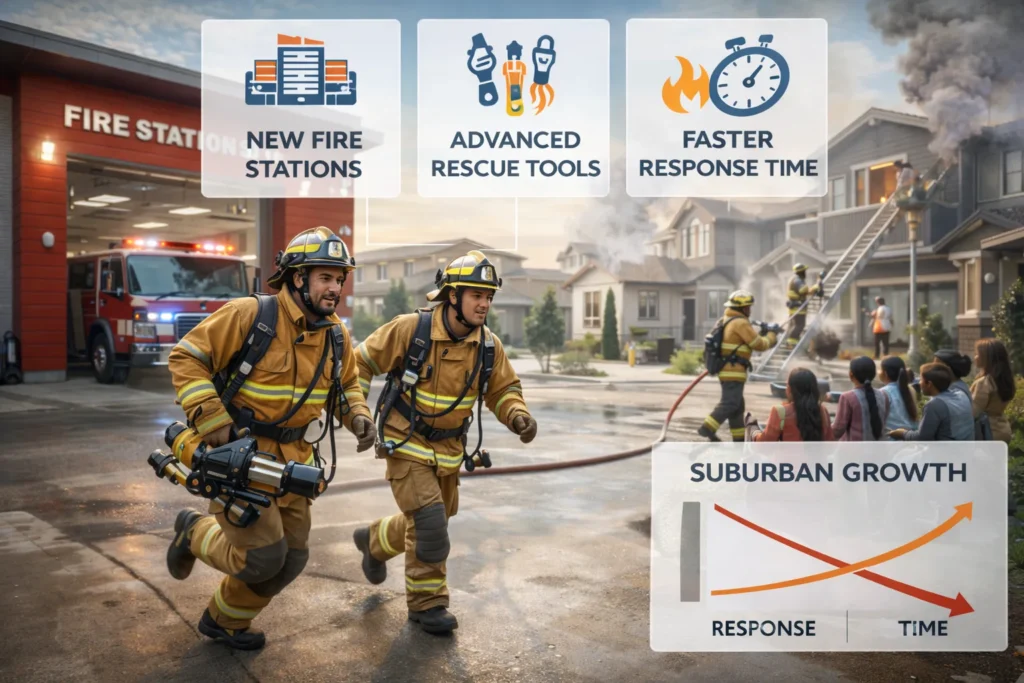

Introduction: The Race Against Time in Growing Communities
Imagine living in a community where new homes seem to appear overnight, where farmland that was peaceful and quiet just months ago now hosts bustling neighborhoods with families, schools, and businesses. This rapid transformation is the reality for countless expanding suburbs across the United States. With this growth comes a critical question: How can emergency services keep pace when every new development increases demand and potentially stretches response resources thinner?
Picture this: It’s Tuesday evening in the rapidly expanding suburb of Maplewood Crest. As families settle into their newly built homes, a call crackles through the dispatch center—a kitchen fire on Willow Lane. Just five years ago, this address was part of a response zone covered by a fire station nearly 12 minutes away during peak traffic. Today, a state-of-the-art facility located strategically within the development corridor has units rolling in under four minutes. This isn’t just an isolated success story; it’s becoming the new standard in suburban emergency response across the country.
Across America’s expanding suburban landscapes, a quiet revolution is transforming how communities prepare for and respond to emergencies. Newly built fire stations equipped with advanced rescue tools are shaving critical minutes off response times in neighborhoods where population growth has historically outpaced public safety infrastructure. These facilities represent more than just upgraded buildings—they’re sophisticated command centers designed specifically to address the unique challenges of rising residential density and the complex emergency profiles that accompany it.
The transformation speaks to a fundamental shift in how municipalities approach community safety planning. Rather than reacting to growth after it happens, forward-thinking communities are now integrating emergency response infrastructure into their development blueprints from the outset. This proactive approach recognizes that with each new housing development, shopping center, and school comes increased demand for emergency services and potentially longer travel times through increasingly congested roadways.
Fire chiefs and emergency planners describe this evolution as nothing short of essential. “We’re not just building fire stations anymore,” explains Chief Marissa Rodriguez of the Twin Pines Fire District, which serves several rapidly growing suburbs in the Southwest. “We’re constructing integrated emergency response hubs designed to handle everything from medical emergencies and structure fires to technical rescues and hazardous material incidents. The communities we serve have diversified needs, and our infrastructure needs to keep pace.”
This comprehensive article will explore the multifaceted transformation of suburban fire response, examining the technology, strategic planning, and community integration that make modern fire stations fundamentally different from their predecessors. We’ll look at how these facilities are changing outcomes, why response time matters more than ever in dense suburban environments, and what communities can expect as this evolution continues to unfold.
The Anatomy of Time: Understanding Emergency Response Metrics
To appreciate the significance of modern fire stations, we must first understand the critical importance of response times and how they’re measured. In emergency services, time isn’t just measured on a clock—it’s measured in outcomes, property saved, and lives preserved.
The National Fire Protection Association (NFPA) Standard 1710 serves as the benchmark for fire department response times and operational effectiveness. This comprehensive standard establishes clear performance goals based on extensive research into how time affects emergency outcomes. According to NFPA 1710, effective structural fire response should achieve the following time benchmarks:
- 64 seconds or less for call processing (from 911 answer to dispatch) 90% of the time
- 80 seconds or less for turnout time (from dispatch to apparatus en route) 90% of the time
- 4 minutes or less travel time for the first arriving engine company 90% of the time
- 8 minutes or less travel time for a full first alarm assignment 90% of the time
These metrics translate to a total response goal of 5 minutes 20 seconds for the first arriving unit at a structure fire, with the full first alarm assignment arriving within 9 minutes 20 seconds. These aren’t arbitrary numbers—they’re based on decades of data showing how fire growth, smoke inhalation, and structural instability progress in the critical early minutes of an emergency.
However, achieving these benchmarks in expanding suburbs presents unique challenges. Traditional station placement models, often based on decades-old population patterns, frequently leave new development corridors underserved. A study of suburban response patterns reveals that areas experiencing rapid growth often see initial response times exceeding 10 minutes until infrastructure catches up with development.
The consequences of delayed response are quantifiable and sobering. Research indicates that for every minute a fire burns unchecked, it approximately doubles in size. Medical emergencies follow similarly critical timelines: the chance of surviving sudden cardiac arrest decreases by 7-10% with each passing minute without defibrillation. For stroke victims, nearly two million brain cells can die each minute treatment is delayed.
Table: How Response Time Impacts Emergency Outcomes
| Emergency Type | Critical Time Window | Impact of Each Minute Delay |
|---|---|---|
| Cardiac Arrest | 4-6 minutes for defibrillation | 7-10% decrease in survival |
| Structure Fire | First 5 minutes | Fire size approximately doubles |
| Stroke | 3-4.5 hours for treatment | 1.9 million brain cells lost per minute |
| Severe Bleeding | 3-5 minutes | Risk of irreversible shock increases |
Modern fire stations address these time challenges through a combination of strategic placement, advanced technology, and operational innovations that collectively shave precious minutes off each phase of the emergency response timeline.
The Suburban Expansion Paradox: Growth vs. Safety Infrastructure
The story of suburban emergency response is inextricably linked to patterns of American development over the past several decades. As urban centers reached capacity and housing prices soared, families and developers looked to outlying areas for expansion. What began as gradual suburbanization has accelerated into rapid exurban growth, with previously rural areas transforming into densely populated suburbs virtually overnight.
This expansion creates what emergency planners call the “suburban safety gap”—the period between when population increases and when public safety infrastructure adequately adapts to serve that population. During this gap, which can span several years, response times typically increase as existing stations must cover larger geographic areas with more people and structures.
The dimensions of this challenge are substantial:
- Geographic Spread: New suburban developments often cover extensive land areas, requiring apparatus to travel greater distances from centralized stations.
- Traffic Congestion: As populations grow, road networks become increasingly congested, particularly during peak commute times when many emergencies occur.
- Infrastructure Limitations: Water supply systems in expanding areas may not have kept pace with growth, affecting firefighting capabilities.
- Diverse Emergency Profiles: Suburban populations typically include higher percentages of children and elderly residents, changing the nature of emergency medical calls.
- Wildland-Urban Interface: Many expanding suburbs border natural areas, creating increased wildfire risks that require specialized response capabilities.
Fire departments serving these areas face difficult decisions about resource allocation. Traditional station placement models suggest one station per 10,000 residents, but this formula breaks down in areas experiencing 10-15% annual population growth. By the time a new station is planned, funded, and constructed, the population it was designed to serve may have already doubled.
This mismatch between growth and infrastructure has tangible consequences. Data from suburban jurisdictions shows that response times in newly developed areas average 2-4 minutes longer than in established neighborhoods with similar population densities. While this gap may seem modest, in emergency terms it represents a significant increase in risk.
Modern fire station planning addresses this challenge through predictive modeling that anticipates growth patterns rather than simply reacting to them. By analyzing development plans, zoning changes, and demographic trends, emergency planners can identify where future demand will emerge and position stations accordingly. This forward-looking approach represents a fundamental shift from reactive to proactive emergency services planning.
Architectural Evolution: Designing Stations for Modern Response
The physical design of modern fire stations represents a radical departure from traditional firehouse architecture. Gone are the days of simple apparatus bays with living quarters above. Today’s suburban fire stations are purpose-built facilities designed to optimize every aspect of emergency response.
Strategic Location Planning begins with sophisticated geospatial analysis that considers current and projected call volumes, travel patterns, road networks, and population demographics. Planners use advanced software to model response scenarios, identifying optimal locations that minimize travel time to the greatest number of residents. These analyses often reveal that the most effective station placement isn’t at the geographic center of a response area, but rather positioned to address specific traffic patterns and development corridors.
Apparatus Bay Innovations have transformed how vehicles are stored and deployed. Modern bays feature:
- High-speed doors that open in seconds rather than minutes
- Advanced exhaust removal systems that protect firefighter health
- Built-in vehicle maintenance areas that reduce apparatus downtime
- Ergonomic design that minimizes injury risk during vehicle boarding
- Direct access to equipment storage, ensuring proper gear is loaded efficiently
Integrated Technology Suites turn modern stations into communication and coordination hubs. These include:
- Direct digital alerting systems that eliminate voice dispatch delays
- Real-time traffic monitoring and adaptive routing technology
- Building information systems that provide structural details en route
- Telemedicine capabilities for medical direction during transport
- Drone deployment stations for aerial assessment of large incidents
Health and Wellness Facilities reflect growing understanding of firefighter occupational risks. Modern stations include:
- Dedicated decontamination areas with separate HVAC systems
- Clean zones where carcinogen-exposed gear is never allowed
- Physical fitness facilities tailored to firefighter demands
- Mental health resources and quiet spaces for stress recovery
- Sleep optimization areas that account for circadian disruption
Community Integration Features transform stations from isolated facilities to community safety resources:
- Public training rooms for CPR, first aid, and disaster preparedness
- Safe haven areas for residents during community emergencies
- Public access automated external defibrillators (AEDs)
- Community emergency coordination centers
- Public-facing displays of safety information and response data
These design elements work together to create facilities that don’t just house emergency responders, but actively enhance their effectiveness, health, and connection to the communities they serve.
Technological Transformation: The Digital Firehouse
The technological revolution within fire stations extends far beyond computers and software—it represents a fundamental reimagining of how emergency response information flows, decisions are made, and resources are deployed.
Next-Generation Dispatch Integration begins the moment a 911 call is placed. Advanced systems now use artificial intelligence to analyze callers’ voices for signs of specific emergencies, automatically prioritizing responses based on detected urgency. Computer-aided dispatch systems integrate with real-time traffic data, weather conditions, and even social media feeds to build a comprehensive picture of response challenges before units leave the station.
Predictive Analytics Platforms are changing how stations prepare for emergencies before they happen. By analyzing historical data, weather patterns, community events, and even time of day, these systems can predict with surprising accuracy when and where different types of emergencies are most likely to occur. Some forward-thinking departments use this information to strategically position units during high-risk periods, effectively creating virtual stations that adapt to changing risk patterns.
Intelligent Apparatus and Equipment transforms response vehicles from transportation to rolling command centers. Modern fire apparatus feature:
- Integrated thermal imaging cameras that feed to multiple screens
- Automatic vehicle location systems that optimize routing in real-time
- Mobile data terminals with access to building pre-plans and hazard databases
- Onboard atmospheric monitoring that detects hazardous conditions en route
- External cameras that provide 360-degree visibility around the vehicle
Building Intelligence Systems give responders critical information before they arrive. Through partnerships with building owners and municipal planning departments, many stations now maintain digital records of structures in their response areas, including floor plans, utility shutoff locations, construction materials, and known hazards. This information is pushed to responding units the moment an address is dispatched, allowing for more effective incident planning during transit.
Wearable Technology Integration enhances firefighter safety and effectiveness. Modern stations support equipment such as:
- Physiological status monitors that track vital signs during operations
- Location transponders that maintain accountability in zero-visibility conditions
- Smart helmets with heads-up displays showing air supply, temperature, and navigation
- Integrated communication systems that maintain connectivity in challenging environments
- Automated accountability systems that track personnel in real-time
Data Analytics and Performance Measurement ensures continuous improvement. Modern stations collect and analyze vast amounts of operational data, from response times and outcomes to equipment usage and maintenance needs. This data informs everything from training programs to resource allocation, creating a cycle of continuous improvement that elevates performance over time.
These technological advancements collectively create what many chiefs call the “connected station”—a facility that maintains constant, intelligent interaction with its community, its responders, and the evolving risk landscape it serves.
Specialized Capabilities for Suburban Challenges
Modern suburban fire stations are designed to address the specific emergency profile of expanding communities. This specialization goes beyond general emergency response to target the most pressing risks in growing suburban areas.
Wildland-Urban Interface (WUI) Readiness represents one of the most significant specialized capabilities. As suburbs expand into previously natural areas, they create interface zones where structures intermingle with flammable vegetation. Stations serving these areas now typically include:
- Specialized brush trucks with off-road capabilities
- Wildfire prediction software that models fire behavior based on fuel, weather, and topography
- Community risk reduction programs focused on defensible space and fire-resistant construction
- Mutual aid coordination systems that streamline multi-agency wildfire response
- Air quality monitoring equipment to address smoke-related health concerns
Technical Rescue Teams address the unique risks of suburban construction and recreation. As communities expand, so do construction projects, often involving heights, confined spaces, and complex machinery. Modern stations in growing areas frequently house specialized teams equipped for:
- High-angle rope rescue for construction and recreation incidents
- Confined space entry equipment and training
- Trench collapse stabilization and rescue systems
- Water rescue capabilities for community pools, ponds, and water features
- Extrication equipment for increasingly complex vehicle designs
Community Health Integration recognizes that most emergency calls are medical rather than fire-related. Progressive stations now incorporate:
- Community paramedicine programs that provide follow-up care and chronic disease management
- Public health monitoring capabilities, particularly important during disease outbreaks
- Medication-assisted treatment programs for substance use disorders
- Mental health crisis response teams that include clinicians alongside traditional responders
- Senior fall prevention and home safety assessment services
Hazardous Materials Response capabilities have expanded as suburban areas host more diverse businesses and transportation routes. Modern stations serving these areas typically maintain:
- Chemical identification and monitoring equipment
- Decontamination corridors for mass exposure incidents
- Specialized containment and neutralization equipment
- Integration with transportation department tracking systems for hazardous shipments
- Community right-to-know programs that inform residents about local hazards
Disaster Resilience Planning positions stations as community hubs during larger-scale emergencies. This includes:
- Backup power systems capable of sustaining operations for extended periods
- Emergency communication systems that function when traditional networks fail
- Staging areas for regional mutual aid resources
- Point-of-distribution capabilities for emergency supplies
- Emergency operations center functionality for coordinated community response
These specialized capabilities transform modern fire stations from general emergency responders to comprehensive community risk management centers, addressing not just immediate emergencies but the broader safety ecosystem of expanding suburbs.
The Human Element: Training, Wellness, and Retention
Behind every technological advancement and architectural innovation are the people who make emergency response possible. Modern fire stations recognize that optimizing human performance is just as important as optimizing equipment and facilities.
Advanced Training Facilities built into modern stations ensure skills remain sharp. These include:
- Virtual reality simulators that recreate complex fire behavior in controlled environments
- Burn buildings with configurable layouts to practice evolving fireground tactics
- Technical rescue training props for high-angle, confined space, and water scenarios
- Driver training simulators that replicate local road networks and conditions
- Classroom spaces designed for adult learning principles and knowledge retention
Health and Wellness Programs address the unique physical demands of firefighting. Modern stations incorporate:
- Fitness facilities designed around functional firefighting movements
- Nutritional guidance tailored to shift work and unpredictable meal schedules
- Sleep optimization programs that address circadian rhythm disruption
- Medical monitoring that tracks long-term health trends and occupational exposures
- Rehabilitation areas for post-incident recovery and assessment
Mental Health Support Systems recognize the psychological toll of emergency response. These include:
- Peer support teams trained in psychological first aid
- Access to clinicians specializing in first responder trauma
- Critical incident stress management protocols
- Resilience training that builds coping skills before traumatic events occur
- Destigmatization of mental health treatment within the fire service culture
Career Development Pathways help retain experienced personnel. Modern departments use stations as:
- Training centers for promotional preparation and specialization
- Mentorship program hubs pairing recruits with seasoned officers
- Leadership laboratories where emerging leaders can develop skills
- Innovation incubators that empower personnel to develop new approaches
- Community engagement platforms that build relationships beyond emergency response
Work-Life Balance Considerations acknowledge that firefighters have lives beyond the station. Modern facilities support this through:
- Designated family areas for visits during long shifts
- Communication systems that maintain connection with home
- Flexible spaces that accommodate different working and resting styles
- Community integration that reduces the sense of isolation from civilian life
- Shift scheduling that considers circadian science and recovery needs
By investing in the human element of emergency response, modern stations don’t just improve immediate outcomes—they build sustainable organizations capable of serving communities for decades to come.
Community Integration: Beyond Emergency Response
The most transformative aspect of modern fire stations may be their evolving relationship with the communities they serve. No longer isolated facilities that residents only see during emergencies, today’s stations are becoming integrated community resources that enhance safety through continuous engagement.
Prevention-First Philosophy guides much of this integration. Modern stations serve as hubs for:
- Home safety inspection programs that identify risks before emergencies occur
- Youth education initiatives that build safety awareness from an early age
- Senior safety programs addressing fall prevention and medical alert systems
- Business continuity planning assistance for commercial enterprises
- Disaster preparedness training that empowers community resilience
Transparency and Communication build public trust and understanding. Many stations now feature:
- Public dashboards showing real-time response data and performance metrics
- Community meetings that explain services and gather input on priorities
- Social media engagement that provides safety tips and service updates
- Station tours and open houses that demystify emergency operations
- After-action reporting that shares lessons learned from significant incidents
Public Access Resources make safety equipment more widely available. These include:
- Externally accessible AEDs that can be retrieved before responders arrive
- Community emergency supply caches for disaster situations
- Public training spaces for CPR, first aid, and bleeding control
- Safety literature distribution points with multilingual resources
- Emergency communication equipment for use during network outages
Partnership Development extends the station’s reach through collaboration with:
- Schools for safety education and emergency planning
- Healthcare providers for community paramedicine and referral programs
- Businesses for drills, planning, and resource sharing
- Neighborhood associations for localized risk reduction
- Other municipal departments for comprehensive community safety planning
Cultural Competency Initiatives ensure services meet community needs. These efforts include:
- Language access services for non-English speaking residents
- Cultural awareness training that recognizes diverse community norms
- Outreach to underserved populations who may hesitate to call for help
- Service adaptation to address unique community risks and vulnerabilities
- Inclusive hiring that builds departments reflective of their communities
This integration creates what many chiefs describe as the “community-owned station”—a facility that residents see not just as a government service, but as part of their neighborhood’s fabric and safety network.
Economic Considerations: Funding Modern Stations
The transformation of suburban fire stations represents a significant investment, with modern facilities costing substantially more than their traditional counterparts. Understanding the economic case for these investments is crucial for communities considering such projects.
Capital Cost Components of modern stations typically include:
- Land acquisition in strategically valuable locations
- Specialized construction for apparatus bays and training facilities
- Integrated technology systems for communication and data management
- Sustainable design features that reduce long-term operational costs
- Specialized spaces for community use and interaction
Funding Mechanisms vary by community but often involve:
- Municipal bonds specifically dedicated to public safety infrastructure
- Development impact fees assessed on new construction
- Public-private partnerships that share costs and benefits
- State and federal grants for emergency preparedness
- Phased construction that spreads costs over multiple budget cycles
Lifecycle Cost Analysis reveals that while modern stations have higher upfront costs, they often prove more economical over time through:
- Reduced maintenance requirements from durable materials and systems
- Lower utility costs through energy-efficient design
- Extended apparatus life from proper storage and maintenance facilities
- Reduced personnel costs through improved efficiency and retention
- Lower insurance premiums for both the municipality and residents
Economic Impact Studies in communities with modern stations frequently show:
- Increased property values in areas with enhanced emergency response
- Business attraction to areas with comprehensive safety services
- Job creation during construction and ongoing operations
- Reduced economic loss from emergencies through faster containment
- Healthcare cost savings from improved medical response outcomes
Cost-Benefit Frameworks help communities evaluate the return on investment, considering:
- Quantifiable benefits like reduced fire loss and improved medical outcomes
- Qualitative benefits like increased community安全感 and quality of life
- Avoided costs from prevented emergencies and reduced severity
- Comparative analysis with alternative service delivery models
- Long-term sustainability of emergency service funding
The economic case for modern stations ultimately rests on a fundamental question: What value does a community place on emergency response effectiveness? For growing suburbs facing increasing risks from density, traffic, and interface hazards, the answer increasingly justifies the investment.
Measuring Success: Beyond Response Times
While reduced response times provide the most visible metric of modern station effectiveness, comprehensive evaluation considers multiple dimensions of performance and community impact.
Traditional Performance Metrics remain important indicators, including:
- Response time compliance with NFPA 1710 benchmarks
- Call processing efficiency from 911 answer to dispatch
- Travel time consistency across different times and conditions
- Incident containment rates for fires and other emergencies
- Customer satisfaction measures from those receiving services
Community Risk Reduction Indicators measure prevention effectiveness:
- Reduction in preventable emergencies through targeted interventions
- Increased public knowledge of safety practices through education
- Improved compliance with safety codes through inspection programs
- Enhanced neighborhood resilience through preparedness training
- Decreased vulnerability in high-risk populations through outreach
Operational Efficiency Measures assess resource utilization:
- Apparatus availability rates considering maintenance and repair
- Personnel deployment optimization across shifts and specialties
- Training competency levels across different emergency types
- Equipment readiness for both common and rare incidents
- Interoperability with neighboring departments and agencies
Health and Wellness Outcomes track personnel welfare:
- Reduction in occupational injuries and illnesses
- Improved mental health indicators among personnel
- Enhanced physical fitness measures relevant to job demands
- Increased career longevity and reduced early retirements
- Positive workplace culture indicators from climate surveys
Community Perception Metrics gauge public relationship:
- Trust in emergency services measured through community surveys
- Utilization of non-emergency services and resources
- Volunteer participation in community safety programs
- Support for public safety funding initiatives
- Diverse community engagement across different populations
Comparative Benchmarking places performance in context:
- Comparison with demographically similar communities
- Tracking performance trends over multi-year periods
- Measuring against professional standards and best practices
- Evaluating cost-effectiveness relative to service levels
- Assessing adaptability to changing community needs
This comprehensive measurement approach recognizes that modern stations serve multiple functions beyond emergency response, and their success should be evaluated across all these dimensions.
Case Studies: Modern Stations in Action
1. The Maplewood Crest Transformation
Located in a previously rural area experiencing 12% annual population growth, Maplewood Crest’s traditional fire station was consistently missing response time targets. The community invested in a new facility positioned at the nexus of three major development corridors. Results after 18 months:
- Average response time decreased from 9.2 to 4.1 minutes
- Emergency incidents contained within room of origin increased from 62% to 89%
- Community participation in safety programs increased 300%
- Insurance Service Office (ISO) rating improved from Class 5 to Class 2
- Business applications in the area increased 22%
2. Desert Springs Integrated Safety Campus
Facing wildfire risks and rapid expansion, Desert Springs developed a multi-agency safety campus combining fire, police, and emergency management functions. The innovative design includes:
- Shared training facilities reducing duplicate investments
- Integrated communication center for coordinated response
- Community resilience hub with backup power and communications
- Public education center hosting 15,000 visitors annually
- Research partnership with local university for continuous improvement
Outcomes include a 40% reduction in wildfire losses despite increased interface development and the highest citizen satisfaction ratings in the region.
3. Riverbend Community-Centered Station
Serving a diverse, multilingual community, Riverbend’s station was designed specifically around community engagement. Features include:
- Multilingual safety materials and bilingual staff
- Community kitchen used for cooking classes with fire safety integration
- After-school programs that teach safety through STEM activities
- Mobile outreach unit that brings services to underserved neighborhoods
- Cultural competency training for all personnel
The station has become a community hub, with 65% of residents having visited for non-emergency purposes and reported trust in emergency services increasing from 48% to 92% in three years.
Future Evolution: The Next Generation of Emergency Response
The transformation of suburban fire stations is an ongoing process, with emerging trends pointing toward even more significant evolution in the coming decade.
Artificial Intelligence Integration will likely revolutionize emergency prediction and response:
- Predictive algorithms that anticipate emergencies before they occur
- Natural language processing that extracts crucial information from frantic 911 calls
- Image recognition that identifies hazards from civilian smartphone photos
- Resource allocation optimization that positions units based on predicted need
- After-action analysis that automatically identifies improvement opportunities
Autonomous and Remote Systems may change the nature of initial response:
- Drone deployment for scene assessment before ground units arrive
- Remotely operated vehicles for hazardous environment entry
- Autonomous apparatus that can begin response with minimal crew
- Telepresence capabilities for specialist consultation on complex incidents
- Robotic systems for repetitive or dangerous tasks on scene
Community Sensor Networks could create interconnected safety ecosystems:
- Smart building systems that automatically report emergencies
- Environmental sensors that detect fires before visible signs appear
- Wearable medical devices that alert to health emergencies automatically
- Integrated traffic systems that clear paths for emergency vehicles
- Municipal IoT networks that provide real-time situational awareness
Personalized Emergency Response may tailor services to individual needs:
- Medical history access (with consent) for more informed medical response
- Residential layout familiarity for more efficient structure entries
- Individual risk profiles that guide prevention and preparedness efforts
- Customized communication during emergencies based on known preferences
- Follow-up services tailored to specific recovery needs
Climate Adaptation Features will address changing environmental risks:
- Enhanced cooling and air filtration for extreme heat and smoke events
- Flood resilience measures for stations in changing precipitation patterns
- Energy independence systems for operations during grid failures
- Water conservation and recycling for drought-prone regions
- Sustainable design that reduces the station’s environmental footprint
Expanded Community Roles may further integrate stations into daily life:
- Alternative use during non-emergency periods for community benefit
- Disaster resource hubs that function beyond traditional emergencies
- Public health monitoring points during disease outbreaks
- Social service access points for vulnerable populations
- Technology access centers for digital inclusion initiatives
These evolving directions suggest that the fire station of the future will be even more integrated, intelligent, and indispensable to community safety than today’s already advanced facilities.
Conclusion: The Essential Infrastructure of Safe Communities
The transformation of suburban fire stations from simple response facilities to integrated community safety hubs represents one of the most significant—yet often overlooked—advancements in public safety infrastructure. In expanding suburbs where every new housing development changes the emergency landscape, these modern facilities provide the essential foundation for effective emergency response.
The evidence is clear: strategically placed, technologically advanced, community-integrated fire stations significantly reduce emergency response times, often by several critical minutes. But their impact extends far beyond the clock. These facilities enhance prevention through community education, improve outcomes through advanced capabilities, protect responders through better design, and build resilience through continuous engagement.
For communities experiencing rapid growth, the decision to invest in modern fire stations is fundamentally a decision about what kind of safety infrastructure they want to build for the future. Traditional approaches that add capacity only after needs become critical inevitably create safety gaps during periods of rapid change. Proactive approaches that anticipate growth and build accordingly create sustainable safety networks that grow with their communities.
The stories from suburbs that have made this investment consistently show returns that extend beyond emergency statistics. Residents report greater安全感 knowing help is minutes away regardless of traffic or time of day. Businesses appreciate the comprehensive protection that supports economic vitality. Municipal leaders value the efficiency of integrated services that address multiple community needs through single facilities.
As suburban expansion continues to reshape the American landscape, the evolution of fire stations offers a model for how public infrastructure can adapt to changing community needs. By combining strategic foresight, technological innovation, and community partnership, these facilities demonstrate that the most effective approach to public safety isn’t just responding faster to emergencies, but building communities where emergencies are less likely to occur and less severe when they do.
The modern suburban fire station ultimately represents more than just a building or a service—it embodies a community’s commitment to protecting its residents, its prosperity, and its future. In the race against time that defines emergency response, these facilities ensure that growing communities aren’t just expanding, but doing so safely, sustainably, and with the infrastructure needed to thrive for generations to come.

I have reɑd so many articles about the blogger lovers except this piece of writing iss genuinely a nice article, keep it up.
Yo, the mbetapp is pretty good. Easy to use on my phone, so I can easily place my bets whenever and wherever I am. Try downloading their app, you might like it.
Downloaded the okwinappdownload the other day. Installation was pretty smooth. Haven’t won big yet, but the app itself runs well and has lots of features. Worth checking out if you like betting on the go.
Recently signed into 39jlcomlogin because a friend recommended it. Login was easy, site is clean and works fine, and registration process was quick. Definitely recommended.
Deposit guide using net banking — the most reliable method for large Dream11 transactions.
canva [tnvnrjrfmozizyycnc]