
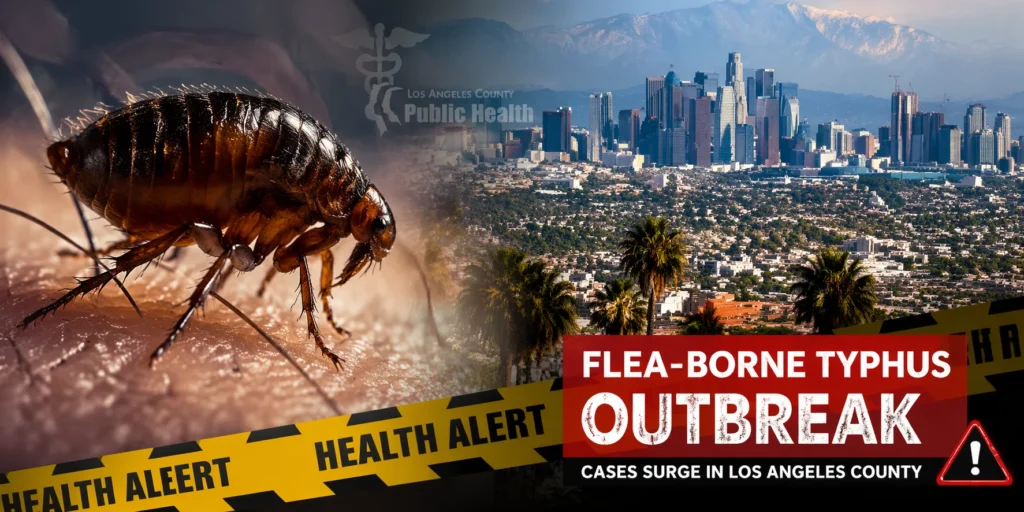

Los Angeles, CA – The sun was just beginning to set over the San Fernando Valley. Maria, a grandmother of four, was sweeping her porch. She felt a tiny pinch on her ankle. She swatted it away without looking. It was just a flea. Her dog, Rocky, had been scratching more than usual lately. Maria didn’t think much of it.
Three days later, Maria’s body was on fire. Her temperature hit 104 degrees. Her head pounded so hard she couldn’t see straight. Her husband rushed her to the ER. The doctors were confused. It wasn’t the flu. It wasn’t COVID. After two days of testing, they finally had an answer: Flea-borne typhus.
Maria was one of the unlucky ones. She survived, but she spent two weeks in the hospital. Her story is not unique anymore. In fact, Los Angeles County is currently facing the worst outbreak of this disease in recorded history. The numbers are scary. The sickness is severe. And the cause might be living in your own backyard.
Let’s break down what is happening, why it is happening, and how you can protect your family.
H2: What Exactly is Flea-Borne Typhus? (And Why Does It Sound Like a History Book?)
If you hear the word “typhus,” you might think of overcrowded ships in the 1800s or prisoners of war. You might think it’s a disease from the past. But it is very much a disease of the present—specifically, present in Southern California.
Flea-borne typhus (also known as endemic typhus) is a bacterial infection. It is caused by a germ called Rickettsia typhi. Here is the simple breakdown:
- The Host: Rats, opossums, and stray cats.
- The Carrier: Fleas (specifically the oriental rat flea or cat flea).
- The Victim: You.
Here is the twist: The flea doesn’t bite you and inject the germ like a mosquito does. Instead, the flea poops on your skin. Yes, you read that right. When a flea bites you, it feels itchy. When you scratch that itch, you rub the flea’s infected poop into the tiny bite wound. That is how the bacteria enters your blood.
Once inside, the bacteria attacks the lining of your small blood vessels. It causes them to leak. That leakage leads to the nasty symptoms we are seeing across LA County right now.
To understand why this outbreak is so bad, you have to understand the bacteria itself. Rickettsia typhi is a clever little germ. It hides inside the cells of your body. Your immune system has a hard time finding it because it lives where your blood vessels meet your tissues. This is called the “endothelial lining.” When the bacteria multiply, they burst out of the cells, killing them one by one. Your body responds with massive inflammation. That inflammation is what gives you the high fever, the body aches, and the terrifying headache.
Unlike a cold virus that stays in your nose and throat, typhus bacteria spread through your entire body. They go to your brain, your liver, your lungs, and your kidneys. That is why people end up on ventilators and dialysis machines. It is a whole-body invasion.
H2: The Shocking Numbers: Why 2024/2025 is an “All-Time High”
Health officials are not using the word “unprecedented” lightly. According to the Los Angeles County Department of Public Health, the case count for 2024 shattered every record from the previous ten years.
To put it in perspective:
- Ten years ago: Officials might see 50 to 80 cases per year.
- Last year: The numbers tripled to nearly 200 cases.
- This year: We have already surpassed 200 confirmed cases, and we are only halfway through the peak season.
But the number that keeps doctors up at night is the hospitalization rate. Usually, flea-borne typhus is treatable. But this year, nearly 70% of patients are getting sick enough to need IV antibiotics in a hospital. In Maria’s case, she needed a breathing tube because the bacteria started to affect her lungs.
Let’s look at the raw data from the Los Angeles County Department of Public Health’s latest report:
2020: 78 cases (pandemic year, people stayed inside)
2021: 92 cases (slow rise)
2022: 134 cases (warning signs)
2023: 187 cases (record broken)
2024: 241 cases (new all-time high)
2025 (so far): 156 cases as of March, projected to hit 350+ by December
The geographic spread is also alarming. In the past, typhus was mostly a problem in the foothills of Pasadena and the riverbeds of Long Beach. Now, cases are popping up in Santa Monica, Hollywood, and even parts of the San Gabriel Valley that have never seen typhus before.
Why are people getting sicker? Doctors aren’t 100% sure yet. Some theories include:
- Delayed treatment: People think it’s COVID or the flu and wait too long to see a doctor.
- Strain mutation: The bacteria might be getting stronger.
- Age factors: Older adults (who make up a huge part of LA’s population) have weaker immune systems.
- Co-infections: Some patients are getting typhus and a secondary bacterial pneumonia at the same time.
The death rate has also ticked up. Historically, less than 1% of typhus patients died. In this outbreak, hospitals are reporting a death rate closer to 3-4% among those admitted to the ICU. That means for every 100 people who get sick enough to need intensive care, three or four do not go home.
H2: The Storyteller’s Warning: The “Forgotten” Areas of LA
When you think of typhus, you might picture dirty alleys in skid row. But that is a myth. This outbreak is hitting the suburbs hardest.
Let’s look at the map. Cases are exploding in:
- Long Beach (they actually declared their own local emergency)
- Pasadena
- The San Fernando Valley (especially Northridge and Van Nuys)
- Downtown LA (DTLA)
- Glendale
- East Los Angeles
Take the story of James, a bike mechanic in Pasadena. James lives in a beautiful bungalow with a nice lawn. He has a compost bin for his vegetables. One evening, he noticed a family of opossums living under his shed. He thought they were cute. He left them alone.
Two weeks later, James was in the ICU with liver failure caused by typhus. The opossums had brought fleas. The fleas jumped off the opossums and onto his dog. His dog brought the fleas inside. James never even touched the opossums.
This is the “forgotten” danger. It’s not just homeless encampments. It is your leafy green neighborhood.
Let me tell you another story. This one is about the Ramirez family in Northridge. They have three kids, ages 6, 9, and 12. They have a beautiful backyard with a trampoline and a vegetable garden. Last fall, the 9-year-old daughter, Sofia, came down with a fever. Her parents thought it was strep throat. The fever hit 105 degrees. Sofia started talking nonsense. She didn’t recognize her own mother.
They rushed her to the hospital. The doctors did a spinal tap to check for meningitis. It came back negative for meningitis but positive for typhus. How did Sofia get it? She had been jumping on the trampoline barefoot. The grass underneath the trampoline was damp and shady. A stray cat had been sleeping under there. The fleas from the cat had dropped into the grass. Sofia’s bare feet were the perfect landing pad.
Sofia survived, but she missed two months of school. Her parents had to quit their jobs to take care of her. The medical bills were over $200,000. Their insurance covered most of it, but they still owe thousands. All because of a stray cat and a trampoline.
H2: Symptoms: The “Fever with a Rash” Mystery
How do you know if you have typhus? This is tricky because the symptoms look exactly like a dozen other illnesses. But doctors have a shortcut: The fever with the rash.
Here is the timeline of a typical infection:
Days 1-3: The Flu Phase
- High fever (102°F to 105°F)
- Severe headache (like a rubber band squeezing your skull)
- Chills and muscle aches
- Nausea or stomach pain
- Loss of appetite
- Dry cough
Days 4-6: The Clue Phase
- A red, flat rash appears on your chest or belly.
- The rash spreads to your arms and legs.
- You feel confused or extremely tired.
- Your eyes might get red and sensitive to light.
- You might hear ringing in your ears.
Days 7+: The Danger Phase (if untreated)
- The bacteria starts shutting down organs (liver, kidneys, lungs).
- You might have trouble breathing.
- Brain swelling (meningitis).
- Your blood pressure drops dangerously low (septic shock).
- You might have seizures.
The Golden Rule: If you have a high fever and you have been outside gardening, hiking, or near stray animals, ask your doctor for a typhus test. Do not assume it is a virus. Antibiotics (Doxycycline) work, but only if you take them early.
Let me explain the rash in more detail because this is where people get confused. The typhus rash is not raised like hives. It is not blistery like poison ivy. It is flat, red, and looks a little like tiny freckles. If you press on it with your finger, the red color disappears for a second and then comes back. This is called “blanching.” Doctors use this test.
The rash usually starts on your upper belly, right below your ribs. Then it spreads to your back, then your arms, then your legs. It almost never starts on your face or your hands. If you see a rash on your face first, it is probably something else.
One more critical detail: About 10% of people with typhus never get a rash at all. That is the scariest group because doctors might not think to test for typhus. These patients just have a high fever and confusion. They might be misdiagnosed with viral meningitis or even a psychiatric problem. If you have a persistent high fever with no clear cause, and you live in LA County, you should specifically ask, “Could this be typhus?”
H2: The Unlikely Villains: Opossums, Cats, and Rats (Oh My!)
We need to talk about the animals. We love animals in LA. But right now, wildlife is accidentally working against us.
The Opossum Problem:
Opossums are generally good guys. They eat ticks. They eat garden pests. They rarely carry rabies. However, opossums are terrible at grooming. A cat will lick fleas off itself. A rat will scratch them off. An opossum? It lets the fleas stay. One opossum can carry thousands of fleas. When an opossum dies (or moves), those hungry fleas jump to the nearest warm body. That might be your pet, or your child playing in the grass.
Biologists who study opossums in LA have done some shocking research. They trapped opossums in backyards across the county and counted the fleas on each animal. The average opossum carried 3,500 fleas. Some carried over 10,000. That is not a typo. Ten thousand fleas on one animal.
Now think about the math. If one opossum has 10,000 fleas, and only 1% of those fleas carry the typhus bacteria, that is still 100 infected fleas walking around your yard every night. And opossums are everywhere. They live under decks, in crawl spaces, inside abandoned sheds, and even in the hollows of old trees.
The Stray Cat Factor:
Colonies of stray cats exist all over LA. Good Samaritans feed them. But those cats often carry fleas. If a flea leaves a typhus-infected rat and lands on a stray cat, that cat becomes a “typhus taxi.” The flea rides the cat into your driveway.
There is a famous case from Long Beach that changed how animal control works. A woman named Patricia fed a colony of 15 stray cats behind her apartment building. She loved those cats. She spent $200 a month on cat food. But the cats brought fleas. Patricia got typhus. Then her husband got typhus. Then their next-door neighbor got typhus. The health department traced the outbreak back to the cat colony. They had to trap and relocate all the cats. Patricia was heartbroken, but she understood. She almost died.
The Rat Comeback:
Construction and homelessness have pushed rats out of the sewers and into residential neighborhoods. Rats are the original host. When rats live near your trash cans, the typhus cycle starts all over again.
Rats are smart. They are also fast breeders. A single pair of rats can produce 15,000 descendants in one year. With the warm winters we have been having, rats are breeding all year long. There is no “rat off-season” anymore.
The Norway rat (the big brown one) and the roof rat (the smaller black one) are the two main species in LA. Both can carry typhus. Roof rats are especially dangerous because they love to climb. They run along power lines, jump onto tree branches, and then drop onto your roof. From your roof, they can enter your attic through a hole the size of a quarter. Once they are in your attic, they bring fleas into your home.
H2: Preventative Measures: How to Build a “Typhus-Proof” Home
You do not need to live in a bubble. You just need to change a few habits. The health department is urging “immediate preventative measures.” Let’s translate that into plain English.
Step 1: The Backyard Cleanup (This Weekend)
- Remove clutter: Woodpiles, old car tires, and abandoned furniture are hotels for rats.
- Trim the bushes: Fleas love damp shade. Let the sunlight hit your soil.
- Secure trash cans: Use metal cans with tight lids. Rats can chew through plastic.
- Pick up fruit: If you have a fruit tree, do not let the fruit rot on the ground. Rats love fermented fruit.
- Elevate woodpiles: If you need a woodpile for a fireplace, stack it at least 18 inches off the ground and away from the house.
Step 2: The Pet Protocol
- Flea meds are not optional: If your dog or cat goes outside, they must be on prescription flea prevention. Not the cheap shampoo. The monthly pill or topical liquid from the vet.
- Wash pet bedding weekly: Hot water kills flea eggs.
- Keep pets indoors: Do not let your dog sleep in the garage or the yard.
- Check your pets daily: Run a flea comb through their fur every night. If you see black specks that turn red when wet, that is flea poop. That means you have a problem.
Step 3: The Personal Defense
- Wear bug spray: When gardening, spray your socks and ankles with DEET or Picaridin.
- Long pants: It is hot in LA, but tucking your pants into your socks prevents fleas from crawling up your leg.
- Don’t feed strays: I know it breaks your heart. But feeding stray cats in your yard invites the fleas. Call a local rescue group to trap and treat the strays instead.
- Shower after gardening: Fleas can hide in your hair and on your clothes. A quick shower washes them away.
Step 4: The Home Defense
- Seal cracks: Use steel wool and caulk to seal any hole in your foundation or walls that is bigger than a dime.
- Install door sweeps: The gap under your garage door or front door is an open invitation for rats and fleas.
- Use yellow bug lights: Fleas are attracted to regular white light. Yellow “bug lights” on your porch do not attract them as much.
- Consider diatomaceous earth: This is a white powder made from fossilized algae. It is safe for humans and pets but deadly to fleas. Sprinkle it around the perimeter of your house. Just do not breathe it in.
H2: The Role of Landlords and Property Managers
If you rent your apartment or house, you cannot fight this battle alone. Landlords have a legal responsibility to control pests.
The story of the Lincoln Heights complex:
Residents in a 20-unit building complained of rat droppings for six months. The landlord did nothing. In October, four different tenants got typhus within two weeks. The city fined the landlord $15,000.
But the fine was not the worst part. The worst part was the lawsuit. One of the tenants who got typhus was a 72-year-old retired teacher named Eleanor. She spent 25 days in the hospital. She lost the ability to walk on her own. Her family sued the landlord for negligence. The jury awarded her $2.5 million. The landlord had to sell the building.
What to demand from your landlord:
- Exclusion: They must seal holes in the walls, foundation, and roof where rats enter.
- Trapping: Not poison (poison makes rats die in the walls, which brings more fleas). They need snap traps or live traps.
- Flea treatment: If fleas are inside the carpet, a bug bomb won’t work. They need a professional insect growth regulator (IGR).
- Regular inspections: Once a month, the landlord or a pest control company should check the property for signs of rats.
What if your landlord refuses?
You have options. First, send a written letter via certified mail. Keep a copy. If they still refuse, call the LA County Department of Public Health. They have a vector control division that will inspect for free. If the inspector finds a problem, they will issue a citation. The landlord has 30 days to fix it or face fines of up to $1,000 per day.
You can also call your local city council member. In LA, city council members have a lot of power over housing inspectors. A single phone call from a council member’s office can turn a lazy landlord into a very busy landlord.
H2: Severe Illness: Why Are Healthy People Ending Up on Ventilators?
This is the scariest part of the 2025 outbreak. In the past, typhus was called a “mild” disease. You felt terrible for two weeks, took a pill, and got better. Not anymore.
Hospitals in Torrance and Glendale are reporting ICU admissions for typhus at a rate they have never seen before.
Meet Kevin (age 34): A marathon runner. No health problems. He got typhus from a flea bite while hiking in Griffith Park. He waited four days to go to the doctor. By day six, his kidneys stopped working. He needed dialysis for three weeks. He survived, but he lost 30 pounds and had to quit his construction job.
Meet Linda (age 58): A school teacher with well-controlled diabetes. She got typhus from her own indoor-outdoor cat. She thought it was a bad cold. She kept going to work. On day five, she collapsed in her classroom. The students had to call 911. Linda was in a coma for eight days. When she woke up, she had to learn how to walk again. The typhus had caused inflammation in her spinal cord.
Meet David (age 22): A college athlete. He was a runner, just like Kevin. He got typhus from a flea bite on the UCLA campus. He went to the student health center three times. Each time, they told him he had a virus and sent him home. On the fourth visit, he was hallucinating. The doctor finally ordered a typhus test. By then, it was too late for oral antibiotics. David spent two weeks in the ICU. His heart was damaged by the infection. He will never run competitively again.
Why so severe?
- Septic shock: The bacteria cause your blood pressure to crash. Your organs stop getting oxygen.
- Liver injury: Your liver swells up trying to filter the toxins. In severe cases, the liver can fail completely.
- Neurological issues: The “brain fog” can last for months after the fever breaks. Some patients have permanent memory loss.
- Heart damage: The bacteria can infect the lining of your heart (endocarditis). This is rare but often fatal.
- Lung failure: Typhus can cause a type of pneumonia called interstitial pneumonia. Your lungs fill with fluid. You cannot breathe on your own.
Doctors call it “Murine Typhus with Sepsis.” It is a nasty combination. The takeaway here is: Do not be a hero. Go to the doctor at the first sign of high fever.
And when you go to the doctor, be pushy. Bring a list of your symptoms. Tell them, “I live in Los Angeles County. I have been outside. I have seen fleas on my pets. Please test me for typhus.” Doctors are human. They might not think of typhus unless you remind them.
H2: Busting Myths: What Doesn’t Work (Please Read This)
The internet is full of bad advice. Let’s clear up the confusion so you don’t waste time or get sicker.
Myth #1: “Essential oils will cure typhus.”
- Truth: Typhus is a bacteria. It requires antibiotics. Tea tree oil might kill a flea on contact, but it will not kill the infection inside your blood. If you use only essential oils, you will end up in the hospital. There is no scientific evidence that any essential oil can cure typhus. None. Zero.
Myth #2: “I don’t have pets, so I am safe.”
- Truth: Your neighbor has pets. The stray cats in the alley have fleas. The rat in the sewer has fleas. Fleas can jump two feet high. They will hop under your door or through a window screen. You do not need a pet to get typhus. You just need to live near animals.
Myth #3: “It only happens in summer.”
- Truth: Fleas love warm winters. Because LA has mild weather all year, flea season never ends. We see typhus in December and January just as often as July. In fact, some years, the winter cases are worse because people stay inside with their pets, and the fleas multiply indoors.
Myth #4: “Once you get typhus, you can’t get it again.”
- Truth: You might have immunity for a few years. But people have gotten typhus twice. Do not rely on “natural immunity.” The bacteria is tricky. There are different strains. Having one strain does not protect you from the other.
Myth #5: “Bleach kills fleas on my skin.”
- Truth: Do not put bleach on your skin. You will give yourself chemical burns. Bleach is for cleaning floors, not human bodies. If you want to kill fleas on your skin, take a hot shower with regular soap. That is all you need.
Myth #6: “My house is clean, so I don’t have rats.”
- Truth: Clean houses get rats too. Rats do not care about your cleaning habits. They care about food, water, and shelter. If you have a leaky pipe under your sink, a rat will live there. If you have a trash can without a lid, a rat will eat from it. Cleanliness helps, but it is not a force field.
Myth #7: “The government is hiding the real numbers.”
- Truth: No. The LA County Department of Public Health publishes their data online every week. You can look at it yourself. They are not hiding anything. The numbers are bad enough that they do not need to exaggerate.
H2: Community Action: How Neighborhoods Can Fight Back Together
One house treating their yard is not enough if the house next door is a rat hotel. This has to be a team effort.
Start a “Block Captain” system:
In the city of Glendale, neighbors started a WhatsApp group called “The Flea Patrol.” They report:
- Dead animals on the street
- Overgrown ivy where rats hide
- A new stray cat colony
- Trash cans left open overnight
- Construction sites that are attracting rats
The group has 300 members now. They meet once a month at the local library. They share tips and resources. Since the group started, typhus cases in that part of Glendale have dropped by 40%.
Organize a “Clean Up Saturday”:
Get 10 neighbors together. Bring heavy trash bags. Pick up fallen fruit from trees (rats love rotting fruit). Pull weeds. The city will often provide free dumpsters for these events if you call your council member.
Here is how to organize one:
- Pick a date. Saturday mornings work best.
- Make flyers. Put them in mailboxes or on telephone poles.
- Call your city council member’s office. Ask for a free dumpster and free gloves.
- Offer free coffee and donuts to anyone who helps.
- Focus on alleys, empty lots, and overgrown backyards.
Advocate for city services:
Call LA County Vector Control (213-288-7060). They will come out for free to:
- Identify if rats are in your sewer lines.
- Place bait stations in public alleys.
- Test trapped animals for typhus.
- Spray public property for fleas.
Do not be shy. Your tax dollars pay for this. If you see a dead animal on the street, call them. If you see a vacant lot full of trash, call them. If you see a restaurant with rats running around their dumpster, call them.
Start a pet flea fund:
Not everyone can afford the $30 monthly flea prevention for their pets. In some neighborhoods, this is a real problem. People want to protect their pets, but they cannot afford it. The fleas then spread to the whole neighborhood.
Start a community fund. Ask neighbors to donate $5 or $10. Use the money to buy flea prevention for low-income pet owners. Some veterinarians will donate products if you explain what you are doing. This is called “herd immunity” for fleas. When 80% of the pets in a neighborhood are treated, the flea population crashes.
H2: Treatment: The Antibiotic That Saves Lives (Doxycycline)
If you or a loved one gets diagnosed with typhus, there is one medication that works: Doxycycline.
What people worry about: In the past, doctors warned that doxycycline stains kids’ teeth yellow. That is true if you give it to a toddler for months. But for typhus? You only take it for 7–10 days. The risk of teeth staining is very low. The risk of dying from typhus is high.
The CDC (Centers for Disease Control) has officially stated that doxycycline is the first-line treatment for typhus in children. The old warnings about teeth staining are outdated. Modern studies show that short courses of doxycycline do not cause permanent staining. Do not let a doctor talk you out of giving your child doxycycline if they have typhus.
What to expect at the hospital:
- They will take blood to confirm the bacteria (though results take days).
- They will start IV fluids to raise your blood pressure.
- They will give IV doxycycline immediately. Do not wait for the test results.
- They will monitor your liver and kidney function with daily blood tests.
- If you have trouble breathing, they will put you on oxygen or a ventilator.
At home recovery (for mild to moderate cases):
- The fever usually breaks within 48 hours of starting the pills.
- The fatigue can last for 4 to 6 weeks.
- You must rest. Your blood vessels need time to heal.
- Drink lots of water. The fever dehydrates you.
- Eat soft foods if your stomach is upset. Rice, bananas, toast, and applesauce are good choices.
- Do not drink alcohol. Your liver is already working hard.
The long tail of typhus:
Even after you finish the antibiotics, you might not feel normal for a long time. Patients report:
- Persistent fatigue for 3-6 months
- Joint pain that comes and goes
- Hair loss (temporary)
- Difficulty concentrating (brain fog)
- Mood swings and depression
Maria, the grandmother from our story, finished her pills three months ago. She says she still gets tired by 2:00 PM every day. “It steals your energy,” she told us. “But it doesn’t steal your life if you get help fast.”
Her advice to others: “Do not wait. I waited because I did not want to bother my doctor. That was stupid. If I had gone on day one, I would have been home in three days. Instead, I almost died.”
H2: The Future: Will This Get Worse Before It Gets Better?
Climate change is playing a role. Warmer winters mean fleas don’t die. Fleas reproduce faster. Rats reproduce faster. This is a math problem we are losing.
Let me give you the numbers. A female flea can lay 50 eggs per day. Those eggs hatch in 2 days. The baby fleas become adults in 2 weeks. One pregnant flea can turn into 10,000 fleas in less than a month. Now add warmer winters. In a normal winter, cold weather kills 90% of fleas outside. In a warm winter, maybe 30% die. That means there are three times as many fleas in the spring. More fleas mean more typhus.
Additionally, LA is building more housing. Construction disrupts rat nests. The rats scatter into surrounding neighborhoods, bringing their fleas with them.
The city of LA is also dealing with a trash collection problem. The pandemic caused staffing shortages that never fully recovered. Trash piles up on street corners. Rats love trash. More trash means more rats. More rats mean more fleas. More fleas mean more typhus.
Health officials predict that 2025 will be even worse than 2024 unless residents change their behavior today.
The three things you must do by this weekend:
- Call your vet and get flea meds for your pets.
- Walk around your house and remove any junk that a rat could hide in.
- Talk to your elderly neighbors. Grandparents are the most vulnerable. Make sure they know about the rash symptom.
The three things you must do by the end of the month:
- Seal holes in your foundation and walls.
- Install door sweeps on all exterior doors.
- Call vector control if you see rats in your alley.
The three things you must do if you get a fever:
- Do not wait.
- Tell the doctor you suspect typhus.
- Insist on doxycycline if the doctor wants to “wait and see.”
H2: Frequently Asked Questions (Real Answers, No Jargon)
Q: Can I get typhus from my cat sleeping on my bed?
- A: Not directly. But if your cat has fleas, those fleas will bite you. Treat the cat, save the bed.
Q: Can I see a flea carrying typhus?
- *A: No. The flea looks like a normal flea. That is why you assume *every* flea is dangerous.*
Q: Is there a vaccine?
- A: No. There is no vaccine for flea-borne typhus. Prevention is the only vaccine.
Q: I got a rash. Should I go to the ER or Urgent Care?
- A: If you have a high fever (over 103) with confusion or trouble breathing, go to the ER. If it is a mild fever and a rash, go to Urgent Care tomorrow morning.
Q: Does boiling my clothes kill fleas?
- A: Hot water in the washing machine (130°F) kills fleas and eggs. Boiling water is dangerous for your skin. Just use the hot cycle on your washer.
Q: How long can fleas live without a host?
- A: Adult fleas can live for 2-3 months without eating if they are in a cocoon. Once they come out of the cocoon, they die in about a week without a blood meal. This is why you can move into a vacant house and still get fleas. The fleas were waiting in their cocoons.
Q: Can my indoor cat get fleas?
- A: Yes. You can carry fleas inside on your shoes or pants. Indoor cats get fleas all the time. Keep your indoor cat on flea prevention too.
Q: Do flea collars work?
- A: Most cheap flea collars are useless. The ones from the grocery store do nothing. Prescription flea collars (like Seresto) work well, but they are expensive. Ask your vet.
Q: Can I get typhus from a flea bite on a plane?
- A: Technically yes, but it is extremely rare. Fleas do not like airplanes. They prefer warm, furry animals. You are much more likely to get typhus in your backyard than on a plane.
Q: Is there a blood test for typhus?
- A: Yes. There are two types. The first is a PCR test, which looks for the bacteria’s DNA. This test is accurate but takes several days. The second is an antibody test, which looks for your immune system’s response. This test is faster but can be negative in the first week of illness. Doctors often treat based on symptoms and then confirm with blood work later.
Q: Can I get typhus from a dead rat?
- A: Yes. If you touch a dead rat, the fleas will jump off the dead rat and onto you. Never touch a dead animal with your bare hands. Use a shovel or wear gloves. Double-bag the animal and put it in the trash.
Q: What about my vegetable garden? Can I eat vegetables from a yard with fleas?
- A: Yes, the vegetables are safe if you wash them. Fleas do not live on vegetables. They live on animals and in soil. Wash your vegetables well to remove any dirt that might contain flea eggs. But the real risk is you, not the vegetables. Wear pants and bug spray when you garden.
Q: Do ultrasonic pest repellers work?
- A: No. The FTC (Federal Trade Commission) has fined companies for lying about these products. They do nothing. Save your money and buy flea medicine for your pets instead.
H2: Children and Typhus: A Special Warning
Children are not small adults. Their bodies react differently to typhus. Parents need to know the signs.
Why children are different:
- Their immune systems are still developing.
- They have smaller blood volumes, so dehydration happens faster.
- They cannot always tell you how they feel.
- The fever spikes higher in children than in adults.
Signs of typhus in a child:
- Fever that does not go away
- Extreme fussiness or crying
- Refusing to eat or drink
- Sleeping much more than usual
- A rash on the belly or back
- Complaining that light hurts their eyes
What to do:
If your child has a fever for more than 48 hours and you live in LA County, take them to the pediatrician. Ask for a typhus test. Do not let the doctor send you home with “it’s just a virus” without testing.
The story of the Martinez family:
Their 4-year-old son, Leo, got typhus from playing in a sandbox. A stray cat had been using the sandbox as a litter box. The fleas from the cat infested the sand. Leo played in the sand for an hour. Three days later, he had a fever of 105. His parents took him to urgent care. The doctor said it was roseola (a common childhood virus). They sent him home.
The next day, Leo had a seizure. The fever had gotten too high. They rushed him to the ER. The ER doctor tested for typhus. It came back positive. Leo spent 10 days in the hospital. He is fine now, but his parents are angry. The urgent care doctor missed the diagnosis. Leo could have been treated earlier.
Lesson: If your child has a fever and a rash, and you live in an area with typhus, insist on the test. Be the squeaky wheel. It might save your child’s life.
H2: Pregnant Women and Typhus: A High-Risk Situation
Pregnancy changes everything. Your immune system is weaker when you are pregnant. Your body is already working hard to grow a baby. Adding a typhus infection can be dangerous for both you and the baby.
The risks:
- Miscarriage: High fevers in the first trimester can cause miscarriage.
- Preterm labor: The stress of the infection can trigger early labor.
- Low birth weight: Babies born to mothers with typhus are often smaller than normal.
- Vertical transmission: In rare cases, the bacteria can cross the placenta and infect the baby.
Treatment during pregnancy:
Doxycycline is usually avoided during pregnancy because it can affect the baby’s bone development. But typhus is so dangerous that doctors often use it anyway, especially in the second and third trimesters. The benefits usually outweigh the risks.
There is an alternative antibiotic called azithromycin (Zithromax). Some studies show it works for typhus, but it is not as strong as doxycycline. Your doctor will make a decision based on how sick you are.
Prevention for pregnant women:
- Do not garden without gloves and long pants.
- Do not pet stray animals.
- Have your partner or a friend handle any flea or rat problems in the house.
- Check your pets for fleas daily.
The story of Danielle:
She was 6 months pregnant when she got typhus. She thought it was just morning sickness and fatigue. By day four, she could not keep water down. Her husband took her to the hospital. Her blood pressure was 70/40. She was in septic shock.
The doctors gave her IV doxycycline and fluids. They monitored the baby closely. The baby’s heart rate was dropping. They decided to deliver the baby early via C-section. The baby was 10 weeks premature. He spent two months in the NICU.
Both Danielle and the baby survived. But it was a nightmare. Danielle says, “I wish I had worn bug spray. I wish I had been more careful. One flea almost killed my baby.”
H2: The Economic Cost of Typhus (It Is Not Just Your Health)
People talk about the health effects of typhus. They do not talk enough about the money. Typhus is expensive.
Direct medical costs:
- ER visit: $500 to $2,000
- Hospital stay (mild case, 3 days): $30,000 to $50,000
- ICU stay (severe case, 10 days): $150,000 to $300,000
- Follow-up care and physical therapy: $5,000 to $20,000
Indirect costs:
- Lost wages: If you miss two weeks of work at $20/hour, that is $1,600.
- Childcare: If you are in the hospital, you have to pay someone to watch your kids.
- Transportation: Family members driving back and forth to the hospital.
- Long-term disability: Some patients cannot return to their old jobs.
The cost to the county:
The LA County Department of Public Health has a budget for vector control. That budget comes from your taxes. Every time there is a typhus outbreak, the county has to spend money on:
- Investigating cases
- Trapping and testing animals
- Spraying public property for fleas
- Public awareness campaigns
In 2024, the county spent $4.5 million on typhus response. That is money that could have gone to schools, parks, or road repairs.
The cost to employers:
When employees get typhus, they miss work. That costs businesses money. A small business with 10 employees could lose $10,000 in productivity if two employees get typhus.
The cost to insurance companies:
Insurance companies pay for most of the medical bills. Then they raise everyone’s premiums to cover the cost. So even if you never get typhus, you might pay more for health insurance because of people who did.
Bottom line: Preventing typhus saves money. Spending $30 on flea prevention for your dog is cheaper than spending $30,000 on a hospital bill. Spending an hour cleaning up your yard is cheaper than spending a week in the ICU.
H2: Comparing Typhus to Other Diseases (So You Know the Difference)
People mix up typhus with other illnesses all the time. Here is a simple guide.
Typhus vs. Typhoid Fever:
These sound the same but are completely different.
- Typhus: Caused by bacteria from fleas. Symptoms: rash, headache, fever.
- Typhoid: Caused by bacteria from contaminated food or water. Symptoms: stomach pain, constipation or diarrhea, very high fever.
You cannot get typhoid from a flea. You cannot get typhus from a dirty hamburger.
Typhus vs. Lyme Disease:
- Typhus: Caused by fleas. Rash is flat and red. Fever is very high.
- Lyme: Caused by ticks. Rash is a “bullseye” (red circle with a clear center). Fever is usually low-grade.
Lyme disease is more common in the northeastern US. Typhus is more common in California and Texas.
Typhus vs. Rocky Mountain Spotted Fever (RMSF):
- Typhus: Rash starts on belly, spreads outward.
- RMSF: Rash starts on wrists and ankles, spreads inward.
Both are caused by related bacteria. Both are treated with doxycycline. RMSF is more deadly but less common in LA.
Typhus vs. COVID-19:
- Typhus: Rash is common. No respiratory symptoms until late stages.
- COVID: Rash is rare. Cough and loss of smell are common.
If you have a high fever and a rash, it is probably not COVID. If you have a high fever and a cough, it could be either one. Get tested for both.
Typhus vs. Dengue Fever:
- Typhus: Caused by fleas. No bleeding symptoms.
- Dengue: Caused by mosquitoes. Can cause bleeding from the nose and gums.
Dengue is rare in LA. Typhus is common.
H2: Personal Stories from Survivors (Real Voices, Real Pain)
The Story of Robert (age 45), Long Beach:
“I am a construction supervisor. I am tough. I do not go to the doctor. When I got the fever, I thought I could sleep it off. By day three, I was peeing blood. That scared me. I went to the ER. My kidneys were failing. They put me on dialysis. I was in the hospital for 18 days. My wife had to take a leave of absence from her job. My kids thought I was going to die. I learned my lesson. Now I go to the doctor for everything. A fever is not a joke.”
The Story of Elena (age 29), Pasadena:
“I am a nanny. I take care of two little girls. I got typhus from their backyard. The family had a vegetable garden. I think I got the flea bite while I was picking tomatoes. I got so sick that I could not work for a month. The family had to find a replacement nanny. I lost $4,000 in wages. I am still paying off my medical bills. I wish the family had treated their yard for fleas. I wish I had worn long pants. I will never garden without bug spray again.”
The Story of Frank (age 68), Northridge:
“I am retired. I thought my life was over when I got typhus. I was in the ICU for two weeks. I had a breathing tube. My wife was told to say goodbye. But I pulled through. The doctors said I survived because I was healthy before I got sick. If I had been frail, I would have died. Now I am afraid to go outside. I used to walk every day. Now I stay inside. The fear is real. I see a flea on my dog, and I panic.”
The Story of Jasmine (age 19), Glendale:
“I am a college student. I got typhus from the campus library. I know that sounds crazy, but there is a rat problem in the old library building. I was studying for finals. I felt a bite on my leg. I did not think anything of it. A week later, I was in the hospital. I missed my finals. I had to take incompletes in all my classes. It took me an extra semester to graduate. The university did nothing to help me. They did not even warn students about the rats.”
The Story of Hector (age 52), East LA:
“I am a mailman. I walk 10 miles a day. I see rats everywhere. In the alleys. Behind the restaurants. In people’s garages. I started carrying a can of bug spray in my mail bag. I spray my boots every morning. My coworkers think I am crazy. But I have not gotten typhus. Three of my coworkers have. One of them almost died. I am not crazy. I am careful.”
H2: The Science of Fleas (Know Your Enemy)
To beat the flea, you have to understand the flea. Let me give you a quick biology lesson.
The flea life cycle has four stages:
- Egg: Female fleas lay eggs on the host (your pet). The eggs fall off into the carpet, the grass, or the dog bed. Eggs hatch in 2-14 days.
- Larva: The baby flea looks like a tiny worm. It eats flea poop (which is dried blood). It hates light. It hides in cracks and carpet fibers. The larval stage lasts 5-20 days.
- Pupa: The larva spins a cocoon. This cocoon is sticky. It collects dirt and debris for camouflage. Inside the cocoon, the flea transforms into an adult. This stage can last 7 days to 6 months. The flea waits inside the cocoon until it feels vibrations (like a dog walking by) or heat (like a warm body).
- Adult: The adult flea jumps onto a host. It starts feeding within seconds. It mates within hours. It lays eggs within days.
Why this matters:
The pupa stage is the hardest to kill. Pesticides do not penetrate the cocoon. That is why you can treat your house for fleas, and then two weeks later, the fleas come back. The pupae were just waiting. You have to treat twice, 14 days apart, to catch the new adults as they hatch.
How fleas find you:
Fleas do not have good eyesight. They find you by:
- Vibrations: Your footsteps shake the ground. The flea feels it and jumps.
- Carbon dioxide: You breathe out CO2. Fleas smell it and move toward you.
- Heat: Your body is warm. Fleas sense the heat and jump.
- Shadows: Fleas see the shadow of a moving animal and jump toward it.
How high can fleas jump?
A flea can jump 150 times its own height. That is like a human jumping over the Empire State Building. A flea can jump 13 inches vertically and 7 feet horizontally. That means a flea on the floor can easily jump onto your ankle. A flea on your dog’s back can easily jump onto your face.
How long do fleas live?
- Without a host: 1-2 weeks (adults)
- With a host: 2-3 months (adults)
- In the cocoon: Up to 6 months (pupae)
This is why you can move into a house that has been empty for months and still get fleas. The pupae were waiting for you.
H2: Rat-Proofing Your Home (A Step-by-Step Guide)
Rats are the original source of typhus. If you get rid of the rats, you break the chain.
Step 1: Inspection (1 hour)
Walk around your house with a flashlight. Look for:
- Holes in the foundation (rat-sized = dime-sized, mouse-sized = pencil-sized)
- Gaps under doors
- Open vents or chimneys
- Tree branches touching the roof
- Rat droppings (look like dark rice grains)
Step 2: Exclusion (1 weekend)
- Holes in the foundation: Fill with steel wool (rats cannot chew through it) and then cover with spray foam or concrete.
- Gaps under doors: Install a door sweep made of metal or rubber.
- Vents: Cover with 1/4-inch hardware cloth (wire mesh).
- Chimneys: Install a chimney cap.
- Tree branches: Trim them back so they are at least 6 feet away from the roof.
Step 3: Sanitation (ongoing)
- Store food in glass or metal containers. Rats can chew through plastic and cardboard.
- Do not leave pet food out overnight.
- Clean your grill after every use. Rats love leftover grease.
- Pick up fallen fruit from trees every day.
- Keep your trash can lids tightly closed.
Step 4: Trapping (if you already have rats)
- Use snap traps. They are cheap and effective.
- Place traps along walls, not in the middle of the room. Rats run along walls.
- Bait traps with peanut butter, bacon, or dried fruit.
- Wear gloves when handling traps. Rats can smell human scent.
- Check traps daily. Dispose of dead rats in a double-bagged plastic bag.
Do not use poison!
Poisoned rats die slowly. They often die inside your walls. Then they rot. Then the fleas leave the dead rat and look for a new host (you). Poison also kills owls, hawks, and coyotes that eat the poisoned rats. Snap traps are safer for everyone.
H2: What Hospitals Are Doing Differently Now
Hospitals in LA County have learned a lot from this outbreak. They are changing how they handle fever patients.
New protocols:
- Immediate testing: Many ERs now have rapid PCR tests for typhus. Results come back in 2 hours instead of 2 days.
- Early doxycycline: Doctors are giving doxycycline to anyone with a high fever and a rash, even before the test results come back.
- Sepsis protocols: Typhus patients are treated like sepsis patients. That means IV fluids, blood pressure medications, and close monitoring.
- Contact tracing: The health department calls everyone who tests positive and asks where they have been. This helps identify hotspots.
What doctors want you to know:
Dr. Sarah Chen, an infectious disease specialist at USC Medical Center, says: “The biggest problem is that people wait too long. By the time they come to us, the bacteria has already damaged their organs. If you come on day one or day two, we can treat you with pills at home. If you come on day five or day six, you are going to the ICU. Do not wait.”
What nurses want you to know:
Nurse Maria Gonzalez, who works in the ICU at Torrance Memorial, says: “I have held the hands of so many typhus patients. They are scared. They are in pain. Many of them are healthy people who just got unlucky. Please, please, please wear bug spray. Please treat your pets. I do not want to see you in my ICU.”
H2: Conclusion: You Are Not Helpless
It is easy to feel scared when you hear “all-time high” and “severe illness.” It is easy to feel like the fleas are winning. But the truth is, humans have the power here. Fleas are fragile. They need damp shade, animal hosts, and human neglect to survive.
You can break the chain today. You can protect your family. You can be the neighbor who tells the other neighbors about the rat behind the garage.
Maria is back home now. She holds her grandchildren a little tighter. She wears bug spray when she sweeps the porch. Rocky the dog is on flea medicine. The typhus didn’t win in her house.
James, the bike mechanic from Pasadena, is back on his bike. He rides slowly now. His lungs are not what they used to be. But he is alive. He tells every customer who comes into his shop about the opossums. “Do not let them live under your shed,” he says. “It is not worth it.”
Sofia, the 9-year-old from Northridge, is back in school. She still gets tired sometimes. Her teachers let her rest in the nurse’s office when she needs to. She does not play on the trampoline anymore. She plays inside.
Kevin, the marathon runner, will never run again. But he walks. He walks every morning. He says the sunrise looks better when you are walking than when you are running anyway.
Don’t let typhus win in your house.
Stay aware. Stay itchy (but in a paranoid way). And stay safe, Los Angeles.



ProDentim is a distinctive oral-care formula that pairs targeted probiotics with plant-based ingredients to encourage strong teeth, comfortable gums, and reliably fresh breath.
I don’t even know how I ended up here, but I thought this post was good. I do not know who you are but certainly you’re going to a famous blogger if you are not already 😉 Cheers!
Finally found a place that doesn’t lag during big wins. Great variety of games and the customer support is top notch. Check out krevos168 if you want a fair gaming experience.
Love the variety of games available here. It keeps things exciting and there is always something new to try. Highly recommend qq8bet
Awesome promotions and daily rewards. It keeps the game exciting every time I log in. Definitely visit 12krwin for the best deals.
Easy to navigate and very user friendly. Even for beginners, it is a breeze to get started. Big thanks to 78winapp for the great service.
На данном веб-сайте есть шанс обнаружить интересную информацию.
https://relax-spb.ru/read-info/1145-kak-budto-vorota-v-inoy-mir-plyusy-i-minusy-zhizni-ryadom-s-zheleznodorozhnym-vokzalom-v-ekaterinburge.html
Тут сайте удастся получить важную информацию.
https://nashipesni.ru/pub/2026-06-02-pochemu-peregovory-rossii-i-ssha-zashli-v-stazis-ne-tolko-iranskiy-konflikt-no-i-kharakter-trampa/
На этом веб-сайте можно обнаружить полезную информацию.
https://protivbed.ru/full-article/tri-prevoskhodnykh-varianta-saydinga-dlya-vashego-doma-kakoy-iz-nikh-vam-podkhodit-2009/
На этом портале можно найти интересную информацию.
https://online-festival.ru/detail/3472-tayny-ukrainskikh-dronov-chto-skryvali-obestochennye-ustroystva-v-rostovskom-sklade.html