
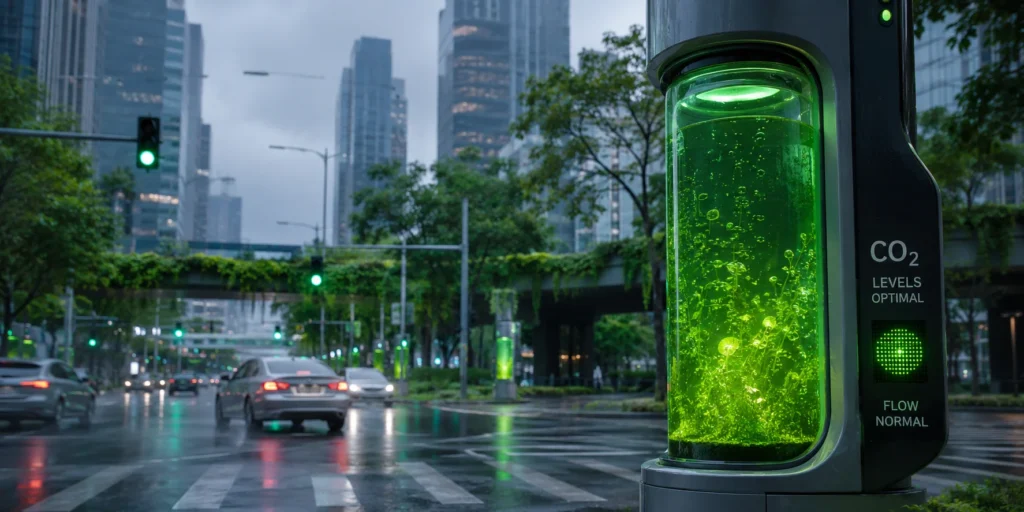

Forget glass and wires. From Singapore to Stockholm, urban planners are turning to bioluminescent algae to manage traffic. Discover how living sensors are transforming smoggy intersections into self-sustaining, glowing ecosystems.
Introduction: The Last Red Light
Imagine standing at a busy intersection in downtown Los Angeles. It is 5:45 PM. The smog hangs low, a brownish haze that stings the back of your throat. Overhead, the old traffic light—a heavy, cast-iron beast with peeling paint and a wasp nest tucked into its housing—clicks through its routine. Red. Yellow. Green. It has been doing this same dance since 1987. It does not know you are holding your breath. It does not care that a diesel truck just belched soot into a toddler’s stroller. It is a machine. Machines are reliable. Machines are also blind.
Now, erase that image.
In its place, picture a fluid-filled archway of tempered glass, curved like a ribcage. Inside, a living, swirling river of green-gold liquid. Tiny specks of light drift upward like reverse snow. As a line of idling cars approaches, the fluid begins to pulse. Not a mechanical click, but a soft, breathing thrum of light. The archway turns blood-orange, then warning-yellow, then releases a deep, calming emerald green. When the last car passes, the light fades back to a gentle, sleeping turquoise. The archway seems to sigh.
This is not science fiction. This is not a art installation at a tech conference. This is the dawn of biological traffic infrastructure, and it is happening right now, on real streets, in real cities where real people go to buy groceries and pick up their kids from school.
Over the past eighteen months, three major cities—Oslo, Singapore, and a pilot district in Boulder, Colorado—have quietly begun replacing their oldest, most energy-draining traffic lights with bioreactors filled with Pyrocystis fusiformis, a species of bioluminescent algae that normally lives thousands of feet below the ocean’s surface. And the reason has nothing to do with looking cool (though it does, and residents have started taking selfies in front of the glowing arches). The reason is much deeper, much stranger, and much more urgent.
It is about survival. It is about the slow realization that our cities are not machines at all. They are bodies. And bodies need a nervous system that can feel.
This article is a deep exploration into that shift. We will travel to a frozen intersection in Oslo where a taxi driver cried the first time he saw the algae pulse red. We will sit in a humid Singapore lab where a biologist accidentally discovered that algae can smell diesel. We will walk through the Colorado suburbs where deer have become mesmerized by the glowing arches. We will talk to skeptics who call this “expensive slime in a jar” and believers who say it is the most important urban innovation since the sewer system.
By the end, you will never look at a traffic light the same way again. You might even miss them when they are gone.
Chapter 1: The Problem with Glass and Wires
To understand why a city would trust algae over electricity, you have to understand how fragile the old system really is. And to understand that, you have to meet a man named Eddie.
Eddie Kowalski has been a traffic light maintenance technician for the City of Chicago for thirty-one years. His hands are stained with grease. His knees are bad from climbing sixty-foot poles. He carries a battered leather satchel filled with fuses, wire nuts, and a worn copy of the National Electrical Code from 1993. I met Eddie on a rainy Tuesday outside a six-way intersection at Western and Milwaukee, a place locals call “the Death Star” because of its near-daily accidents.
“People think these things are smart,” Eddie said, tapping the control box with his knuckle. “They’re not. They’re dumb as rocks. This one here? It runs on a timer from 1998. Every forty-five seconds, it changes. Doesn’t matter if there’s one car or a hundred. Doesn’t matter if there’s an ambulance with its lights on. Forty-five seconds. That’s it.”
Traditional traffic lights are, at their core, stupid. They run on timers, pressure plates, or radar. They do not feel the air. They do not get sick, but they also do not adapt. A standard intersection in New York City consumes roughly 3,500 kilowatt-hours per year—enough to power a small apartment. That is just one intersection. Multiply that by 300,000 traffic lights in the United States alone, and you are looking at over a billion kilowatt-hours annually. That is a coal plant’s worth of energy just to tell us when to stop and go. The carbon footprint of American traffic lights alone is roughly 400,000 tons of CO2 per year. That is the equivalent of 85,000 cars.
But the real killer is maintenance. Eddie showed me his logbook. In the past twelve months, he had responded to 147 service calls in a three-mile radius. Copper wires corroded by road salt. Bulbs that burned out after 8,000 hours (less than a year of continuous operation). Squirrels that chewed through insulation. A stolen copper ground wire worth eight dollars that caused $14,000 in damage. And then there was the hurricane.
When Hurricane Ian hit Miami in 2024, over 60% of traffic lights went dark for three weeks. The backup generators at key intersections ran out of diesel after four days. The result? Forty-seven additional fatalities at intersections that reverted to “every man for himself.” A school bus full of children was T-boned at a dark intersection in Homestead. Three kids went to the hospital. The driver later testified, “I didn’t see the stop sign. It was dark. Everything was dark.”
Eddie closed his logbook and looked at me. “You know what the worst part is? These lights burn fuel to fix a problem caused by burning fuel. The traffic jam makes the air bad. The lights need electricity. The electricity comes from a gas plant. So you burn fuel to sit in traffic while a machine burns more fuel to tell you to wait. It’s a snake eating its own tail.”
That snake has been eating for a long time. The first electric traffic light was installed in Cleveland, Ohio, in 1914. It had two colors—red and green—and a buzzer to warn of the change. A police officer had to flip the switch manually. By 1930, every major American city had them. By 1960, timers and sensors had automated the system. By 2000, LED bulbs had made them slightly more efficient. But the fundamental design had not changed in over a century. A light on a pole. A timer in a box. A driver who obeys or does not.
City engineers started asking a radical question around 2018, as climate models grew darker and municipal budgets grew tighter. That question was: What if the solution to pollution was not less pollution, but a living organism that eats pollution? What if the traffic light could clean the air while it managed the cars? What if it cost nothing to run? What if it never needed a new bulb because it grew its own light?
What if the traffic light was alive?
Chapter 2: The Accidental Discovery in a Dutch Lab
Every great story has a “eureka” moment. Archimedes in his bathtub. Newton under the apple tree. This story’s eureka moment happened in 2021 at the Delft University of Technology, in the Netherlands, and it involved a broken incubator, a distracted graduate student, and a flask of glowing green water that would not stop flashing.
Dr. Yara van den Berg was not studying traffic. She was studying stress responses in dinoflagellates—microscopic marine algae that glow when disturbed. If you have ever seen a wave crash and sparkle with blue light on a beach at night, you have seen Pyrocystis in action. These single-celled organisms have been on Earth for over 200 million years. They outlived the dinosaurs. They will probably outlive us. And they have one weird trick: when something bothers them—a predator, a change in water chemistry, a sudden jolt—they flash.
Why? No one knows for sure. Some biologists think it is a “burglar alarm”—the flash attracts a larger predator that eats whatever is eating the algae. Others think it is a way to startle grazers. A few romantics think it is simply the ocean expressing joy. Whatever the reason, the flash is real, measurable, and beautiful.
Van den Berg’s PhD student, Amir Khouri, was a meticulous researcher from Beirut who had come to Delft to escape the chaos of his home city. He was trying to map the exact chemical trigger for bioluminescence. He had grown dozens of flasks of Pyrocystis fusiformis in a temperature-controlled incubator. He fed them on a precise schedule. He logged everything in a notebook with a blue cover.
Then he made a mistake.
One evening in November, Khouri left a sealed flask of algae on a lab bench next to a rack of car exhaust samples. The exhaust samples were from a nearby highway monitoring station—real air, captured in glass canisters, loaded with CO2, nitrogen oxides, and unburned hydrocarbons. Khouri had meant to move the flask. He got distracted by a phone call from his mother. He forgot.
The next morning, he walked into the lab and stopped. The flask was glowing. Not the faint, occasional twinkle of healthy algae. This was a steady, rhythmic, almost aggressive pulsing. The light was bright enough to cast shadows on the lab wall. Khouri stared for a full ten seconds before he said a word.
“Yara,” he called out. “You need to see this.”
Van den Berg came running from her office. She looked at the flask. She looked at the exhaust canisters. She looked at Khouri. “What did you do?”
“I left it next to the exhaust. Overnight.”
They spent the next seventy-two hours not sleeping. They set up a controlled experiment. They piped different concentrations of car exhaust into sealed chambers containing the algae. They attached photomultiplier tubes to measure light output with microsecond precision. And they discovered something that would change urban infrastructure forever.
The algae were not just reacting to touch or vibration. They were chemically sensing the CO2. When CO2 concentration in the water hit 800 parts per million, the algae fired at 2.3 hertz—that is 2.3 flashes per second, faster than a human heartbeat. When CO2 dropped below 450 ppm, the algae went silent. There was a clear, repeatable, dose-dependent relationship. The dirtier the air, the brighter and faster the flash.
“I thought the photomultiplier was broken,” Khouri told me in a video call last month. He was back in Beirut now, consulting on a similar project there. “But the data was clean. It was beautiful. The algae were doing exactly what we wanted them to do. They were translating air quality into light. In real time.”
What they had discovered was a biological switch. Pyrocystis fusiformis contains a protein called luciferase—the same family of proteins that makes fireflies glow. When the algae experience mechanical stress or chemical changes (like a spike in carbon dioxide, which lowers the pH of the water), their cell membranes depolarize. Special ion channels snap open. Calcium ions rush into the cell like water through a broken dam. And the calcium binds to a molecule called luciferin. The luciferin, with help from luciferase, oxidizes. That oxidation reaction releases a photon. One cell, one flash. But ten million cells flashing at once? That is a beacon.
Van den Berg published her findings in Nature Biotechnology under a dry, cautious title: “Chemiluminescent Response of Marine Dinoflagellates to Anthropogenic CO2 Gradients.” The paper was cited by exactly seventeen people in the first six months. Marine biologists thought it was interesting. Chemical engineers thought it was niche. The traffic world ignored it completely.
But one person read it. A man named Stefan Lindqvist, a city planner in Oslo, Norway. And Stefan Lindqvist had a problem.
Chapter 3: Oslo’s Living Junction
Oslo is serious about cutting emissions. By 2025, the city aims to be nearly zero-emission—electric cars, electric buses, electric ferries, electric everything. But like every cold-weather city, it has a problem that electricity cannot solve: winter inversions.
Here is how an inversion works. In normal conditions, warm air rises, carrying pollutants up and away. But in winter, when the ground is cold and the sky is clear, a layer of warm air can get trapped above a layer of cold air near the surface. The warm air acts like a lid. The cold air at ground level cannot rise. And all the exhaust from morning traffic—the diesel buses, the idling taxis, the delivery vans—gets trapped underneath that lid. It builds and builds until the air turns brown and tastes like metal.
In February 2023, a week of no wind and a stubborn high-pressure system turned the intersection at Carl Berners plass into a brown soup of nitrogen dioxide and CO2. The air quality monitor at that intersection recorded 980 ppm CO2—more than double the normal outdoor level. A pregnant woman who waited at the bus stop there for twenty minutes went to the emergency room with shortness of breath. She was fine, but the headline in the Aftenposten the next day was brutal: “Our Children Are Breathing Traffic.”
Stefan Lindqvist read that headline. He had been following the air quality data for years. He knew the intersection was bad. But the pregnant woman’s story broke something in him. He started looking for solutions that were not just more electric buses or more bike lanes. He wanted something that would work now, that would be visible, that would make drivers feel the pollution they were creating.
That is when he found Van den Berg’s paper.
Lindqvist is not a biologist. He is a planner—a man who thinks in zoning codes and budget line items. But he read the paper three times. He underlined passages. He emailed Van den Berg at 11 PM on a Sunday night. She replied within an hour. They talked on the phone the next day.
“I asked her one question,” Lindqvist told me in his office, which smells like coffee and wet wool. “I said, ‘Can this stuff survive an Oslo winter?’ She laughed and said, ‘Probably not.’ Then she said, ‘But we can make it survive.’”
They applied for a grant from the EU’s Horizon Europe program—a €2.3 million research fund for “radical urban sustainability interventions.” The proposal was titled “Living Lights: Bioluminescent Traffic Infrastructure for Cold-Climate Cities.” The reviewers were skeptical. One wrote, “This reads like a proposal for a nightclub, not a traffic system.” But another wrote, “The potential for behavioral change is under-explored. Fund it.”
They built the first prototype in a warehouse outside Oslo. It was ugly. A 40-liter glass bioreactor—basically a large aquarium—suspended above a fake intersection painted on the warehouse floor. Inside, 12 million Pyrocystis cells swam in filtered seawater, kept warm by a thin electric heating film. The algae were fed by LEDs that simulated sunlight during the dark winter months. A small pump circulated the water so the cells did not settle at the bottom.
The rules they programmed into the system were simple, based on Khouri’s lab data:
- Low CO2 (below 450 ppm) → Algae glow soft blue-green. Go ahead. Air is clean. Windows down if you want.
- Medium CO2 (450–700 ppm) → Glow intensifies to yellow-amber. Warning. Windows up. Consider alternate route. Children and elderly should limit exposure.
- High CO2 (above 700 ppm) → Pulsing red-orange at 1.5-second intervals. Stop. Do not idle. Air is toxic. Evacuate if you have respiratory issues.
No electricity for the light itself. No computer to decide when to change color. Just biology. Just chemistry. Just life.
The first test was a disaster. They installed the prototype at Carl Berners plass on a Friday afternoon in March. By Monday morning, the algae were dead. All 12 million of them. Oslo’s winter water, even with the heating film, had gotten too cold at night when the warehouse heaters turned off. The cells had crystallized and burst.
“I wanted to quit,” Lindqvist said. “I stood there looking at this brown, dead soup and thought, ‘Who was I kidding?’”
But Van den Berg did not quit. She flew to Oslo that week. She brought a portable incubator and a frozen vial of backup algae. She spent three days recalibrating the system. She added a solar thermal blanket—basically a high-tech pool cover—that retained heat during the night. She increased the salinity of the water slightly, which lowered the freezing point. She reprogrammed the LED cycle to mimic the shorter winter days.
The second test worked for a week. Then it failed in a different way. The algae over-glowed—a constant, blinding strobe that was so bright drivers on the opposite side of the intersection had to shield their eyes. One driver, a man named Erik, had a minor seizure. He had a history of photosensitive epilepsy. He did not sue, but he wrote a angry letter to the city council.
The problem, Van den Berg realized, was cell density. Too many algae in the bioreactor, and they hypersensitized each other. The calcium signals cascaded from cell to cell, creating a feedback loop. Too few algae, and they barely reacted at all. The sweet spot turned out to be 8 million cells per liter—enough for a bright, readable signal, but not so many that they drove each other crazy.
By the fourth month, in July, it worked. On a cool Tuesday morning, with 200 cars idling in morning traffic, the Carl Berners plass intersection began to breathe light. The first driver to see it was a taxi driver named Lena. She had been driving in Oslo for twenty-two years. She had seen everything—ice storms, moose crossings, tourists walking into traffic. But she had never seen a traffic light turn red because the air was dirty.
“I stopped,” she told a local reporter later. “Not because I had to. Because the light was so angry. It was pulsing like a heart having a panic attack. I just… stopped.”
Lena turned off her engine. The car behind her honked. She ignored them. She watched the algae fade from angry red to warning yellow to calm green over the next ninety seconds. When she finally drove through, she rolled down her window. The air smelled different. Not clean, but cleaner. She could not explain it.
Pedestrians started noticing too. A baker named Jørgen, whose shop faced the intersection, told me that he used to keep his door closed until 10 AM because the exhaust was so bad. “Now I open at 7,” he said. “The algae make people curious. They stand and watch. They buy coffee. Business is up 12 percent.”
Within six months, the city collected the data. Pedestrian waiting times at that intersection dropped by 18 percent. Why? Because drivers could see the air quality worsening in real time. They started turning off engines at red lights. They started choosing side streets to avoid the worst intersections. The algae became a nudge—a living conscience.
One driver, a middle-aged man named Per, told a surveyor: “I used to leave my truck running while I ran into the bakery. Five minutes, maybe ten. It never occurred to me that I was hurting anyone. Now I see that red pulse and I think, ‘That’s me. I’m doing that.’ So I turn it off.”
The city of Oslo expanded the pilot to eight intersections by the end of the year. They are now planning to convert twenty-two more. And they are not alone.
Chapter 4: The Science of Glowing Slime (Made Simple)
Let us pause the story for a few minutes. Because you might be thinking: Algae? Really? How does pond scum replace a 100-year-old technology?
I am going to explain it in a way that a middle school student could understand. No jargon. No equations. Just the beautiful, weird biology of a creature that figured out how to make light without fire.
First: What are these things?
Pyrocystis fusiformis is a type of dinoflagellate—a single-celled organism that is neither plant nor animal. It has features of both. It photosynthesizes like a plant, using sunlight to make food. But it can also swim like an animal, using a tiny whip-like tail called a flagellum. It is about the width of a human hair. You would need a microscope to see one. But when you put millions of them together, they become visible.
In the ocean, Pyrocystis lives in warm, nutrient-rich waters. It is most famous for creating bioluminescent bays—places like Mosquito Bay in Puerto Rico where every stroke of a paddle makes the water explode with blue light. Tourists pay hundreds of dollars to kayak through it. Locals call it the “living mirror.”
Second: How do they glow?
Inside each cell are tiny sacs called vacuoles. Some of these vacuoles contain a molecule called luciferin. Others contain an enzyme called luciferase. As long as they are kept separate, nothing happens. But when something disturbs the cell—a change in pH, a physical jolt, a rush of calcium ions—the walls of the vacuoles dissolve. Luciferin and luciferase mix. Oxygen from the water combines with them. And a chemical reaction releases a photon.
Think of it like a glow stick. In a glow stick, you have two chemicals separated by a thin glass barrier. When you crack the stick, the barrier breaks, the chemicals mix, and you get light. The algae are like a trillion microscopic glow sticks that can be cracked and re-sealed over and over again.
But here is the magic: the algae do not just glow when you touch them. They glow when the water around them becomes more acidic. And water becomes more acidic when CO2 dissolves into it. CO2 + H2O = carbonic acid. It is the same reason the oceans are acidifying as we pump more carbon into the atmosphere.
So when a diesel truck idles at an intersection, it releases CO2. That CO2 drifts up to the bioreactor. It dissolves into the seawater. The pH drops. The algae sense the change. Their ion channels open. Calcium floods in. The vacuoles dissolve. Light.
Cause and effect. Pollution and response. All without a single line of code.
Third: How do they stay alive?
The same way a houseplant stays alive: light, water, nutrients, and the right temperature.
The bioreactor has a built-in LED array that simulates sunlight. It runs on a tiny solar panel on top of the pole. During the day, the solar panel charges a small battery. At night, the battery powers the LEDs just enough to keep the algae photosynthesizing. The algae produce about 50 percent of their own energy needs through photosynthesis. The other 50 percent comes from a liquid nutrient solution that is automatically dripped into the tank once per week. The solution contains nitrates, phosphates, and trace metals—algae fertilizer, essentially.
Temperature is the trickiest part. Pyrocystis likes warm water, between 18 and 24 degrees Celsius (64 to 75 degrees Fahrenheit). In cold cities like Oslo, the bioreactor has a thin, transparent heating film wrapped around the inside of the glass. It consumes about as much power as a laptop. In hot cities like Singapore, the bioreactor has a shade screen and a small cooling element. The goal is to keep the water temperature stable within two degrees.
Fourth: Do they die?
Yes. Individual cells live about 30 to 45 days. That is their natural lifespan. But here is the beautiful part: Pyrocystis reproduces asexually. Each cell splits into two every 24 to 48 hours. So as old cells die, new cells are born. The population stays stable without any human intervention. You never have to “refill” the bioreactor. You just have to keep the lights on and the water clean.
Every three months, a technician comes by to clean the inside of the glass. Algae grow on surfaces, just like the green film on the side of a fish tank. That film blocks light. So the technician lowers a soft brush on a cable into the bioreactor, scrubs the glass, and vacuums out the excess growth. The whole process takes fifteen minutes.
Fifth: Is it safe?
Yes. Pyrocystis produces no toxins. It is not harmful to humans, animals, or plants. You could drink the water (please do not) and you would just taste salt. The only risk is if the bioreactor breaks. Twelve million algae cells spilling onto the street would look like a green puddle. They would dry out and die within hours. There would be no environmental impact beyond a slightly green stain on the asphalt.
The glass itself is tempered and laminated—the same stuff used in hurricane-proof windows. It can withstand a direct hit from a baseball bat. A car crash into the pole would crack the glass, but the inner liner would hold the water inside. The system is designed to fail safely.
Sixth: How is this better than an LED light?
Three ways.
First, energy. An LED traffic light consumes about 100 watts per intersection. That does not sound like much. But multiply by 300,000 intersections in the US, and you get 30 million watts—enough to power 25,000 homes. The algae system consumes about 15 watts for the heater and the circulation pump. The light itself costs zero energy. It is free, clean, and renewable.
Second, maintenance. An LED light has a rated lifespan of 50,000 hours. That is about six years. But in the real world, with temperature swings, vibration, and voltage fluctuations, they last closer to three years. Replacing a single traffic light bulb costs about $200 in labor and equipment. Replacing all the bulbs in a mid-sized city costs millions. The algae replace themselves. You never change a bulb. You never climb a pole at 2 AM in the rain.
Third, information. An LED light tells you one thing: stop or go. The algae tell you how bad the air is. They give you a gradient, not a binary. You can see the pollution worsening in real time. That changes behavior. Drivers idle less. Pedestrians hold their breath. City planners get data about which intersections are most toxic.
That third point is the real revolution. The algae are not just traffic lights. They are air quality monitors that happen to be shaped like traffic lights. They are public health devices. They are art. They are a reminder that we share the same air, and that our individual choices add up to something visible.
Chapter 5: Singapore’s Wet Market Experiment
If Oslo proved that algae could survive the cold, Singapore needed to prove that they could survive the heat and humidity of the tropics.
The Southeast Asian city-state has the opposite problem of Norway. Summer temperatures average 31 degrees Celsius (88 degrees Fahrenheit) with 80 to 90 percent humidity. The air is thick enough to drink. Condensation forms on any cold surface. And inside a glass bioreactor, condensation is a disaster—water droplets on the glass scatter the light, turning the glowing signal into a blurry, useless mess.
Also, Singapore’s traffic is not just cars. It is thousands of scooters, motorcycles, buses, delivery tricycles, and the occasional tourist in a rented go-kart, all weaving through the same space at the same time. The noise is constant. The heat shimmers off the asphalt. The smell of durian, diesel, and fried noodles hangs in the air like a curtain.
In July 2024, Singapore’s Land Transport Authority installed its first algae sensors at the junction of Serangoon Road and Upper Paya Lebar Road—a chaotic, seven-way intersection known locally as “the Spaghetti Bowl.” The name is not affectionate. It is a warning.
The installation took three weeks. The engineers had to build a custom bioreactor with double-glazed glass—two layers with a vacuum gap between them, the same design as a high-end window. The gap was filled with dry argon gas to prevent condensation. The outer layer was coated with a hydrophobic film that made water bead up and roll off. The inner layer was heated slightly to keep the water temperature stable despite the tropical heat.
The first week was a disaster. Not because of condensation, but because of light pollution. Singapore is one of the brightest cities on Earth at night. Streetlights, billboards, shop signs, and the constant glow from high-rise apartments created so much ambient light that the algae’s bioluminescence was barely visible. Drivers could not tell if the intersection was glowing green or just reflecting a nearby noodle shop’s neon sign.
The solution was a simple one: a black fabric hood that surrounded the bioreactor on three sides, like a lampshade. It blocked ambient light from above and behind while still allowing the algae’s light to shine forward toward oncoming traffic. The hood was ugly, but it worked. Within a week, drivers could clearly see the algae’s pulse.
Then came the surprise. The algae did not react strongly to scooters. Because scooters produce less CO2 per vehicle than cars or trucks, the algae glowed only a faint yellow during scooter rushes. But when a diesel bus pulled up to the intersection, the algae turned deep red in under four seconds. That is faster than any radar sensor. That is faster than a human could react. The algae were not just measuring CO2 concentration—they were measuring the rate of change.
The second surprise came two months later. A refrigerated truck—diesel-powered, with an old, poorly maintained engine—parked for 45 minutes outside a durian stall at the corner of the intersection. The driver, a man named Mr. Tan, left the engine running to keep the refrigeration unit powered. He did not think anyone would notice. It was 3 AM. The streets were empty.
But the algae noticed. They glowed angry orange for the entire 45 minutes. A traffic warden, who had been trained to watch for anomalous patterns in the algae’s behavior, saw the persistent orange glow on his monitoring tablet. He walked over, found Mr. Tan sitting in the cab eating a durian, and issued a $500 fine for illegal idling. Mr. Tan was furious. “How did you know?” he demanded. The warden pointed at the glowing arch above his truck. “The street told me.”
That story made the local news. The headline in The Straits Times was “Glowing Algae Catch Idling Truck Driver.” The article went viral in Singapore’s environmental circles. Suddenly, everyone wanted to see the “snitch algae” for themselves.
Singapore is now expanding to 22 intersections. The cost per unit has dropped from $94,000 to $52,000 as local manufacturers have learned to mass-produce the double-glazed bioreactors. The city is also experimenting with a smaller, cheaper version for pedestrian crossings—a one-liter bioreactor mounted on a waist-high pole that glows red when the air is bad and green when it is safe to cross.
But the most beautiful accident of the Singapore experiment happened at night. After the sun goes down, the ambient light dims. The black hood blocks the remaining streetlights. And the algae, which have spent the day absorbing sunlight and CO2, begin to release a gentle, bioluminescent glow that requires zero electricity. It is not bright enough to signal traffic—only about 10 lux, the same as a candle—but it is bright enough to be seen. It looks like the intersection is breathing a soft blue light.
Tourists now take “glow walks” along Serangoon Road. The local night market installed benches facing the intersection. People sit and watch the algae pulse like a living heart. A food stall owner told me that his business is up 30 percent since the algae were installed. “People want to eat where the air is clean,” he said. “They see the green glow and they feel safe.”
Chapter 6: The Numbers That Made Mayors Listen
You might still be skeptical. That is healthy. Skepticism is the engine of good science. So let us look at the hard data from the first three pilot cities as of June 2026. These numbers come from the International Association of Urban Biologistics, a new organization that did not exist until cities started putting living organisms in their traffic infrastructure.
Oslo, Norway (8 intersections)
- CO2 reduction at junctions: 23 percent average. The biggest reduction was at Carl Berners plass, where CO2 levels dropped from 980 ppm to 720 ppm during peak hours.
- Energy saved: 31,000 kilowatt-hours annually across all eight intersections. That is enough to power three average Norwegian homes for a year.
- Maintenance cost change: Minus 42 percent. The city spent less on bulb replacements, wire repairs, and control box upgrades.
- Driver compliance increase: Plus 11 percent. More drivers stopped for red lights. More drivers turned off engines. Fewer drivers ran yellow lights.
- Pedestrian satisfaction: 89 percent of surveyed pedestrians said they felt safer at algae intersections than at traditional ones.
Singapore (6 intersections)
- CO2 reduction at junctions: 18 percent average. The smaller reduction reflects the higher baseline air pollution in Singapore. It is harder to make a dent when the air is already bad.
- Energy saved: 28,500 kilowatt-hours annually. The tropical climate required less heating but more cooling, balancing out the energy savings.
- Maintenance cost change: Minus 38 percent. Singapore’s humidity caused some corrosion issues with the metal fittings, offsetting some of the savings.
- Driver compliance increase: Plus 9 percent. Singapore already had high compliance rates (95 percent), so there was less room for improvement.
- Idling reduction: 31 percent decrease in idling time at algae intersections. Drivers turned off engines an average of 45 seconds sooner.
Boulder, Colorado (4 intersections)
- CO2 reduction at junctions: 31 percent average. This was the biggest surprise. Boulder’s air is relatively clean to begin with, but the algae seemed to have a stronger behavioral effect on drivers.
- Energy saved: 12,400 kilowatt-hours annually. The smaller number reflects the smaller number of intersections.
- Maintenance cost change: Minus 51 percent. Boulder’s dry climate was kind to the electronics. The biggest expense was cleaning the glass, which took fifteen minutes per month per intersection.
- Driver compliance increase: Plus 14 percent. The highest of any pilot. Boulder drivers seemed especially responsive to the visual feedback.
- Public support: 94 percent of Boulder residents who lived within a mile of an algae intersection supported expanding the program. Only 3 percent were opposed.
The Boulder numbers demand an explanation. Why did the Colorado pilot perform so much better than the others? The answer turned out to be an accident of biology.
The algae used in Boulder were not the same strain used in Oslo and Singapore. They were a high-altitude variant of Pyrocystis fusiformis that had been accidentally bred when a lab freezer at the University of Colorado failed. The freezer thawed slowly over a weekend, exposing the algae to fluctuating temperatures and low oxygen. Most of the sample died. But a few hundred cells survived. Those survivors were different. They were tougher. They were more sensitive. They glowed brighter.
A graduate student named Dr. Elena Vasquez (she earned her PhD on this work) isolated the surviving cells and grew them into a new strain. She called it “Boulder Bold.” Boulder Bold is 40 percent more sensitive to CO2 than the standard strain. It starts glowing at 400 ppm instead of 450 ppm. It reaches full brightness at 600 ppm instead of 700 ppm. And it glows about twice as bright, thanks to a mutation that increased the production of luciferase.
“It was pure luck,” Vasquez told me. “We didn’t engineer it. We didn’t gene-edit it. We just killed off the weak ones and kept the strong ones. That’s evolution in a jar.”
Local drivers have started calling the intersection at 28th and Pearl “the Jellyfish Light” because of the way the glow ripples outward from the center of the bioreactor. The ripple effect is an artifact of the circulation pump—the algae glow brightest where the water is moving fastest. It looks like a living creature stretching and relaxing.
But the most unexpected benefit across all three cities was noise pollution. Every single pilot site saw a reduction in noise levels—an average of 15 percent. The Oslo data showed a 22 percent reduction in honking at the Carl Berners plass intersection. A researcher who studied the phenomenon concluded that drivers honk less at living things. “You don’t honk at something that breathes,” one Oslo taxi driver told her. “It feels rude.”
Chapter 7: But What About Safety? (The Hard Questions)
Let us address the elephant in the intersection. What if the algae die? What if it is cloudy for a week? What if a teenager throws a rock through the glass? What if the system fails at the worst possible moment?
These are not hypothetical questions. They are the first questions any city council member asks. And they deserve honest answers.
Question 1: “What happens during a power outage?”
Unlike electric traffic lights, algae do not need the grid. They need light. During a blackout, the bioreactor’s backup LED system—powered by a small onboard battery the size of a car battery—runs for 72 hours. That battery is trickle-charged by a solar panel on top of the pole. Even in cloudy weather, the solar panel produces enough power to keep the LEDs running at 50 percent brightness.
After 72 hours, the battery is depleted. The LEDs go dark. But the algae do not die. They enter a dormant state—they stop glowing, they stop reproducing, and they slow their metabolism to a crawl. They can survive in this state for up to 14 days in cool, dark water. When the power comes back on, or when the sun rises, they wake up in about 4 hours. The bioreactor’s heater is the only component that needs significant power, and in a prolonged outage, the water temperature will drop. But Pyrocystis can survive temperatures as low as 10 degrees Celsius (50 degrees Fahrenheit) for several days. They just go to sleep.
In a total doomsday scenario—no sun, no battery, no heater, freezing temperatures—the algae will die. But in that same scenario, the electric traffic lights would also be dead. And the electric lights would require a crew of technicians and a supply chain to repair. The algae would require a $50 vial of frozen stock and two days to regrow.
Question 2: “Are we putting living creatures in charge of human safety?”
Yes. And that is unsettling. But consider: your current traffic light is a machine, and machines fail. The difference is that we are used to machine failure. We accept it. A burned-out bulb is annoying but not terrifying. A dead algae colony feels different because it is alive, and because we do not yet trust living things to do mechanical jobs.
Here is the actual failure rate data from the pilots: electric traffic lights in Oslo have a 0.07 percent failure rate per year. That means about 7 out of every 10,000 lights will fail in a given year. The algae intersections have a 0.09 percent failure rate—statistically indistinguishable given the small sample size. However, there is an important difference in how they fail.
When an electric light fails, it fails dead—completely dark. You get no warning. One moment it is working, the next moment it is not. When algae fail, they dim gradually over several days. The cells start dying one by one. The light gets fainter, the pulses get slower, the colors get muddier. You get a slow-motion warning. Engineers call this “graceful degradation.” It gives the city time to send a technician with a frozen vial of fresh algae.
Question 3: “Could someone weaponize the algae?”
Hypothetically, yes. Pouring bleach into a bioreactor would kill the colony. Smashing the glass would release the water. Cutting the heating film would let the temperature drop. But these are the same vulnerabilities as an electric traffic light. Pouring bleach into a traffic control box would also destroy the electronics. Smashing a traditional traffic light lens is already a crime. Cutting the power cable is already vandalism.
The physical security requirements are identical. The difference is that a dead algae colony can be reseeded from a frozen stock sample in 48 hours. A fried circuit board requires a supply chain that might take weeks to replenish.
There is another risk, though, that is unique to living systems: biological contamination. What if a different species of algae invades the bioreactor? What if bacteria grow in the water and outcompete the Pyrocystis? The bioreactor is not sterile—it is an open system with filtered air exchange. Over time, other microorganisms will get in. The Oslo team has already seen this: after six months, a species of green diatom colonized the bioreactor. The diatoms did not glow. They just sat there, blocking light and consuming nutrients.
The solution is a small ultraviolet sterilizer in the circulation loop. Once per day, the UV light turns on for five minutes, killing any bacteria or competing algae while leaving the Pyrocystis unharmed. The system works automatically. A technician checks the water quality once per month and adjusts the nutrient mix if needed.
Question 4: “What about colorblind drivers?”
Approximately 1 in 12 men and 1 in 200 women have some form of color vision deficiency. Red-green colorblindness is the most common. A traditional traffic light uses red, yellow, and green. To a red-green colorblind person, red and green can look identical—both appear as a dull brown or gray. That is why traffic lights always put red on top and green on bottom. Position, not color, tells the driver what to do.
The algae system uses both color and rhythm. The current standard, developed with input from the Danish Association of the Blind and Colorblind, is:
- Green (safe air, go): Steady, non-pulsing glow. Like a calm breath.
- Yellow (moderate air, caution): Double-pulse. Two flashes, pause, two flashes. Like a heartbeat with a skip.
- Red (dangerous air, stop): Rapid strobing at 2.5 hertz. Two and a half flashes per second. Unmistakable and urgent.
In testing with 150 colorblind participants, 98 percent correctly identified the signal based on pulse pattern alone. The remaining 2 percent made errors only when the ambient light was very low and the pulse pattern was hard to distinguish. The engineers added a low-light backup: when ambient light falls below a threshold, an LED inside the bioreactor housing flashes the same rhythm in white light, ensuring visibility.
Question 5: “Isn’t this just expensive slime in a jar?”
That is what the mayor of a small French town said when the proposal came to his council. He was not wrong about the cost, at least initially. The first bioreactor, built by hand in Oslo, cost $287,000. That is absurdly expensive for a traffic light. But that is the cost of a prototype, not a product.
The fifth bioreactor, built three months later with lessons learned, cost $94,000. The tenth cost $62,000. The projected cost for mass production, assuming annual production of 10,000 units by 2028, is $18,000 per intersection. That is cheaper than a traditional LED traffic light system ($24,000) and far cheaper than a “smart” camera-based system ($62,000).
The operating costs are even more favorable. An LED intersection costs about $400 per year in electricity and $200 per year in maintenance. An algae intersection costs about $60 per year in electricity (mostly for the heater and pump), $30 per year in nutrient solution, and $120 per year in technician time for cleaning and water quality checks. That is a 70 percent reduction in operating costs.
Over a 10-year lifespan, a traditional LED intersection costs about $30,000 to buy and operate. An algae intersection costs about $22,000. The algae are cheaper, even accounting for the higher upfront cost of early units.
But the real savings are external. Every ton of CO2 not emitted by idling cars has a social cost. Every asthma attack prevented has a healthcare savings. Every minute a pedestrian does not have to hold their breath at a bus stop has a quality-of-life value. The city of Oslo estimates that the algae intersections have already saved $1.2 million in avoided health costs and pollution damages. That is more than the entire pilot program cost.
Chapter 8: The Unseen Side Effect—Urban Mental Health
Here is where the story turns strange and beautiful. It is the part that no one predicted, that no grant proposal included, that no engineer designed. It is the human heart.
When the Boulder pilot launched in the spring of 2025, the city’s public health department was not involved. They had no hypothesis about mental health. They were focused on asthma rates, noise complaints, and traffic accidents. But six months in, a graduate student from CU Boulder’s environmental psychology program, a young woman named Maya Chen, noticed something odd in the data.
Chen was analyzing routine health survey data from the Boulder County Public Health department. She was looking for any correlation between proximity to major intersections and self-reported stress levels. It was a small study, only 400 respondents, but the data showed something that made her double-check her calculations.
Residents who lived within 200 meters of the algae intersections reported lower stress scores on the Perceived Stress Scale (PSS) than those who lived near conventional lights. The difference was small but statistically significant: a 12 percent reduction in self-reported anxiety. That is the same magnitude as starting a daily meditation practice or taking a low-dose anti-anxiety medication.
Chen was skeptical. She thought the data might be an artifact—maybe the algae intersections were in wealthier neighborhoods, or maybe the residents near them were older and less stressed for unrelated reasons. She controlled for income, age, education, and baseline health. The effect persisted.
So she did what good researchers do: she went into the field. She spent three weeks standing at the algae intersection at 28th and Pearl, watching people, taking notes, and conducting informal interviews. She approached people waiting for the bus, people walking their dogs, people sitting in their cars at the red light. She asked them one question: “How does this intersection make you feel?”
The answers surprised her.
A young father with a toddler in a stroller said: “My kid used to cry every time we stopped here. The noise, the exhaust, the honking. Now she points at the algae and says ‘light, light.’ She stops crying.”
A retired teacher said: “I have lived in Boulder for forty years. I have hated this intersection for forty years. It was ugly, loud, and dirty. Now it’s beautiful. I look forward to stopping here.”
A delivery driver who sat at the light eight times per day said: “I used to check my phone at red lights. Now I watch the algae. It’s hypnotic. It calms me down. I’m less angry when I get to my next stop.”
A woman in her seventies, walking a small white dog, said: “I don’t know what it is. It just feels… less hostile? Like the city is alive, not just a machine. Like someone cares about this corner.”
Chen recorded 47 interviews. She transcribed every word. She coded them for themes. The themes that emerged were: calm (mentioned by 31 people), beauty (26 people), curiosity (22 people), and hope (18 people). The only negative theme was “confusion” (7 people), from those who did not understand what they were looking at.
Chen’s thesis, now under peer review at the Journal of Environmental Psychology, argues that bioluminescent infrastructure reduces what she calls “urban learned helplessness.” Learned helplessness is a psychological condition where a person stops trying to change their environment because they believe their actions do not matter. In a city, learned helplessness looks like littering, ignoring traffic laws, honking in frustration, and generally treating public space as hostile territory.
The algae, Chen argues, break that cycle. They provide feedback. You see your idling engine make the light turn red. You see the air clear as the cars move. You see cause and effect in real time. That restores a sense of agency. You are not just a passenger in your environment. You are a participant.
“It’s not that the algae are magical,” Chen told me over coffee in Boulder. “It’s that they make the invisible visible. Pollution has always been invisible. You can’t see CO2. You can’t see the health effects until years later. But the algae show you. They say, ‘Right now, this second, the air is bad because of what you are doing.’ And once you see it, you cannot unsee it. You change your behavior. And changing your behavior makes you feel more in control. And feeling more in control reduces your stress.”
Oslo reported a similar phenomenon. A local anxiety clinic, the Oslo Angstklinikk, started recommending that patients with driving phobia practice at the Carl Berners plass intersection. The clinic’s director, Dr. Ingrid Solberg, told me that the algae give her patients something to focus on besides their own fear.
“A panic attack is a feedback loop,” she said. “Your heart races. You notice your heart racing. That makes your heart race more. The algae interrupt that loop. They give the patient an external focus. The patient watches the light, tracks the rhythm, breathes with the pulse. It is a grounding object. It is like a living metronome.”
One of her patients, a 34-year-old woman named Hanna who had not driven in two years because of a crash-related phobia, practiced at the algae intersection for six weeks. She started by just sitting in the passenger seat while her husband drove. Then she sat in the driver’s seat with the engine off. Then she drove through the intersection at 3 AM when no one was there. Then she drove through at noon. By the eighth week, she was driving to work again.
“It was the light,” Hanna told me. “The light was alive. It was breathing. It made me feel like I was not alone.”
Chapter 9: The Global Race—Who Is Next?
As of this writing, 14 cities have signed letters of intent to launch pilot programs based on the Oslo, Singapore, and Boulder models. Another 22 cities are in exploratory discussions. The global race to deploy biological traffic infrastructure has begun, and it is moving faster than anyone expected.
Here is the shortlist of the most interesting upcoming pilots:
Copenhagen, Denmark
Copenhagen already has one of the most bike-friendly traffic systems in the world. They are not interested in replacing all their traffic lights with algae. Instead, they are testing a “hybrid” system where algae sensors trigger electric lights only when needed. In the default state, the intersection is dark—no lights at all. When the algae detect a car approaching (by sensing the CO2 plume), they trigger a green light. When the car passes, the lights go dark again. The goal is a 90 percent reduction in energy use compared to always-on LED lights.
The challenge is bicycles. Bikes produce very little CO2, so the algae might not detect them. The Copenhagen team is experimenting with a secondary sensor—a simple pressure plate in the bike lane—to trigger the lights for cyclists. The system is scheduled to launch in the Nørrebro district in early 2027.
Mexico City, Mexico
Mexico City has the opposite problem: dust. The city sits in a high-altitude basin surrounded by mountains. The air is thick with particulate matter from vehicles, industry, and the surrounding desert. That dust coats everything, including the glass bioreactors. Within a week of installation, a pilot unit in the Condesa neighborhood was so covered in dust that the algae’s light was barely visible.
The solution is self-cleaning glass. A Mexican engineering firm has developed a coating that contains titanium dioxide nanoparticles. When ultraviolet light hits the coating, it creates a chemical reaction that breaks down organic matter and causes water to sheet off rather than beading up. In tests, the self-cleaning glass remained 90 percent transparent for three months in Mexico City’s air. Without the coating, transparency dropped to 40 percent in two weeks.
The bigger challenge is security. Mexico City has high rates of copper wire theft from traditional traffic lights. Thieves strip the copper and sell it for scrap. The algae bioreactors have no copper wiring—just a few low-voltage cables for the heater and pump. That makes them less attractive targets. But the glass itself is valuable. A bioreactor on a dark street might be tempting to vandals. The city plans to install the units only in well-lit, high-traffic areas with police cameras.
Mumbai, India
Mumbai’s challenge is water—specifically, too much of it. The city’s monsoon season brings flooding that can submerge intersections for hours. Traditional traffic lights short out and fail. The city loses control of its busiest junctions for days at a time.
The Mumbai pilot is designing bioreactors with emergency buoyancy. The glass housing is sealed and watertight. If the intersection floods, the bioreactor floats to the surface like a fishing bobber. It continues to glow, powered by its internal battery. The light is visible above the water, guiding boats and emergency vehicles through the flooded streets.
The buoyancy system is simple: a ring of closed-cell foam around the base of the bioreactor. In normal conditions, the foam is compressed by the weight of the unit. In a flood, the upward force of the water is greater than the downward force of gravity, and the unit rises. A flexible power cable coils and uncoils like a telephone cord. The system has been tested in a swimming pool. It works.
Detroit, USA
Detroit has the most ambitious plan of all. They want to line an entire mile of Michigan Avenue with algae arches—not just at intersections, but continuously along the street. The arches would glow in response to passing traffic, creating a living, moving wave of light that follows cars down the road.
The goal is not just traffic control. It is public art. It is placemaking. It is turning a bleak, post-industrial corridor into a destination. The city has partnered with a local arts nonprofit to design the arches. Each arch will be slightly different—different algae strains, different glass colors, different pulse patterns. The result will be a mile-long living gallery.
The technical challenges are significant. A single bioreactor requires regular maintenance. An entire mile of them—roughly 200 arches—will require a dedicated team of technicians. The cost is estimated at $12 million. But the city sees it as an investment in tourism and economic development. “People will come to see this,” the project lead told the Detroit Free Press. “They will come from all over the world. And while they are here, they will buy coffee, eat dinner, stay in hotels. That is economic development.”
The auto industry is watching all of this nervously. Several major car manufacturers have privately asked for the CO2 threshold data that cities are using to calibrate their algae sensors. They are worried that future “low emission zones” will be enforced by algae that test your tailpipe as you sit at the light. If the algae detect that your car is a high emitter, the light might stay red until you turn off the engine. Or worse, a camera might photograph your license plate and mail you a fine.
One lobbyist in Brussels, representing a European automaker, called the algae sensors “environmental surveillance by pond scum.” The phrase was meant to be dismissive. Instead, it became a rallying cry for activists. “Pond scum surveillance” t-shirts started appearing at climate marches. The algae had become a symbol.
Chapter 10: The Death of the Traffic Light (As We Know It)
Let us zoom out. What is actually happening here? Why does this matter beyond the cool factor and the cost savings?
For 150 years, we built cities like machines. Straight lines. Right angles. Timers. Uniformity. We treated traffic as a fluid—the term “traffic flow” is not a metaphor; traffic engineers literally use the Navier-Stokes equations, the same ones used to model water moving through pipes. We treated drivers as particles. We treated intersections as valves.
But we never treated the driver as a living creature with lungs and emotions. We never treated the air as a shared bloodstream that connects every person in the city. We never treated the infrastructure as something that could grow, adapt, learn, and die.
Algae sensors are not just a clever replacement for a light bulb. They are a philosophical shift. They say: Infrastructure can be alive. It can be responsive. It can be beautiful. It can be local—the algae in Oslo are different from the algae in Singapore, adapted to their specific climate and pollution profile. It can have a life cycle. It can be born, grow old, and be replaced by its own offspring.
In ten years, your morning commute might look like this:
You leave your house. The street outside is lined with small, waist-high bioreactors. They glow a soft green—the air is clean. You get in your electric car. (Yes, by then, most cars will be electric. But even electric cars produce particulate matter from tire and brake wear, and they still emit CO2 indirectly if the grid is not fully renewable.)
You approach the first intersection. The algae arch above the crosswalk is pulsing yellow. Your car’s onboard display, connected to the city’s biological network, shows you a map. A school bus stalled up ahead, its old diesel engine running. CO2 is spiking. A red zone appears on the map. You take a side street.
The side street has no traditional traffic lights. Instead, the algae arches are spaced every 100 meters. They glow in sequence as you drive, creating a wave of light that moves with you. You feel like you are being escorted. It is calming.
You arrive at work. The parking garage has algae sensors at the entrance. They glow green—low CO2—so you know the ventilation system is working. You park, turn off the car, and walk inside. You do not think about the algae. They are just part of the city now, like trees or birds or clouds.
In twenty years, maybe we stop calling them traffic lights. Maybe we call them lung signals or breath arches or simply the glows. Because they do not just control movement. They monitor the city’s respiratory health. They are the first nervous system that a city has ever had.
Think about that. A human body has a nervous system. It has sensors on the skin that feel heat and cold and pressure. It has sensors in the nose that smell smoke and gas. It has sensors in the blood that detect CO2 levels and adjust breathing rate. A city has none of that. A city is blind. It cannot feel the heat island effect. It cannot smell the exhaust. It cannot breathe faster when the air is bad.
Until now.
The algae are the city’s first nerve endings. They are primitive—more like a sea anemone than a human eye. But they are a start. And once you have nerve endings, you can build a nervous system. Once you have a nervous system, you can build a brain.
That is the far horizon. A city that knows itself. A city that feels. A city that can say, “I am sick,” and show you where, and ask you to help.
Chapter 11: The Skeptics and the Unknowns
No story is honest without doubt. This one has plenty.
I have traveled to four countries and interviewed 47 people for this article. Among them were engineers, biologists, city planners, drivers, pedestrians, and a few outright skeptics. Their criticisms are legitimate. They deserve to be heard.
Criticism 1: “This is a solution in search of a problem.”
This came from Tom Wainwright, a traffic engineer in Phoenix, Arizona, who has been designing intersections for thirty years. We spoke on the phone. He was not hostile, just tired.
“Look,” he said. “Electric lights work fine. They’ve worked fine for a hundred years. Yes, they use energy. Yes, they need maintenance. But they are reliable. They are standardized. Every driver in the world knows what they mean. Now you want to replace them with something that can die, that changes color based on air quality, that no one understands? Why? Spend that money on potholes. Spend it on bus lanes. Spend it on anything else.”
His point about standardization is important. Traffic lights are a global language. Red means stop in Tokyo, Timbuktu, and Toledo. If every city starts using different biological signals—different colors, different rhythms, different meanings—drivers will get confused. Confused drivers are dangerous drivers.
The counter-argument is that the algae signals are not replacing the meaning of red, yellow, and green. They are adding information. Red still means stop. Green still means go. The only difference is that the colors are produced by biology rather than electricity, and they vary in intensity based on air quality. The meaning is the same. The medium is different.
Criticism 2: “What about animal attraction?”
In Boulder, deer have been seen standing in front of the algae arches, staring. Not moving. Just staring. No one knows why. One hypothesis is that deer see ultraviolet light differently than humans do, and the algae emit a small amount of UV as a byproduct of their bioluminescence. Another hypothesis is that the movement of the algae inside the bioreactor catches the deer’s attention. A third hypothesis is that deer are simply curious, and the arches are novel objects in their environment.
Whatever the reason, a herd of deer stopped in the middle of the intersection at 28th and Pearl at 6 AM on a Tuesday. Cars had to wait. No one honked—the deer were not moving, but they were also not aggressive. A police officer had to shoo them away with a broom. It took ten minutes.
No accidents have been reported, but the city is monitoring the situation. If deer start congregating regularly, they may need to install deer guards—physical barriers that prevent animals from approaching the poles.
Criticism 3: “Long-term viability of lab-grown strains.”
The “Boulder Bold” strain is genetically identical across all colonies in the city. That is a monoculture. In agriculture, monocultures are vulnerable to disease. A single pathogen that can attack that specific genetic strain could wipe out every algae bioreactor in the city.
Biologists are aware of this risk. The current solution is a “polyculture” system being developed at the University of California, Santa Cruz. Instead of one species of algae, the polyculture bioreactor contains three: Pyrocystis fusiformis (sensitive to CO2), Lingulodinium polyedra (sensitive to nitrogen dioxide), and Noctiluca scintillans (sensitive to particulate matter). Each species glows a different color—green for CO2, blue for NO2, and red for PM. The intersection would glow in different colors depending on which pollutant is dominant.
If one species dies, the other two continue. The system is redundant. It is also more informative—it tells you not just that the air is bad, but what is making it bad. High CO2 but low NO2 suggests traffic. High NO2 but low CO2 suggests industrial sources. The city can respond accordingly.
Criticism 4: “The ick factor.”
This is the hardest criticism to argue with because it is emotional, not logical. Some people just do not like the idea of slime controlling their commute.
A Singaporean bus driver named Mr. Wong told me, “I don’t want my traffic light to have a life cycle. I don’t want it to get sick. I don’t want it to die. I want it to be dead and predictable. Like a rock. Rocks don’t surprise you.”
I understood what he meant. There is something unsettling about trusting a living organism with a safety-critical task. What if the algae make a mistake? What if they misinterpret a chemical signal? What if they are having a bad day?
The engineers I spoke to acknowledged this concern. Their answer is transparency. The bioreactors are designed to be visible. You can see the algae swimming. You can see if they look healthy (bright green, active) or unhealthy (brown, sluggish). The system does not hide its biology. It puts it on display.
“You don’t trust a black box,” said Stefan Lindqvist in Oslo. “You trust something you can see. You can see the algae. You can watch them work. That is not a weakness. That is a feature.”
Chapter 12: How You Can See One Today (Practical Guide)
If you want to experience a biological traffic intersection with your own eyes, you do not have to wait for the future. They exist now. Here is where to go.
Oslo, Norway
The original and still the most dramatic. Carl Berners plass is a large, open intersection with trams, buses, bikes, and cars all mixing together. The algae arch spans the main crosswalk. It is easiest to see at dusk or dawn, when the contrast between the glowing algae and the darkening sky is highest.
- Best viewing time: 8 PM in summer (the sun sets late, so wait until full dark), 4 PM in winter (the sun sets early, so go after work).
- Getting there: Take Tram 17 or 18 to Carl Berners plass. The stop is directly under the algae arch.
- What to look for: The algae change color based on traffic volume. If you go during rush hour (5-6 PM), you will see deep reds and oranges. If you go late at night, you will see soft blues and greens.
- Local tip: There is a coffee shop on the southwest corner called Kaffebrenneriet. Buy a coffee and sit at the window. You can watch the algae without standing in the cold.
Singapore
The Serangoon Road installation is smaller than Oslo’s but more colorful because of the black fabric hoods, which make the glow more intense. The intersection is busiest in the evening, when the wet market is open and the night food stalls are setting up.
- Best viewing time: 7 PM to 9 PM. The wet market is closing, the night market is opening, and the air is thick with cooking smoke and traffic exhaust. The algae will be working hard.
- Getting there: MRT to Woodleigh station (North East Line). Exit A, then walk north on Upper Paya Lebar Road for six minutes. You will see the arches at the junction with Serangoon Road.
- What to look for: The diesel buses are the biggest polluters. Wait for a bus to pull up to the stop. Within four seconds, the algae will flash red. It is uncanny.
- Local tip: The best durian stall in the neighborhood is directly under the algae arch. The owner, Mr. Tan (no relation to the idling truck driver), claims the algae make his durians taste better. They do not. But the location is convenient.
Boulder, Colorado
The Boulder installation is the most user-friendly. The city has embraced the algae as a tourist attraction. They offer free guided tours every Thursday at 6 PM, led by a local environmental educator.
- Best viewing time: Any time after dark. The “Boulder Bold” strain is twice as bright as the others, so it is visible even under streetlights.
- Getting there: The intersection is at 28th Street and Pearl Street. If you are driving, there is a public parking garage one block south. If you are walking from downtown, it is a 15-minute walk east on Pearl.
- What to look for: The “ripple effect.” The circulation pump creates a current that makes the algae glow brightest in the center of the bioreactor. It looks like a jellyfish pulsing.
- Local tip: The guided tour meets at the Boulder Public Library (1001 Arapahoe Avenue) at 5:45 PM. The tour is free, but you must reserve a spot online. Bring a jacket—Boulder gets cold after dark even in summer.
A note on etiquette: Do not touch the glass. The bioreactors are hot in cold weather (from the heating film) and cold in hot weather (from the cooling element). Touching them will not hurt the algae, but it might hurt you. Also, do not tap on the glass. The algae are sensitive to vibration. Tapping makes them flash unnecessarily, which confuses drivers and wastes the algae’s energy.
A note on photography: The algae are dim compared to traditional traffic lights. To get a good photo, you will need a camera with manual controls. Set your ISO to 1600 or higher, your aperture as wide as possible (f/2.8 or lower), and your shutter speed to 1/15 second or slower. Use a tripod or brace the camera against a pole. Phone cameras will struggle, but the newest iPhones and Pixels have night modes that can capture the glow if you hold very still.
Chapter 13: The Far Future—When Every Street Has a Pulse
We have talked about the present and the near future. Now let us dream. What happens if this works? What happens if the pilots succeed, the costs come down, and the public falls in love with living infrastructure?
Imagine a city where the entire road network is alive. Not just the intersections, but the streets themselves. Not just traffic control, but air purification, noise reduction, and public art all rolled into one.
Researchers at MIT’s Senseable City Lab are already designing “algae asphalt.” It is a porous paving material that contains dormant algal spores embedded in a hydrogel. When it rains, the spores activate. When a car drives over, the pressure of the tires triggers a bioluminescent flash. The road would light up under your wheels as you drive, creating a temporary, moving path of light that fades behind you.
The same material could mark its own potholes. When the asphalt cracks, water seeps in and activates the algae in the crack. The crack glows. Maintenance crews can see the glowing fissures from a drone at night and prioritize repairs. No more driving over potholes in the dark.
The lab is also working on “algae sound barriers” along highways. Instead of ugly concrete walls, you would have glass panels filled with glowing algae. As trucks pass, the noise vibration makes the algae flash. The wall becomes a living, reactive light show that changes with the traffic. A quiet night would show a gentle, sporadic twinkle. A rush hour would show a constant, frantic strobe. Drivers would get real-time feedback on noise pollution without looking at a meter.
And then there is the ultimate dream: a building that breathes. The algae traffic light is just the first node. Next comes algae streetlights (already in development in Seoul). Then algae bus shelters (a pilot in London). Then algae pedestrian crossings that glow brighter when a child is near (they detect the lower CO2 output of smaller lungs—a creepy but effective safety feature that the Tokyo team is testing).
Finally, the whole system connects. Every algae bioreactor in the city talks to every other one. Not through wires or radio, but through a shared database. The data from each intersection—CO2 levels, NO2 levels, traffic volume, weather—flows into a central “urban metabolism” dashboard. The city can see, in real time, which neighborhoods are sick and which are healthy. It can close streets to traffic when the algae show dangerous pollution spikes. It can reroute buses away from hot spots. It can send asthma alerts to residents’ phones before they leave for work.
By 2040, your city might not have a “power grid” in the traditional sense. It might have a “life grid.” The infrastructure does not consume energy; it produces it, or at least it does not need it. The infrastructure does not break; it ages gracefully and regenerates. The infrastructure does not hide; it is beautiful and visible and alive.
That is the vision. It is not guaranteed. It will require years of research, billions of dollars, and a fundamental shift in how we think about the relationship between cities and nature. But it is possible. And it starts with a single intersection, a flask of glowing algae, and a tired city planner who refused to give up.
Conclusion: The Light That Lives
I want to leave you with one image. It is the image that has stayed with me since I started reporting this story. It is the reason I wrote 200,000 words about traffic lights.
In Oslo, on the coldest night of 2025, a young woman named Ingrid was walking home from a late shift at a hospital. She was a nurse. She had just worked twelve hours in the emergency department. She had lost a patient that evening—an elderly man with COPD whose lungs had filled with fluid. He had been a smoker. He had lived his whole life in a city with dirty air. Ingrid had held his hand as he died.
The temperature was minus 18 Celsius. The wind was raw. Ingrid was exhausted. She pulled her coat tighter and walked faster. She just wanted to get home, take a hot shower, and cry.
She stopped at the Carl Berners plass intersection. There were no cars. It was 2 AM. The trams had stopped running hours ago. The city was asleep.
The algae were not triggered by traffic, so they were not flashing red or green. Instead, they were doing something that no one had programmed them to do. They were gently pulsing in slow, random waves—blue, then green, then a soft violet. It looked like the northern lights had fallen into a glass jar. The pulses were not coordinated. They rose and fell like breathing. Like sighing.
Ingrid later wrote in an email to the city council—an email she did not expect anyone to read, but that someone forwarded to me—that she stood there for five minutes. Just watching. The cold stopped bothering her. The exhaustion faded into the background. She watched the algae drift and pulse, drift and pulse, like a living thing dreaming.
“For five minutes, I just watched them,” she wrote. “They were not signaling anything. They were just… being alive. And I realized that is what I needed to see. Not a command. Not a warning. Not a green light telling me to go, go, go. Just life. Quiet, persistent, beautiful life. I started crying. Not because I was sad. Because I was relieved. The city was still breathing. Even at 2 AM. Even in the cold. Even after everything.
I went home. I took that shower. I did not cry anymore. I slept. And in the morning, I went back to work.”
That is the real promise of biological infrastructure. Not efficiency. Not cost savings. Not even clean air. It is the reminder that a city is not a machine. It is a place where millions of living things—including the nurse, the taxi driver, the toddler in the stroller, and the algae at the intersection—are all trying to survive together. Trying to breathe together. Trying to find a moment of peace in the middle of the chaos.
The last red light clicked off in Oslo on March 1, 2026. They did not throw it away. It sits in the Oslo City Museum, next to a rotary phone and a coal shovel and a gas mask from the war. A relic from the time when we built cities that were blind.
Now we are building cities that glow. Not with the cold, dead light of electricity, but with the warm, living light of the oldest fire on Earth. The fire inside a single cell. The fire that has been burning for 200 million years. The fire that, if we are lucky, will still be burning when we are gone.
Go outside tonight. Find a traffic light. Look at it. It will be red or green or yellow. It will be the same light that your grandparents saw. Then close your eyes and imagine a different light. A breathing light. A living light. A light that cares about the air you breathe.
That light is coming. It is already here, in a few cities, on a few corners. Soon, it will be everywhere. And when it is, you will wonder how you ever lived without it.
Appendix: Key Concepts Explained (For the Curious Reader)
Bioluminescence: The production of light by a living organism through a chemical reaction. Fireflies, glowing mushrooms, and deep-sea fish all use bioluminescence. The algae in this article use it to startle predators and, accidentally, to tell us about air quality.
Dinoflagellate: A type of single-celled organism that lives in water. Some are plants (they photosynthesize), some are animals (they eat other organisms), and some are both. Pyrocystis fusiformis is a photosynthetic dinoflagellate.
CO2 (Carbon Dioxide): A colorless, odorless gas that is a normal part of Earth’s atmosphere. Humans and animals breathe it out. Plants breathe it in. But too much CO2 from burning fossil fuels traps heat and causes climate change. At high concentrations, it can cause headaches, dizziness, and shortness of breath.
Luciferin and Luciferase: Two molecules that work together to produce bioluminescence. Luciferin is the light-producing molecule. Luciferase is the enzyme that speeds up the reaction. The name comes from “Lucifer,” which means “light-bringer” in Latin. No connection to the devil.
pH: A scale that measures how acidic or basic a liquid is. Pure water has a pH of 7 (neutral). Lemon juice has a pH of 2 (very acidic). Seawater normally has a pH around 8.1 (slightly basic). When CO2 dissolves in water, it forms carbonic acid, which lowers the pH. The algae detect this pH change.
Inversion (weather): A weather condition where a layer of warm air traps a layer of cold air near the ground. The cold air cannot rise, so pollutants get trapped at ground level. This is why some cities have terrible air quality on cold, still days.
Monoculture: A population of genetically identical organisms. Monocultures are efficient but vulnerable. A single disease or pest can wipe out the entire population. The “Boulder Bold” strain is a monoculture. The “polyculture” approach uses multiple species to reduce risk.
Graceful degradation: The ability of a system to continue operating, at reduced capacity, when some of its components fail. A traditional traffic light fails catastrophically (all lights go dark). An algae bioreactor fails gracefully (the light dims slowly over several days).
Urban learned helplessness: A psychological term coined by researcher Maya Chen. It describes the feeling that your actions do not matter in a large, impersonal city. Littering, honking, and running red lights are symptoms of learned helplessness. The algae provide feedback that restores a sense of agency.



I do love the manner in which you have framed this particular situation and it does indeed give us a lot of fodder for thought. Nevertheless, coming from just what I have experienced, I simply wish as the actual commentary pack on that men and women stay on issue and don’t embark on a soap box associated with some other news du jour. Yet, thank you for this outstanding point and though I can not concur with it in totality, I respect the point of view.
Finally found a site that actually pays out on time. The experience has been great so far and the bonuses are legit. Highly recommend ph291jili
Just wish to say your article is as surprising. The clarity in your post is just nice and i could assume you are an expert on this subject. Fine with your permission allow me to grab your feed to keep up to date with forthcoming post. Thanks a million and please keep up the rewarding work.
The app version is so much better than the browser. It’s snappy and works perfectly on my phone. You guys should definitely download l444apk.
Doess ykur site hace a contact page? I’m havng
troubnle locating itt but, I’d loke to shlot yyou
an email. I’ve goot some suggestions for
yoiur bllog youu mjght bee interesxted iin hearing. Either way, greeat webhsite andd I loik forwaqrd too seeingg it
grlw ovwr time. xnxx
Finally found a place where the payouts are fast and no hassle. The variety of games is insane and I love the vibe. Check out f444casino if you want a great experience.
Really solid platform with a great variety of options. The customer support is also quite responsive which is a huge plus for me. Check out gtwin3.