
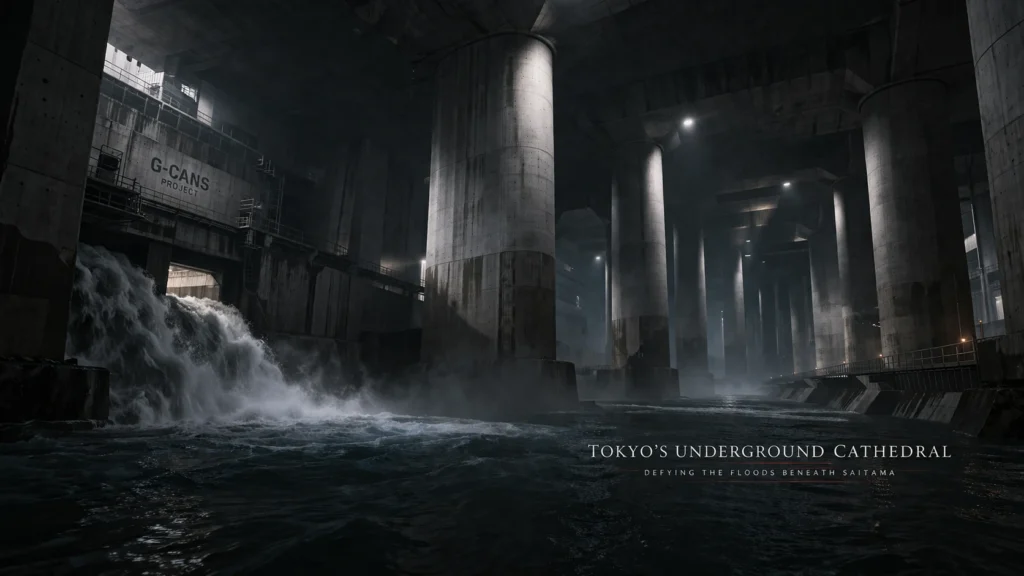

Part One: The Weight of Water
Imagine you are standing in a dark, endless tunnel. The ceiling arches so high above your head that a space shuttle could fit comfortably inside with room to spare. Above that ceiling, 50 meters of solid rock and wet soil separate you from the busy streets of Tokyo, a city of 14 million people going about their daily lives. They are riding trains, buying groceries, scrolling through phones. They have no idea you are down here.
Now imagine a sound. It starts as a low rumble, like distant thunder. But it grows. It becomes a roar. Then a scream. Suddenly, millions of liters of angry river water come blasting through a giant shaft overhead. The water hits the concrete floor with the force of a freight train derailing. The ground vibrates beneath your feet. The air turns into a wet, cold fog. For a few terrifying seconds, you cannot see, cannot hear, cannot think. There is only water.
This is not a scene from a disaster movie. This is a typical Tuesday inside the Metropolitan Area Outer Underground Discharge Channel, better known as the G-Cans project. Locals call it the “Underground Cathedral” because its towering pillars and arched ceilings look like something from a gothic church built by giants. But make no mistake: this is not a place of worship. This is a war machine. It is a concrete fortress built to fight water.
Every year, typhoons slam into Japan like angry fists. The country gets hit by an average of three to five typhoons annually, and some years see as many as ten. These storms carry ocean water that has been heated by the sun for months, turning it into a engine of destruction. When a typhoon makes landfall, it can drop more than 400 millimeters of rain in a single day. Rivers that look like peaceful ribbons on a map turn into raging brown monsters. Groundwater rises from below. Sewers back up. Low-lying neighborhoods disappear under murky, fast-moving water.
And without this underground fortress beneath the city of Saitama, just north of Tokyo, the entire capital region would turn into a giant bathtub. Not slowly. Not gently. Within hours.
Let’s walk through this labyrinth together. You will learn how engineers tame 6.3 million liters of water per second—enough to fill an Olympic swimming pool in just over two seconds—using nothing but concrete, steel, and human genius. You will meet the workers who keep the system alive. You will hear the stories of floods that almost destroyed Tokyo. And by the end, you will understand why this Cathedral is one of the most important pieces of infrastructure on planet Earth.
Part Two: The Monster That Tokyo Tried to Ignore (But Couldn’t)
For centuries, Tokyo has lived in a love-hate relationship with water. On one hand, rivers like the Edo, the Arakawa, and the Sumida gave the city life. They carried trade goods from the countryside. They provided fresh fish for the massive fish market. They offered a natural defense against invading armies. People built their homes near the water because the water was wealth.
On the other hand, every few years, those same rivers turned into killers.
Let’s go back in time. Way back. In 1742, a typhoon hit the region that would become Tokyo. The local rivers rose so fast that samurai on horseback were swept away. Over 3,000 people died. The government at the time, ruled by the Tokugawa shoguns, built levees and called it done. But levees are just dirt walls. They erode. They leak. And when they break, they break catastrophically.
Fast forward to 1910. Another massive flood. This time, the newly modernized Tokyo government tried something different: canals. They dug channels to divert water away from the city center. It worked for small floods. But for big ones? Not even close.
Then came 1947. Typhoon Kathleen. This storm was different. It moved slowly, parked itself over Tokyo, and dumped rain for 36 hours straight. Rivers burst their banks in seventeen different places. Over 1,000 people died. Entire neighborhoods floated away like paper boats. The famous photograph from that flood shows a wooden house drifting down a street that used to be a road, with a grandmother still sitting on the roof, clutching a cat.
The Japanese government built higher levees. They raised walls. They dredged riverbeds. They installed early warning sirens. And for a while, they prayed that would be enough.
But by the 1980s, it was clear: praying was not enough. The problem was not the rivers themselves. The problem was geography. Tokyo sits on a flat floodplain called the Kanto Plain. This plain is shaped like a shallow bowl. Five major rivers—the Naka, the Ayase, the Kuramatsu, the Oochi, and the Shingashi—all drain into the same low area. When heavy rain hits the mountains northwest of Tokyo, all five rivers rise at once. And there is nowhere for that water to go except into people’s living rooms, basements, and subway tunnels.
In 1988, a particularly close call happened. Typhoon Judy sent water lapping at the tops of levees in Saitama. Workers stacked sandbags all night. One levee started to weep—that is the technical term for water seeping through the dirt. A weep means a break is coming. They dumped concrete sacks into the leak just in time. After that, a senior engineer named Kenji Horikoshi wrote a memo that would change history. His memo said: “We cannot keep building up. We must build down.”
In 1992, the government finally agreed. They said: “We need something insane.” That something became the G-Cans project. Construction started in 1993. It took thirteen years and cost over two billion dollars. When it opened in 2006, it was the largest underground floodwater diversion system on the entire planet. China, the United States, the Netherlands—none of them had anything close.
But here is the part that still gives engineers goosebumps when they talk about it. The system does not stop floods by holding water back. That would be impossible. Instead, it does the opposite. It invites the flood in—on its own terms. It opens its arms and says: “Come inside. We have room for you.” And then, once the water is trapped, the system spits it out somewhere safe.
Think of it like a bouncer at a crowded club. The flood is a line of angry people trying to get in. The Cathedral does not block the door. It opens a side door, leads the crowd into a huge empty room, and then lets them out the back exit. The club stays calm. The neighborhood stays dry.
Part Three: Entering the Cathedral – A Journey Fifty Meters Below the Surface
To really understand this marvel, you have to go down there. Let me take you on a virtual tour. Close your eyes for a moment. Okay, open them—you need to read.
You start at a small, unassuming building in Kasukabe City, Saitama. From the outside, it looks like a maintenance shed for a highway department. The building is gray, rectangular, and utterly forgettable. There are no signs announcing that you are about to enter one of the greatest engineering achievements of the modern era. That is intentional. The Japanese do not brag about their infrastructure. They just build it.
You walk through a plain metal door. Inside, there is a reception desk, a small museum with old flood photos, and a single elevator. The elevator has no fancy lights or music. It is industrial, with scuffed metal walls and a rubber floor. You press the button marked “B4” for basement level four. The doors close with a solid thunk.
The elevator drops. Your ears pop once. Then again. The descent takes about forty seconds. That is how deep you are going. Fifty meters is roughly the height of a sixteen-story building. You are going down the equivalent of sixteen floors.
When the doors open, the air changes immediately. It is cool—about 15 degrees Celsius year-round, no matter how hot the summer is above ground. It is damp. You can feel moisture on your skin. And it smells like wet stone, like the inside of a cave that has never seen sunlight. That smell is ancient. It is the smell of water that has been filtered through fifty meters of soil.
You step out onto a metal walkway. The walkway is grated so water can fall through. It clangs under your feet. Then you look up.
Your brain will struggle for a moment. What you are seeing does not match anything you have experienced before. You are standing inside a temple of concrete. The main chamber is officially called the “pressure-adjusting water tank,” but that name is so boring that nobody uses it. Everyone calls it the Cathedral.
The Cathedral is 177 meters long. That is longer than two soccer fields placed end to end. It is 78 meters wide. That is wider than a professional soccer field is long. And it is 18 meters high. That is a five-story building. So put it all together: the Cathedral is roughly the size of a football stadium with a five-story ceiling. Now put that entire space underground. No windows. No natural light. Just concrete and silence.
Holding up this massive roof are 59 enormous pillars. Each pillar weighs 70 tons. To understand 70 tons, think of an adult elephant. A big male African elephant weighs about 7 tons. So one pillar equals ten elephants stacked together. Now imagine fifty-nine of those pillars, each one rising from the floor like an ancient redwood tree. They are arranged in perfect rows, creating a tunnel that seems to go on forever. The perspective is dizzying. If you stand at one end and look toward the other, the pillars get smaller and smaller until they vanish into darkness.
The pillars are not just concrete blobs. They are shaped like inverted triangles. The base is wider than the top. Why? Because water pressure is strongest near the floor. When millions of liters of water push against the pillars, the force is not the same at the top as it is at the bottom. At the bottom, the pressure is enormous. A wider base spreads that force out across more concrete. It is the same reason a tree has a wide trunk near the ground.
Now, here is where it gets eerie. On a dry day, when no floods are happening, the Cathedral is silent. Not quiet. Silent. The kind of silence that presses against your eardrums. Your footsteps echo for three full seconds. Drip. Drip. Drip. Water condenses on the cold ceiling and falls to the floor somewhere in the dark. The lights are dim yellow, spaced far apart, casting long shadows that move as you walk. It feels like a lost civilization. It feels like you have discovered a temple built by a forgotten people.
But during a typhoon, that silence shatters. Water comes roaring in from five separate silos, each one ten stories deep. The pressure is so intense that the entire structure groans like a living thing. The floor vibrates. The walls sweat. And those seventy-ton pillars? They flex. Not much—just a few millimeters. But enough to remind you that nature is never fully tamed. The pillars bend so they do not break.
Workers who have been inside during a flood describe it as both terrifying and beautiful. One worker told a reporter: “The water does not come in like a wave. It comes in like a curtain. One moment the room is empty. The next moment, there is a wall of water rushing toward you. You have to stand on the highest walkway or you will be swept away. And the sound—it is not just loud. It is deep. You feel it in your bones.”
Part Four: The Five Giant Silos – How the System Sucks Up a Flood
Let’s talk about those silos. They are the real heroes of this story. Without them, the Cathedral would be just a big empty room. The silos are the doorways through which the flood enters.
Imagine five concrete cylinders. Each one is 32 meters wide. That is wider than a four-lane highway. If you parked a school bus across the diameter, you could fit three buses side by side. Now make each cylinder 70 meters deep. That is taller than Niagara Falls. That is taller than the Statue of Liberty from the base of the pedestal to the tip of the torch. Now put those cylinders underground, connected to the five local rivers by a network of tunnels.
Here is how the system works step by step. Follow closely because this is the clever part.
Step one: Rain falls. Not a little rain. Typhoon-level rain. We are talking about rain that falls so hard you cannot see across the street. Rain that turns gutters into rivers. Rain that makes drivers pull over because their windshield wipers cannot keep up.
Step two: River levels rise. Every major river in the area has sensors. These sensors measure water depth every five seconds and send the data to the control room. When a river hits a dangerous point—usually about 80 percent of the levee height—alarms go off.
Step three: A computer makes a prediction. Using radar rain data, historical flood patterns, and soil moisture readings, the computer calculates how much more water is coming in the next six hours. It then recommends a plan.
Step four: A human pushes the button. The control room operator looks at the computer recommendation, looks at the sky, feels the wind, and makes a final call. If they decide to open a gate, they press a button on a console. That button sends an electronic signal to a massive steel gate located where the river meets the silo.
Step five: The gate opens. Water is diverted from the river into the nearest silo. The gate does not open all the way. It opens just enough to match the incoming flow. Think of it like a faucet. You do not turn the faucet all the way on unless you need that much water.
Step six: Water falls. It drops fifty meters straight down into the pressure-adjusting tank—the Cathedral. That fall creates enormous energy. The water hits a concrete splash pad at the bottom that is designed to absorb the impact. Without that splash pad, the falling water would carve a hole in the floor over time.
Step seven: Water collects in the Cathedral. The room fills like a bathtub. At full capacity, it can hold 670,000 cubic meters of water. That is enough to fill 265 Olympic swimming pools. To picture that, imagine every swimming pool in your city filled to the brim. Now multiply by ten.
But wait—if the Cathedral fills up, does not that just move the flood underground? Good question. The answer is no, because the water does not stay there. The Cathedral is not a storage tank. It is a waiting room.
At the far end of the Cathedral, opposite the silos, there is a massive tunnel called the “water conveyance culvert.” This is a 6.3-kilometer-long tube, 10 meters wide, bored through solid rock. It works like a giant drinking straw. When the Cathedral reaches a certain level, gravity alone starts pulling water into the tunnel. The tunnel slopes gently downward toward the Edo River. Water flows downhill. That is physics.
But gravity is not always fast enough. That is where the pumps come in. Four massive pumps sit at the end of the tunnel, just before the Edo River. Each pump is powered by a 14,000-horsepower electric motor. To understand that, a typical family car has about 150 horsepower. So one pump has the power of 93 cars. Four pumps together have the power of 372 cars. When they turn on, the sound is incredible. They do not hum. They roar.
The pumps can move 200 cubic meters of water per second just by gravity alone. When the pumps join in, that number jumps to 240 cubic meters per second. Do the math: 240 cubic meters per second equals 240,000 liters per second. That is enough to fill a backyard swimming pool in half a second. Enough to fill an Olympic pool in just over two minutes.
The Edo River is huge. It can handle the extra water. From there, the water flows safely to Tokyo Bay, forty kilometers away. The flood that would have drowned a city becomes just another day at the river delta. Fishermen cast their lines. Seagulls circle. Life goes on.
Part Five: Seventy-Ton Pillars vs. The Pressure of a Planet
Let’s get real about pressure. When that much water moves, it does not ask nicely. It slams. It punches. It pushes with the weight of a mountain.
Engineers call it hydrostatic pressure. Imagine lying on the ground and having one hundred sumo wrestlers stand on your chest. Each sumo wrestler weighs about 150 kilograms. So one hundred of them would be 15,000 kilograms pressing down on you. That would kill you instantly. Now multiply that by a thousand. That is what the Cathedral’s walls and pillars feel during a worst-case flood.
At the bottom of the Cathedral, when the water is 18 meters deep, the pressure is 1.8 kilograms per square centimeter. That does not sound like much, but a square centimeter is about the size of your fingernail. So every fingernail-sized spot on the wall has 1.8 kilograms pushing against it. Now imagine how many fingernail-sized spots are on a wall that is 177 meters long and 18 meters high. The total force is billions of kilograms.
Each seventy-ton pillar is made of high-strength reinforced concrete. Inside the concrete is a steel cage of rebar. Rebar is thick metal bars tied together with wire, forming a skeleton. The concrete protects the steel from water, and the steel gives the concrete strength. Together, they form a composite material that is far stronger than either one alone.
But the pillars are not solid blocks. They have hollow spaces inside for drainage and inspection. Workers can actually climb inside some of the pillars through small hatches. Inside, there are ladders and sensors. The sensors measure stress, temperature, and moisture. If any pillar starts to fail, the sensors will send an alert to the control room before any human can see the damage.
The pillars are spaced 18 meters apart. That is about the length of a city bus. The space between them allows water to flow freely. But it also creates a problem: the water flowing between the pillars pushes against the sides of the pillars. That sideways force is called shear stress. If the pillars were too skinny, they would snap. If they were too thick, water would not flow fast enough. The engineers spent two years running computer models just to find the perfect thickness.
Now here is the part that kept the engineers awake at night: the joints. Where a pillar meets the ceiling, there is a tiny gap—just a few centimeters—filled with a special rubber seal. When water pressure builds, the pillar pushes against the ceiling. The rubber compresses. The whole structure shifts maybe three to five millimeters. If that gap were rigid, the concrete would crack. Instead, it flexes like a living spine. The building breathes.
And the walls? They are 2.5 meters thick in some places. To give you perspective, a typical house in Japan has walls that are 0.1 meters thick. So the Cathedral’s walls are twenty-five times thicker than your living room walls. In the places where the tunnels connect to the silos, the walls are even thicker—up to 4 meters. That is thicker than a rhinoceros is long.
During a real flood in 2019, Typhoon Hagibis, the system was pushed to ninety percent of its capacity. Workers inside reported feeling the floor vibrate like a drum. The water screamed through the silos with a sound that one worker described as “a jet engine wrapped in thunder.” The pillars groaned. The rubber seals compressed. The walls wept moisture. But the Cathedral held. The pillars flexed and returned to their original shape. The seals stayed tight. And Tokyo stayed dry.
After the flood, inspectors spent three weeks examining every centimeter of concrete. They found tiny surface cracks in three places. None were deeper than two millimeters. They filled them with epoxy and called it a day. That is how well the system was built.
Part Six: The Control Room – Where Humans Tame the Beast with Buttons
You cannot just open the gates and hope for the best. That would be like driving a car with your eyes closed. The G-Cans system requires constant attention during a storm. That attention happens in the control room.
The control room is above ground, in that same unassuming gray building. It looks like NASA’s little cousin. One entire wall is covered with screens. There are thirty-two screens in total, arranged in four rows of eight. Each screen shows live data from a different part of the system. Rain gauges. River levels. Pump speeds. Gate positions. Water pressure inside the Cathedral. Temperature. Humidity. Electrical load. Backup generator fuel levels.
In the center of the room, there is a large desk with four workstations. Each workstation has three computer monitors, a telephone, and a red button. The red button is not for emergencies. It is the mute button for the alarm system. When an alarm goes off—and during a storm, alarms go off constantly—the operator presses the red button to acknowledge it. Then they fix the problem.
Four people run the entire system during a major storm. Their job titles are: Operations Chief, Gate Controller, Pump Controller, and Data Analyst. The Operations Chief is the boss. They make the final decisions. The Gate Controller opens and closes the five silo gates. The Pump Controller turns the four massive pumps on and off. The Data Analyst watches the screens and calls out numbers.
These four people work twelve-hour shifts during a typhoon. They do not leave the control room except for bathroom breaks. They eat meals at their desks. They sleep in a small room down the hall during quiet periods. Their job is to make split-second decisions. Open a gate too early, and you waste capacity that might be needed later. Open it too late, and a river overflows its banks. The margin for error is measured in minutes, sometimes seconds.
The computers help, but they do not decide. The computers run a predictive model that takes in radar rain data, river flow history, and soil saturation levels. The model then calculates exactly how much water is coming in the next six hours. It suggests a gate-opening schedule. But a human always pushes the final button. That is a rule written into the system’s operating manual. No computer can override a human. And no human can blame a computer if something goes wrong.
In 2015, that human was a woman named Yuki Tanaka. She was the Operations Chief on a rainy Tuesday in September. The computer predicted moderate flooding—nothing to worry about. But Yuki had been doing this job for eleven years. She knew things the computer did not know. She looked out the window. The sky was greenish-yellow, a color that experienced storm watchers recognize. She opened the door and stepped outside. The wind smelled different. It smelled like wet earth and ozone. That is the smell of a storm that is about to intensify fast.
Yuki went back inside and disobeyed the computer. She opened all five silos fifteen minutes early. Her team thought she was making a mistake. The Gate Controller asked her twice if she was sure. She said yes.
Fifteen minutes later, the storm intensified faster than any model had predicted. Rain fell at a rate of 110 millimeters per hour. The rivers rose six feet in twenty minutes. If Yuki had waited those fifteen minutes, the Kuramatsu River would have overflowed. A small town downstream would have been under four feet of water before anyone could evacuate.
After the storm passed, a reporter asked Yuki how she knew. She thought for a moment. Then she said: “The smell. Rain has a different smell when it is angry. I cannot explain it. But I have learned to trust it.”
That is not a sensor. That is experience. That is the difference between a machine and a human.
Part Seven: The Secret Life of the Cathedral – Maintenance in the Dark
You have seen the Cathedral during a flood. But what about the other 360 days a year? What happens down there when the weather is sunny and dry?
Meet Kenji Saito. Kenji is a maintenance worker. He has been walking the tunnels of the G-Cans system for eighteen years. He knows every pillar, every pipe, every drain. He has walked the 6.3-kilometer tunnel to the Edo River more than two hundred times. That is more than 1,200 kilometers of walking underground. He could do it blindfolded.
Kenji’s job is to check for cracks, leaks, and corrosion. He works in the dark. The Cathedral has lights, but Kenji does not use them. He uses a flashlight and a headlamp. “The overhead lights create shadows that hide small cracks,” he explains. “A flashlight at a low angle makes cracks stand out.”
Every three months, Kenji and his team inspect all fifty-nine pillars. The inspection takes three days. They work in pairs. One person taps each pillar with a hammer. The other person listens and records. A solid ring means good concrete. A dull thud means the concrete might be separating inside. That is called delamination. It is a sign of water damage.
In 2018, one pillar made a dull thud. Kenji marked the spot with orange spray paint. His partner drilled a core sample—a small cylinder of concrete about the size of a soda can. They took it back to the lab. Under a microscope, they found a hairline crack, two millimeters wide, running thirty centimeters deep. That is deep enough to let water reach the steel rebar. If water reaches the rebar, the steel rusts. Rust expands. Expanding rust cracks more concrete. It is a chain reaction that can destroy a pillar from the inside.
The team injected epoxy into the crack. Epoxy is a special glue that bonds to concrete and fills every tiny gap. They pumped it in until it came out the other side. Then they let it cure for twenty-four hours. Problem solved. The pillar is now stronger than it was before the crack formed.
Kenji also checks the 6.3-kilometer tunnel that leads to the Edo River. That tunnel has no lights. None. It is pitch black. Kenji uses a GPS tracker on his belt and a headlamp that can shine two hundred meters. He walks the entire length—about ninety minutes one way—looking for sediment buildup. Over time, sand and gravel wash into the tunnel and settle on the bottom. If too much sediment collects, the tunnel’s capacity decreases. Less water can flow through. That means slower drainage and higher flood risk.
When Kenji finds sediment deeper than ten centimeters, he calls in the vacuum team. They bring a machine that looks like a giant pool cleaner on wheels. The machine sucks up the sediment and pumps it into trucks waiting above ground. In a typical year, they remove about five hundred tons of sediment. That is the weight of three blue whales.
It is lonely work. Kenji spends most of his day underground, alone, with only the sound of dripping water and his own footsteps. But he says he never feels alone. “The water is always there,” he says. “Even on a dry day, there is condensation dripping from the ceiling. You hear it ping off the walls. Ping. Ping. Ping. It is like the system is talking to you. It is saying: I am here. I am working. Do not forget me.”
Part Eight: When the Cathedral Became a Tourist Attraction
Here is a twist you might not expect. The Underground Cathedral, this dark, wet, terrifying war machine, is now a tourist destination. On dry days, the Japan Water Agency opens the facility for public tours. And people love it.
The tours run twice a day, five days a week, except during typhoon season when the system might be needed. Each tour is limited to fifty people. Tickets are cheap—about five dollars for adults, free for children. They sell out weeks in advance. People come from all over Japan and around the world.
The tour starts in the small museum upstairs. A guide shows old photographs of floods from the 1940s and 1950s. Black and white images of houses floating down streets. People standing on rooftops, waiting for rescue. Boats rowing through neighborhoods. The photos are shocking because they show places that are now dry, safe, ordinary. The guide points to a photo and says: “This is Shibuya. That street is now the crossing with the big screen.” The tourists gasp. Shibuya Crossing is one of the busiest intersections in the world. And it was once underwater.
Then the group takes the elevator down. The guide warns everyone: “It will be cold. It will be damp. Do not touch the walls. Do not wander off. Stay with the group.” The elevator doors open. The group steps out onto the metal walkway. And then they see it. The pillars. The ceiling. The endless rows of concrete. Someone always whispers. Someone always takes out a phone to take a picture. The guide smiles. They have seen that reaction thousands of times.
The tour walks the length of the Cathedral, about 177 meters. The guide explains the history, the engineering, the floods. At the far end, the group stands beneath the five silos. From below, the silos look like giant wells disappearing into darkness. Water drips from the edges. The guide says: “Imagine this full. Imagine water falling from that height. That is what we stop every year.”
After the walk, the group returns to the museum for a video. The video shows footage from inside the Cathedral during a real flood. The water roars. The pillars shake. The lights flicker. The video is only three minutes long, but it feels like an hour. When it ends, the room is quiet. Then someone always asks the same question: “Does it ever scare you?”
The guide always gives the same answer: “Yes. That is why we respect it.”
The Cathedral has become strangely popular with photographers, filmmakers, and musicians. The echoing acoustics are so perfect that a Japanese rock band once recorded a live song inside. The reverb lasted eight seconds. The band released the recording as a single. It sold surprisingly well. A fashion magazine did a photoshoot in the Cathedral, with models posing in bright red dresses against the gray concrete. The photos went viral. For a few weeks, the Cathedral was the most talked-about location in Japanese fashion.
But the tours serve a serious purpose too. They remind people that floods are real. Many younger Tokyo residents have never seen a major flood. They have grown up dry, safe, comfortable, thanks to this system. They know typhoons happen, but they do not feel them. They stay inside, watch TV, eat snacks, and go back to work the next day. The tours reconnect them to the danger that still exists just outside the levees. The danger that is held back only by concrete and steel and human vigilance.
Part Nine: What Happens If the Cathedral Fails? A Worst-Case Scenario
Let us be honest for a minute. No engineering marvel is perfect. The G-Cans project has limits. It is not a magic wand. It is a tool. And every tool has a breaking point.
If a typhoon drops more than fifty centimeters of rain in twenty-four hours—which has happened twice in the last twenty years—the system can be overwhelmed. The Cathedral fills up. The pumps run at maximum. The tunnel to the Edo River flows at full capacity. But the water still comes. And at some point, the Cathedral cannot take any more.
In that scenario, the gates have to close. Not because engineers want to, but because keeping them open would send river water backward into the city. Think about it. The rivers are already full. The Cathedral is full. If you keep the gates open, water will flow from the Cathedral back into the rivers. That would make the flooding worse. So the gates close. The system becomes a victim of its own success: it protects eighty percent of the area, but the remaining twenty percent—the lowest-lying parts—take the hit.
Those lowest-lying parts are not empty. They are towns. They are homes. They are schools and hospitals and businesses. People live there. So when the gates close, those people flood. That is the brutal math of flood control. You cannot save everyone. You can only save most people.
That is why Japan is already planning a second Cathedral. Proposed in 2021, the “G-Cans 2” would be built even deeper—eighty meters down. It would connect to more rivers and include even larger storage capacity. The cost is estimated at four billion dollars. That sounds like a lot of money. But when a single typhoon can cause ten billion dollars in damage, the math is simple. Four billion to prevent ten billion is a good deal.
There is also the nightmare of a power failure. The pumps run on electricity. If the power goes out, the pumps stop. The Cathedral becomes a giant swimming pool. Water fills it, but it cannot drain. That is why there are backup generators on site. Four diesel generators, each the size of a shipping container. They hold enough fuel to run the pumps for seventy-two hours. That is three full days. After that, fuel trucks would have to get through flooded roads to deliver more. That is not guaranteed.
That is why there is a manual override. In the control room, behind a glass panel, there is a giant red lever. The lever has no computer connection. It is purely mechanical. When you pull it, a series of cables and pulleys physically opens emergency spillways. Those spillways bypass the pumps entirely and drain water directly into the Edo River. No electricity required. No computers. No sensors. Just gravity and a lever.
The manual override has never been used. But every year, the maintenance team tests it. They pull the lever. The spillways open. Water flows. They close the spillways. The test takes ten minutes. And every time, the Operations Chief says the same thing: “I hope we never need this for real.”
Part Ten: How Climate Change Is Rewriting the Rules
When the G-Cans system was designed in the 1990s, engineers used rainfall data from the previous fifty years. They looked at every major storm between 1940 and 1990. They calculated the worst-case scenario: a storm that would happen once every fifty years. Then they designed the Cathedral to handle that storm.
But climate change has torn up that rulebook.
Between 2010 and 2020, Japan saw seven “once in fifty years” storms. Not one. Seven. The old models were wrong. The atmosphere is warmer now. Warmer air holds more water vapor. More water vapor means more rain. It is that simple. A storm that would have dropped thirty centimeters of rain in 1980 now drops fifty centimeters. A storm that would have lasted twelve hours now lasts twenty-four.
Typhoon Hagibis in 2019 was the wake-up call. Hagibis dropped one meter of rain in forty-eight hours. That is more water than the entire G-Cans system had ever been tested against. The Cathedral worked, but just barely. The pressure-adjusting tank was ninety-five percent full for six straight hours. Workers later found stress cracks in three pillars. Repairs took two months. If the storm had lasted another hour, the Cathedral would have overflowed.
After Hagibis, the Japan Water Agency announced a major upgrade program. New pumps are being installed. The old pumps could move 240 cubic meters per second. The new pumps will move 280 cubic meters per second. That is a sixteen percent increase. The rubber seals in the pillars are being replaced with a newer polymer that can flex fifty percent more before failing. The computer models are being updated with artificial intelligence that learns from every storm. The AI does not just predict. It adapts.
But here is the scary truth. Even with these upgrades, G-Cans is designed for one hundred millimeters of rain per hour. In 2022, a storm over Tokyo hit one hundred twenty millimeters per hour for twenty minutes. That is beyond the design limit. The only reason there was not a disaster was that the storm was narrow and moved fast. It dropped a huge amount of rain on a small area for a short time. A slower, wider storm at that intensity would overwhelm the Cathedral completely.
So what is the solution? The solution is not just bigger tunnels and stronger pumps. The solution is also above ground. Japan is planting more trees on mountain slopes to slow down runoff. They are building green roofs on city buildings to absorb rain. They are digging rain gardens in parks and schoolyards. They are raising homes and roads in the lowest-lying areas. The real engineering marvel might not be what is underground. It might be what is above: a whole society learning to live with water instead of just fighting it.
Part Eleven: The Human Cost of a Dry City
There is a side to this story that does not make it into engineering magazines. It is the human side. The cost of living in a dry city.
Every time the G-Cans system activates, somewhere upstream, a farmer loses a field. The water that fills the Cathedral is water that does not flow downstream. But it is also water that does not soak into the ground. Rice paddies need that water. Vegetable farms need that water. When the system opens its gates, it takes water that would have watered crops and sends it straight to the bay. Farmers downstream have complained for years. They say the Cathedral is stealing their livelihood.
The government has a compensation program. Farmers who lose crops because of the system can apply for payments. But the paperwork is slow. The payments are small. And no amount of money can bring back a ruined harvest. Some farmers have given up. Their fields sit empty. Weeds grow where rice used to grow.
There is also the question of wildlife. The rivers that feed the Cathedral used to flood naturally every few years. Those floods created wetlands. Wetlands are homes for birds, fish, and insects. When the Cathedral prevents floods, the wetlands dry up. The birds leave. The fish die. The insects disappear. The ecosystem changes. Biologists have documented a forty percent decline in wetland bird species in the areas protected by G-Cans. The Cathedral saves human homes. But it destroys animal homes.
And then there is the psychological cost. People who live near the Cathedral know what is underneath them. They think about it. They dream about it. Some cannot stop thinking about it. A woman who lives directly above the tunnel system told a newspaper: “I lie awake at night and imagine the water rushing below my bed. I know it is safe. I know the engineers did their job. But I cannot help it. I feel the water moving under me.”
Her neighbors feel the same way. They have formed a support group. They meet once a month in a community center. They talk about their fears. They share coping strategies. Some have moved away. Others have learned to live with the feeling. One man put it this way: “It is like living on top of a sleeping giant. You respect it. You do not wake it up. And you are grateful that it is there. But you never, ever forget that it could wake up.”
Part Twelve: What the Rest of the World Can Learn from Tokyo’s Underground Cathedral
Other cities are watching. Bangkok, Jakarta, Miami, London, New York, Shanghai—all are flood-prone. All are struggling with heavier rains and rising seas. All are looking for solutions. And many are looking at Tokyo.
But G-Cans is not just a blueprint. It is a lesson in three things.
First: think big. Small fixes fail. Levees and walls just push the problem downstream. Sandbags are temporary. Pumping stations get overwhelmed. The only way to truly stop a flood is to give the water somewhere else to go. Underground storage works because it does not compete with people for space. The water goes down. The people stay up.
Second: expect the unexpected. The engineers who designed G-Cans in the 1990s did not know about climate change. But they overbuilt anyway. They built for a once-in-fifty-years storm, even though the data only went back fifty years. That overbuilding is why the system still works today, thirty years later, under conditions that the original designers never imagined. Overbuilding is not waste. Overbuilding is insurance.
Third: embrace public awe. The Cathedral is a tourist attraction for a reason. When people see those seventy-ton pillars, when they feel the cold air and hear the dripping water, they understand something deep. They understand that nature is powerful. But they also understand that human ingenuity is powerful too. That feeling builds support for infrastructure spending. It turns a boring concrete tunnel into a symbol of human achievement.
China has since built an even larger system under Shanghai. The Shanghai Deep Tunnel System is sixty meters deep and can hold three times as much water as G-Cans. The Netherlands has expanded its “Room for the River” program, which gives floodplains back to rivers instead of fighting them. London has built the Thames Barrier, a series of massive steel gates that close during high tides.
But Tokyo’s Cathedral remains the original. It remains the one that proved it could be done. It remains the one that showed the world that you do not have to live in fear of water. You can live with it. You can tame it. You can build a cathedral in its honor.
Part Thirteen: The Future – Will the Cathedral Ever Be Truly Finished?
Here is the final truth. No flood control system is ever finished. Water always finds a way. The Cathedral is not a completed project. It is a living thing. It grows. It changes. It adapts. Or it dies.
The Japanese government is already studying a plan to connect G-Cans to a new twenty-kilometer tunnel that would reach all the way to Tokyo Bay. That tunnel would bypass the Edo River entirely. Water would go straight from the Cathedral to the ocean. No waiting for the river to catch up. No backup from high tides. Just a straight shot. The cost is estimated at over ten billion dollars. The timeline is at least fifteen years. But the government is moving forward. Environmental impact studies began in 2023.
There is also a wild idea to install underwater turbines inside the Cathedral. When water flows through the tunnels, the turbines would spin. Spinning turbines generate electricity. That electricity could power the pumps themselves. The system would become energy-independent. It would not need power from the grid. It would not need backup generators. It would create its own energy. Prototypes are being tested in 2025. If they work, the Cathedral will be the first flood control system in the world that pays for its own electricity.
And then there is the human factor. As Tokyo’s population ages, fewer young people want to work in dark, wet tunnels. The average age of a G-Cans maintenance worker is fifty-two. In ten years, most of them will retire. Who will replace them? The Water Agency is developing robots that can inspect pillars and clean tunnels without human help. Small, wheeled robots with cameras and sensors. They can work twenty-four hours a day. They do not get tired. They do not get scared. They do not retire.
By 2030, Kenji Saito’s job might be done by a machine. He is not sad about that. “If a robot can do my job, that means the system is safe,” he says. “That means we built it well enough that a machine can maintain it. That is not a failure. That is a success. The Cathedral is not a monument to engineers. It is a gift to our children. And if robots can take care of that gift, then our children are free to do other things.”
Conclusion: Standing Beneath the Pillars, Listening to the Silence
If you ever visit Tokyo, take the train to Kasukabe. It is a forty-minute ride from central Tokyo. The train passes through suburbs and rice fields and small factories. Get off at the Kasukabe station. Walk ten minutes to the gray building. Buy a ticket for the tour. Go down the elevator. Stand beneath those seventy-ton pillars. Listen to the silence.
Feel the cold air on your face. Smell the wet stone. Look up at the ceiling that holds back fifty meters of earth. Look around at the fifty-nine pillars, each one weighing as much as ten elephants. Listen to the drip of condensation falling somewhere in the dark. And remember: above your head, fourteen million people are going about their day. They are riding trains. They are buying groceries. They are scrolling through phones. They are arguing with their spouses. They are laughing with their friends. They are living.
They do not think about floods. They do not worry about typhoons. They do not know that a silent, concrete labyrinth is fighting a war for them every single second of every single day.
That is the real marvel. Not the concrete. Not the pumps. Not the 240,000 liters per second. It is the peace of mind. It is the ability to live on a floodplain without fear. It is the ordinary, beautiful, boring days when nothing bad happens. When the sun shines. When the rivers stay in their banks. When children play in parks that used to be underwater.
The Underground Cathedral is not just protecting Japan from massive floods. It is protecting the ordinary moments. The small joys. The quiet mornings. The simple fact that you can wake up, make coffee, and not worry about the weather.
And sometimes, that is the greatest engineering miracle of all.



m0iizv
Great post, you have pointed out some excellent details , I as well conceive this s a very wonderful website.
Hey very nice blog!! Man .. Beautiful .. Amazing .. I’ll bookmark your site and take the feeds also…I’m happy to find a lot of useful info here in the post, we need develop more techniques in this regard, thanks for sharing. . . . . .
The download process was straightforward and the installation took no time at all. Great start with in777gamedownloadin
Been playing here for a week and the winning streaks are real. The atmosphere and the game mechanics are just spot on. Love ph33jili so much.
Amateur free gang bangSex when she sleepsPortable concrete vibratorsNature fucks teensWoman bondage harnessHorrn thumbsDiana wynn vintage erotica xnxx Free antimated
3d fucking cartoonsFolliculitis around anusSwinglifestyles erotic storiesHentai
video link freeTeenage dirty slut video clipsGirls love black muscle dicksEscort in indian uk https://xnxxfree.win/ Spartan teenBareback dickTied girl pornFree porn video bondageHairy
gay sex pixxxAsian drama freeEscorts intimate sex xnxx Bbw superstarxxx anal sex videosSilk and satin blouse
fetishCamera beach bikini picturesMassage porn vidsAdult porno classicsWife swapping
athens alabamaHooker 3someIcarley hentaiMature black stockingAdult learining
Everything from registration to the first deposit was handled professionally. I am very happy with the welcoming bonus I received. Get started with 38jililoginregister